Loading
by BlastRoom
Air pressure, what drives wind, and the belts that circle the globe.
#earth_space_science
40 questions
One question set, multiple game modes. Tap any game to see it in action. Not sure which to pick?
Answer to place stones and capture territory.
Outrun the snow together.
Earn blasts, then hunt the other team.
Answer to earn energy, then climb.

The class blasts through walls together.
Bid on mystery lots. Most money wins.
Sell tours. Nice, standard, or a total scam.

Answer, restock, and serve the rush.
More correct answers pulls the rope your way.
Answer, then shoot down the alien wave.
Answer, then tap to leap the frozen ridge.
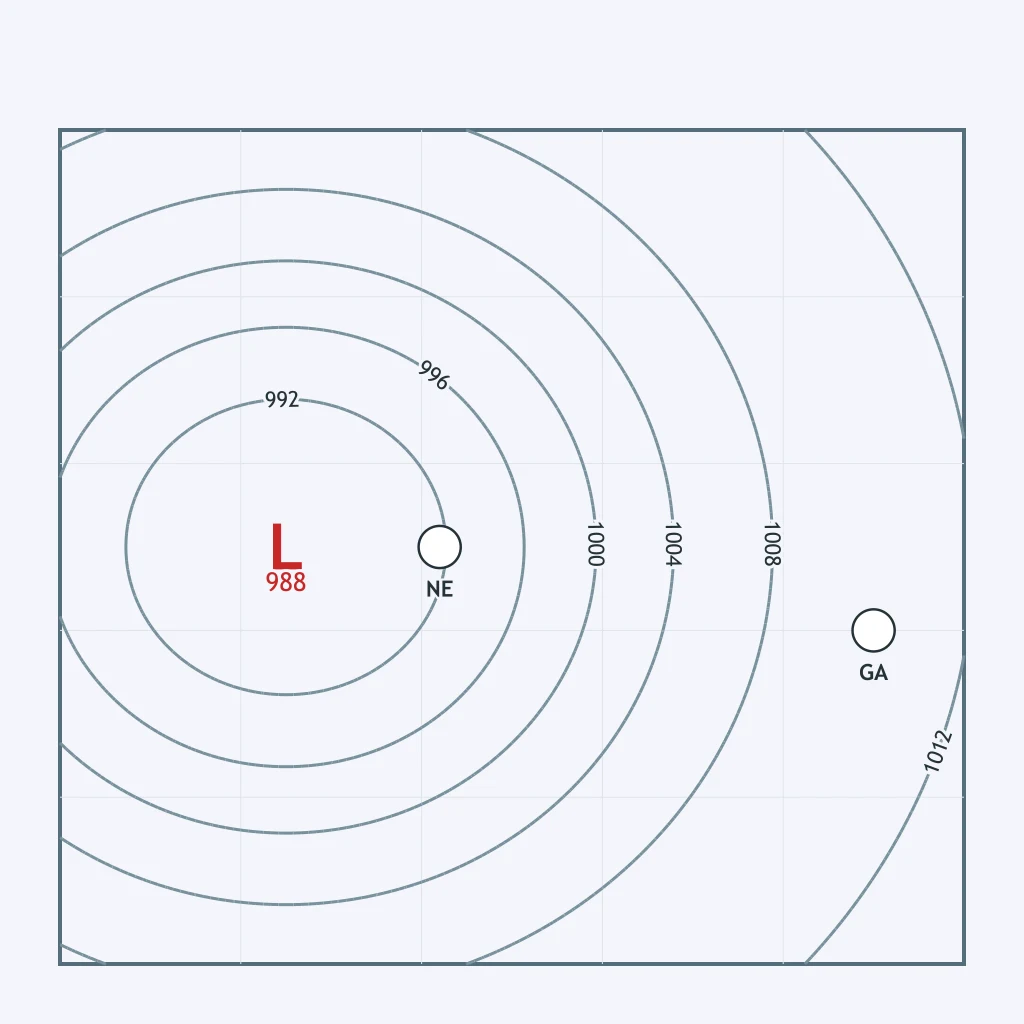
On this weather map, isobars are drawn every 4 millibars. Compare the isobar spacing at the stations marked NE (Nebraska) and GA (Georgia). What does it tell you about the wind at the two places?
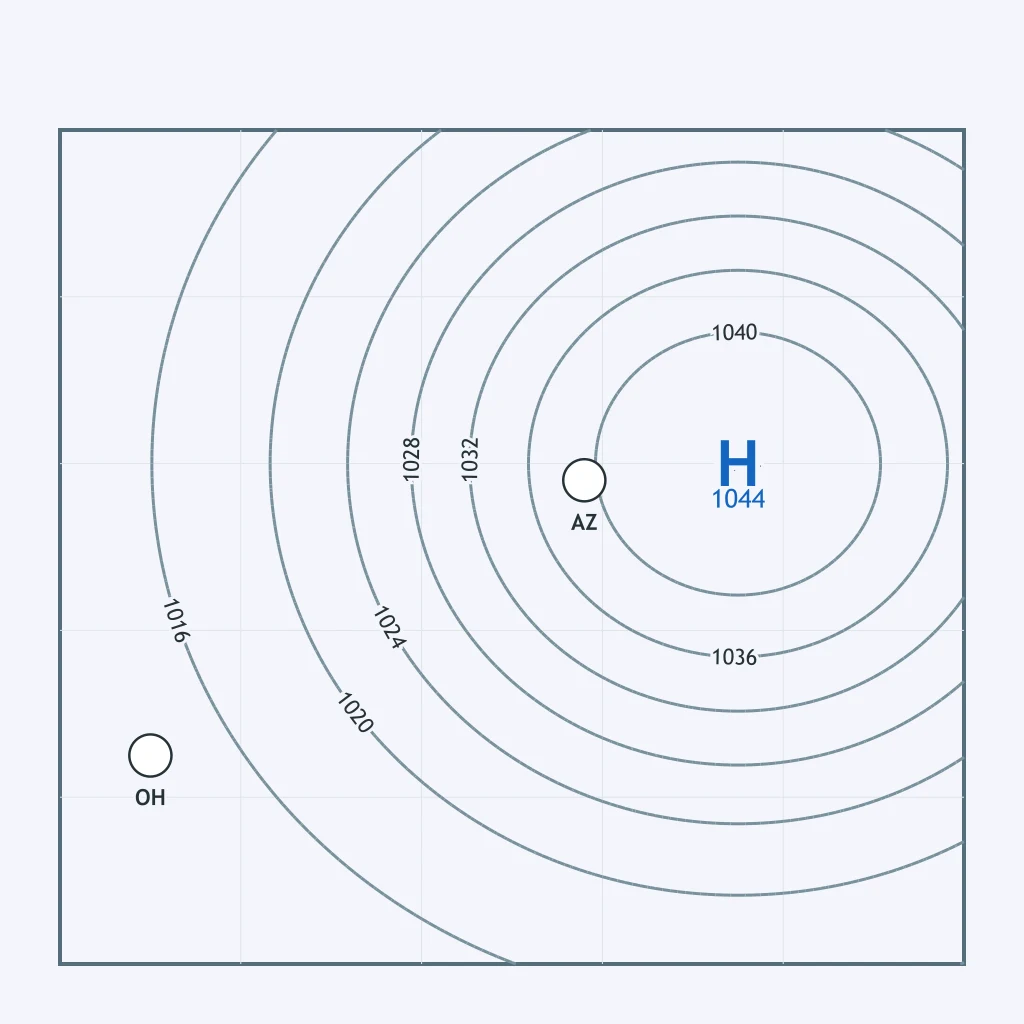
A synoptic chart plots isobars every 4 millibars. Compare the isobar spacing at the stations marked OH (Ohio) and AZ (Arizona). Which state is more likely having strong, gusty wind?
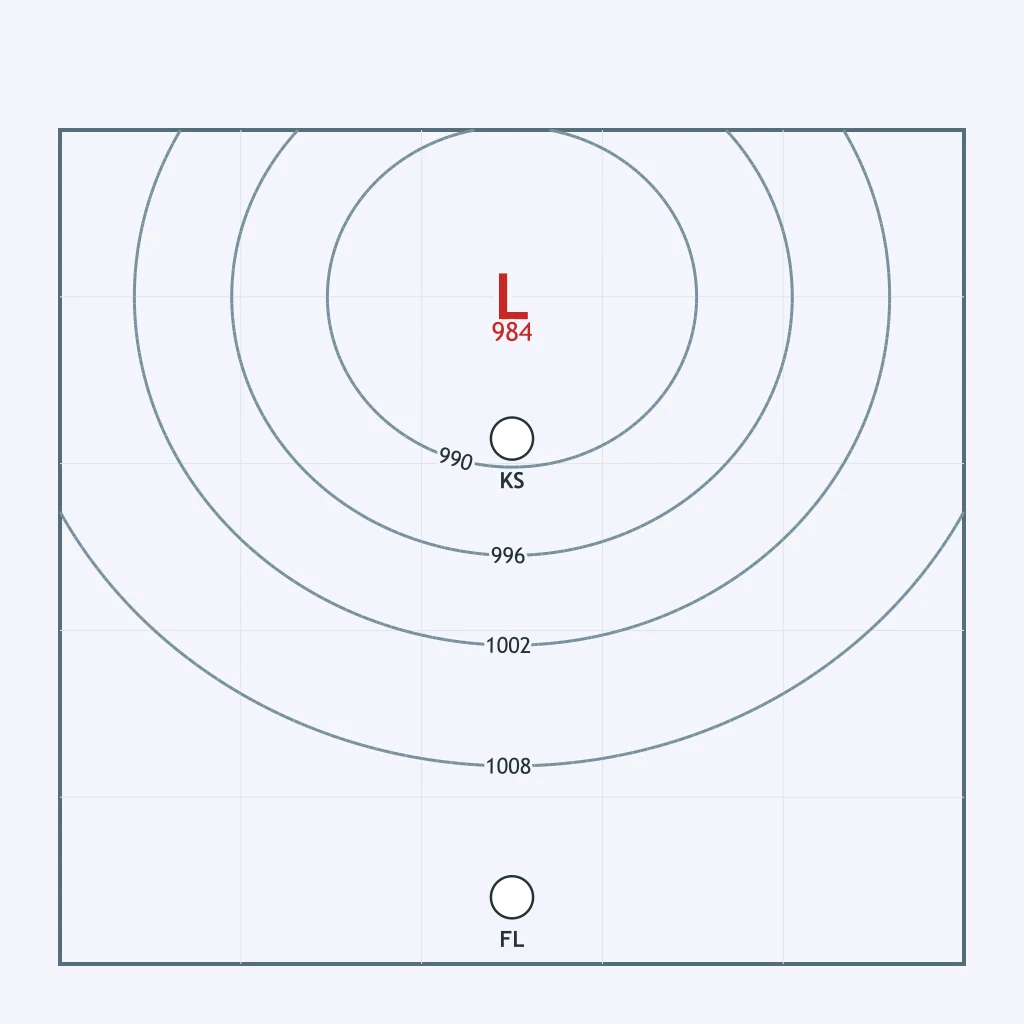
This weather map is contoured with isobars every 6 millibars. Compare the isobar spacing at the stations marked KS (Kansas) and FL (Florida). What can you conclude about wind speed at each place?
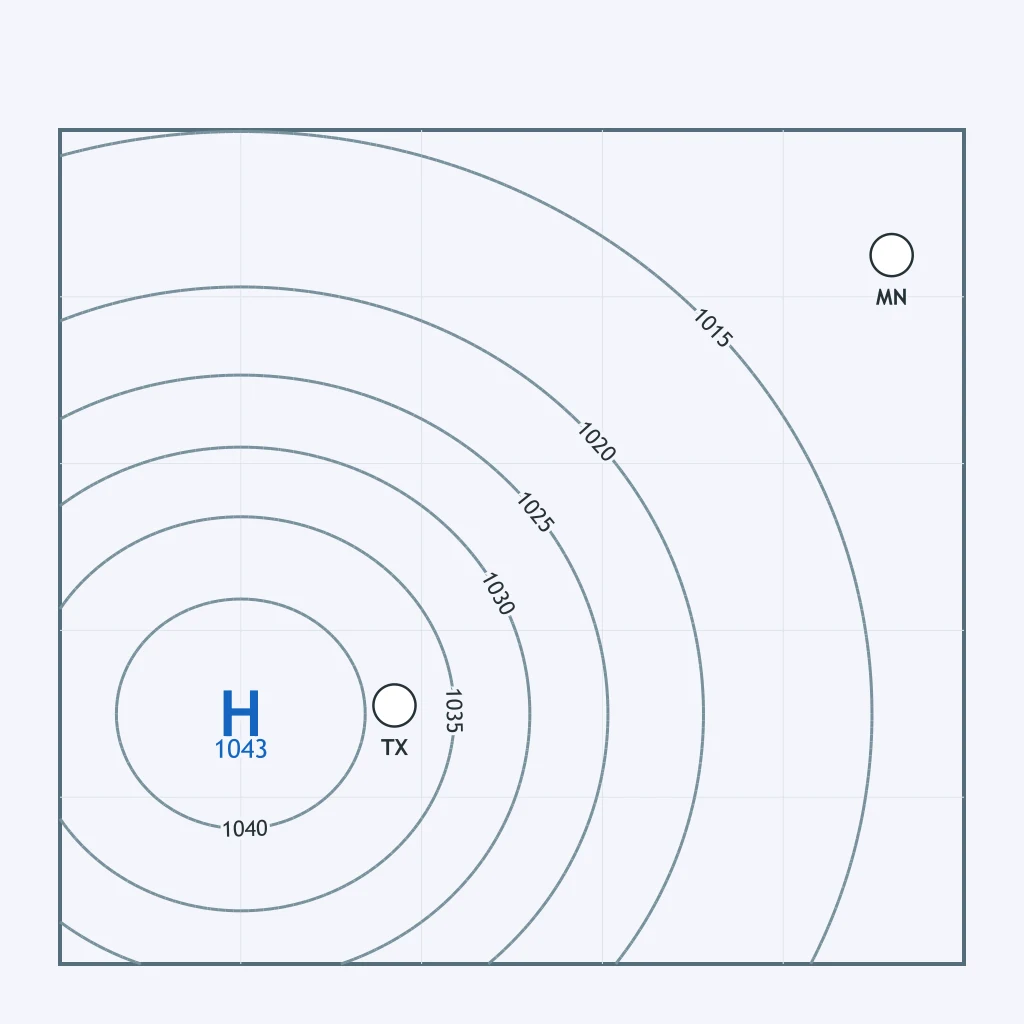
Isobars on this chart are spaced every 5 millibars. Compare the isobar spacing at the stations marked MN (Minnesota) and TX (Texas). Where is the pressure gradient force, and therefore the wind, stronger?
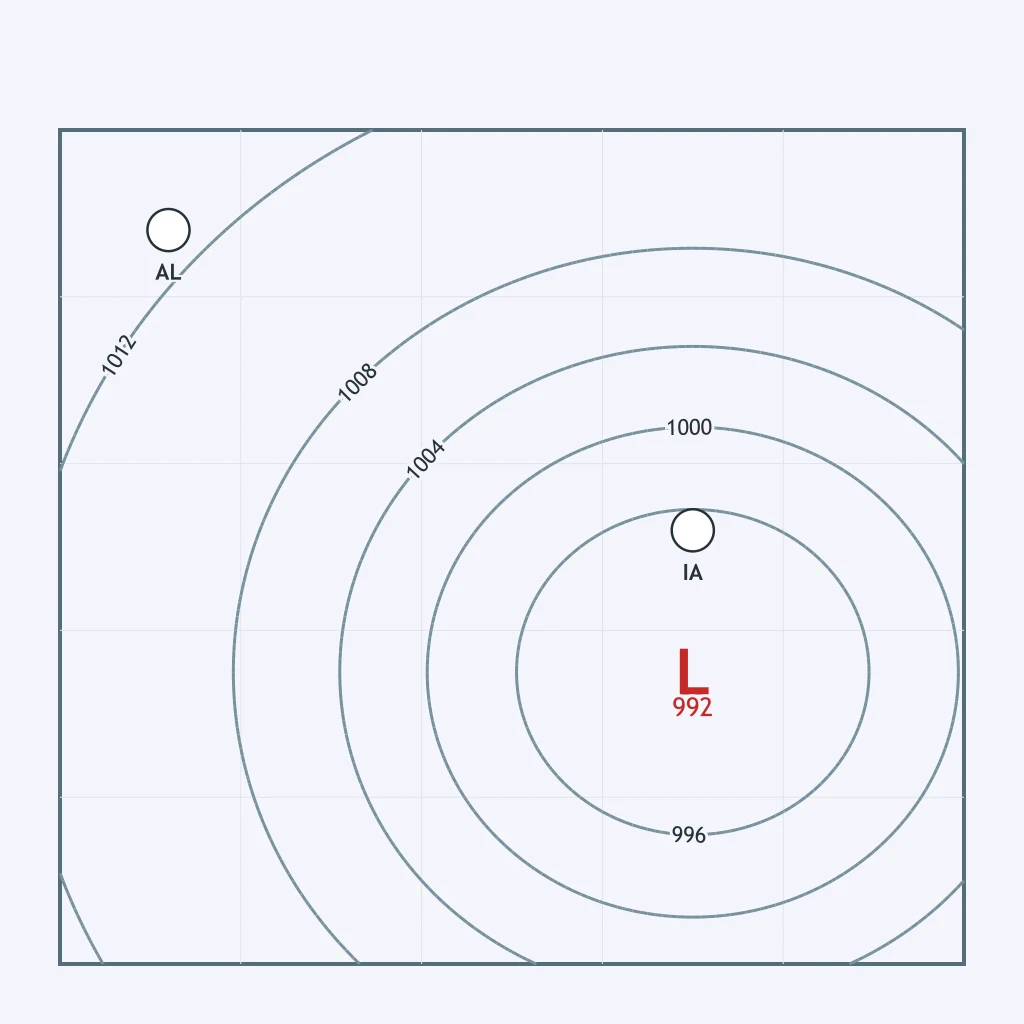
A weather map uses a 4-millibar isobar interval. Compare the isobar spacing at the stations marked IA (Iowa) and AL (Alabama). Which location should report the higher wind speed?
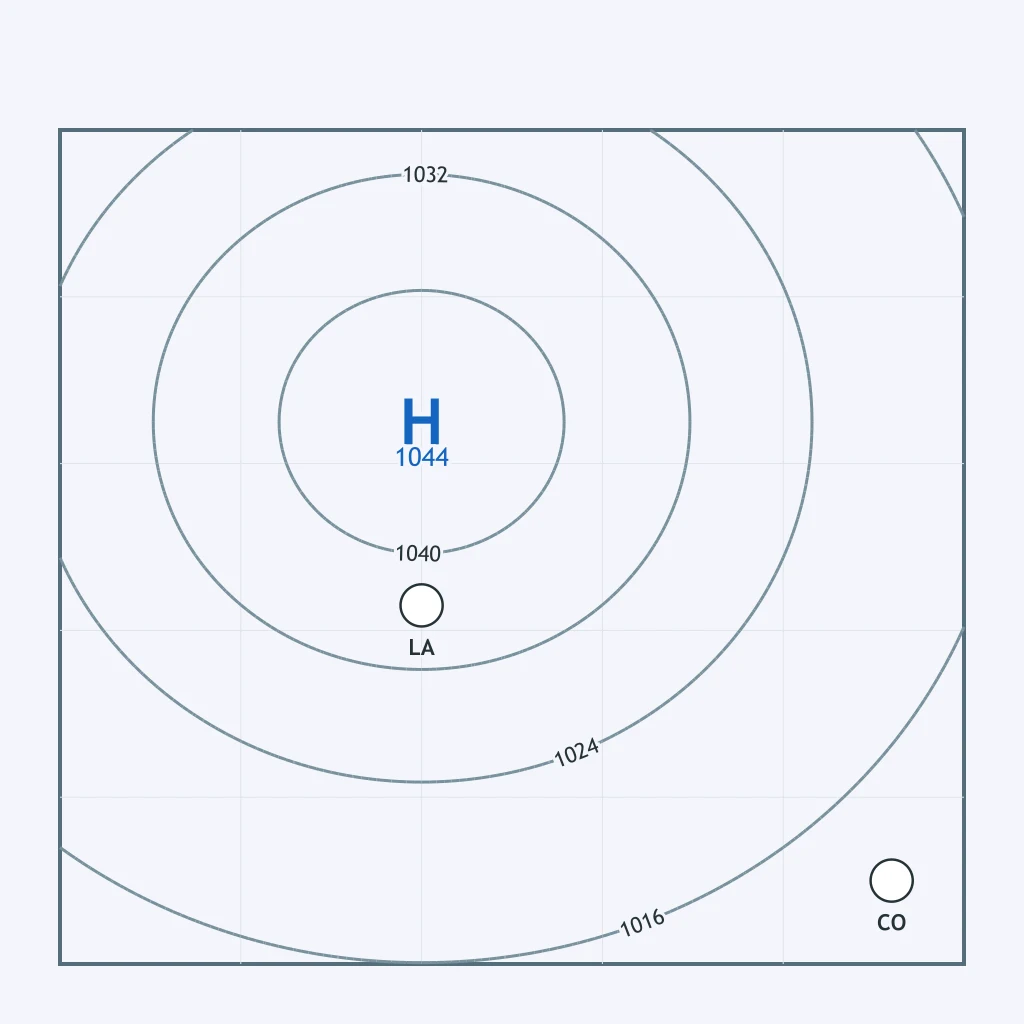
Isobars are contoured every 8 millibars on this map. Compare the isobar spacing at the stations marked CO (Colorado) and LA (Louisiana). What does that spacing indicate about the wind?
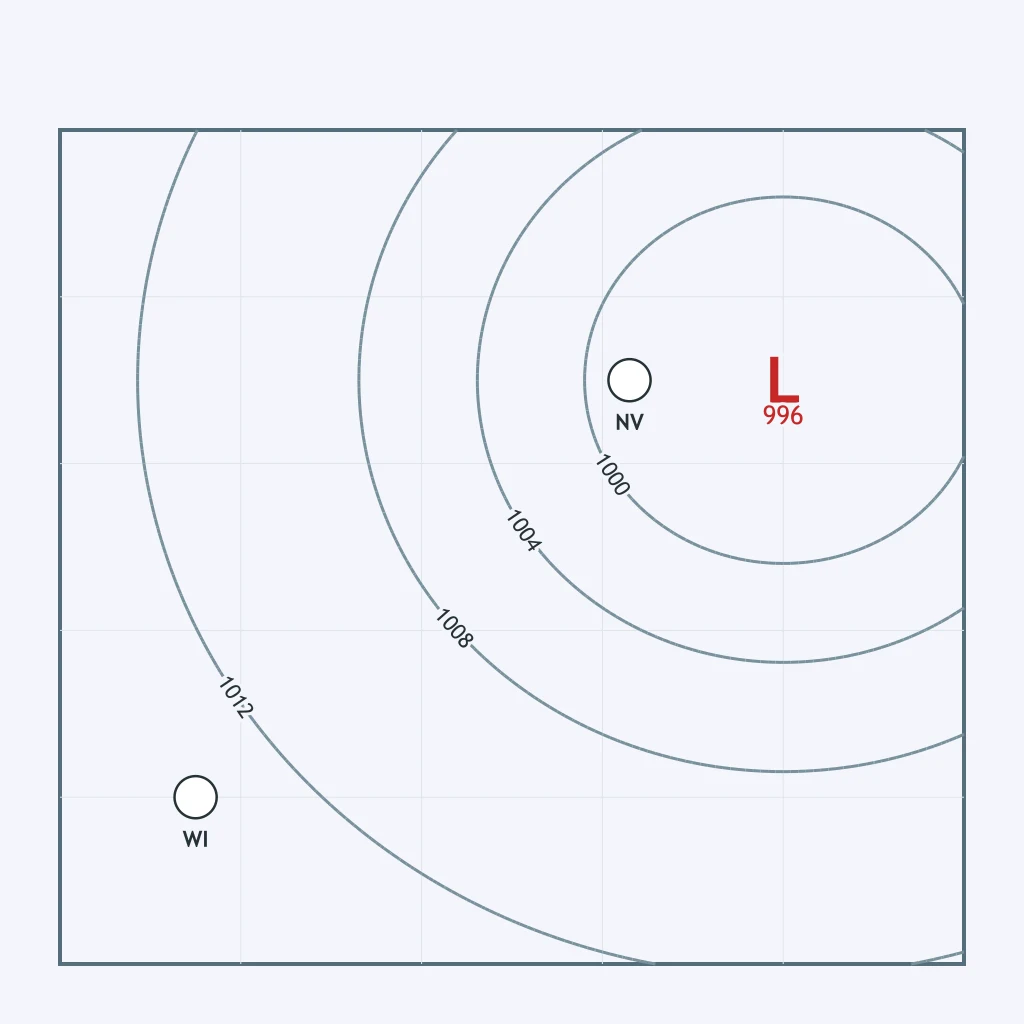
This surface map has isobars drawn every 4 millibars. Compare the isobar spacing at the stations marked NV (Nevada) and WI (Wisconsin). Which state has the steeper pressure gradient, and so the stronger wind?
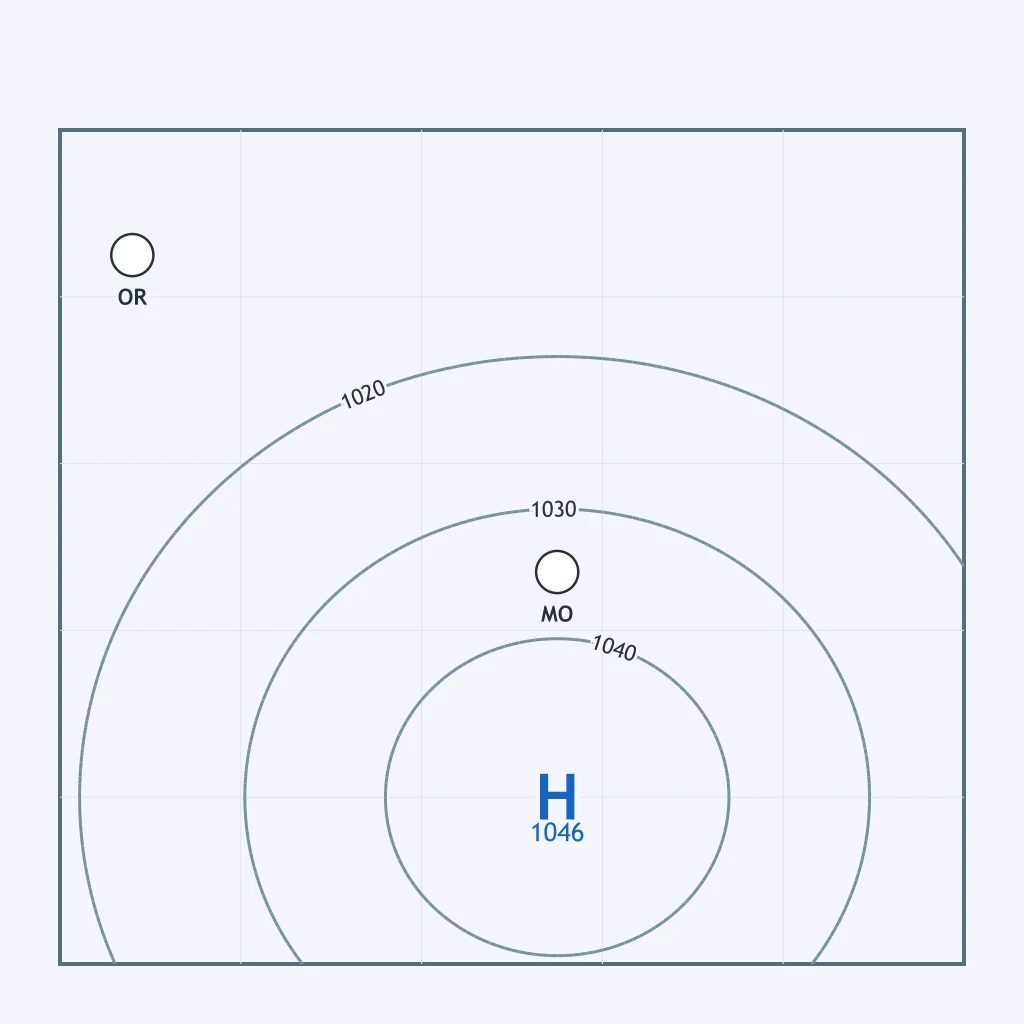
A meteorologist draws isobars every 10 millibars. Compare the isobar spacing at the stations marked OR (Oregon) and MO (Missouri). What should this tell a forecaster about wind speed at each place?
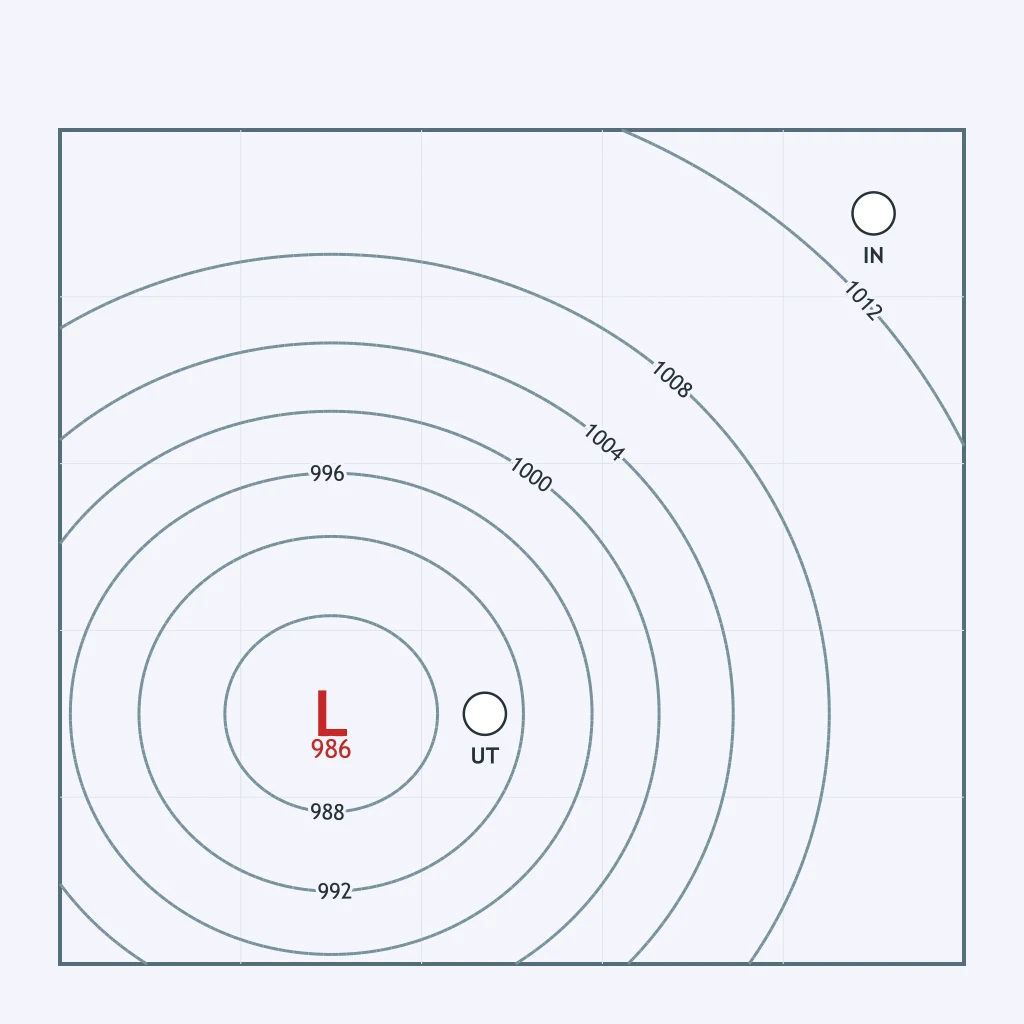
Isobars on this map are drawn every 4 millibars. Compare the isobar spacing at the stations marked UT (Utah) and IN (Indiana). What does the spacing say about the wind at each location?
An aneroid barometer's dial is marked in divisions of 2 millibars each. The needle points 3 divisions above the 1,004 millibar mark. What is the current pressure reading?
A mercury barometer's glass tube is marked with a numbered line every 10 millimeters and a small line every 2 millimeters. The mercury column's top sits 3 small lines above the 740 millimeter mark. What is the mercury height?
An aneroid barometer needle sits 2 divisions above the 1,008 millibar mark, where each division equals 3 millibars. Yesterday the needle sat 4 divisions above that same mark. What is today's pressure reading?
A mercury barometer tube is graduated with a small mark every 1 millimeter and a numbered line every 20 millimeters. The mercury surface sits 6 small marks above the 720 millimeter line. What is the reading?
An aneroid dial has one division for every 5 millibars. The needle is now 4 divisions above the 980 millibar mark, having climbed 2 divisions since noon. What is the pressure right now?
A mercury barometer is marked in millimeters, with a small division every 1 millimeter. The mercury stands 5 millimeters below the 758 millimeter line, after falling 2 millimeters since the last check. What is the current reading?
At the same altitude and the same humidity, air parcel P is 32 degrees Celsius and parcel Q is 4 degrees Celsius. Which parcel exerts the lower pressure at the surface beneath it, and why?
At the same altitude and the same temperature, sample R is very humid and sample S is very dry. Which sample exerts the lower surface pressure, and for what reason?
Two air samples sit at the same altitude. Sample M is cold and dry; sample N is warm and humid. Which sample exerts the greater surface pressure, and why?
Two weather stations report the same air temperature and humidity. Station J sits at sea level, and station K sits on a plateau 1,500 meters higher. Which station's barometer reads lower, and why?
Air over a sun-baked desert surface warms, expands, and rises, while air over a nearby cold lake sinks and settles. Which location has the lower surface air pressure?
A meteorologist reports that a large, cold, dry air mass is settling over a region, while a large, warm, humid air mass approaches from the south. Which air mass is associated with rising surface pressure?
A hot-air balloon pilot notes that the air just above a paved parking lot at midday is noticeably warmer than the air above an adjacent grassy field. Over which surface would you expect slightly lower surface air pressure at that moment?
A home barometer drops steadily for several hours on a calm morning. What change in the weather does the falling pressure most likely signal?
Near 30 degrees south, air sinks toward the surface, surface winds are light and variable, and many of the Southern Hemisphere's deserts lie beneath this belt. What is this belt called?
A narrow belt straddles the equator where warm air rises, thunderstorms build most afternoons, and sailing ships once sat becalmed for lack of steady surface wind. What is this belt called?
A stormy belt near 60 degrees north is where warm air from the south meets cold polar air and is forced to rise. What is this belt called?
A belt centered on the South Pole has air that is extremely cold and dense, sinking steadily and producing light surface winds that flow outward. What is this belt called?
Near the equator, surface wind blows steadily from the subtropical highs toward the equator, bent by the Coriolis effect into a northeast-to-southwest flow in the Northern Hemisphere. What are these winds called?
Between 30 and 60 degrees north, surface wind blows from the subtropical high toward the subpolar low, curved by the Coriolis effect into a general southwest-to-northeast flow. What are these winds called?
Between 60 degrees north and the pole, surface wind flows from the polar high toward the subpolar low, curved by the Coriolis effect so it arrives from the northeast. What are these winds called?
High in the atmosphere, right where cold polar air and warmer mid-latitude air meet, a narrow, fast-moving ribbon of wind blows far faster than any surface wind belt below it. What is this feature called?
A loop of circulation has air rising near the equator, flowing poleward high in the atmosphere, sinking back to the surface near 30 degrees latitude, and returning to the equator at the surface. What is this circulation loop called?
A surface weather map shows a low-pressure center over Iowa, with closed isobars drawn around it every 4 millibars and station wind arrows plotted nearby. Which circulation pattern do those arrows show in the Northern Hemisphere?
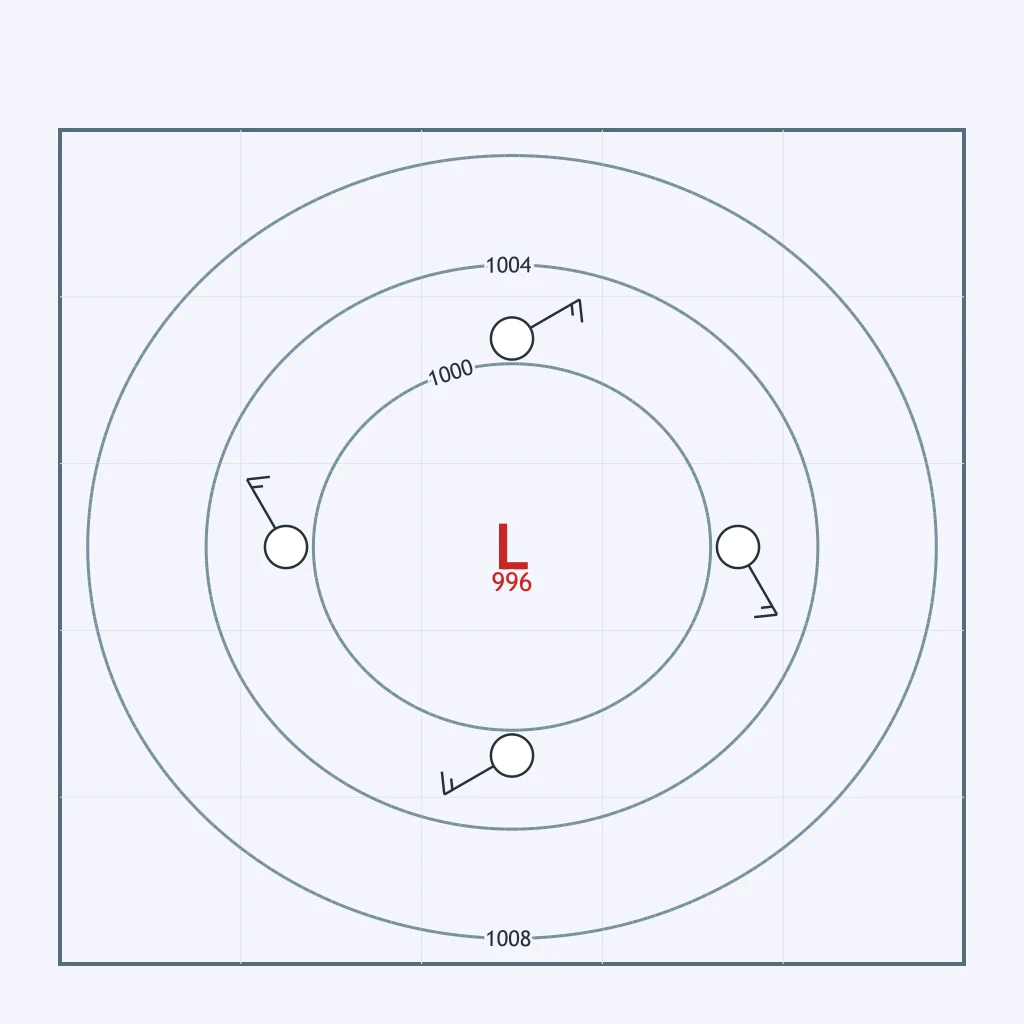
Above the friction layer, geostrophic wind circles a Northern Hemisphere low nearly parallel to the isobars. Near the surface, wind instead crosses the isobars at an angle and spirals inward. What causes this near-surface difference?
A large low-pressure system covers several states. Isobars are packed tightly close to the center of the low but spread far apart near its outer edge, hundreds of miles away. Where should surface wind be faster?
A surface low and a surface high sit side by side in the Northern Hemisphere. Which statement correctly contrasts their surface wind circulation?
A weather map shows a high-pressure center over Arizona, with isobars contoured every 4 millibars and wind arrows plotted around it. What circulation pattern should a Northern Hemisphere high produce?
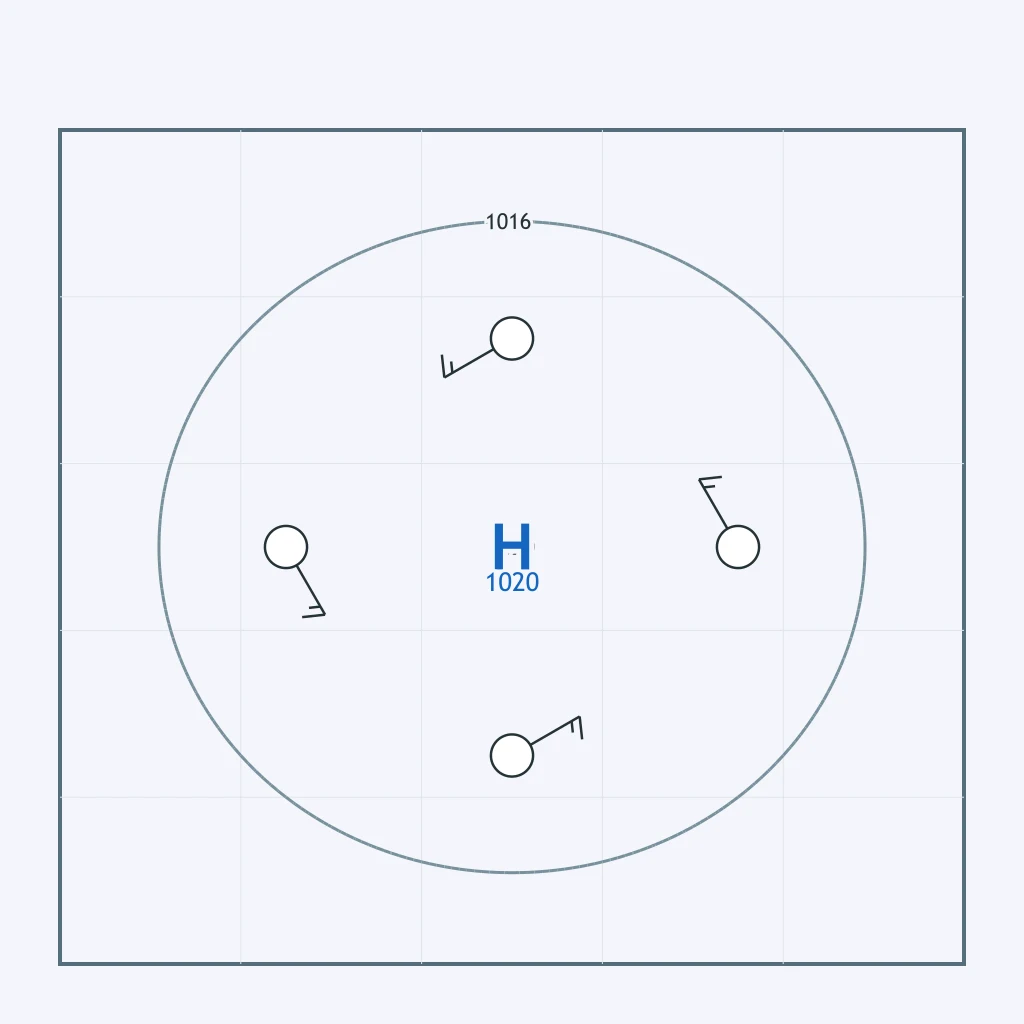
Surface high-pressure systems are usually associated with clear skies and fair weather. What process beneath a high explains this?
Compare two surface highs in the Northern Hemisphere: a strong high with isobars packed tightly together, and a weak high with isobars spread far apart. Which one produces faster outward-spiraling surface wind?
A well-developed surface high features divergence at the surface, with air spiraling outward and away from the center. For that air to be continuously replenished, what must happen higher up in the atmosphere above the high?
Crack the passcode before the zombies get in.
Answer, then swat bugs for bonus points.
Race through questions at your own speed.
Same question on every screen. Fastest wins.

Pick a tile, answer, hit bonuses and steals.
Humidity and Dew Point
50 questions