Loading
by BlastRoom
Read and compare solar system data on size, distance, gravity and orbit.
#us_grade_8_science
40 questions
One question set, multiple game modes. Tap any game to see it in action. Not sure which to pick?
Answer to place stones and capture territory.
Outrun the snow together.
Earn blasts, then hunt the other team.
Answer to earn energy, then climb.

The class blasts through walls together.
Bid on mystery lots. Most money wins.
Sell tours. Nice, standard, or a total scam.

Answer, restock, and serve the rush.
More correct answers pulls the rope your way.
Answer, then shoot down the alien wave.
Answer, then tap to leap the frozen ridge.
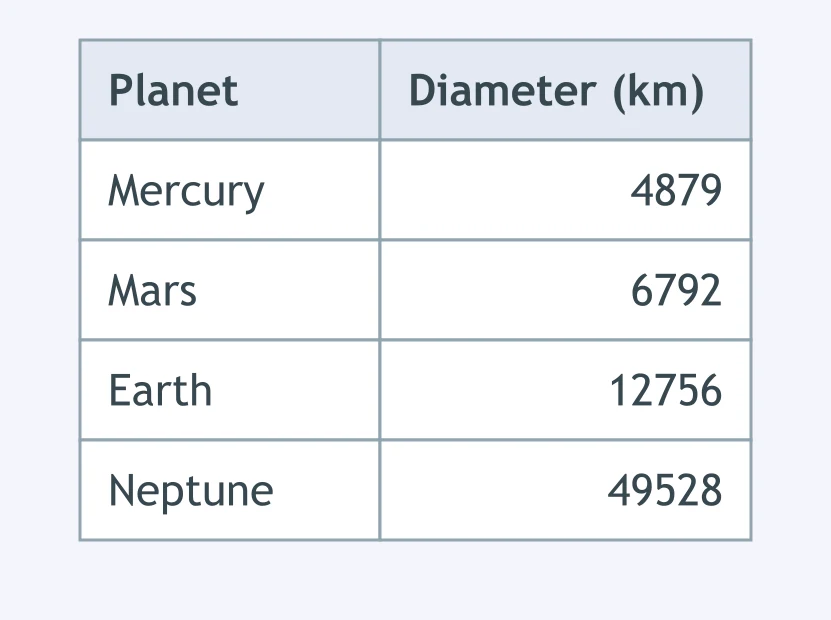
Use the table of planet diameters. What is the diameter of Mars?
A table gives mean distance from the Sun: Venus 108 million km, Earth 150 million km, Mars 228 million km, Jupiter 778 million km. Which neighboring planets in the table have the largest gap between their orbits?
A table gives surface gravity: Moon 1.6 N/kg, Mars 3.7 N/kg, Earth 9.8 N/kg, Saturn 10.4 N/kg. About what fraction of Earth's surface gravity does the Moon have?
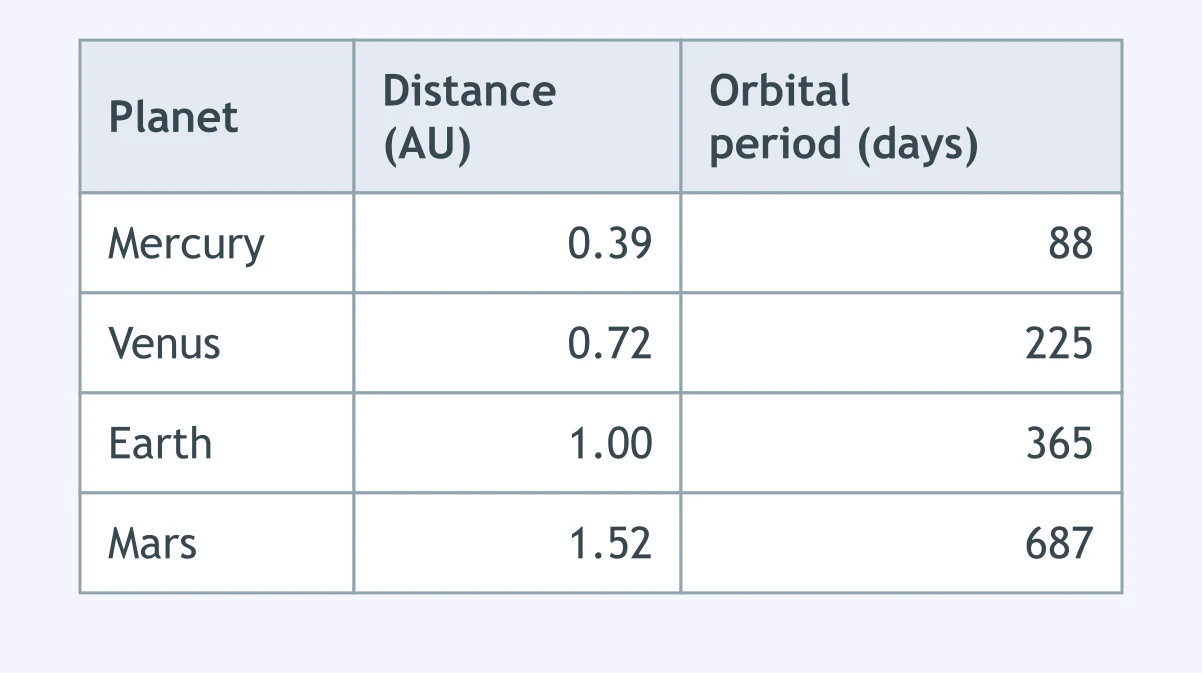
The table pairs each planet's distance from the Sun with its orbital period. How long is one Venus orbit?
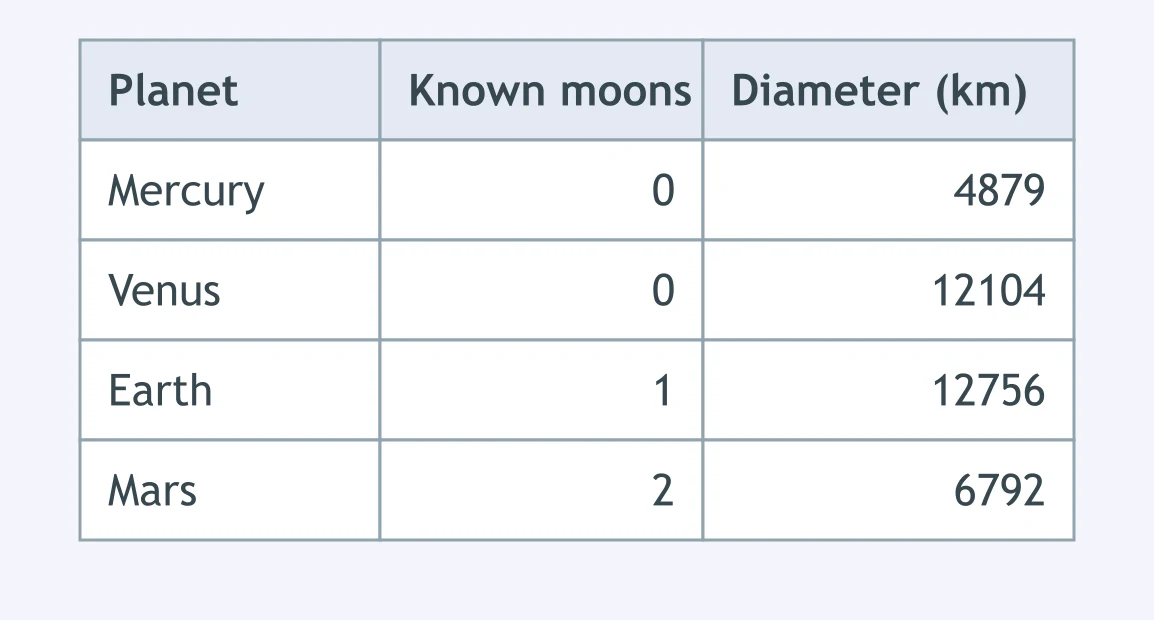
Use the table of known moons and diameters. Which planet has 2 known moons and a diameter of 6,792 km?
A table gives average surface temperature: Venus 464 degrees C, Earth 15 degrees C, Mars -65 degrees C, Jupiter -110 degrees C. How many degrees warmer is Earth's average than Mars's?
A table gives mass compared with Earth: Mars 0.11, Venus 0.82, Uranus 14.5, Jupiter 318. Which planet in the table has a mass closest to Earth's?
A table gives rotation period: Jupiter 9.9 hours, Earth 24.0 hours, Mars 24.6 hours, Venus 5,832 hours. About how many Earth days does one rotation of Venus take?
A table gives diameters: Ceres 940 km, Pluto 2,377 km, the Moon 3,475 km, Ganymede 5,268 km. Which diameter in the table belongs to the larger of its two dwarf planets?
A table gives mean distance from the Sun in astronomical units: Jupiter 5.2, Saturn 9.6, Uranus 19.2, Neptune 30.1. Which planet in the table orbits about twice as far from the Sun as Saturn?
A table lists diameters: Earth 12,756 km, Jupiter 142,984 km. About how many times wider than Earth is Jupiter?
A table gives mean distance from the Sun: Earth 150 million km, Mars 228 million km. How much further from the Sun is Mars than Earth?
A table gives surface gravity: Earth 9.8 N/kg, Mars 3.7 N/kg. A 50 kg student weighs 490 N on Earth. What would the same student weigh standing on Mars?

A table gives orbital period: Earth 365 days, Mars 687 days. About how many Earth years does one orbit of Mars take?
A table lists diameters: the Moon 3,475 km, Earth 12,756 km. About how many times wider than the Moon is Earth?
A table gives mean distance from the Sun: Earth 1.0 AU, Neptune 30.1 AU. How many times further from the Sun than Earth is Neptune?
A table gives Jupiter's mean distance from the Sun as 5.2 AU. One astronomical unit is 150 million km. About how far is Jupiter from the Sun in kilometers?
A table gives surface gravity: the Moon 1.6 N/kg, Jupiter 24.8 N/kg. About how many times stronger is Jupiter's surface gravity than the Moon's?
A table gives surface gravity: Earth 9.8 N/kg, Venus 8.9 N/kg. A 20 kg rock weighs 196 N on Earth. How much less would that rock weigh on Venus?
A table gives mass compared with Earth: Saturn 95, Jupiter 318. About how many times more massive than Saturn is Jupiter?
A table gives diameters: Mercury 4,879 km, Mars 6,792 km, Venus 12,104 km, Earth 12,756 km. Which of these planets is the smallest across?
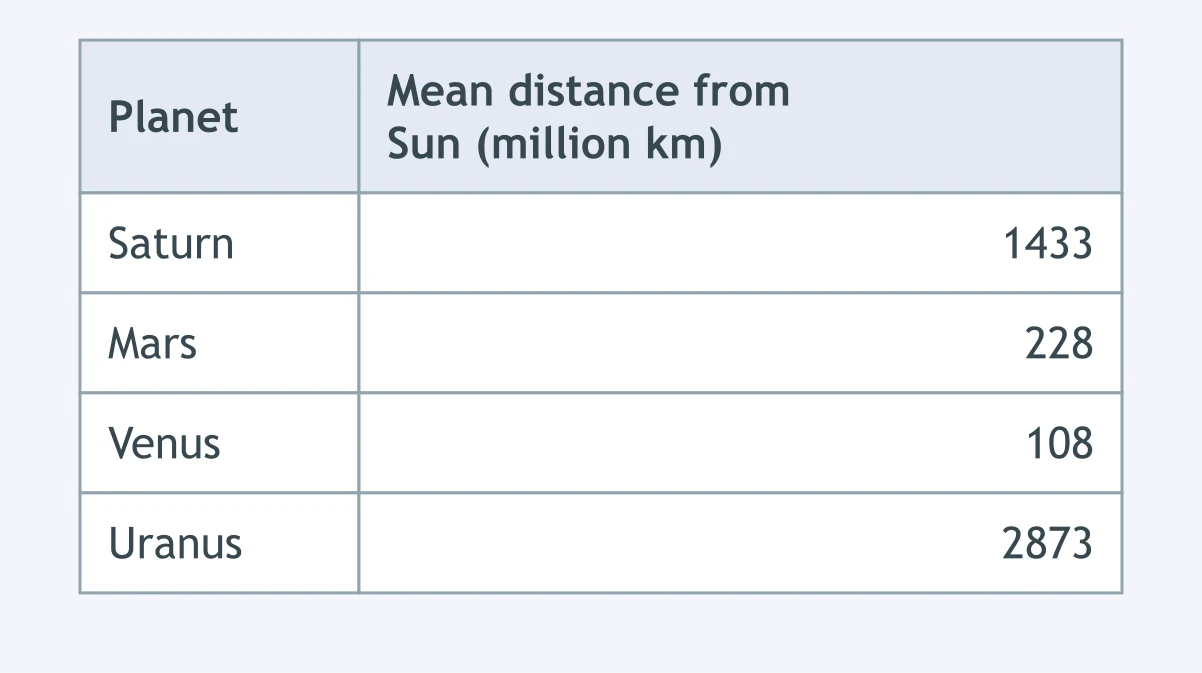
Use the table of mean distances from the Sun. Which list orders these planets from nearest the Sun to furthest?
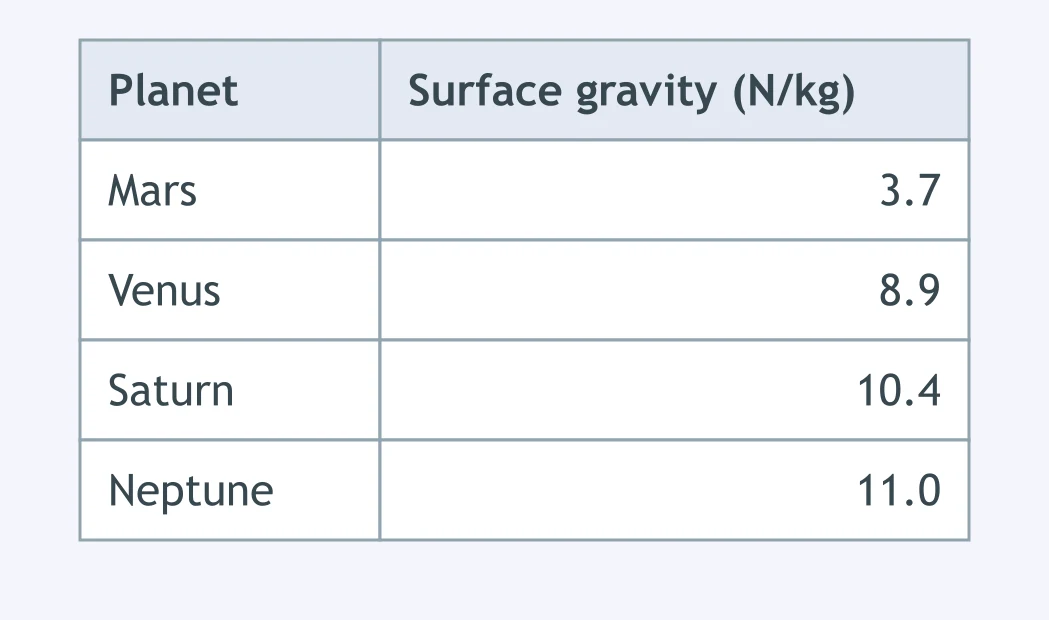
A table gives surface gravity in N/kg for several planets. A 60 kg astronaut would be pulled down hardest while standing on which one?
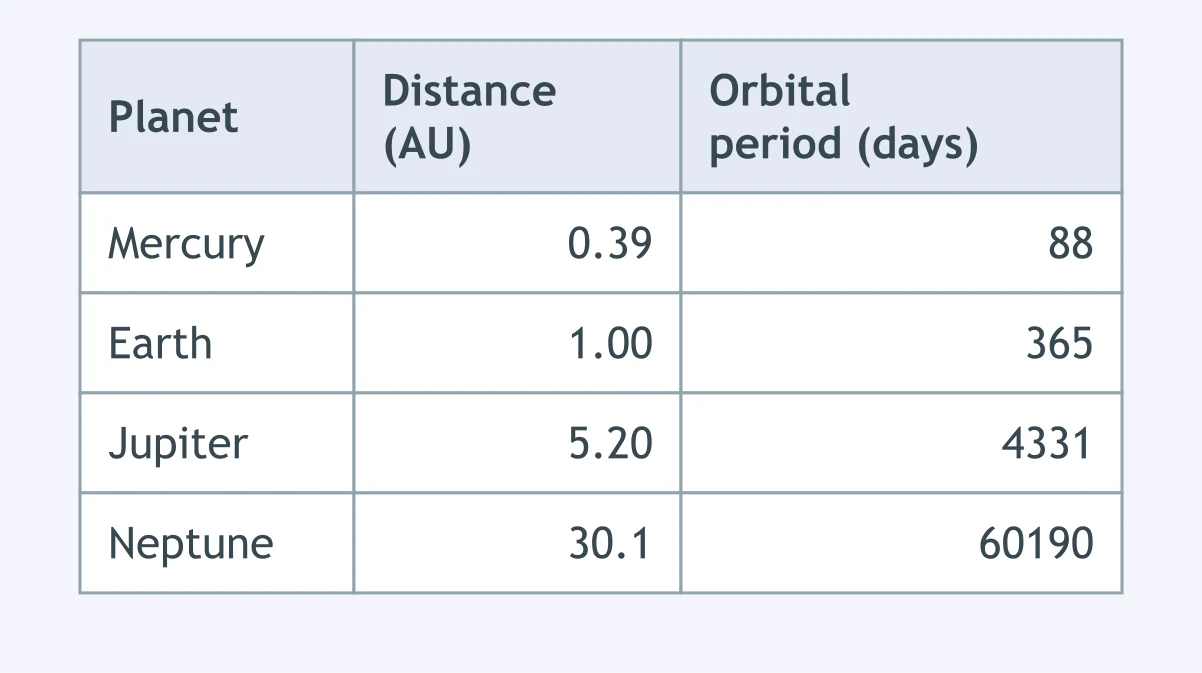
A table gives orbital period: Mercury 88 days, Earth 365 days, Jupiter 4,331 days, Saturn 10,747 days. Which planet takes longest to complete one orbit of the Sun?
A table gives diameters: the Moon 3,475 km, Ganymede 5,268 km, Mercury 4,879 km, Pluto 2,377 km. Which of these objects is the largest?
A table gives known moons: Earth 1, Mars 2, Jupiter 101, Saturn 285. Which planet in the table has the fewest known moons?
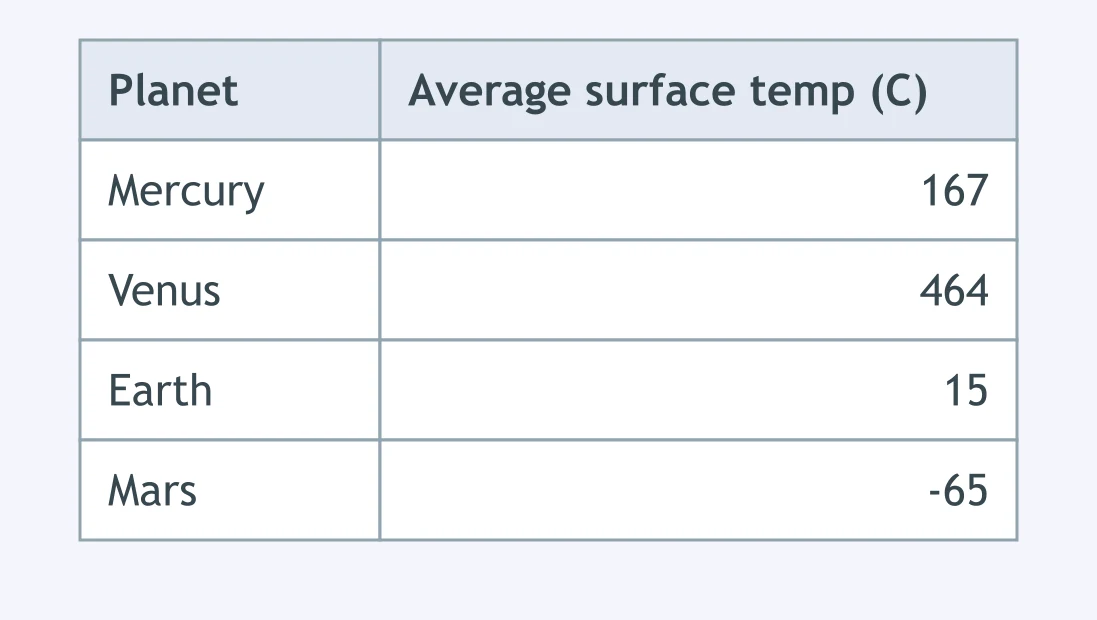
Use the table of average surface temperature in degrees C for the planets shown. Which of these planets is hottest at its surface?
A table gives diameters: Jupiter 142,984 km, Saturn 120,536 km, Uranus 51,118 km, Neptune 49,528 km. Which list orders these planets from widest to narrowest?
A table gives diameter and mass compared with Earth: Venus 12,104 km, 0.82; Neptune 49,528 km, 17.1; Jupiter 142,984 km, 318; Saturn 120,536 km, 95. Which of these is a terrestrial planet?
A table gives rotation period: Venus 5,832 hours, Earth 24.0 hours, Mars 24.6 hours, Jupiter 9.9 hours. Which planet in the table spins once in the shortest time?
The table pairs each planet's mean distance from the Sun with its orbital period. What relationship does the table show?
A table pairs distance from the Sun with average temperature: Venus 108 million km, 464 degrees C; Earth 150 million km, 15 degrees C; Mars 228 million km, -65 degrees C. What does the table show?
A table pairs diameter with mass compared with Earth: Mars 6,792 km, 0.11; Earth 12,756 km, 1.0; Neptune 49,528 km, 17.1; Jupiter 142,984 km, 318. How do the two columns relate?
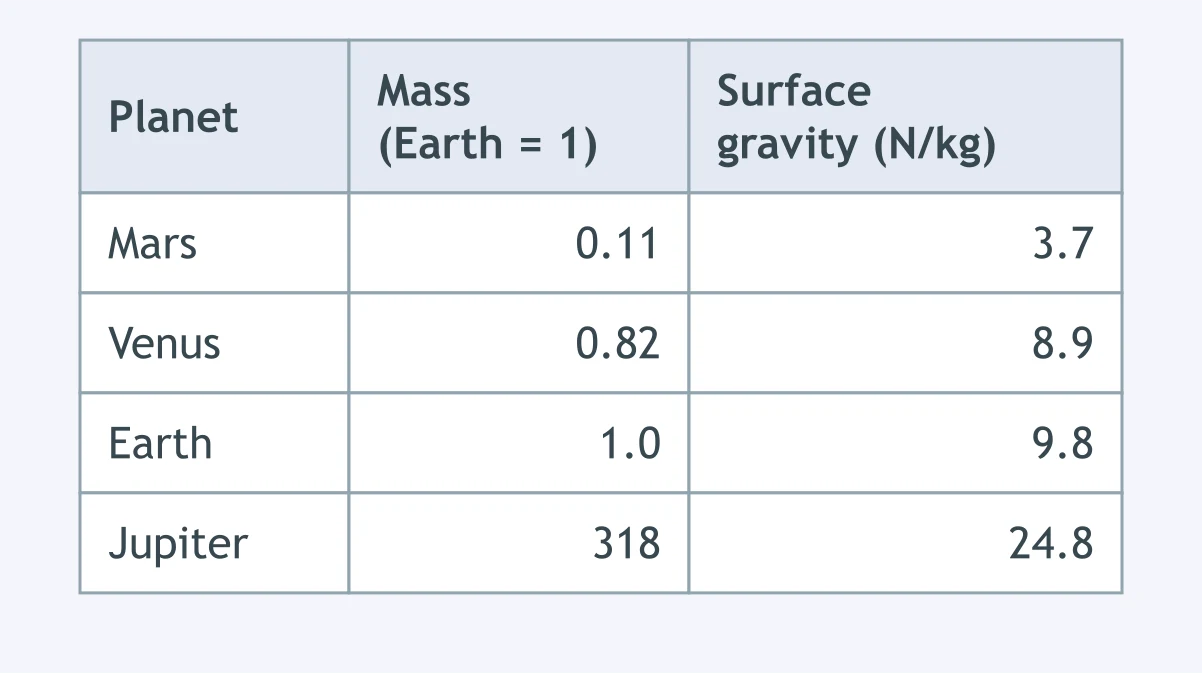
The table pairs each planet's mass, compared with Earth, with its surface gravity. Which relationship does the table support?
A table pairs mean distance with orbital period: Mercury 0.39 AU, 88 days; Mars 1.52 AU, 687 days; Saturn 9.58 AU, 10,747 days. The table shows that orbital period increases as distance increases.
A table pairs diameter with known moons: Mercury 4,879 km, 0 moons; Earth 12,756 km, 1 moon; Jupiter 142,984 km, 101 moons. The table shows that the smallest planet listed has the most moons.
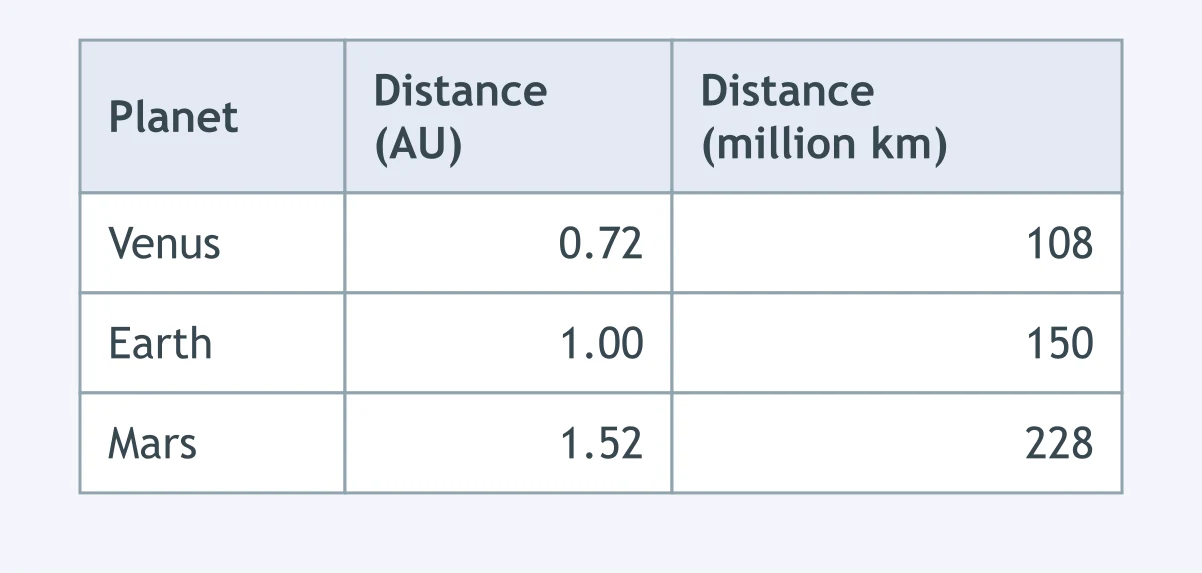
The table gives each planet's mean distance from the Sun in two units. What do the two columns together show?
A table pairs diameter with surface gravity: Mercury 4,879 km, 3.7 N/kg; Mars 6,792 km, 3.7 N/kg; Earth 12,756 km, 9.8 N/kg; Saturn 120,536 km, 10.4 N/kg. Which statement fits the table?
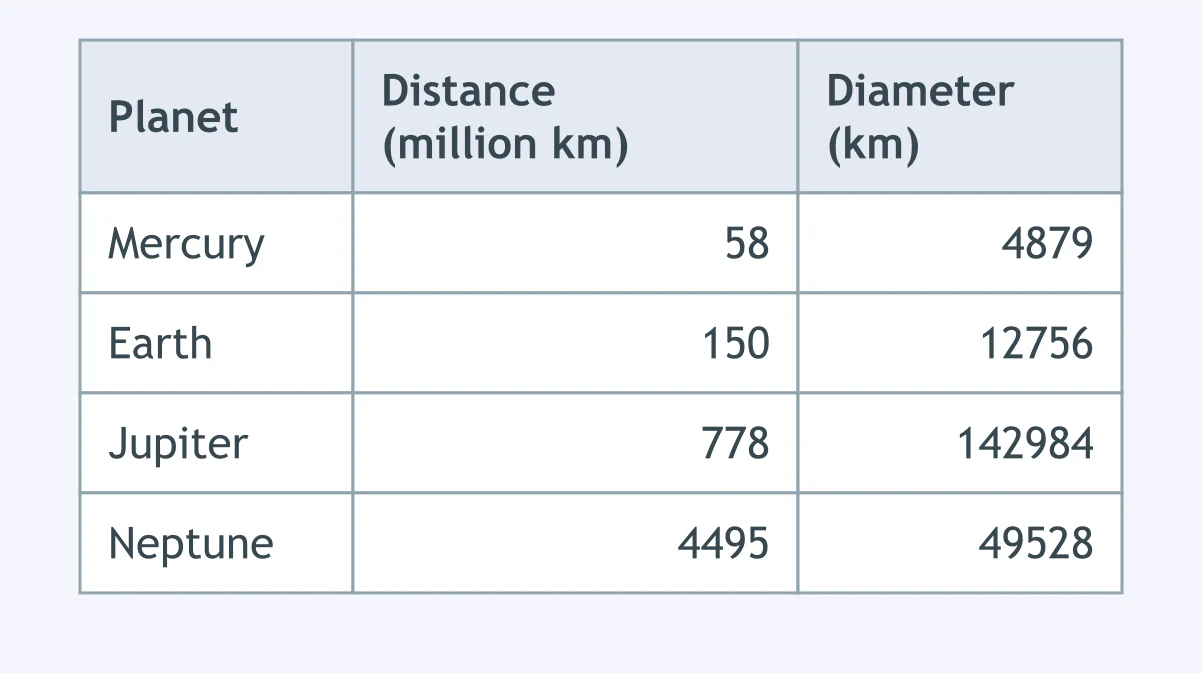
Use the table of each planet's distance from the Sun and its diameter. What does the table show?
A table pairs orbital period with distance: Mercury 88 days, 0.39 AU; Venus 225 days, 0.72 AU; Earth 365 days, 1.00 AU. A newly found planet orbits in 500 days. What does the pattern predict?
Crack the passcode before the zombies get in.
Answer, then swat bugs for bonus points.
Race through questions at your own speed.
Same question on every screen. Fastest wins.

Pick a tile, answer, hit bonuses and steals.
Geocentric and Heliocentric Models
20 questions