Loading
by BlastRoom
Reason from Earth's tilt, sunlight angle and daylight length to explain why the seasons happen.
#us_grade_8_science

40 questions
One question set, multiple game modes. Tap any game to see it in action. Not sure which to pick?
Answer to place stones and capture territory.
Outrun the snow together.
Earn blasts, then hunt the other team.
Answer to earn energy, then climb.

The class blasts through walls together.
Bid on mystery lots. Most money wins.
Sell tours. Nice, standard, or a total scam.

Answer, restock, and serve the rush.
More correct answers pulls the rope your way.
Answer, then shoot down the alien wave.
Answer, then tap to leap the frozen ridge.
Earth's axis is tilted about 23.5 degrees. In late June the northern end of the axis leans toward the sun. What season is Australia having then?
On December 21, which hemisphere receives the most direct sunlight?
As Earth travels around the sun, its axis keeps pointing toward the same spot in space all year. What does that fixed tilt produce?

When it is summer in the Northern Hemisphere, it is winter in the Southern Hemisphere.
At the March equinox, neither end of Earth's axis leans toward the sun. Where is the noon sun directly overhead on that date?
A globe is tilted 23.5 degrees with its northern end leaning away from a lamp. Which month does this model, and where is it summer?

Suppose Earth's axis stood straight up instead of tilted, with the orbit unchanged. What would happen at a place like Paris?
On June 21 the sun stands directly overhead at the Tropic of Cancer, 23.5 degrees north. What does that show about Earth's axis on that date?
Six months after the northern end of Earth's axis leans toward the sun, where is Earth and what season is Canada having?
Buenos Aires has its warmest month in January, while Madrid has its warmest month in July. What does this difference show about Earth?
A student shines a flashlight straight down onto a sheet of paper, then tilts it to a low angle without moving it closer. What happens to the lit patch?
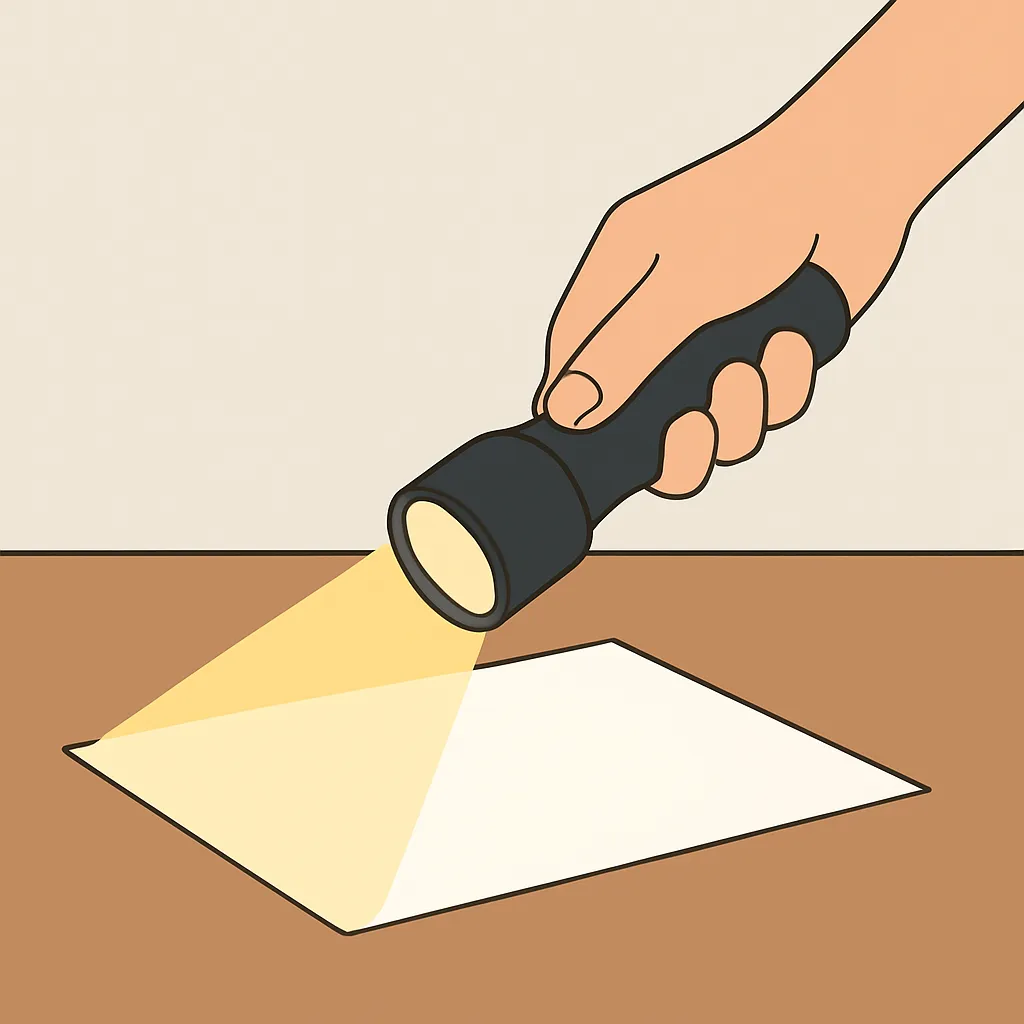
At noon in July the sun stands about 70 degrees above Chicago's horizon, and in January it stands about 25 degrees. Why does the ground warm less in January?
Two black cups holding thermometers sit in the sun. One faces the sun squarely, the other is tilted far away from it. Which warms faster, and why?
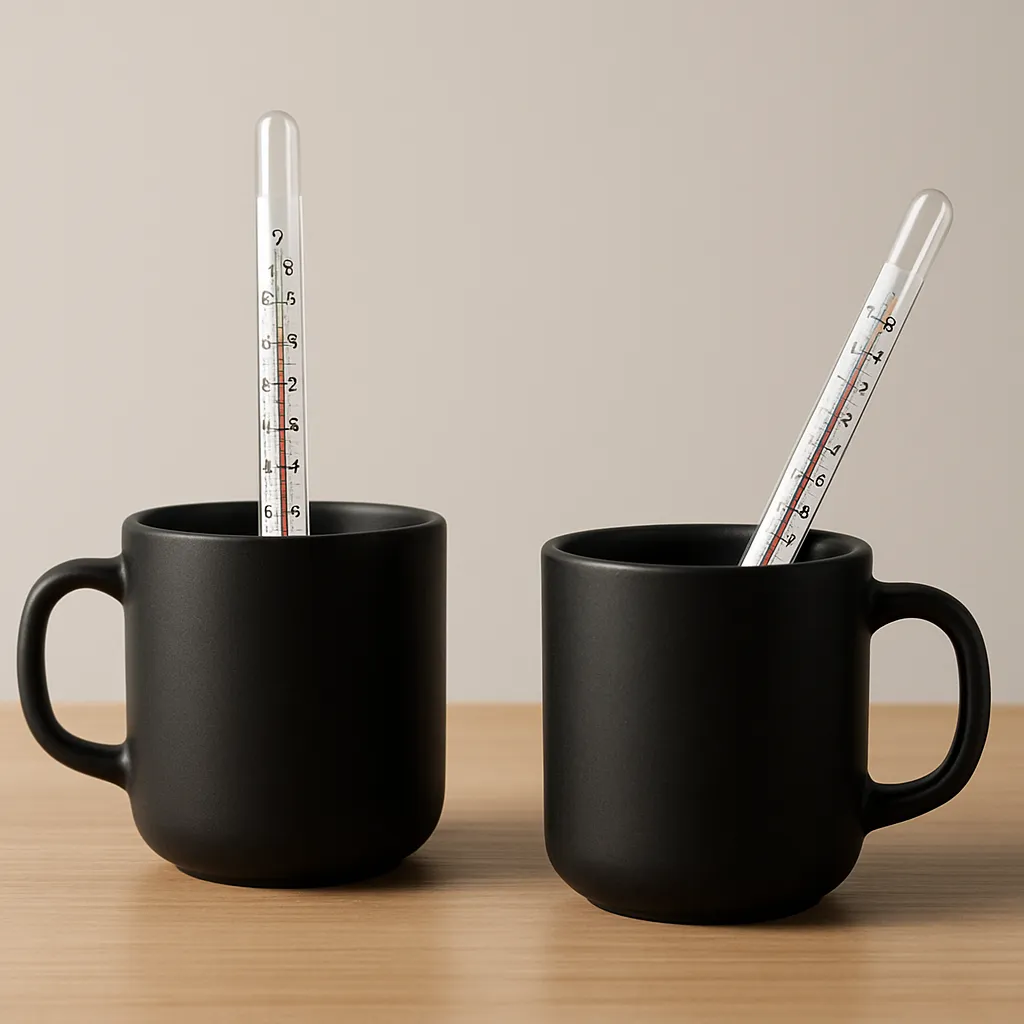
Sunlight strikes the equator nearly head-on all year but reaches northern Alaska at a low angle. What does that difference explain?
Sunlight arriving at a low angle passes through more of the atmosphere before reaching the ground than sunlight arriving from straight overhead.
Solar panels on a roof in Norway are tipped up to face the low winter sun. What does tipping the panels actually do?
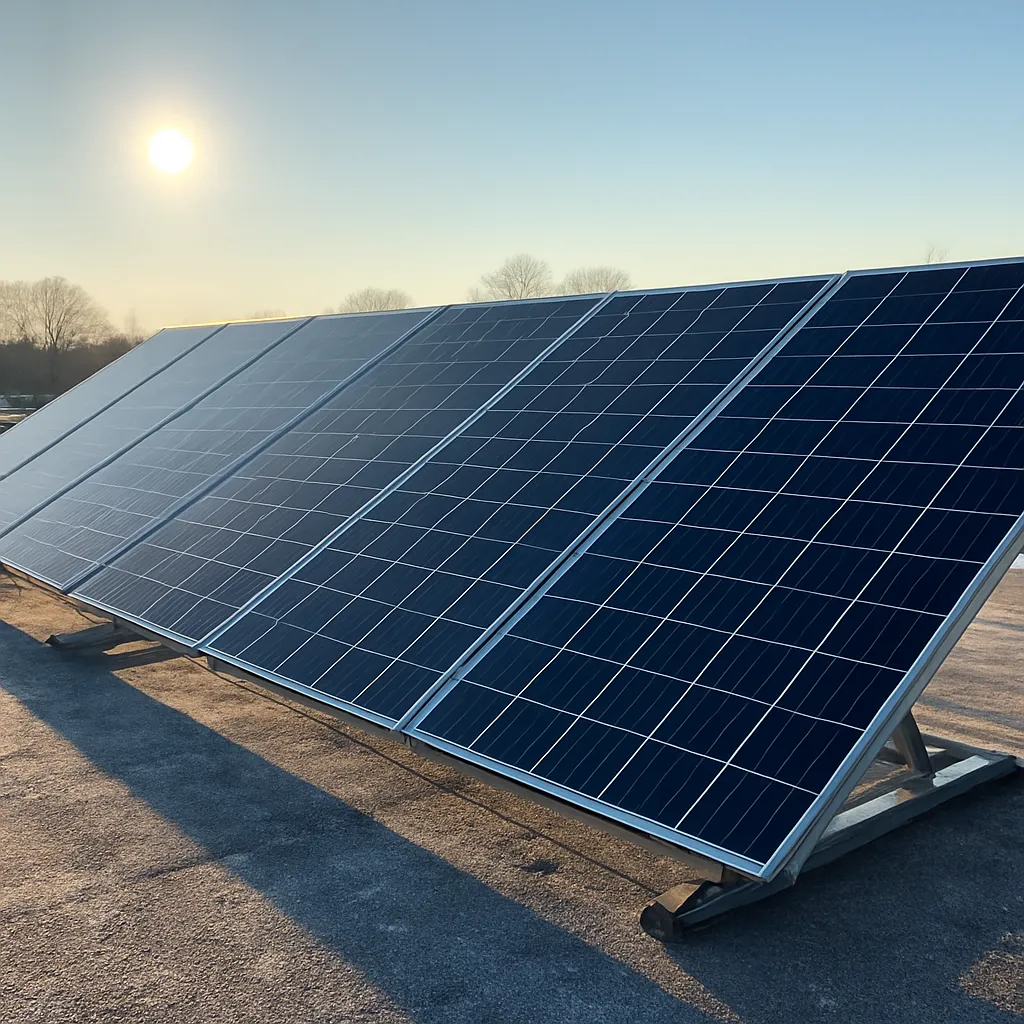
A sunbeam covers 1 square meter of ground when it lands straight on, but covers 3 square meters when it lands at a low angle. How much energy does each square meter then receive?
In summer the noon sun climbs high in the sky, and in winter it stays low. How does a flagpole's noon shadow change between the two seasons?
A lamp shining on a tilted globe makes a small bright oval near the equator and a long stretched oval near the Arctic Circle. What does the stretched oval show?

In a Northern Hemisphere valley, snow lingers for weeks on north-facing slopes after it has melted from south-facing slopes. What best explains that?

A town records 15.7 hours of daylight on June 21 and 8.5 hours on December 21. Where does the town lie?
Quito, Ecuador, sits on the equator and records about 12.1 hours of daylight in every month of the year. What explains that steady value?
The table gives one city's daylight hours on the 21st of four months. Which statement about the city does the data best support?
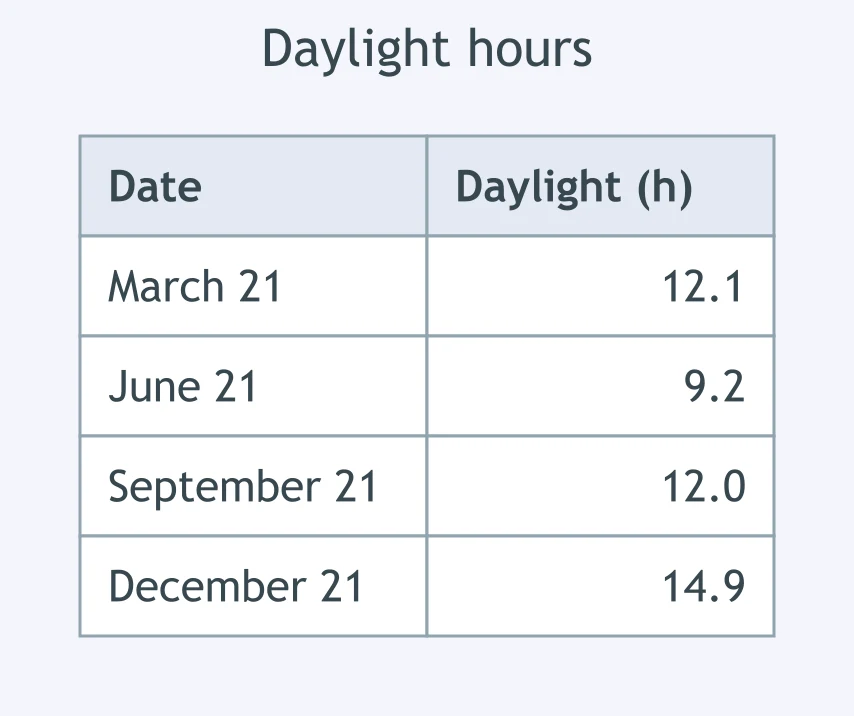
Fairbanks, Alaska, gets about 21 hours of daylight in late June and about 4 hours in late December. Why is the swing there so large?
At the equinoxes, nearly everywhere on Earth receives about 12 hours of daylight.
On June 21 Oslo records 18.8 hours of daylight while Cape Town records 9.9 hours. What do these two measurements together show?
Use the graph of one city's daylight hours. Which month has the longest day there, and what season is the city in then?
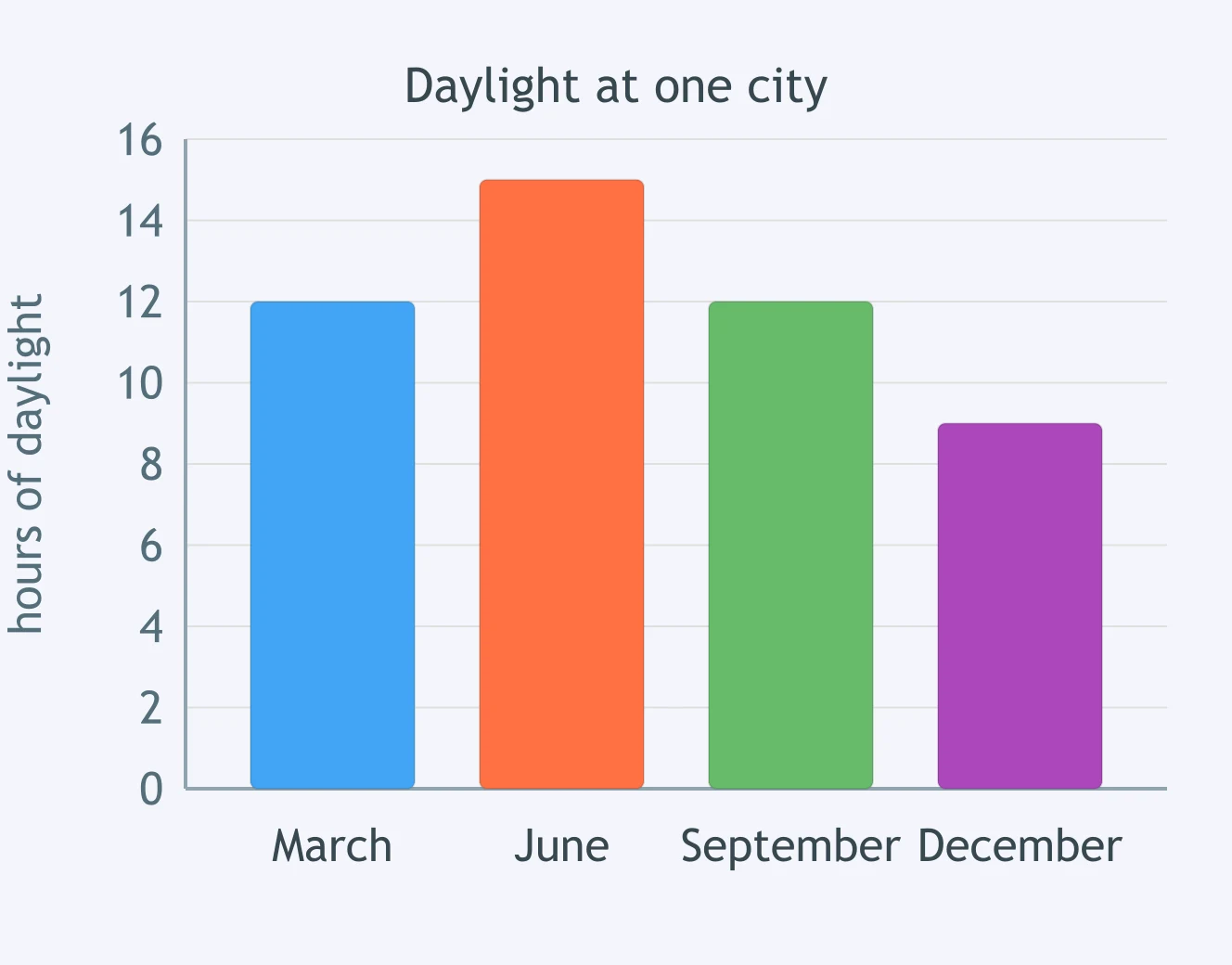
Between March 21 and June 21, a city's daylight grows from 12.1 hours to 15.4 hours. What is happening to that city's hemisphere across those months?
In summer a place has both longer days and higher-angle sunlight. How do those two effects work together on that place's temperature?
Wellington, New Zealand, records about 15.1 hours of daylight in late December. About how many hours should you predict for late June there?
Earth is closest to the sun in early January, yet January is New York's coldest month. What does that pairing show about the distance explanation of seasons?
In July, when Earth is farthest from the sun, Rome is hot and Santiago is cold. Which claim does this evidence best support?
Earth's distance from the sun changes by only about 3 percent over a year. What does that tell you about the big seasonal temperature swings?
Earth is closer to the sun in early January than it is in early July.
When the Northern Hemisphere is tilted toward the sun, the Southern Hemisphere is tilted toward the sun as well.
A student claims that summer happens because Earth swings much nearer to the sun. Which observation argues most strongly against that claim?
In January, Sydney is hot while Chicago is cold, though the whole planet is the same distance from the sun. What must any correct explanation of seasons do?
Suppose Earth's orbit were a perfect circle, holding its distance from the sun constant, while the axis kept its 23.5 degree tilt. What would happen to the seasons?
Earth is about 152 million kilometers from the sun in early July and about 147 million kilometers from it in early January. Which statement fits those values?
Suppose Earth's axis were tilted 35 degrees instead of 23.5 degrees, with the orbit unchanged. How would seasons in the United States change?
Crack the passcode before the zombies get in.
Answer, then swat bugs for bonus points.
Race through questions at your own speed.
Same question on every screen. Fastest wins.

Pick a tile, answer, hit bonuses and steals.
Gravity in the Solar System
40 questions