Loading
by BlastRoom
Compare P waves, S waves and surface waves, and read seismograms, particle-motion diagrams and shadow zones for what they reveal about Earth's interior.
#earth_space_science
40 questions
One question set, multiple game modes. Tap any game to see it in action. Not sure which to pick?
Answer to place stones and capture territory.
Outrun the snow together.
Earn blasts, then hunt the other team.
Answer to earn energy, then climb.

The class blasts through walls together.
Bid on mystery lots. Most money wins.
Sell tours. Nice, standard, or a total scam.

Answer, restock, and serve the rush.
More correct answers pulls the rope your way.
Answer, then shoot down the alien wave.
Answer, then tap to leap the frozen ridge.
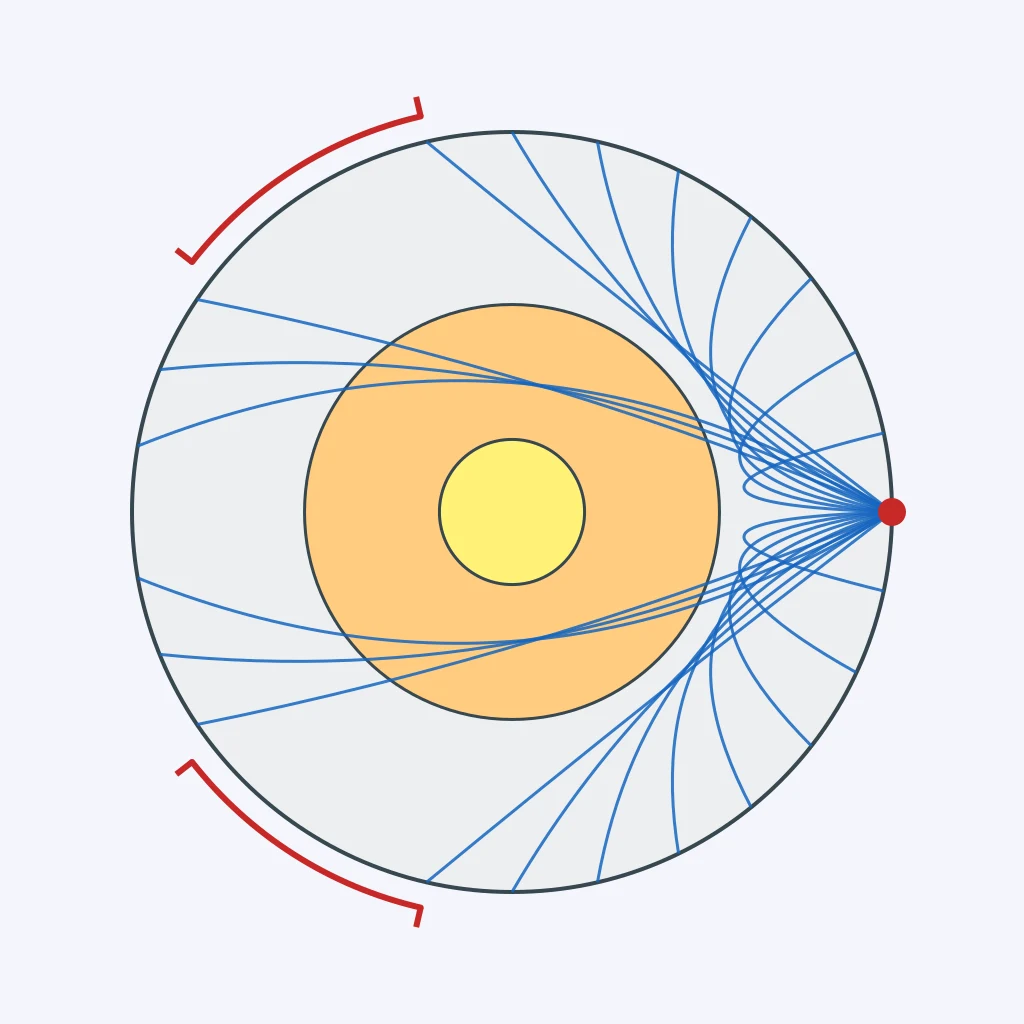
Two waves leave the same earthquake focus. One passes through both the mantle and the liquid outer core; the other stops at the core-mantle boundary and is recorded nowhere beyond it. Which wave stops there?
Of the three seismic wave categories, which type generally travels slowest through Earth and arrives last at a distant seismograph station?
Which seismic wave shakes the ground side to side in a horizontal, snakelike motion with no vertical component, and travels only along Earth's surface?
Which seismic wave rolls the ground surface in an elliptical, up-and-down and back-and-forth motion, similar to an ocean wave, and typically causes the most structural damage?
What term describes P waves and S waves together, since both travel through Earth's interior rather than only along the surface?
A seismic station located anywhere on Earth, including the point directly opposite an earthquake's epicenter, can still record this type of body wave. Which one?
In continental crust, P waves typically travel about 6 kilometers per second while S waves travel about 3.5 kilometers per second. What does this tell you about the two waves?
Because P waves and S waves travel at different constant speeds through the same rock, seismologists use the delay between their arrivals at one station to determine what?
Love waves and Rayleigh waves form when P waves and S waves reach which boundary and interact there?
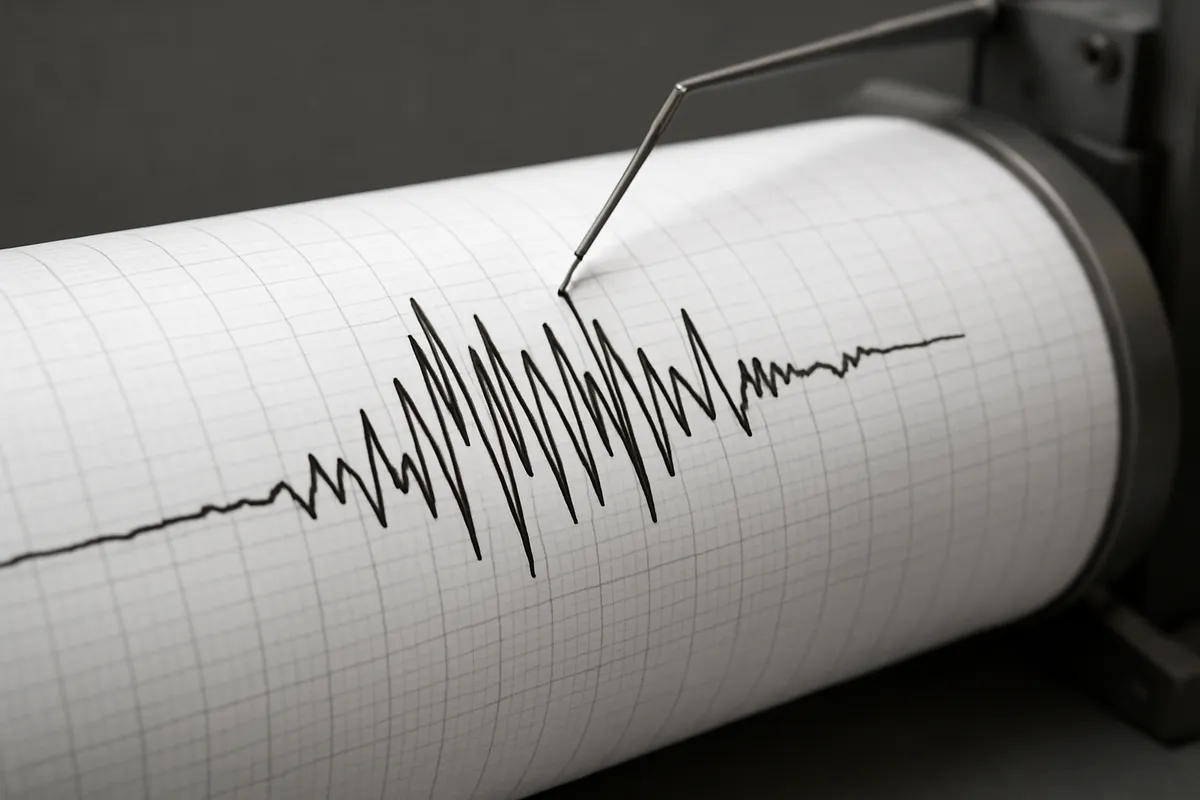
On Station A's seismogram, no ground motion is recorded before the first ticked arrival. What does that first arrival mark?
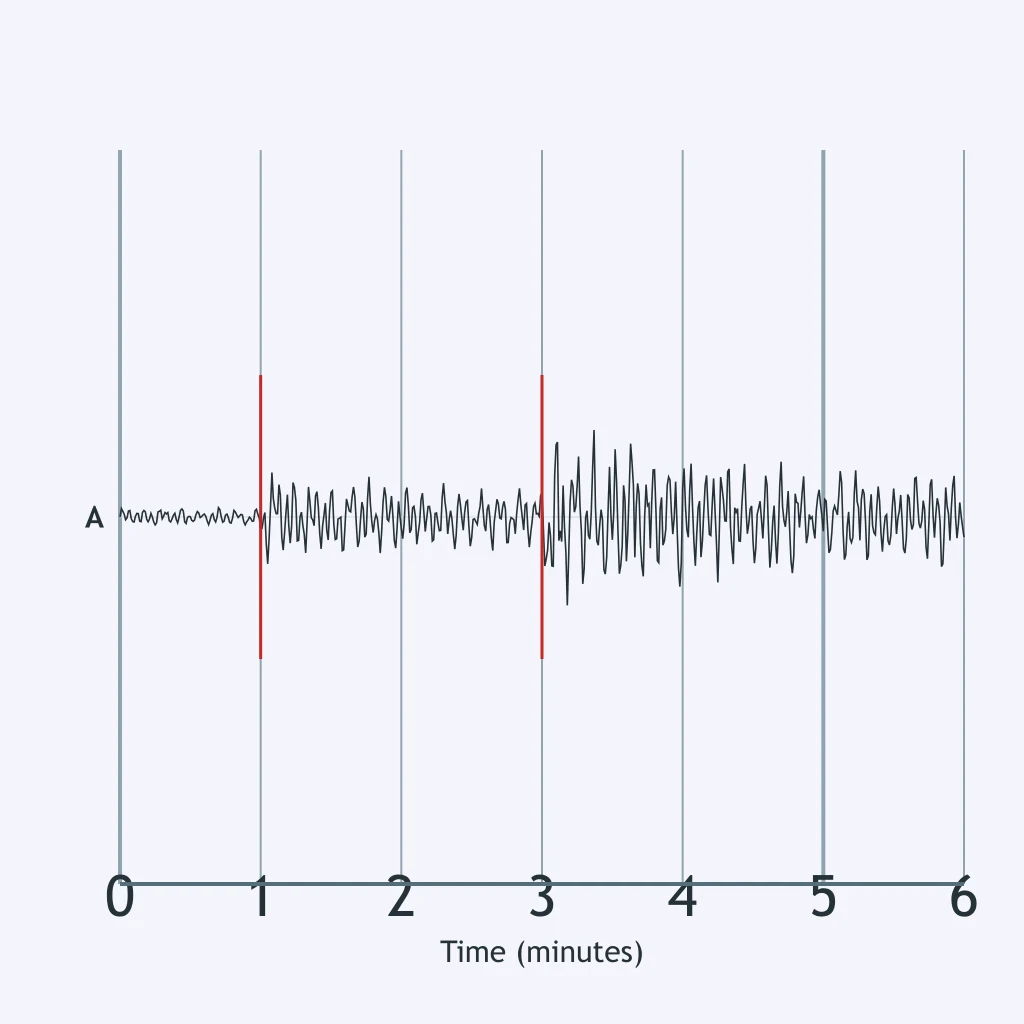
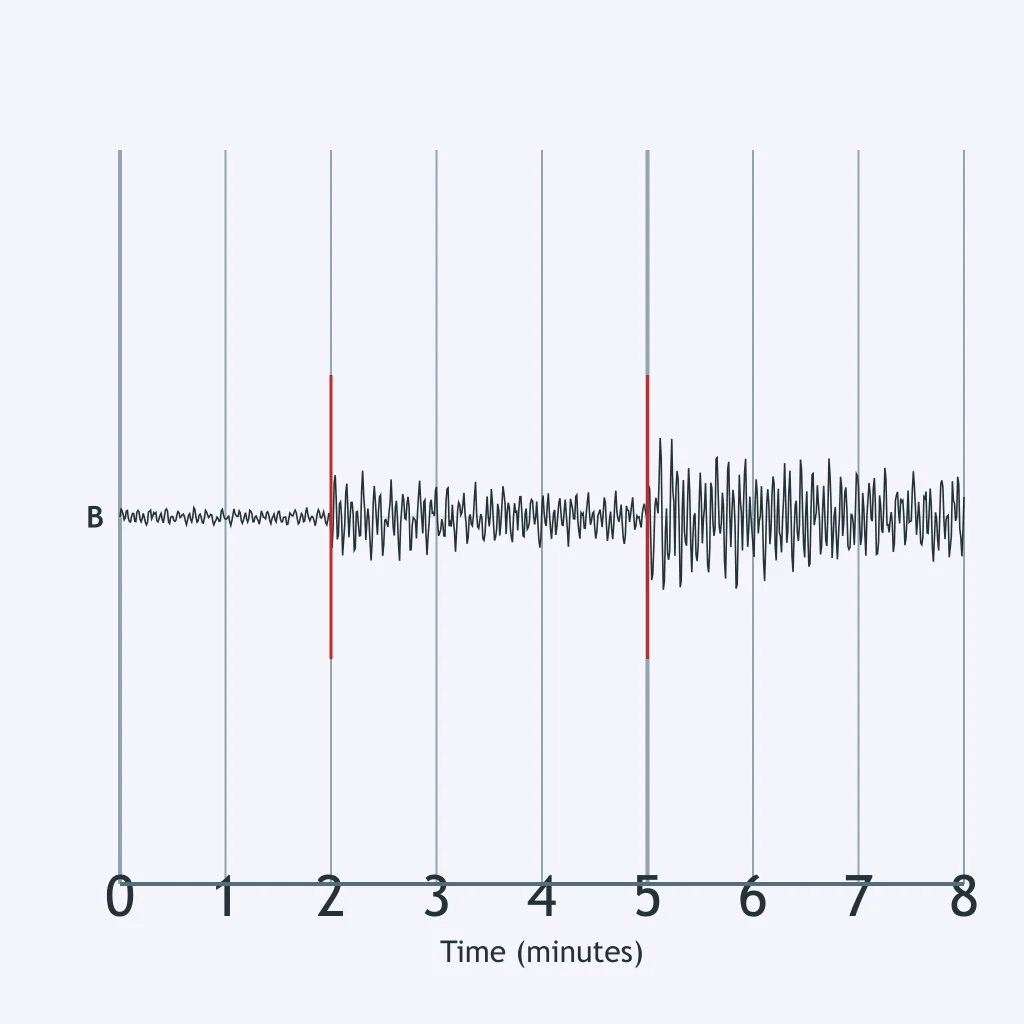
On Station B's seismogram, the second ticked arrival has a noticeably larger amplitude than the first. What does that second, larger arrival mark?
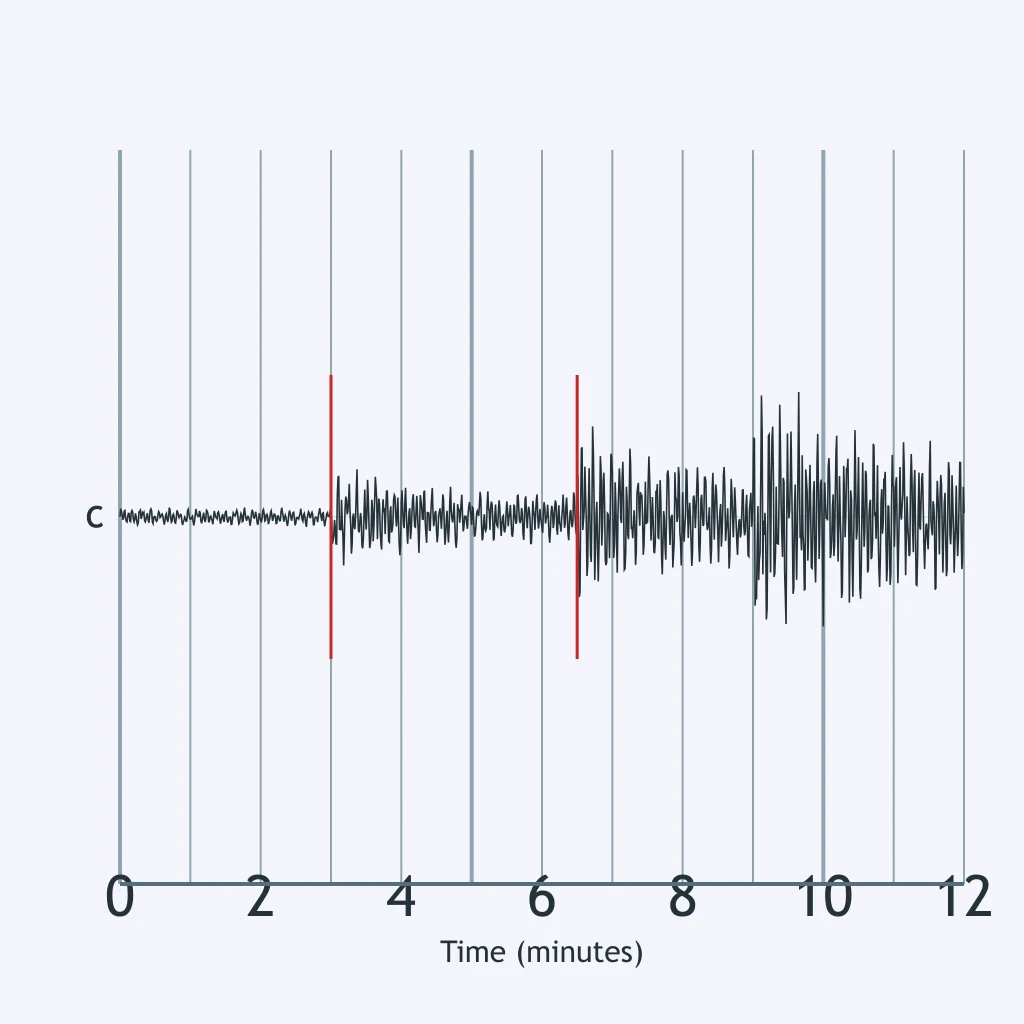
Station C's seismogram shows a small first arrival, a larger second arrival, then the largest, longest wave train of all beginning after the second arrival. What does that final wave train mark?
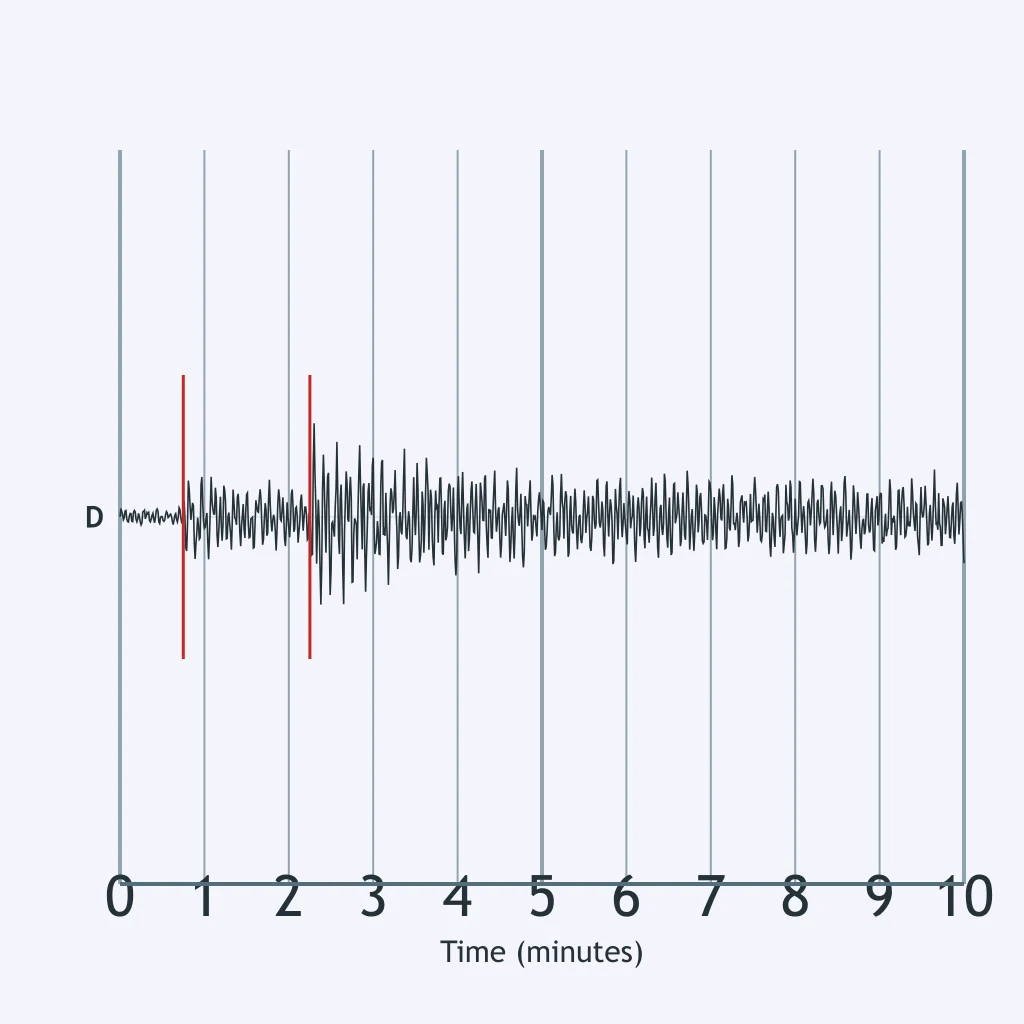
On Station D's seismogram, ground motion begins abruptly at 45 seconds into the record. What event does that moment mark?
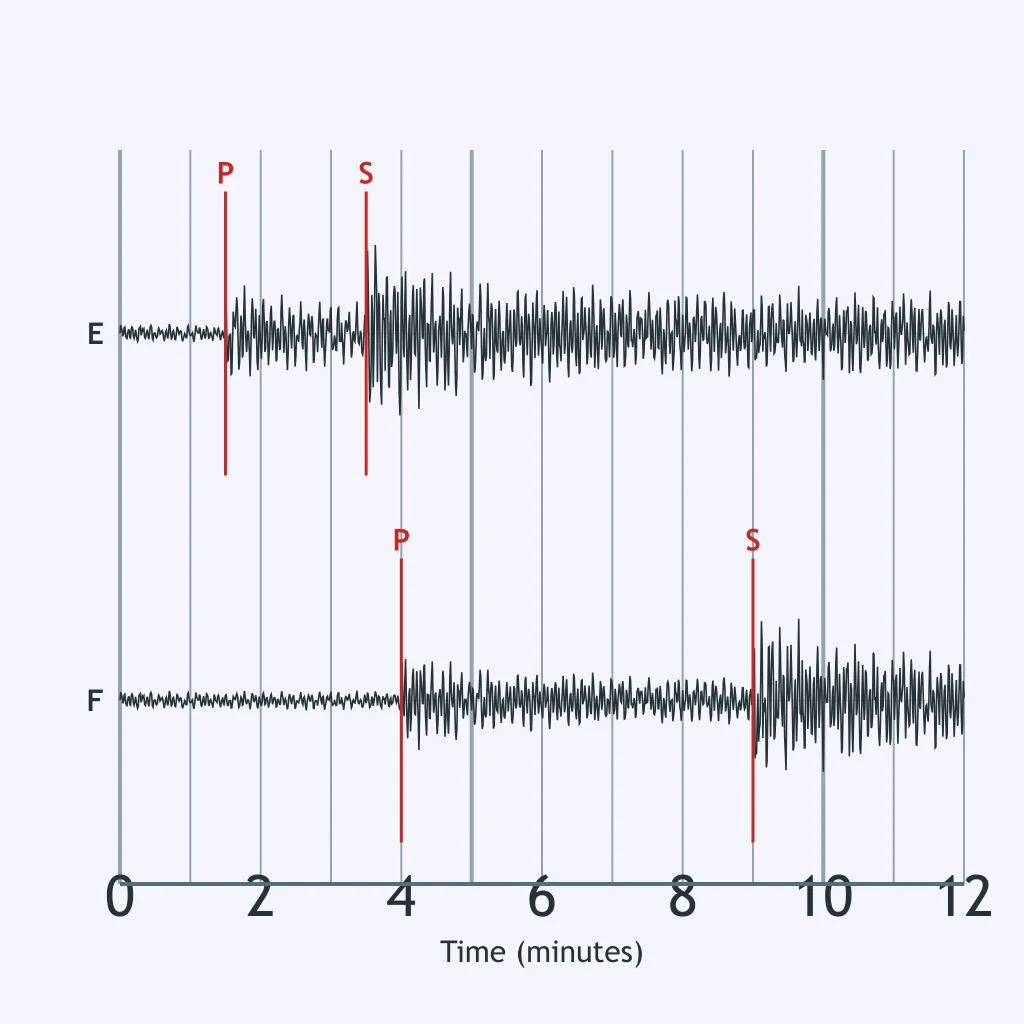
Compare the ticked seismograms for Stations E and F. The gap between each station's first and second ticked arrival is different. What does a LARGER gap indicate about that station?
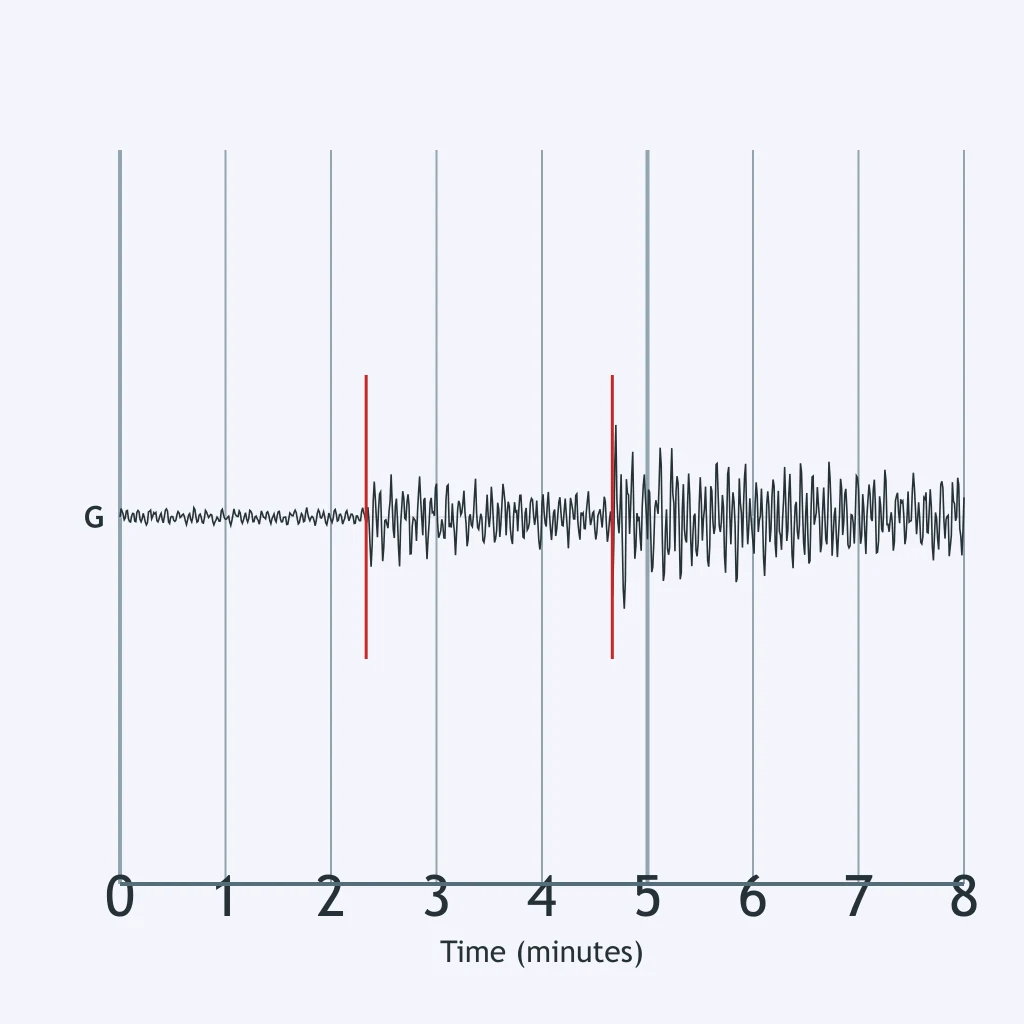
On Station G's seismogram, the first ticked arrival shows small, sharp vibrations, while the second ticked arrival shows larger, rolling vibrations. Which wave produces the second arrival's motion?
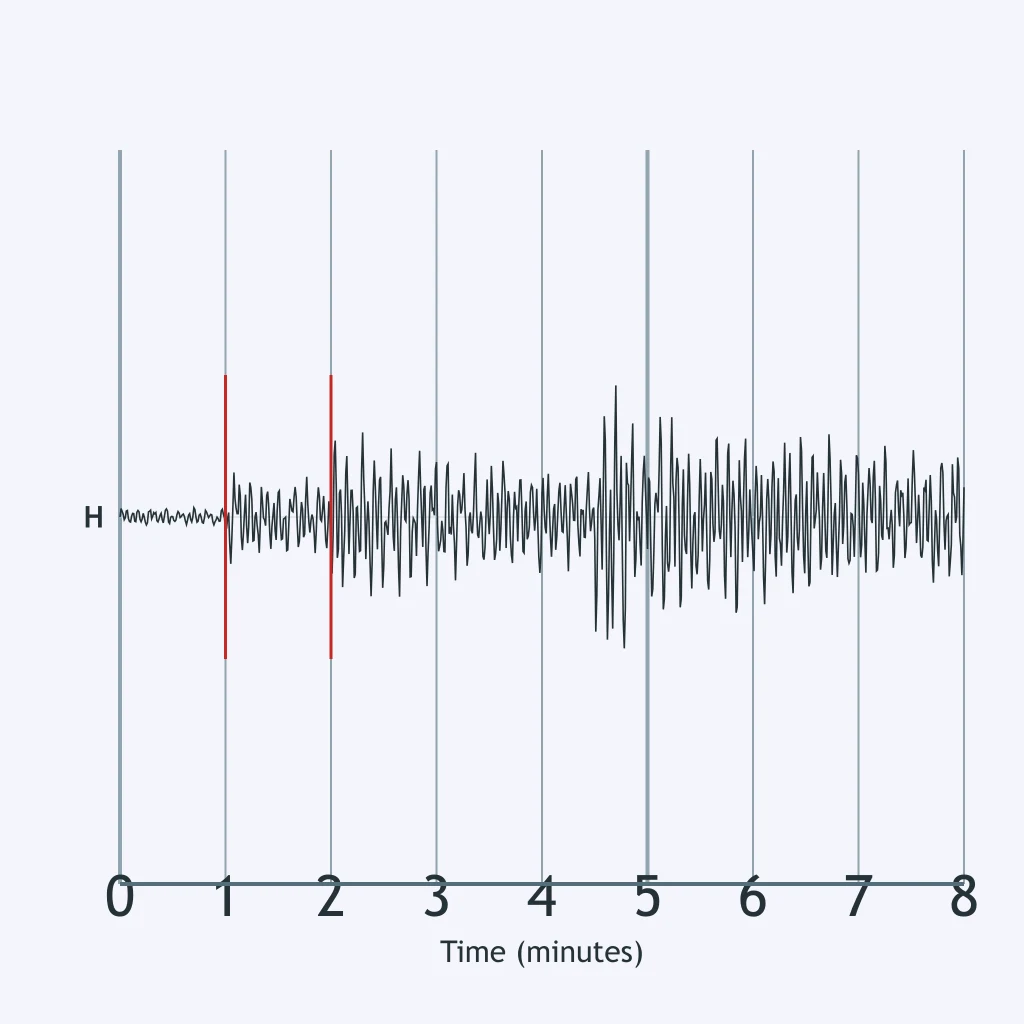
Two arrivals are ticked on Station H's seismogram. Which wave does the first tick mark?
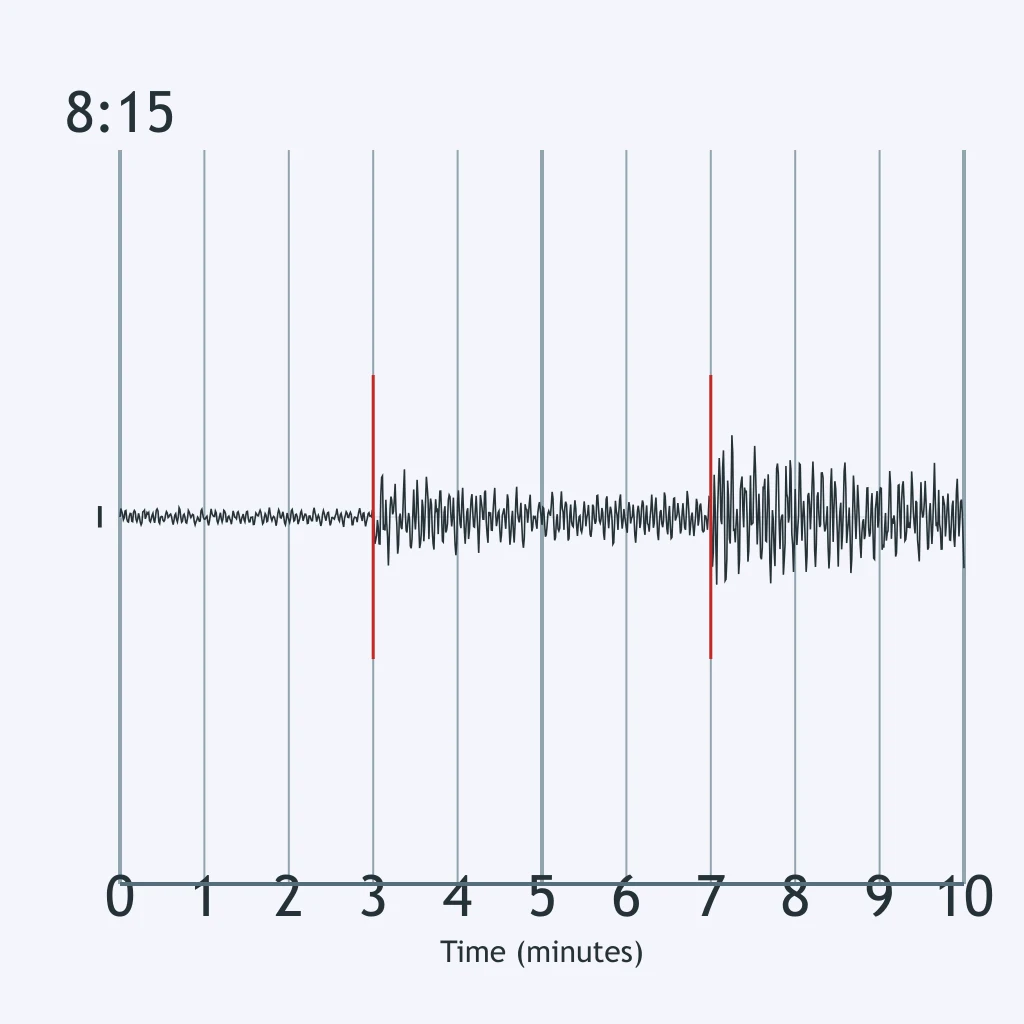
Station I's record starts at 8:15. The first ticked arrival lands at 8:18 and the second at 8:22. What does the second arrival at 8:22 mark?
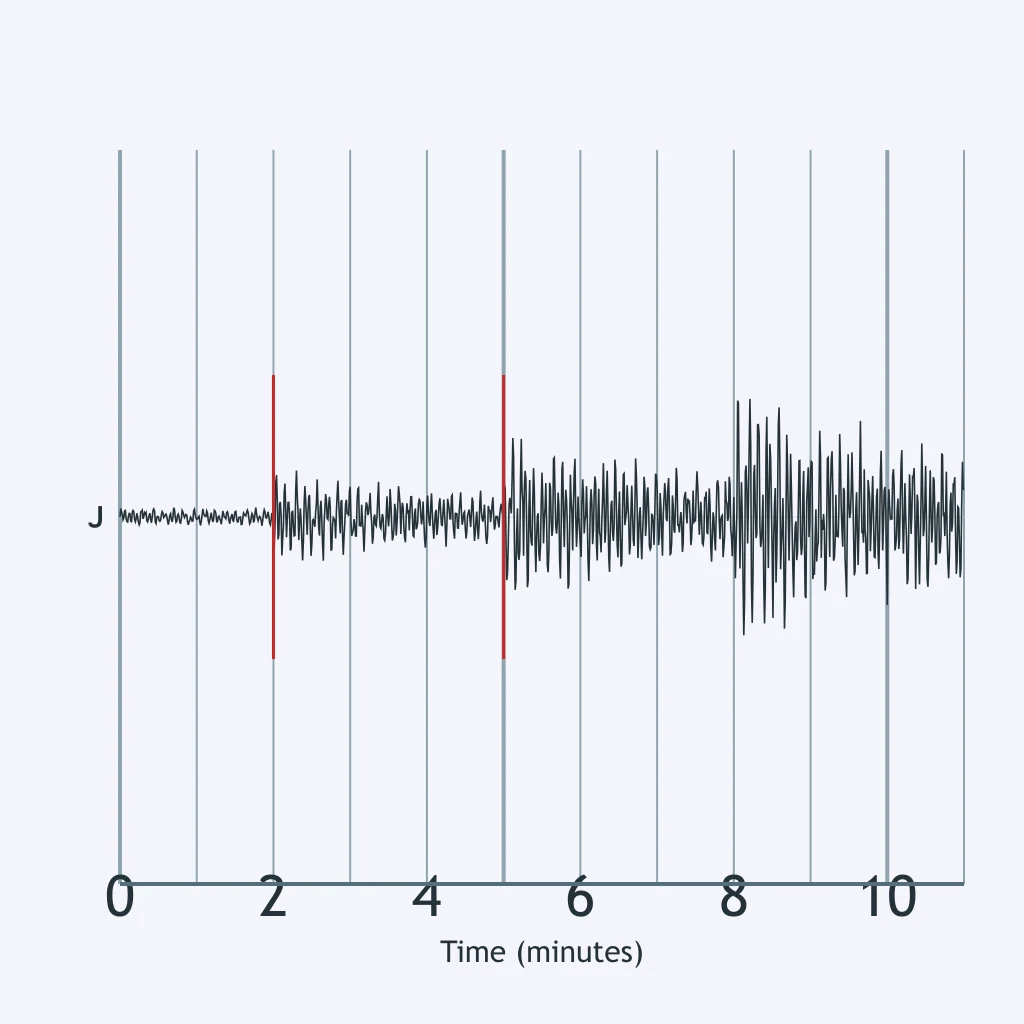
On Station J's seismogram, which arrival marks the wave type that cannot travel through the liquid outer core?
The diagram shows rock particles vibrating back and forth along the same line the wave travels, squeezing and stretching the material as it passes. Which wave moves rock this way?

The diagram shows particles vibrating up and down, at a right angle to the direction the wave is traveling. Which body wave moves rock with this shearing motion?
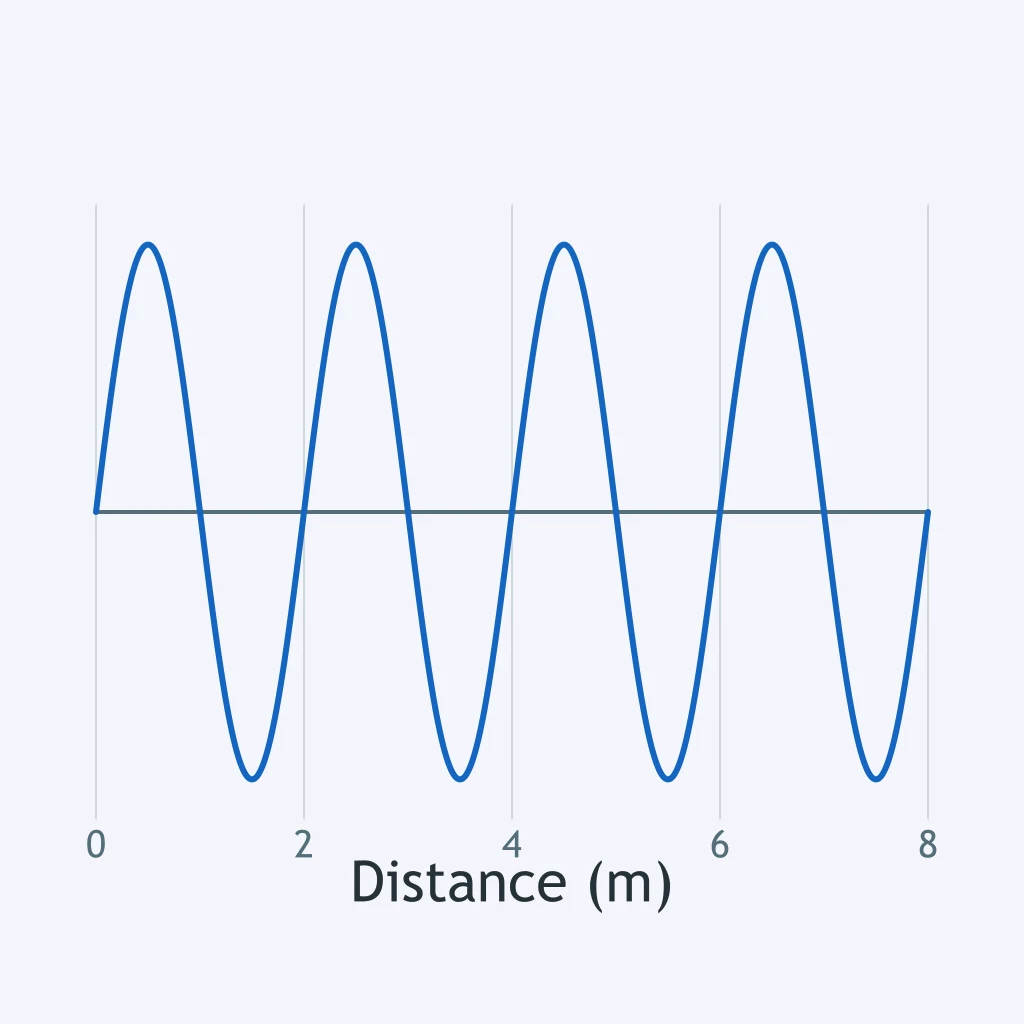
The diagram shows a wave shaking the ground purely side to side, perpendicular to its direction of travel, with no vertical motion, and existing only at Earth's surface. Which wave is this?
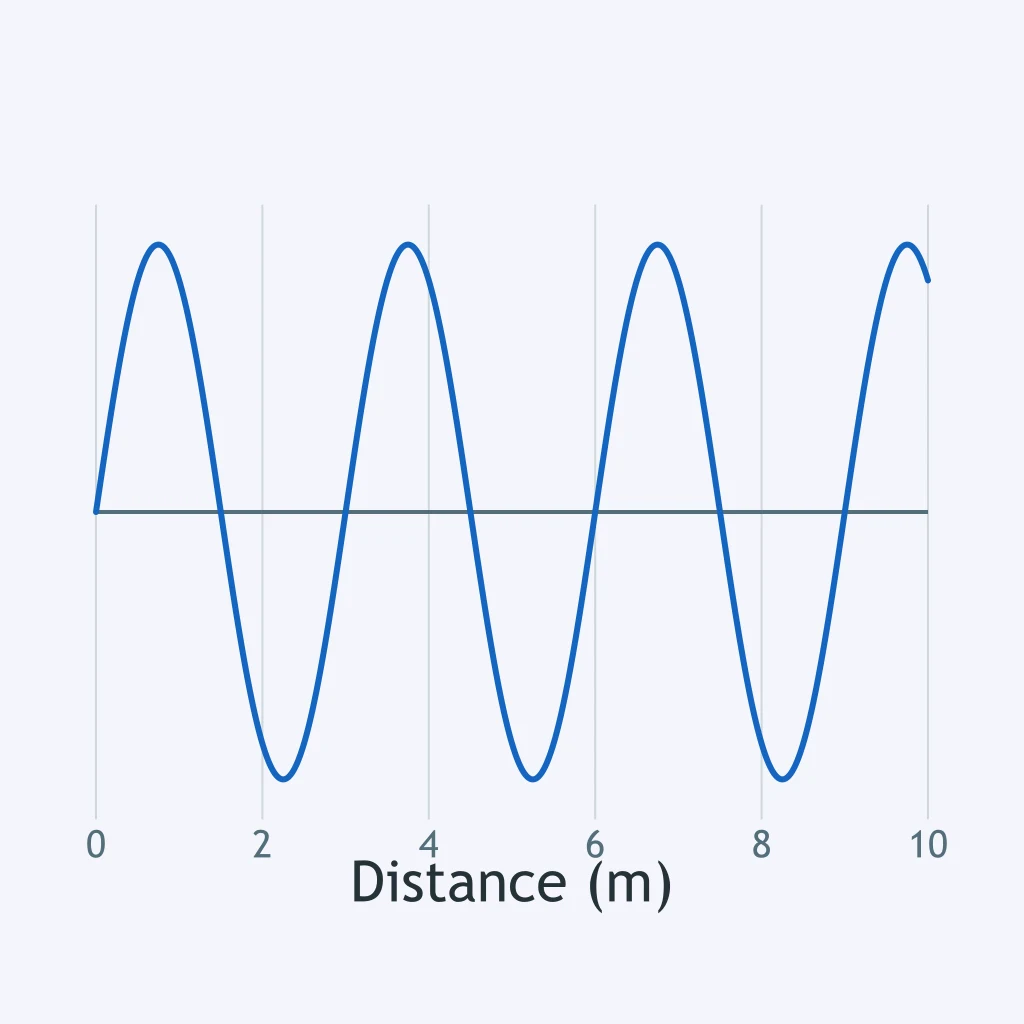
A seismometer that measures only up-and-down ground motion records one type of surface wave clearly but not the other. Which surface wave does it record?
The diagram shows a wave whose perpendicular, shearing particle motion is strong enough to twist and topple rigid structures during a large earthquake. Which wave produces this shearing motion?
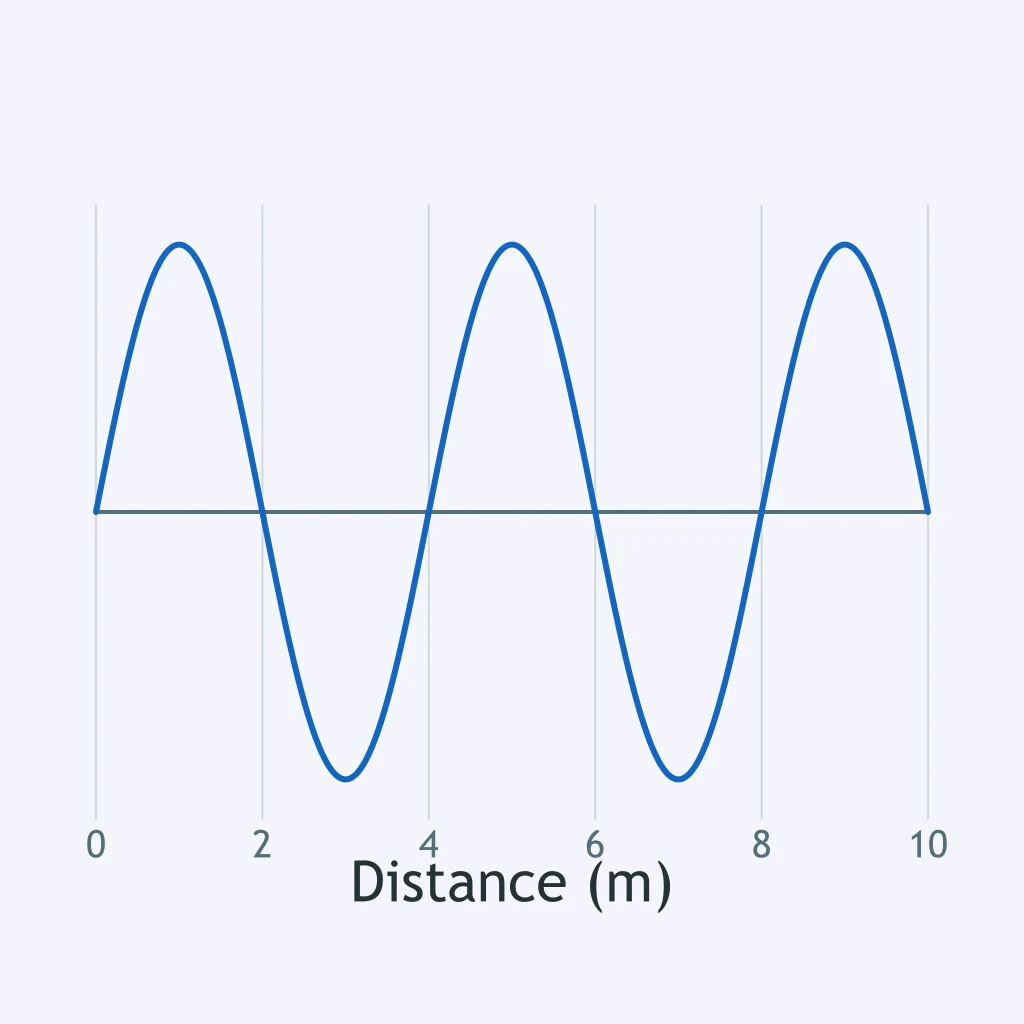
The diagram shows a wave that compresses and expands the material it passes through, a motion that works equally well in a solid, a liquid, or a gas. Which seismic wave moves this way?

A P wave moves through rock the same way sound moves through air: by compressing and expanding the medium rather than shearing it side to side. Which everyday wave shares this compressional motion?

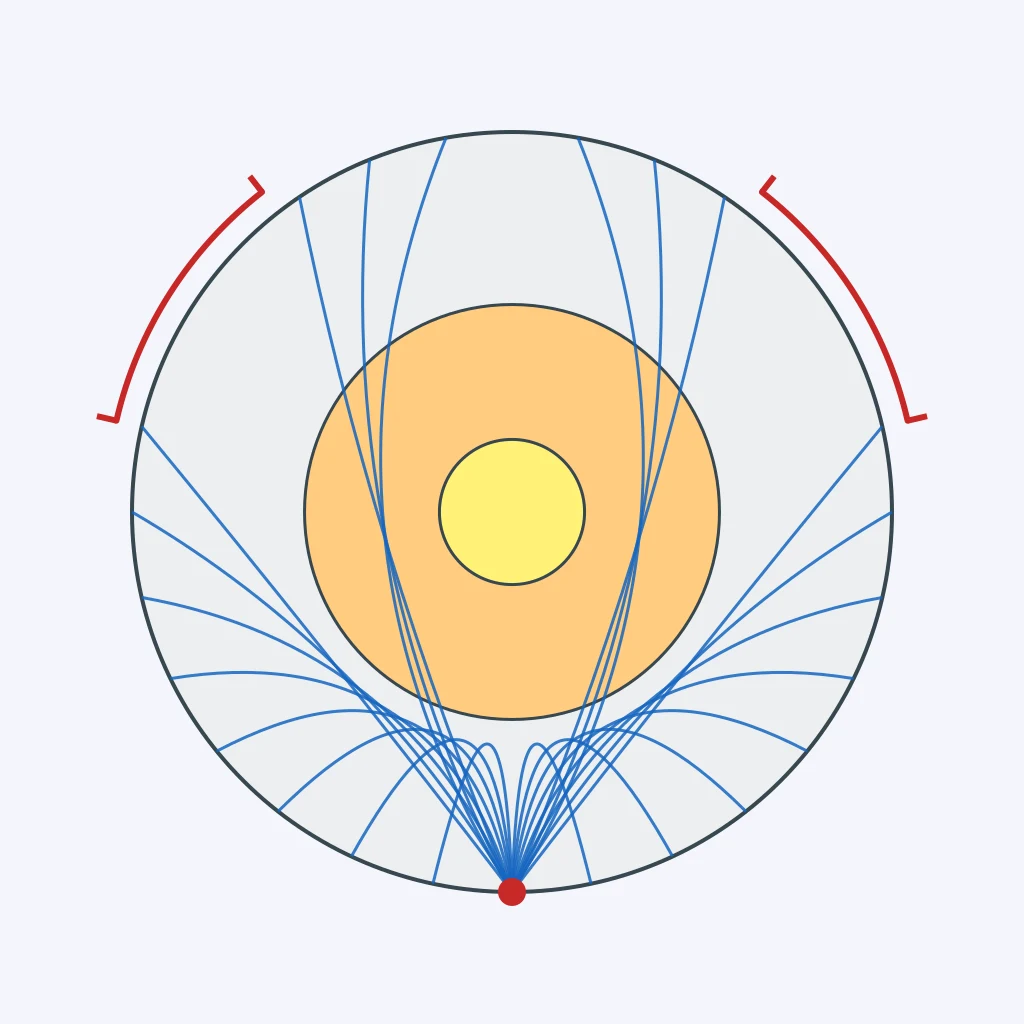
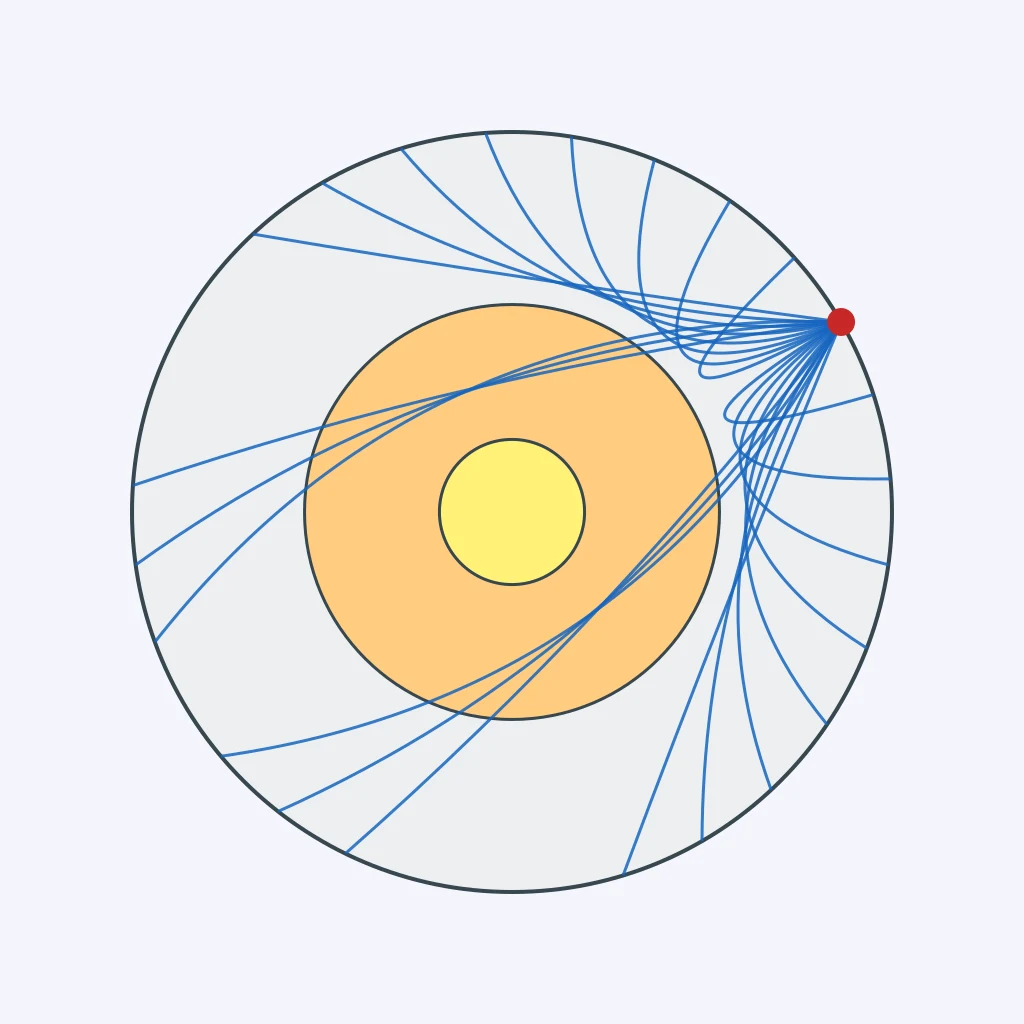
Stations between 103 and 142 degrees from the epicenter record no direct P waves, and no station beyond 103 degrees records S waves at all. What does this pattern show?
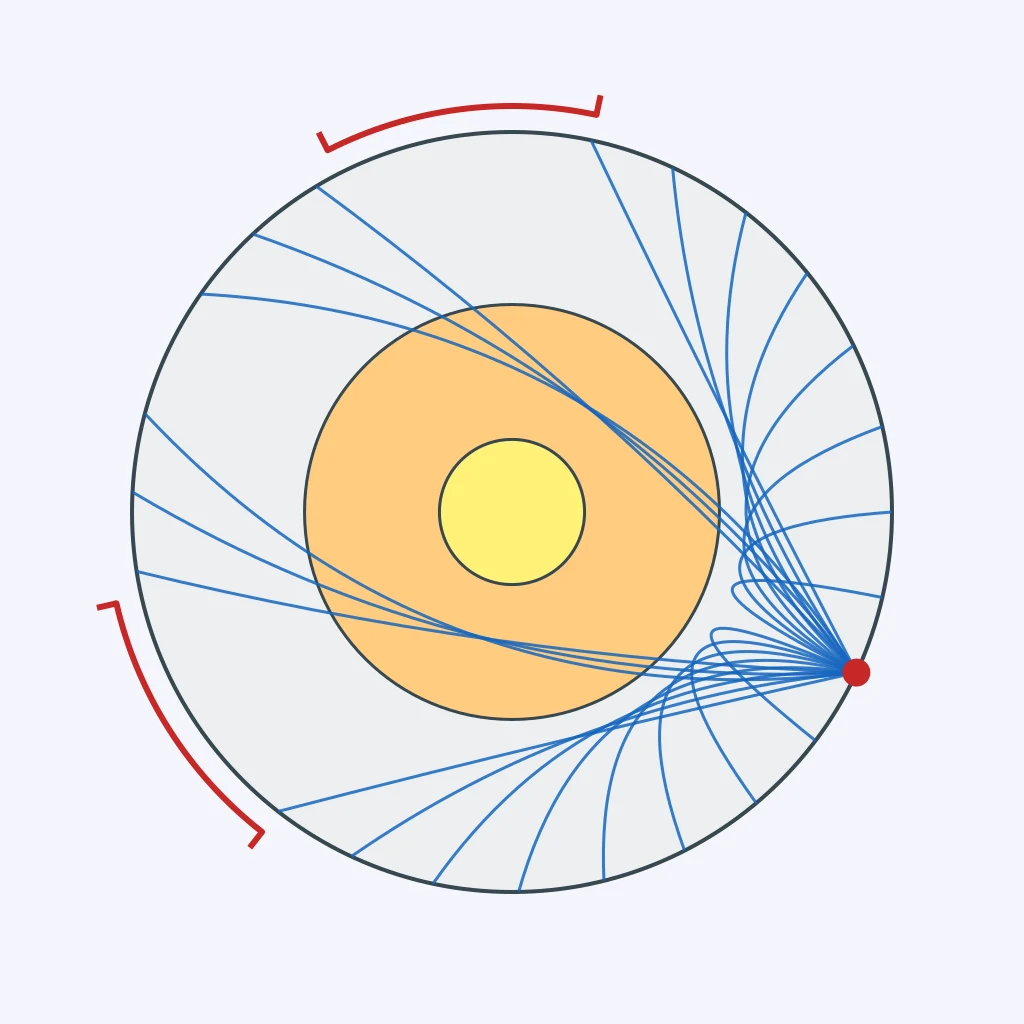
In the diagram, layer D is Earth's innermost layer. Seismic evidence shows P waves travel faster through layer D than through the liquid layer just outside it. What does this tell you about layer D?
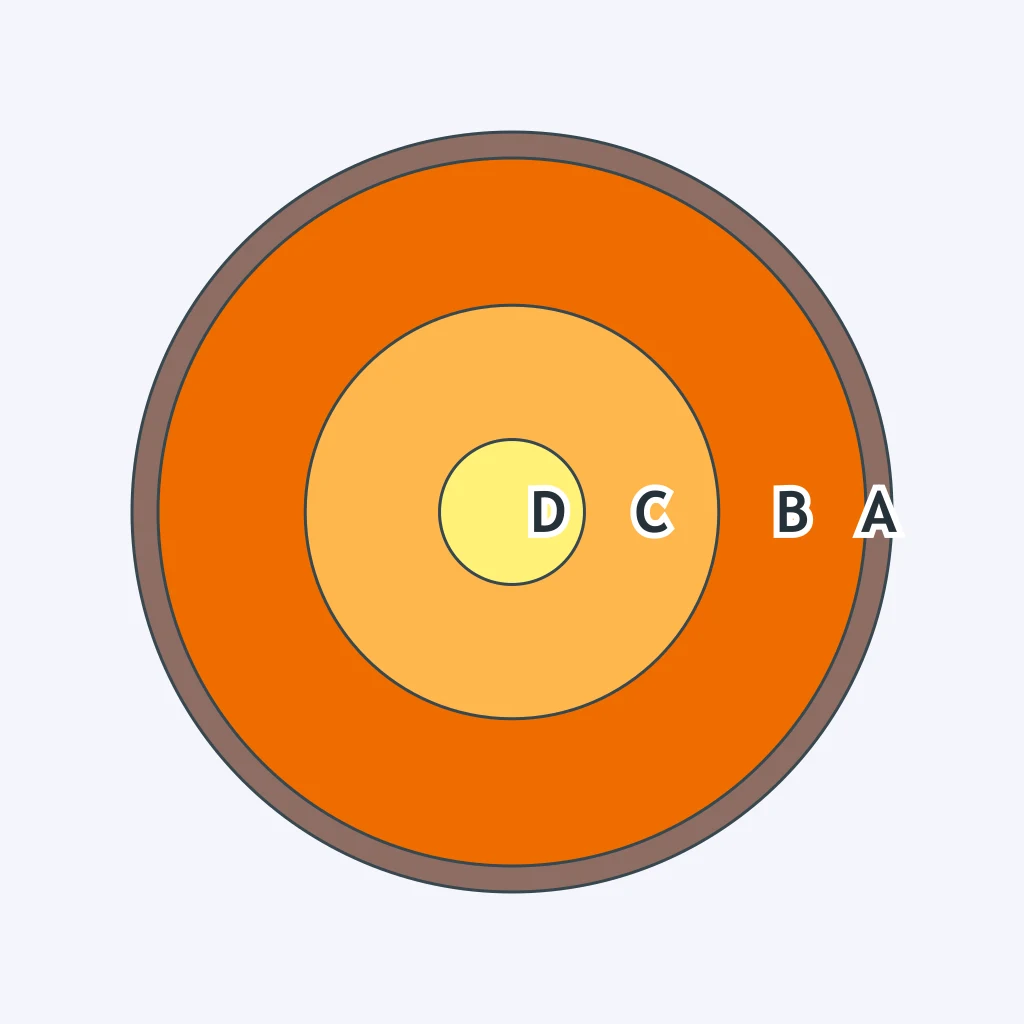
In the diagram, no S waves are ever recorded on the far side of layer C, even though S waves travel easily through layer B just above it. What must be true of layer C?
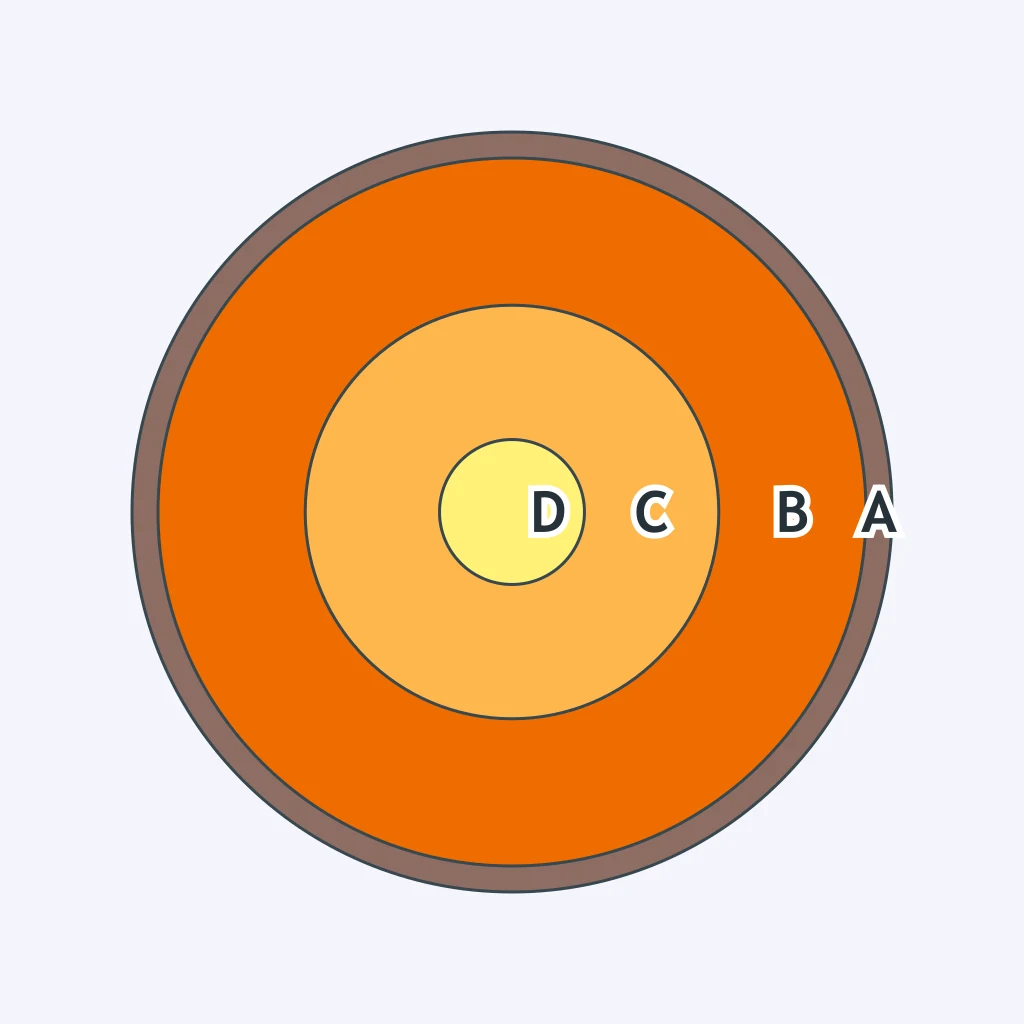
P wave ray paths curve gradually as they travel deeper into the mantle rather than traveling in straight lines. What does this curvature show about the mantle?
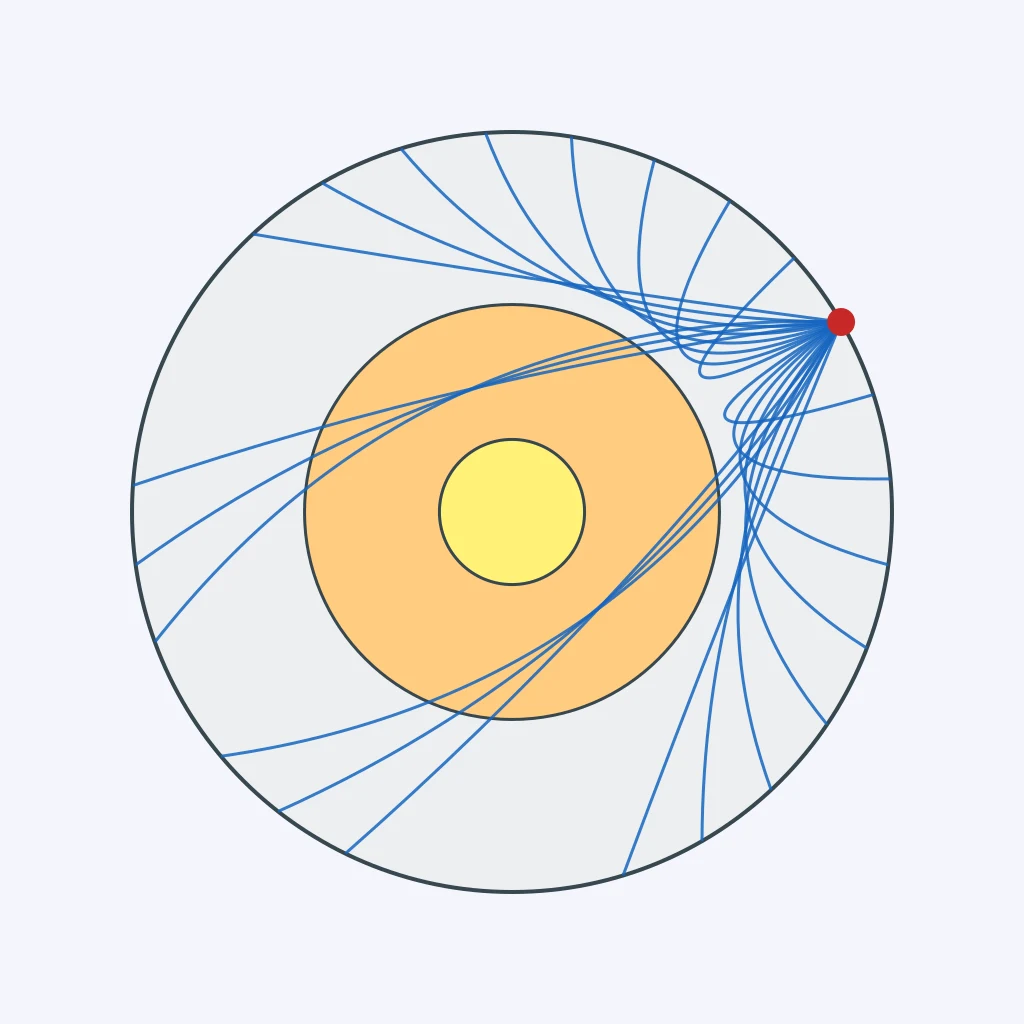
P waves bend sharply all at once where they cross from the mantle into the outer core, rather than curving gradually. What does this abrupt bend show?
Andrija Mohorovicic noticed that P waves suddenly sped up at a certain depth beneath the crust. What did he conclude this sudden speed increase marked?
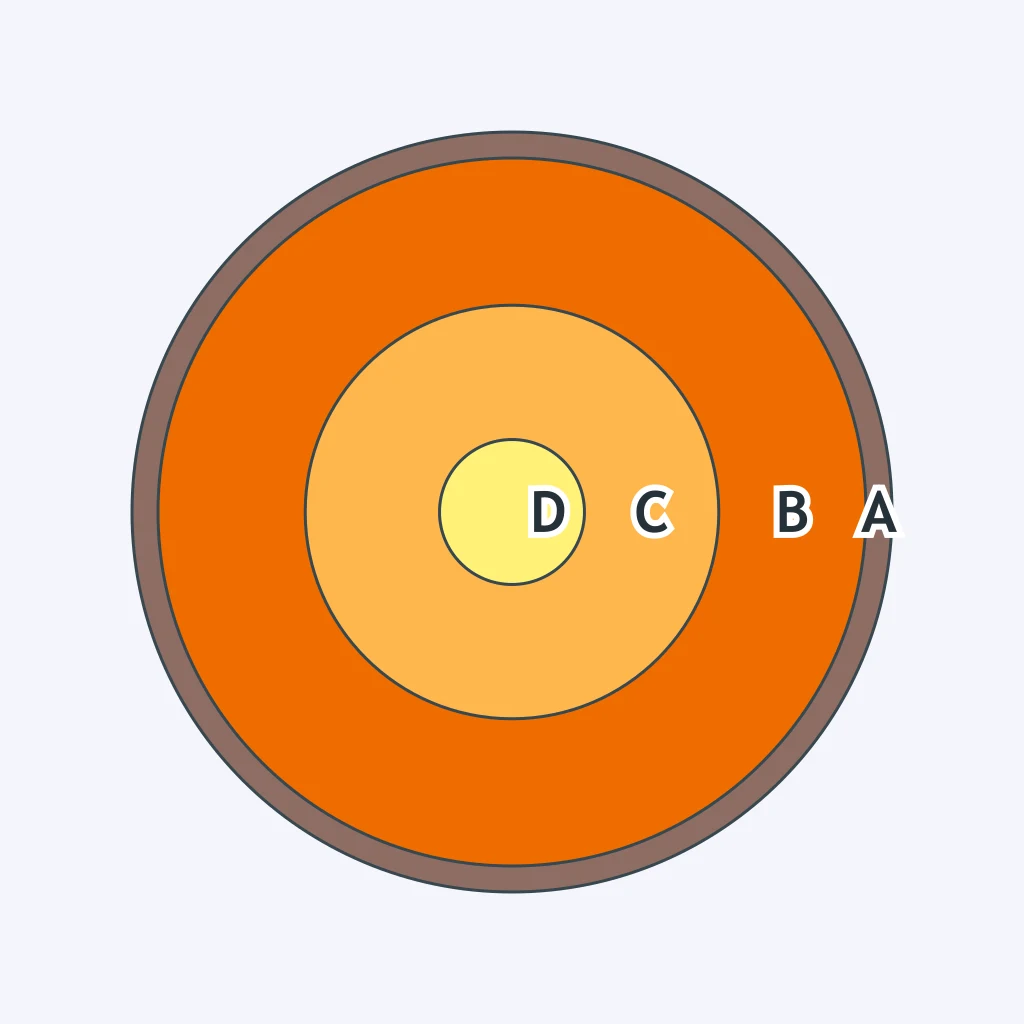
In 1936, Inge Lehmann analyzed seismic data and found faint P waves arriving inside the outer core's shadow zone, where the simple liquid-core model predicted none. What did she conclude this showed?
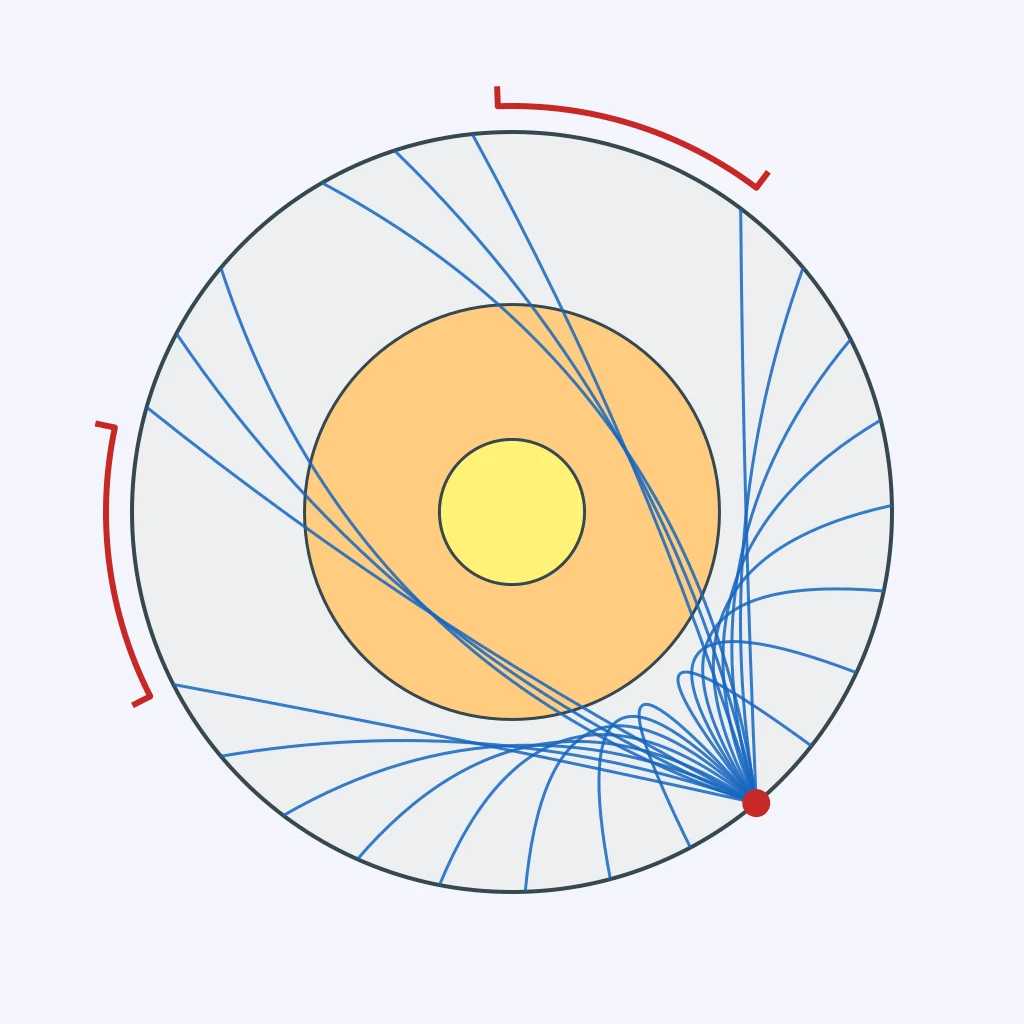
A station is located only 60 degrees from an earthquake's epicenter, well inside the shadow zone boundary of 103 degrees. Which waves should that station record?
A P wave travels 1,800 km through the crust in 300 seconds. What is its average speed?
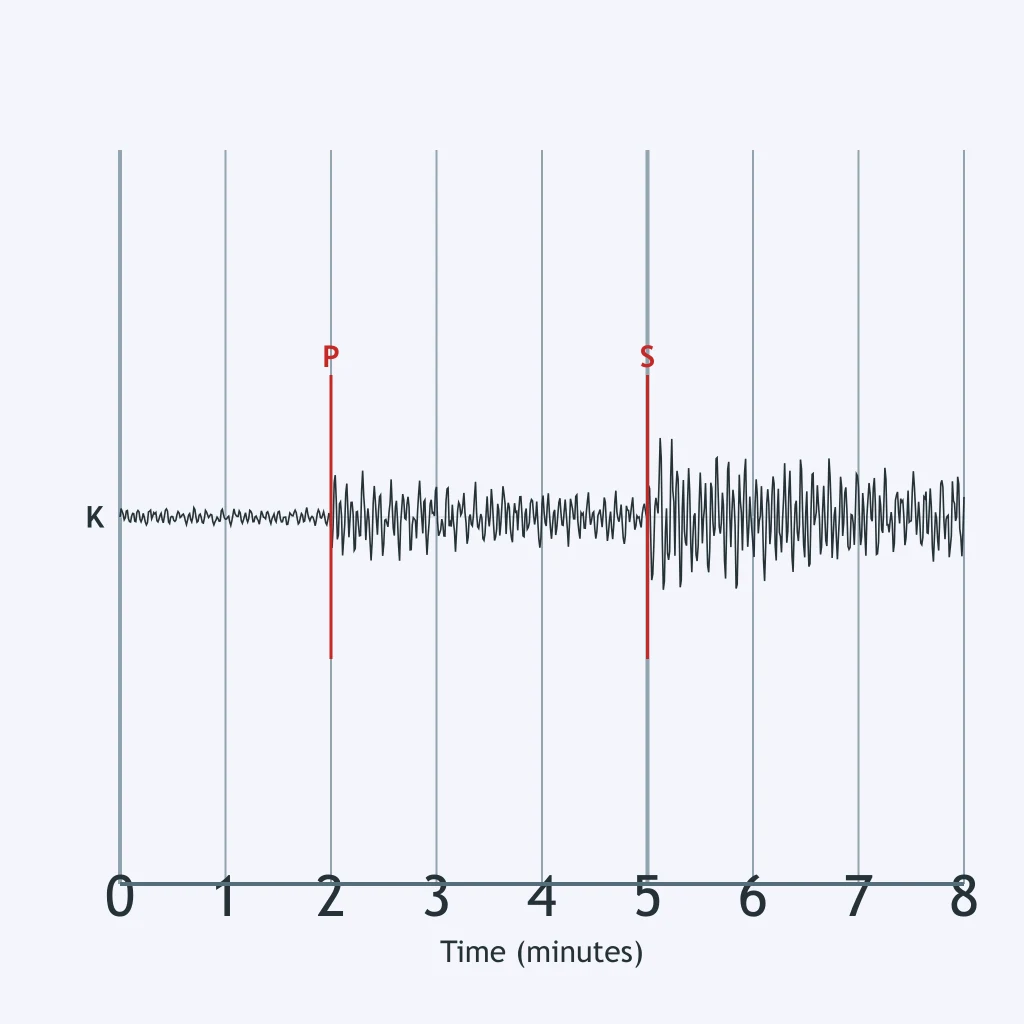
The seismogram record begins at the moment the earthquake occurred. If the station is 900 km from the epicenter, what is the S wave's average speed?
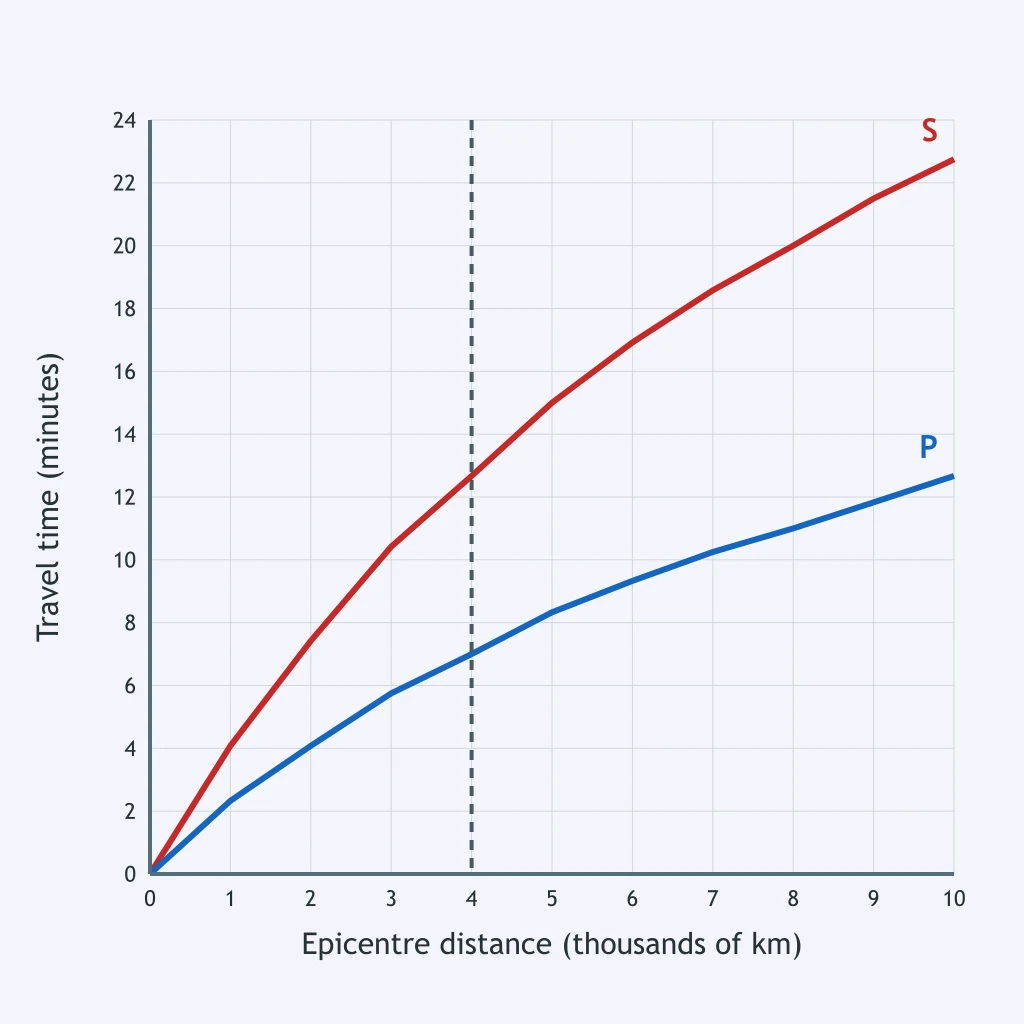
Use the travel-time graph. What is the P-S time lag at a station 4,000 km from the epicenter?
An S wave travels 660 km through the mantle in 200 seconds. What is its average speed?
Read the P-S lag from the seismogram. If the epicenter distance in kilometers is approximately 8 times the lag in seconds, how far is the station from the epicenter?
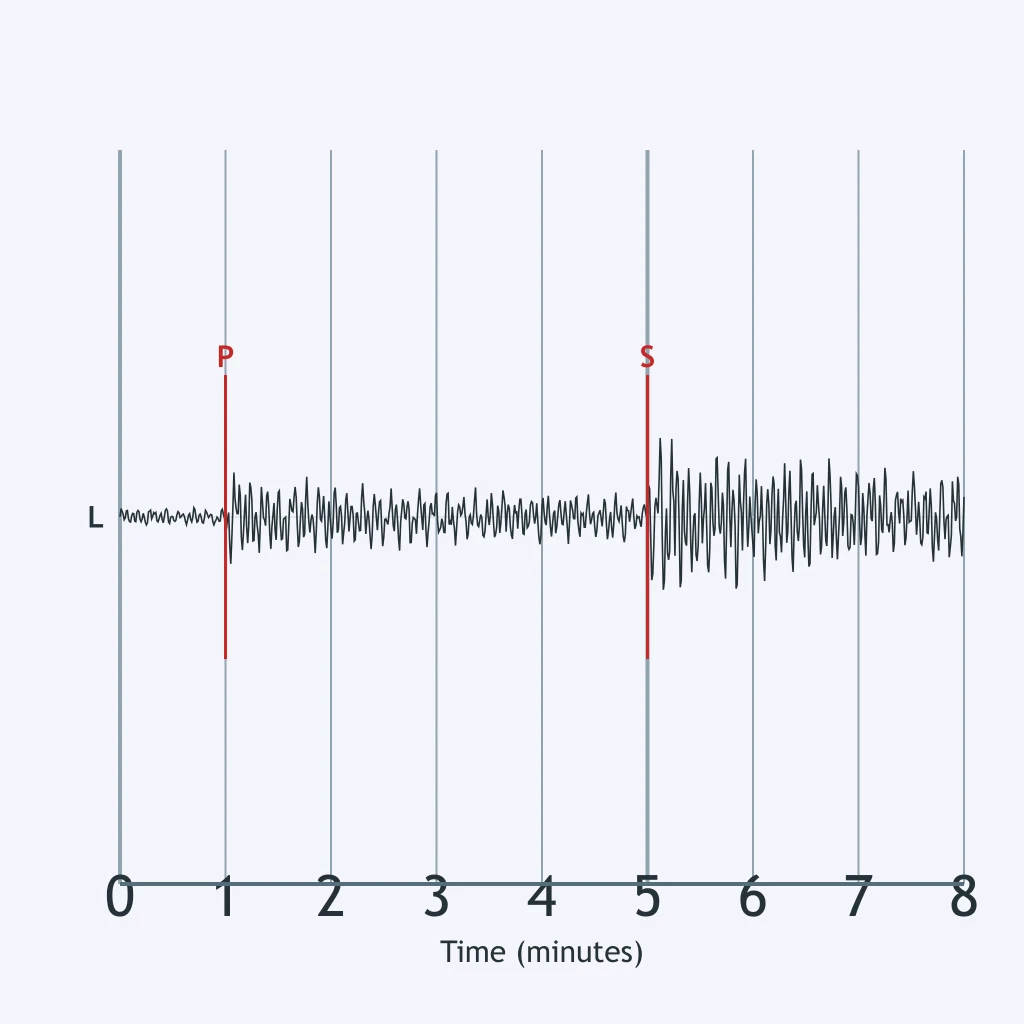
Use the travel-time graph. What is the P wave's average speed from the epicenter to a station 2,000 km away?
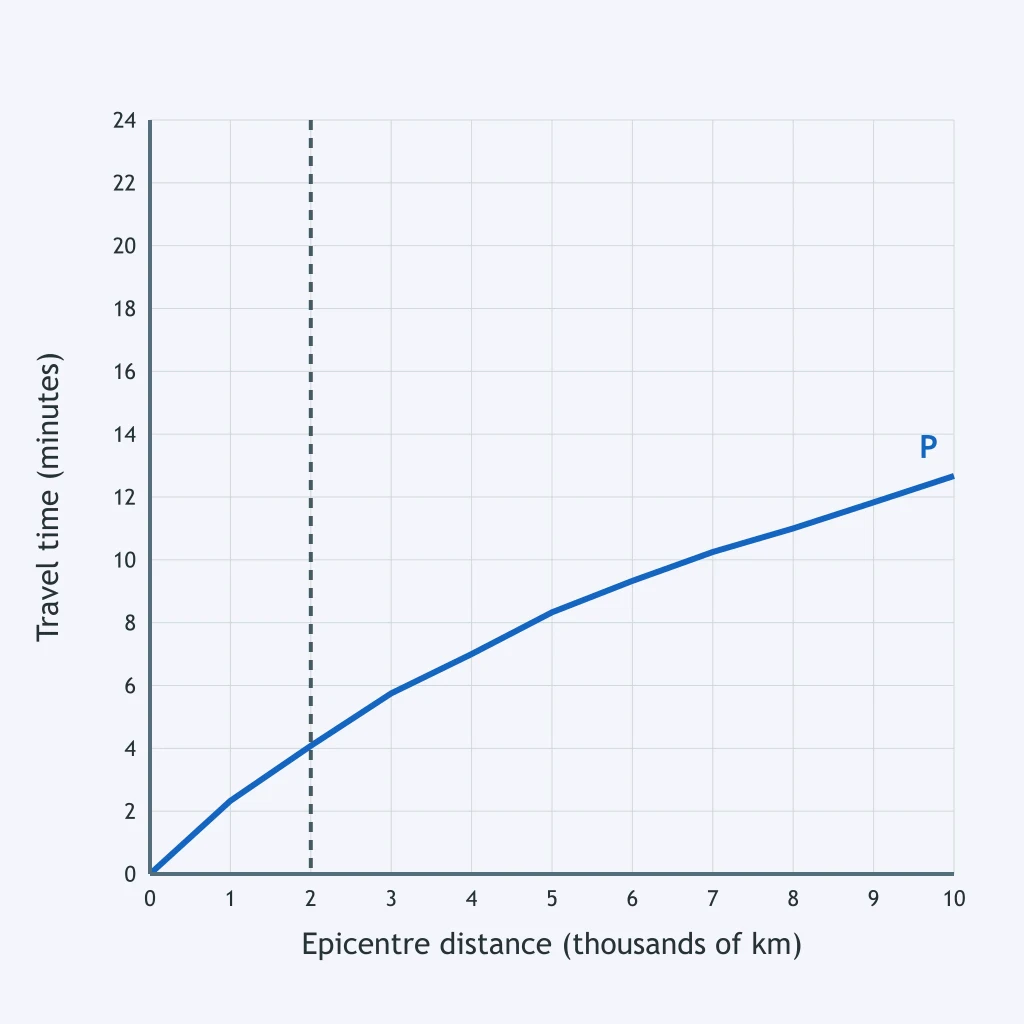
A P wave travels at an average speed of 8 km/s through the lower mantle. How long does it take to cover 2,000 km?
Crack the passcode before the zombies get in.
Answer, then swat bugs for bonus points.
Race through questions at your own speed.
Same question on every screen. Fastest wins.

Pick a tile, answer, hit bonuses and steals.
Earthquake Magnitude and Damage
25 questions