Loading
by BlastRoom
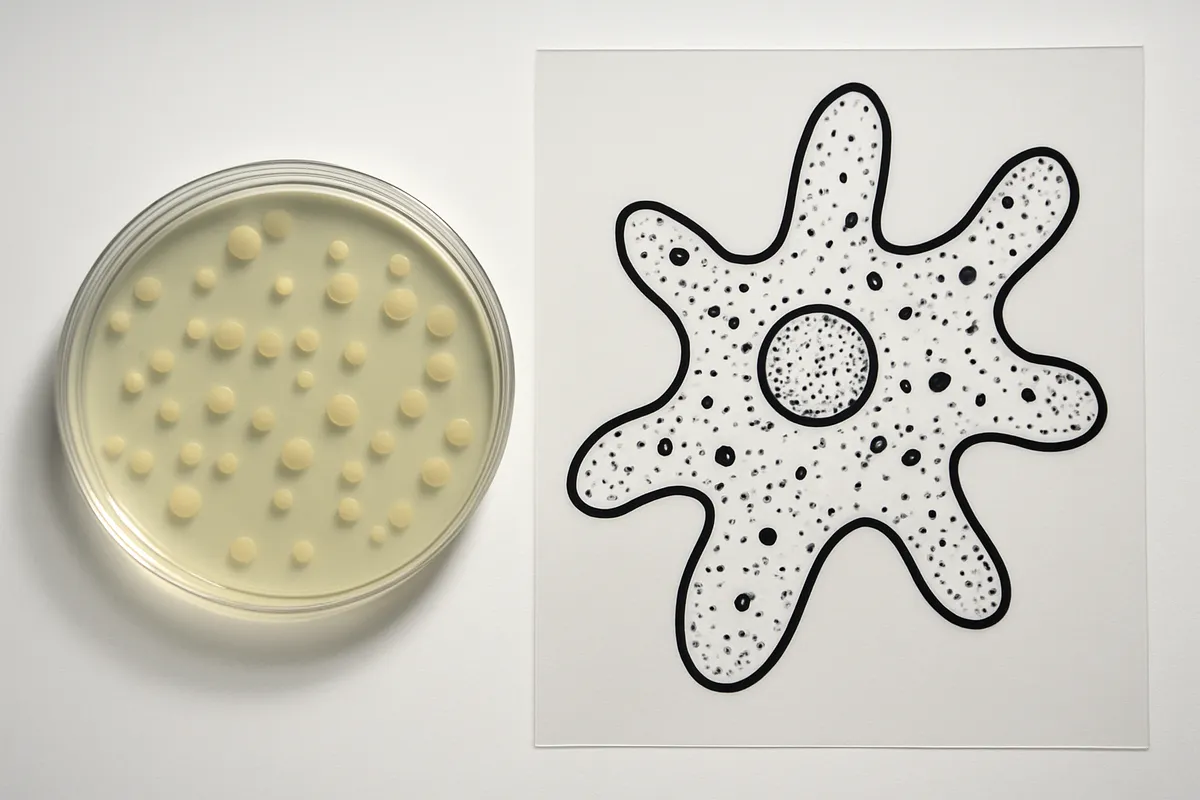
Sort described cells by nucleus and membrane-bound organelles, and compare the two cell types by complexity.
#biology
20 questions
One question set, multiple game modes. Tap any game to see it in action. Not sure which to pick?
Answer to place stones and capture territory.
Outrun the snow together.
Earn blasts, then hunt the other team.
Answer to earn energy, then climb.

The class blasts through walls together.
Bid on mystery lots. Most money wins.
Sell tours. Nice, standard, or a total scam.

Answer, restock, and serve the rush.
More correct answers pulls the rope your way.
Answer, then shoot down the alien wave.
Answer, then tap to leap the frozen ridge.
A cell is 1.5 micrometers long. Its DNA is a single circular molecule lying free in the cytoplasm, and its only internal structures are ribosomes. How is this cell classified, and why?
A cell is 45 micrometers across. Its DNA sits inside a compartment bounded by a double membrane, and its cytoplasm holds mitochondria and endoplasmic reticulum. Which type of cell is it, and what settles it?
A cell from pond water is about 70 micrometers wide. It has a nucleus, green disc-shaped organelles, a large central vacuole and a cellulose wall. Which conclusion about this cell is correct?
A cell taken from a hot spring is 1 micrometer long. It has a wall, a whip-like flagellum and ribosomes, and it carries one circular chromosome with no membrane around it. Which classification and reason fit?
Under a microscope a student sees a cell about 60 micrometers wide containing a dense round nucleus, several mitochondria and a network of internal membranes. How should the cell be recorded in the lab notebook?
Cell X is 3 micrometers long with its DNA in the cytoplasm and no internal membranes. Cell Y is 30 micrometers wide with a nucleus, a Golgi apparatus and lysosomes. Which statement classifies both correctly?
Which structure is found in eukaryotic cells but never in prokaryotic cells?
Which description fits the genetic material of a prokaryotic cell but not that of a eukaryotic cell?
A chemical destroys every membrane inside a cell but leaves the outer cell membrane intact. Which kind of cell would keep working almost normally, and why?
Where does a prokaryotic cell carry out the energy-releasing reactions that a eukaryotic cell runs inside mitochondria?
Every organelle found in a eukaryotic cell is also found in a prokaryotic cell.
A bacterium and a human liver cell differ greatly in size and internal structure. Which set of features do both nonetheless have?
Which structure assembles proteins in a bacterium and in an onion root cell alike?
Both prokaryotic and eukaryotic cells are surrounded by a cell membrane that controls what enters and leaves.
A eukaryotic cell is many times the diameter of a prokaryotic cell and divides its interior into many membrane-bound compartments. What does that compartmentation make possible?
In a eukaryotic cell the digestive enzymes are sealed inside lysosomes rather than left loose in the cytoplasm. What does this arrangement show about membrane-bound organelles?
A bacterium and a human pancreas cell are compared for structural complexity. Which statement ranks them correctly and gives the right reason?
A biologist lists four groups of organisms: bacteria, archaea, fungi and protists. Which of these groups are made of cells whose DNA is enclosed in a nucleus?
A newly discovered organism is placed in the domain Bacteria. What can be concluded about its cells?
Which list contains only organisms whose cells are eukaryotic?
Crack the passcode before the zombies get in.
Answer, then swat bugs for bonus points.
Race through questions at your own speed.
Same question on every screen. Fastest wins.

Pick a tile, answer, hit bonuses and steals.
The Cell Membrane
20 questions