Loading
by BlastRoom
The three statements of the cell theory and the instruments, experiments and observers behind them.
#biology
20 questions
One question set, multiple game modes. Tap any game to see it in action. Not sure which to pick?
Answer to place stones and capture territory.
Outrun the snow together.
Earn blasts, then hunt the other team.
Answer to earn energy, then climb.

The class blasts through walls together.
Bid on mystery lots. Most money wins.
Sell tours. Nice, standard, or a total scam.

Answer, restock, and serve the rush.
More correct answers pulls the rope your way.
Answer, then shoot down the alien wave.
Answer, then tap to leap the frozen ridge.
A single paramecium in pond water takes in food, expels wastes, moves with its cilia and divides, all on its own and without any other cell. Which statement of the cell theory does this observation support?
A biology class examines onion skin, a moss leaf, frog blood and a drop of pond water, and finds every one of the samples built of small bounded units. Which statement of the cell theory do these observations support?
A time-lapse recording of one bacterium in warm broth shows it lengthen and split into two, then those two split again, until the drop is crowded with bacteria. Which statement of the cell theory does the recording support?
Nerve cells, muscle cells and skin cells look nothing alike, yet each is bounded by a membrane, holds cytoplasm and organelles, and carries out its own metabolism. Which statement of the cell theory does this best illustrate?
After part of a liver is removed in surgery, the organ regrows because the liver cells left behind enlarge and divide; no new cells appear out of the blood plasma. Which statement of the cell theory does this support?
A Dutch draper ground tiny glass beads into single-lens microscopes and, looking at scrapings from his own teeth and at drops of pond water, described tiny moving 'animalcules'. Who made these observations?
After examining tissue from many different plants, this botanist concluded in 1838 that every part of a plant is built of cells. Who was he?
A zoologist studying cartilage and other animal tissues found them built of units like the ones a botanist colleague had just described in plants, and in 1839 extended the claim to animals. Who was he?
Working on diseased tissue, this physician rejected the idea that cells condense out of a formless fluid and argued instead that every cell comes from another cell. Who was he?
Boiled broth in flasks whose long necks curved downward and trapped dust stayed clear for months; tipping the flask so the broth washed into the neck and ran back brought growth within days. Who ran this experiment?
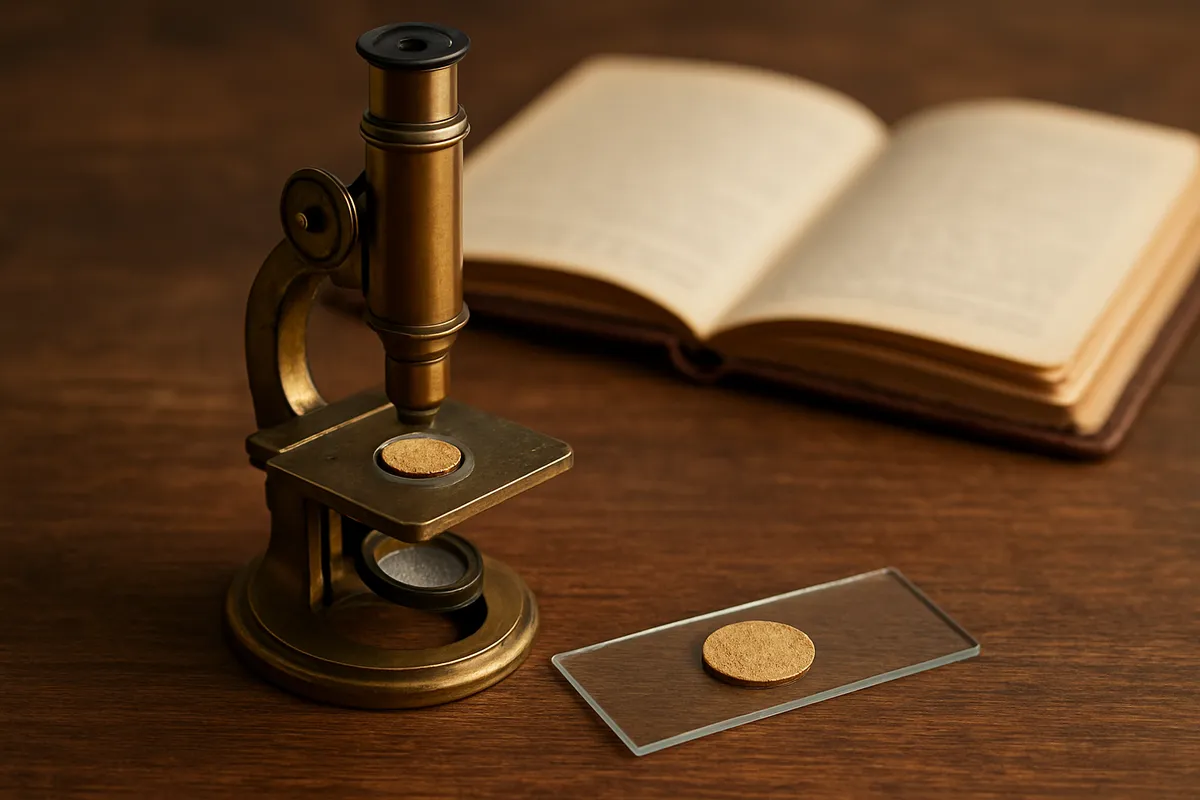
Hooke saw little on a smooth cut surface of cork. He then sliced off a very thin piece, set it on a black plate, and lit it from above. What did the thin slice make possible?
Leeuwenhoek's microscopes used a single small, almost spherical lens and reached magnifications several times higher than the compound microscopes of his day. What did that extra magnification let him see?
Most structures inside a cell are nearly transparent, so early workers saw very little contrast. Applying colored dyes to a prepared specimen changed that. What did staining make possible?
A light microscope cannot separate two points closer than about 200 nanometers. The electron microscope, which forms its image with beams of electrons instead of light, does far better. Which discovery did it make possible?
Pasteur boiled his broth and then drew the flask's neck out into a long curve rather than sealing the flask, so air could still reach the broth but dust could not. What did that design make possible?
Hooke's cork slices showed rows of empty box-like compartments with firm walls. What did that observation establish, and what did it not?
A student boils broth, seals the flask, finds it still clear a month later, and concludes that life never arises from non-living matter. What is the strongest weakness of that evidence?
Schleiden and Schwann also claimed that new cells crystallize out of a formless nutrient fluid, an idea later abandoned. What does that show about the cell theory as they left it?
A student examines onion skin, an elodea leaf and moss cells, and concludes that every cell is enclosed by a rigid wall. What is the strongest limitation of her evidence?
A virus is not built of cells and can copy itself only inside a host cell. Does that overturn the cell theory?
Crack the passcode before the zombies get in.
Answer, then swat bugs for bonus points.
Race through questions at your own speed.
Same question on every screen. Fastest wins.

Pick a tile, answer, hit bonuses and steals.
Identify the Organelle
40 questions