Loading
by BlastRoom
Practice half-life calculations, parent-daughter ratios, isotope choice, and decay-rate reasoning.
#earth_space_science
50 questions
One question set, multiple game modes. Tap any game to see it in action. Not sure which to pick?
Answer to place stones and capture territory.
Outrun the snow together.
Earn blasts, then hunt the other team.
Answer to earn energy, then climb.

The class blasts through walls together.
Bid on mystery lots. Most money wins.
Sell tours. Nice, standard, or a total scam.

Answer, restock, and serve the rush.
More correct answers pulls the rope your way.
Answer, then shoot down the alien wave.
Answer, then tap to leap the frozen ridge.
Use the half-life table. A mineral dated with potassium-40 has 25% of its original parent isotope left. What age does that mineral record?
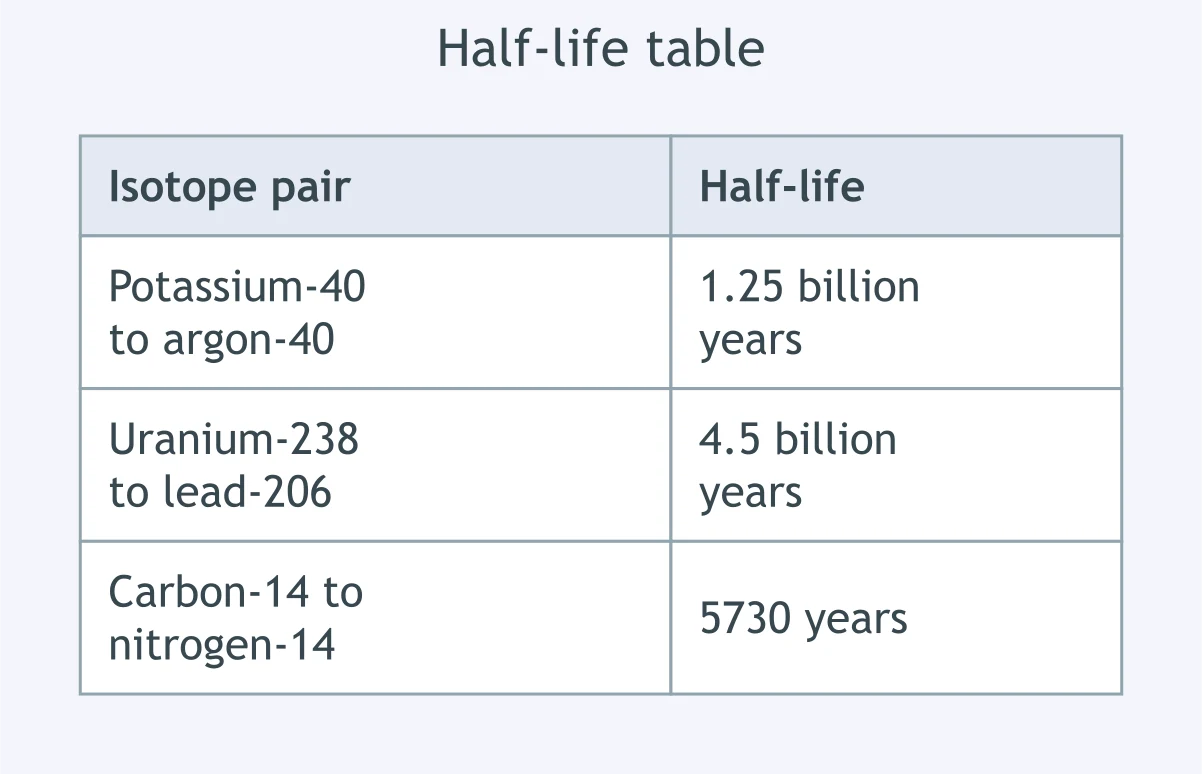
Use the half-life table. A zircon dated with uranium-238 has 50% of its parent isotope remaining. How old is the zircon?
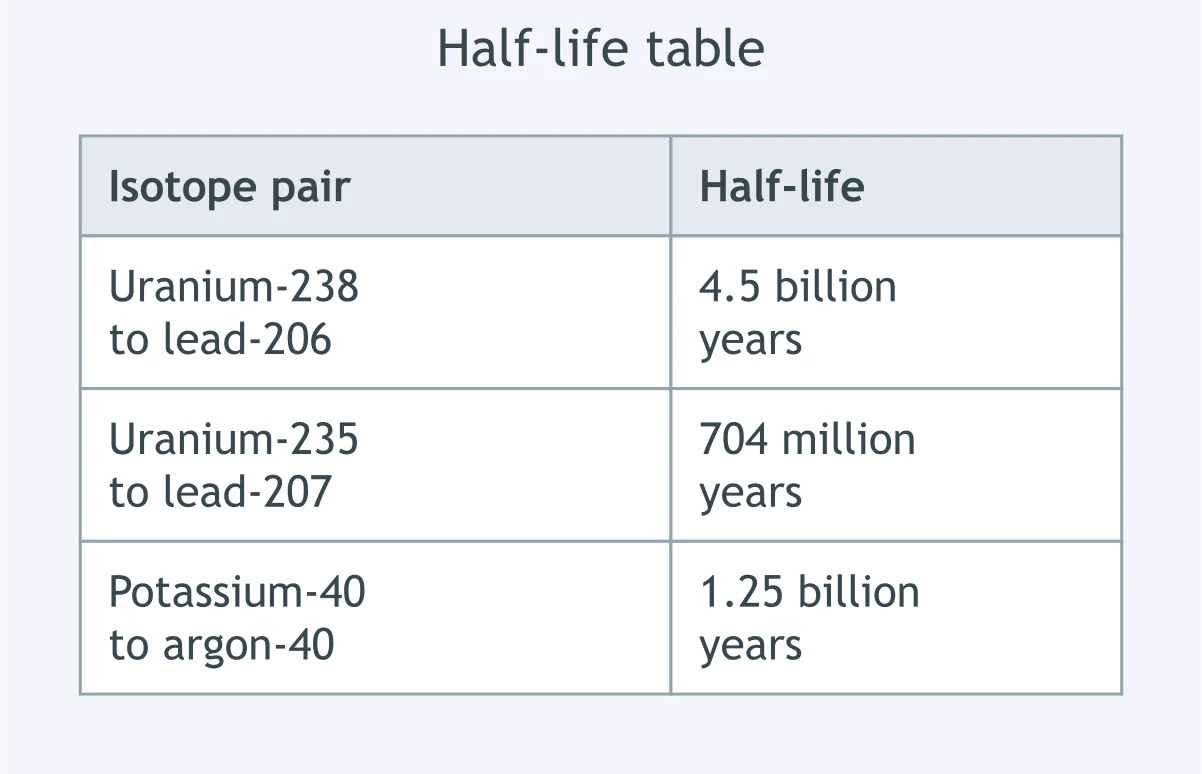
Use the half-life table. A charcoal sample has 25% of its original carbon-14 left. What age should be calculated for the sample?
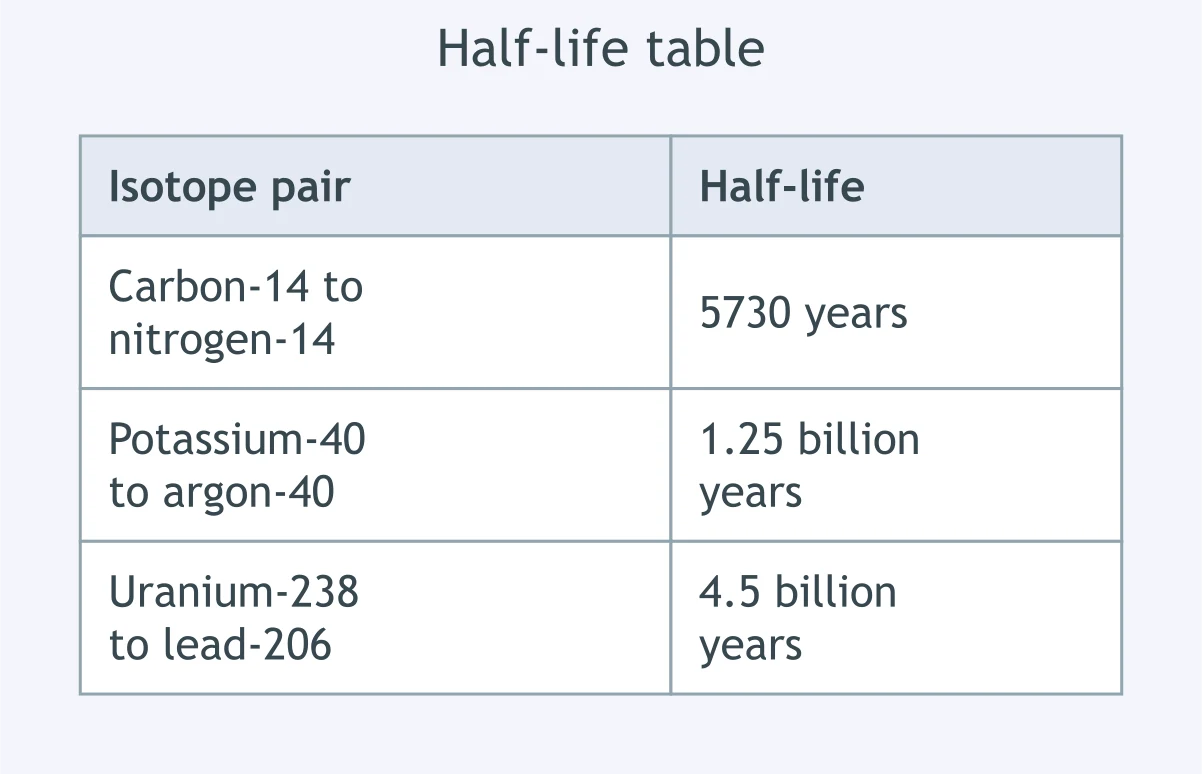
Use the half-life table. A mineral dated with uranium-235 has 12.5% of its parent isotope remaining. What age does this represent?
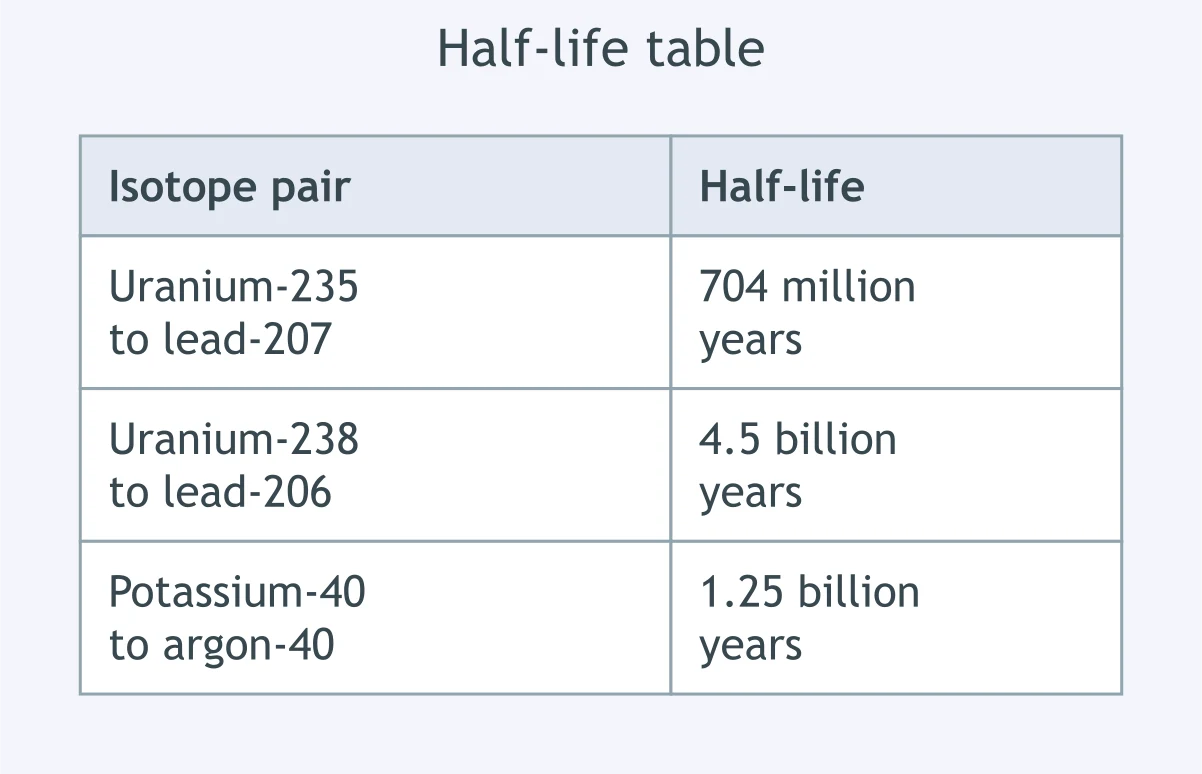
Use the half-life table. A basalt mineral has 12.5% of its original potassium-40 remaining. What age is indicated?
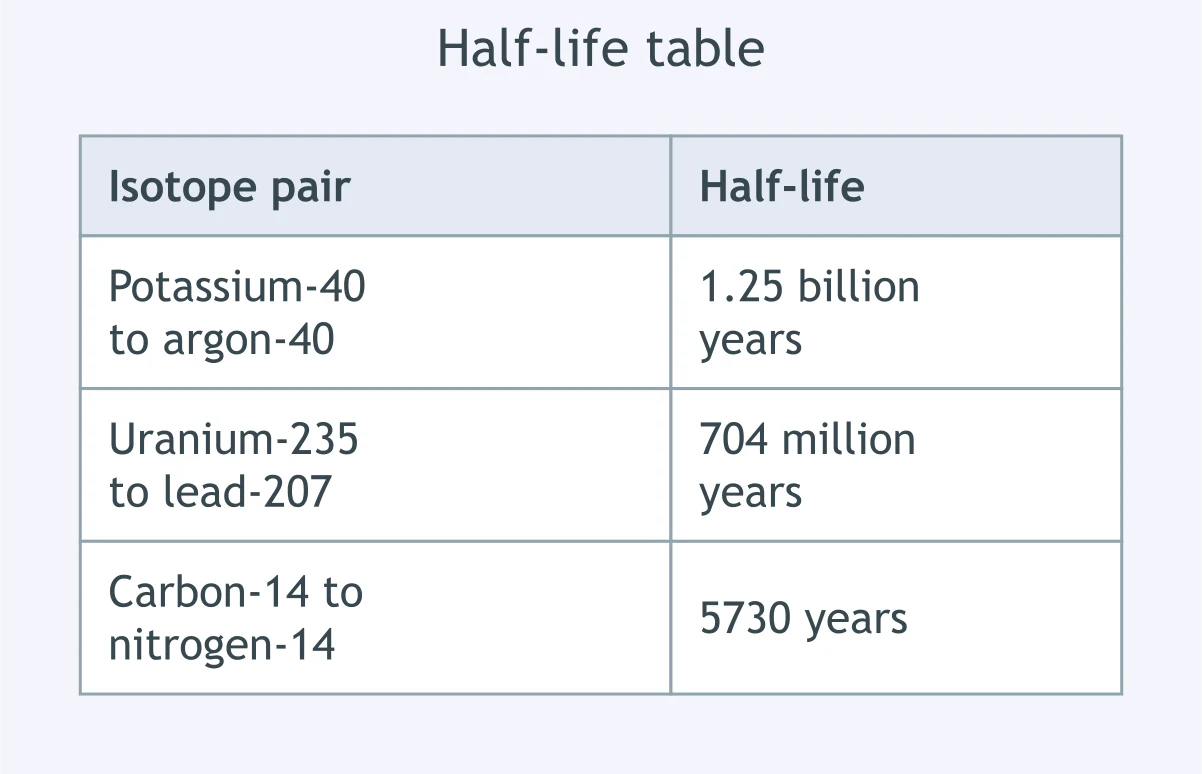
Use the half-life table. A uranium-235 mineral retains 25% of its parent isotope. How much time has passed since the clock started?
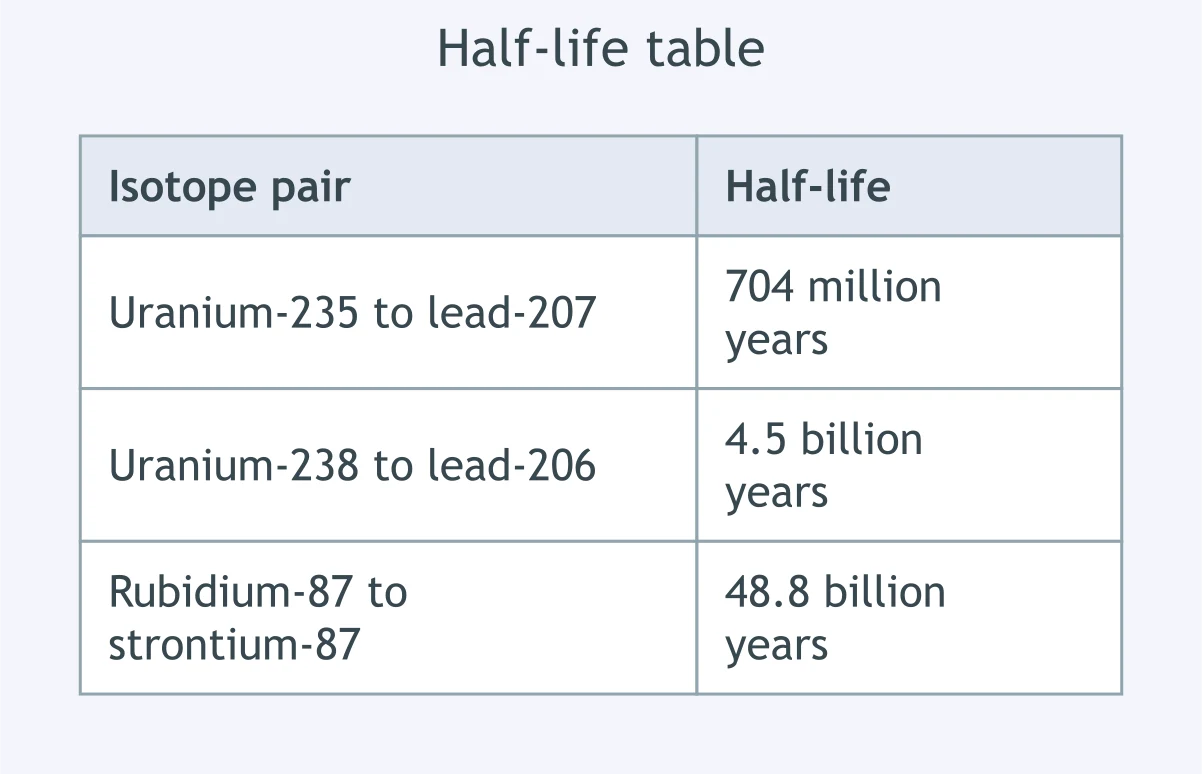
Use the half-life table. A bone sample has 12.5% of its original carbon-14. What radiocarbon age does that fraction give?
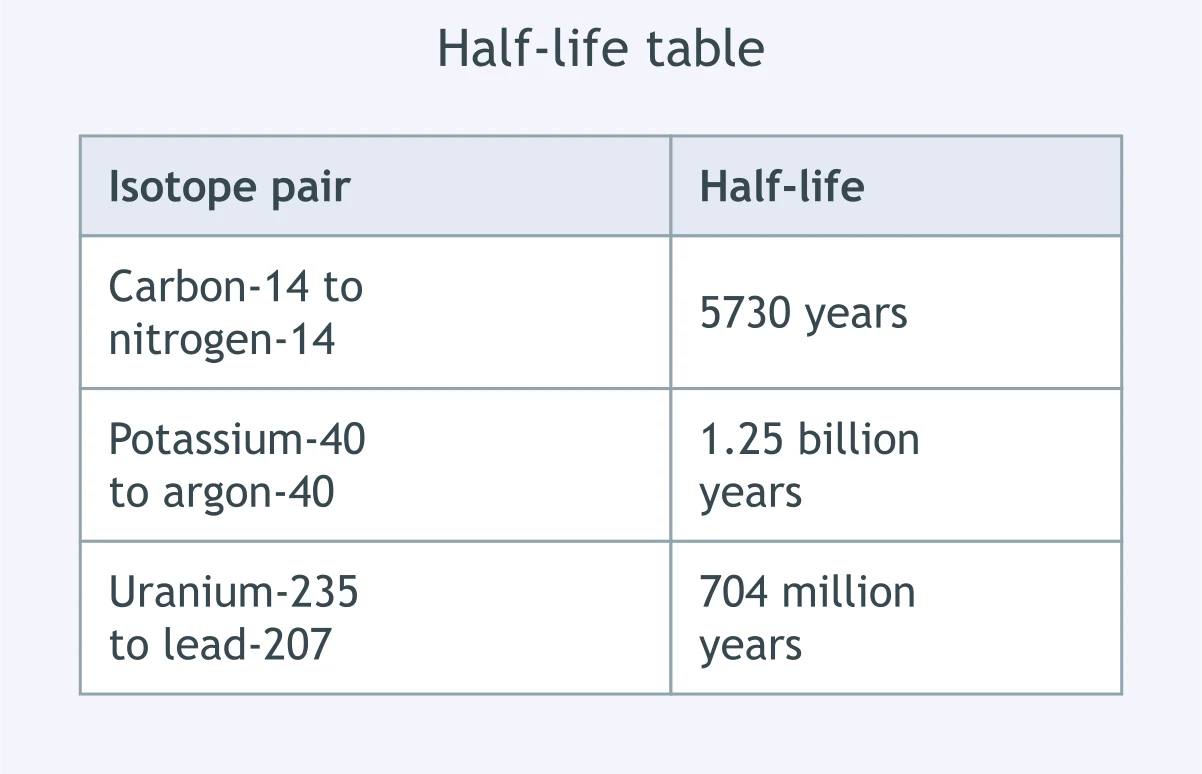
Use the half-life table. Isotope X in a closed mineral has 6.25% of its parent isotope left. What age should be calculated?
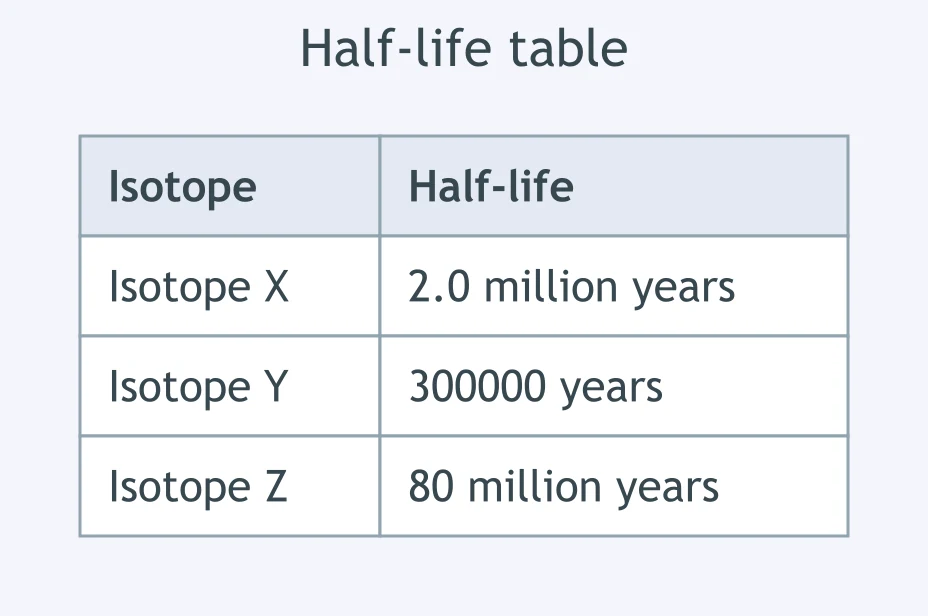
Use the half-life table. Isotope Y has 12.5% of the original parent isotope remaining in a sample. What is the sample age?
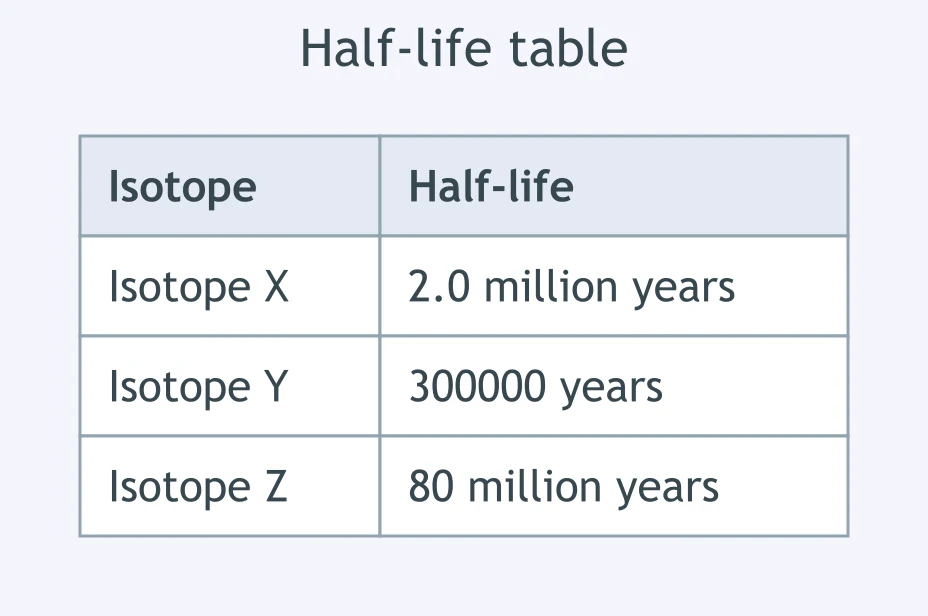
Use the half-life table. Isotope Z in a mineral has 50% of its parent isotope remaining. What age is indicated?
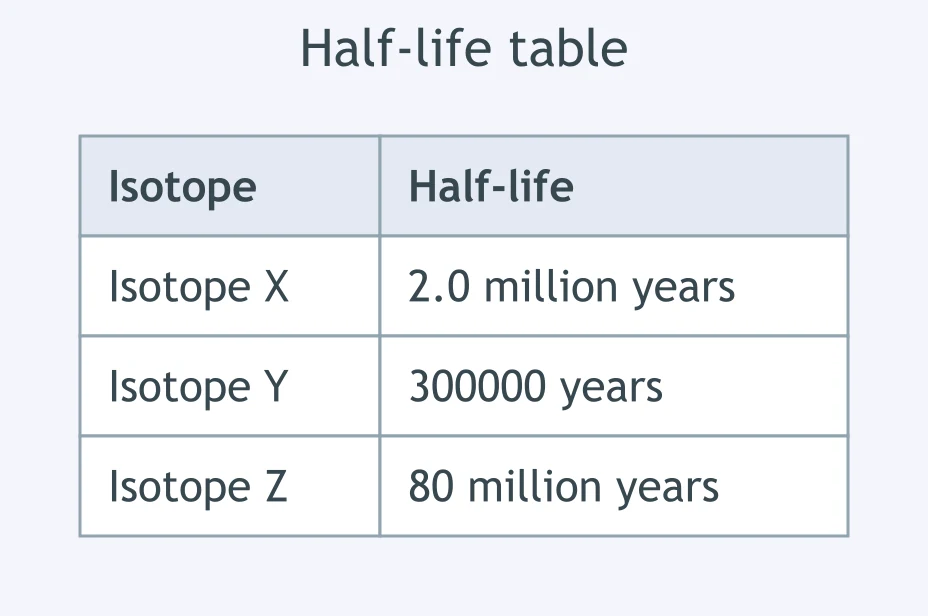
Use the half-life table. Isotope W has 1/32 of its original parent isotope remaining. What age does this fraction represent?
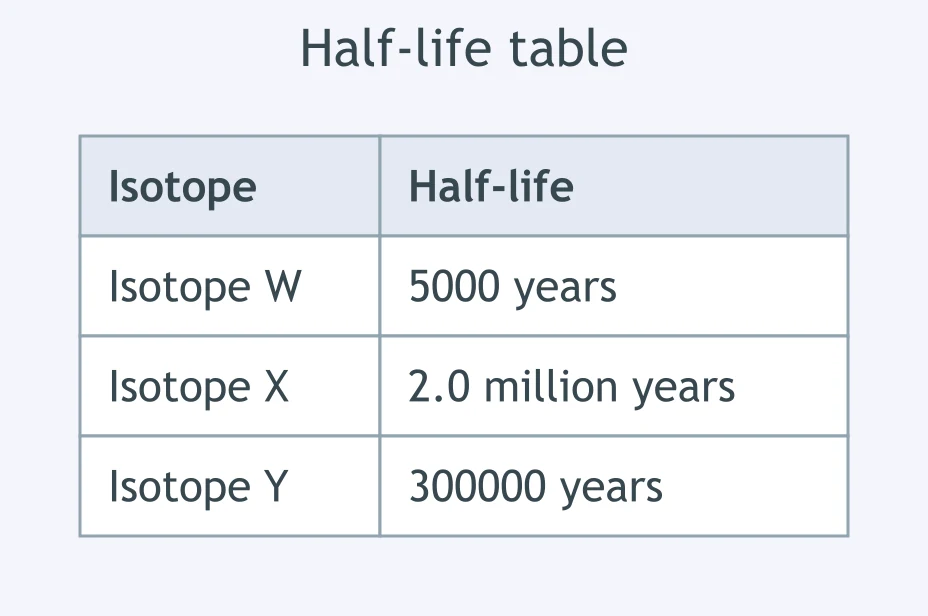
Use the half-life table. A closed mineral contains 25% of isotope Q's original parent atoms. What numerical age should be reported?
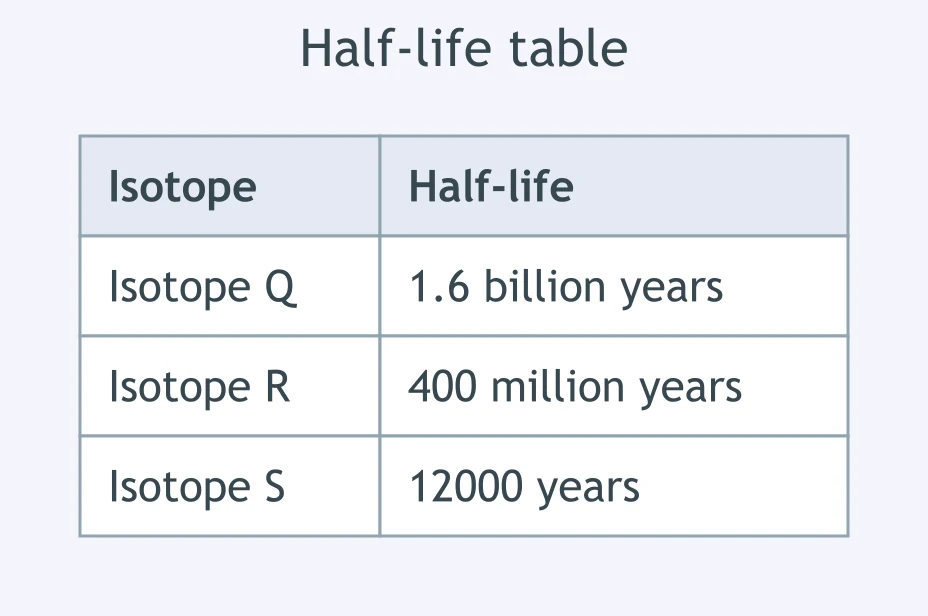
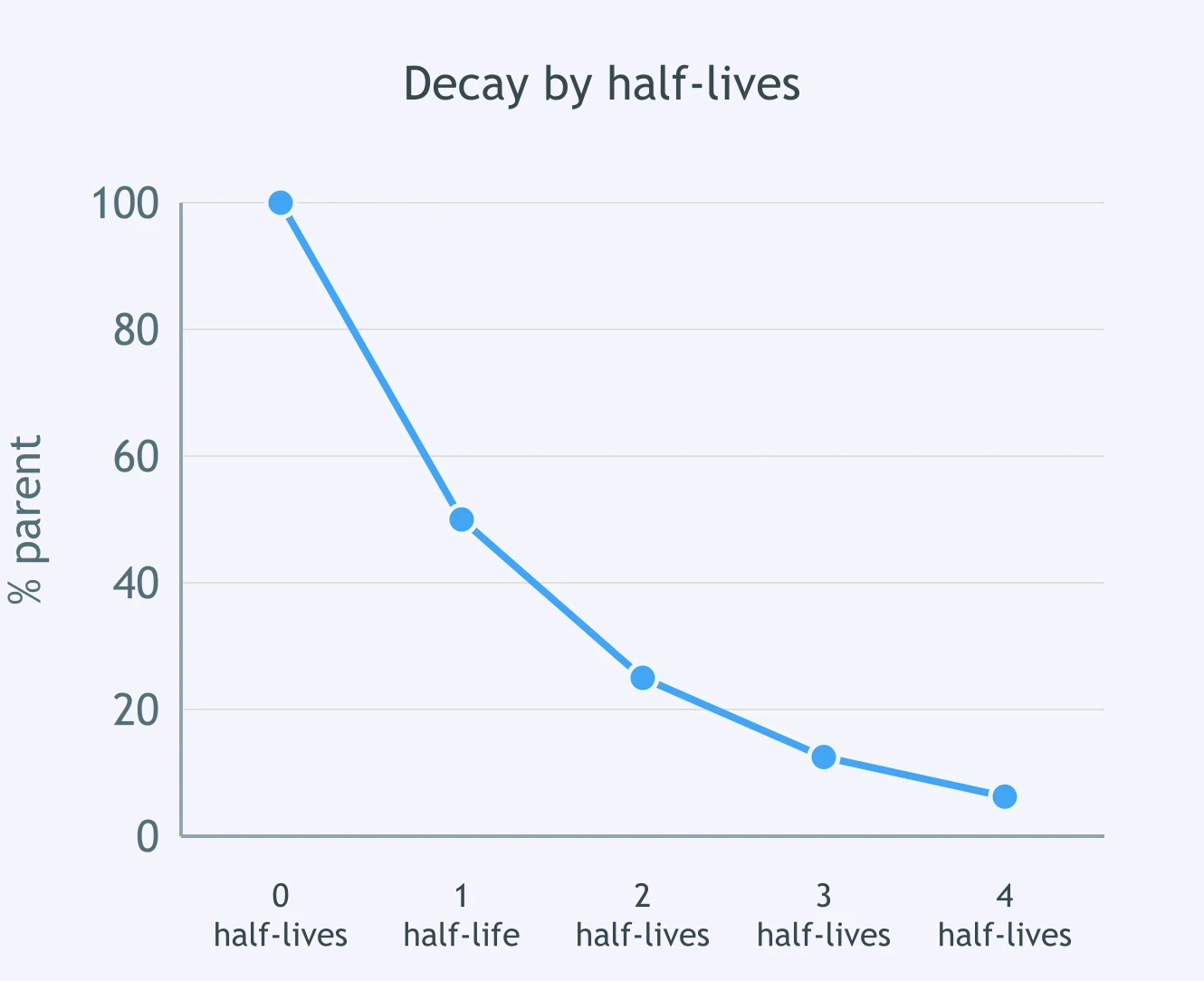
Use the decay curve. At what time has the parent isotope fallen to 50% of its original amount?
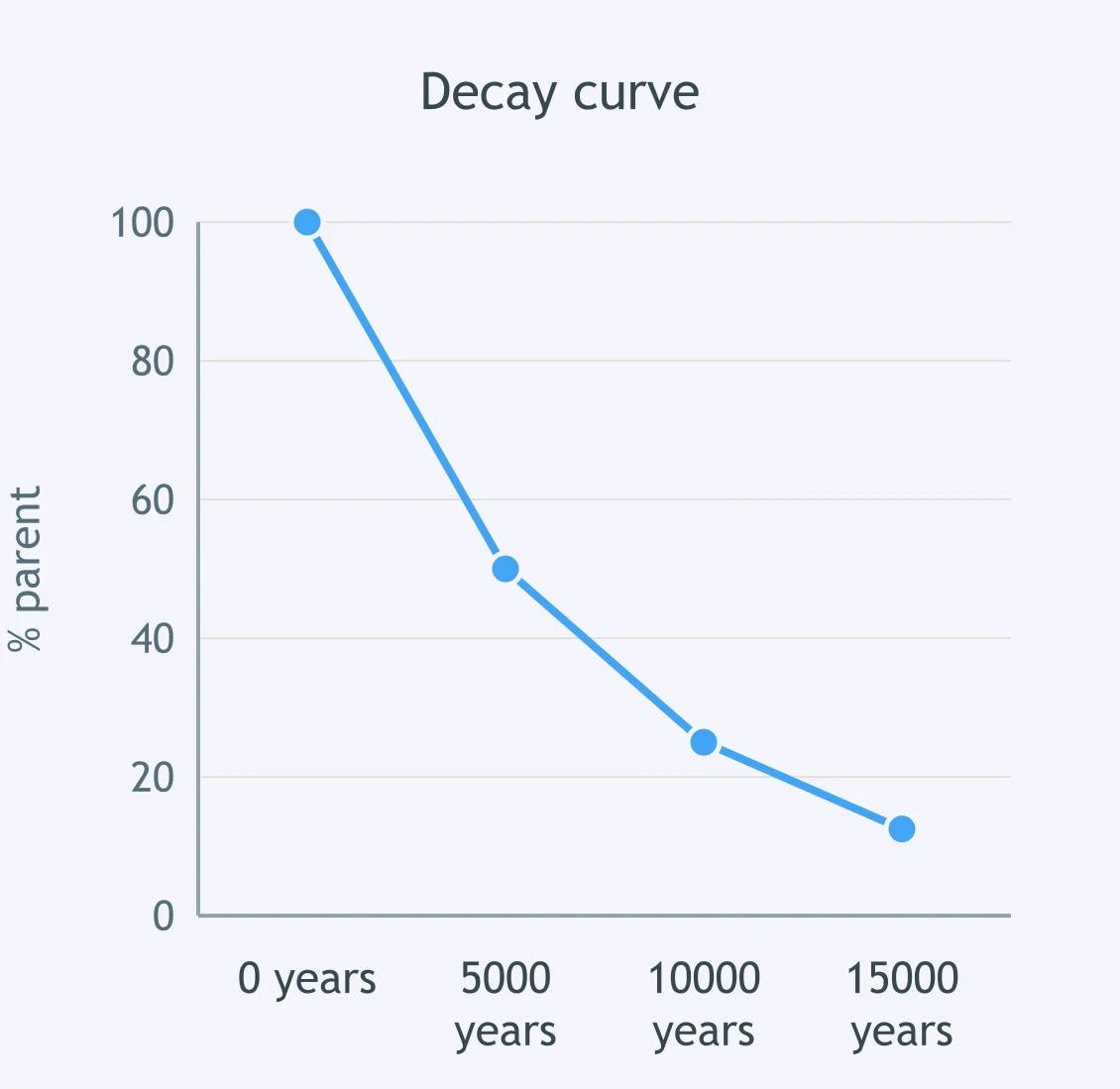
Use the decay curve. What percent of the parent isotope remains after 2 half-lives?
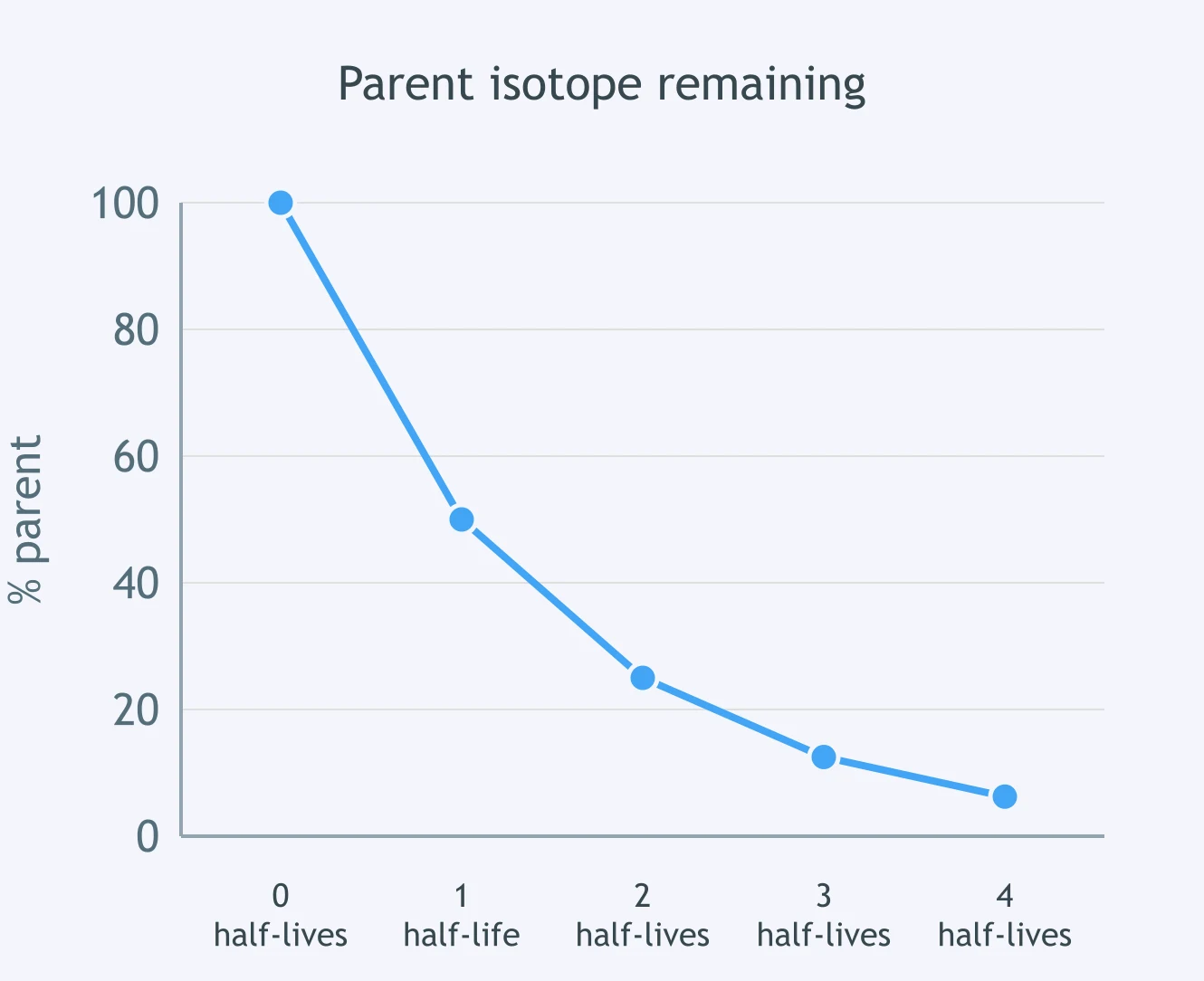
Use the decay curve. The curve reaches 50% parent remaining at one tick on the time axis. What is the isotope's half-life?
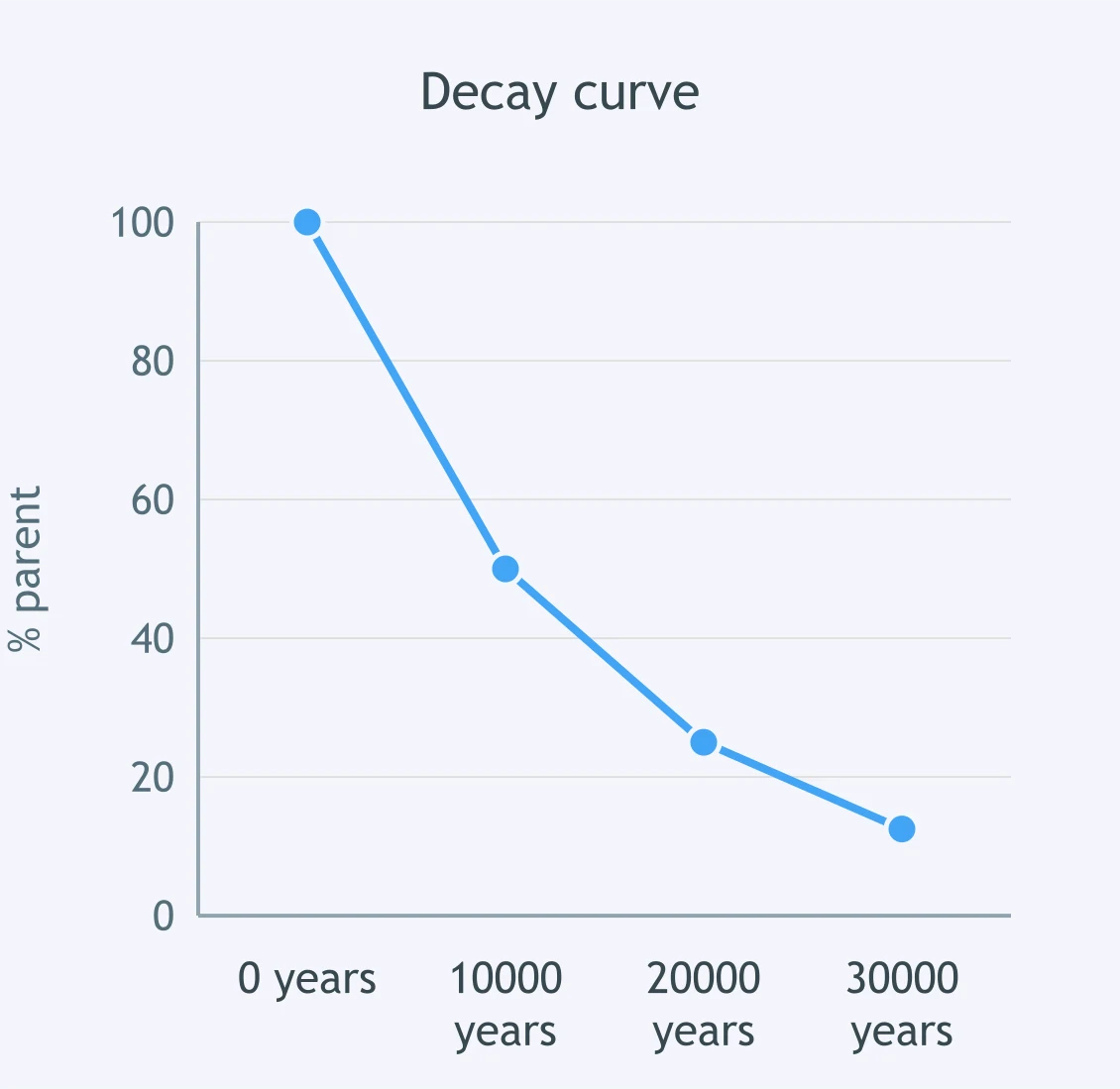
Read the decay curve for isotope M. What parent-isotope percentage remains at 400 million years?
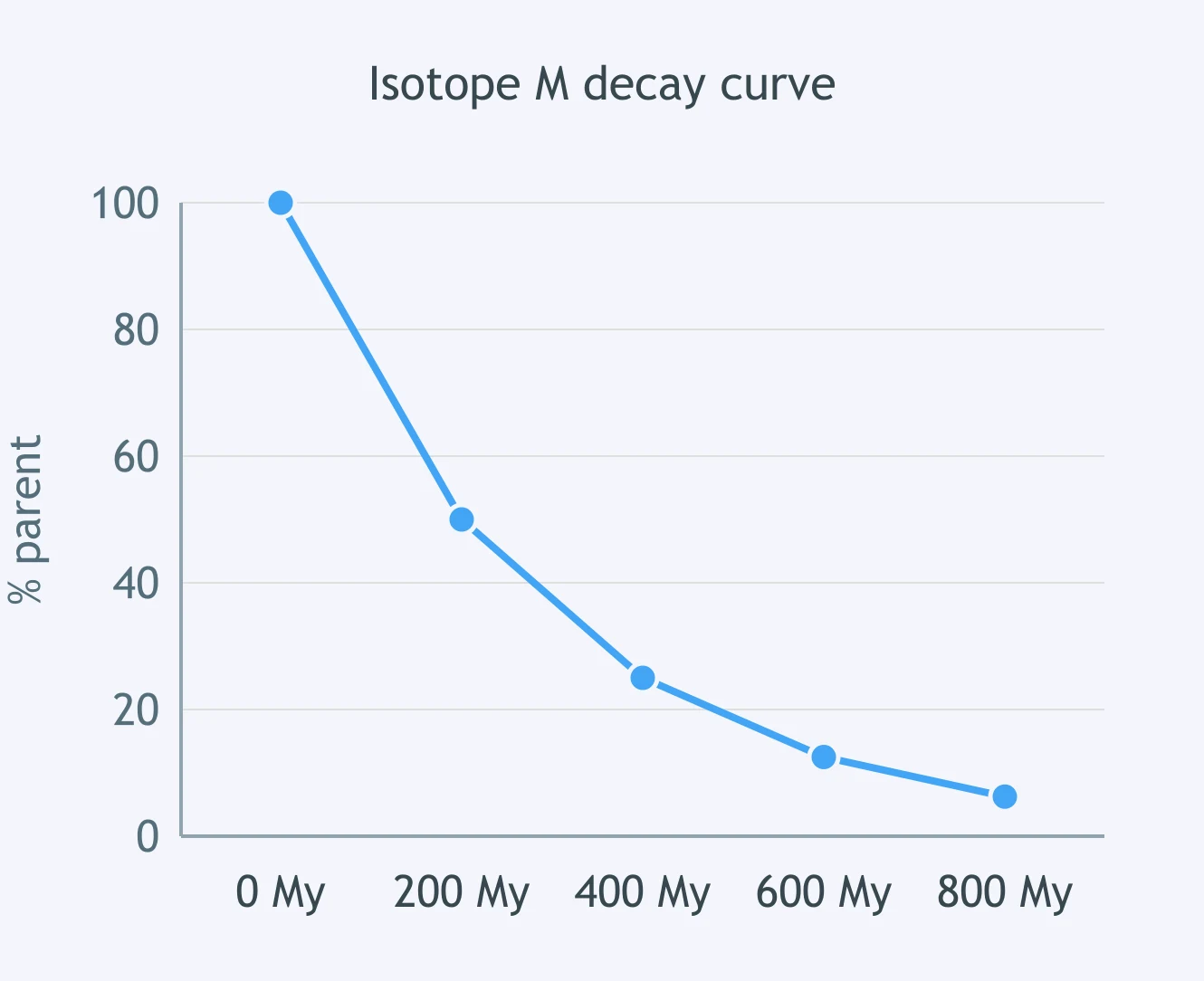
Use the decay curve. At what time does the parent isotope reach 12.5% of the original amount?
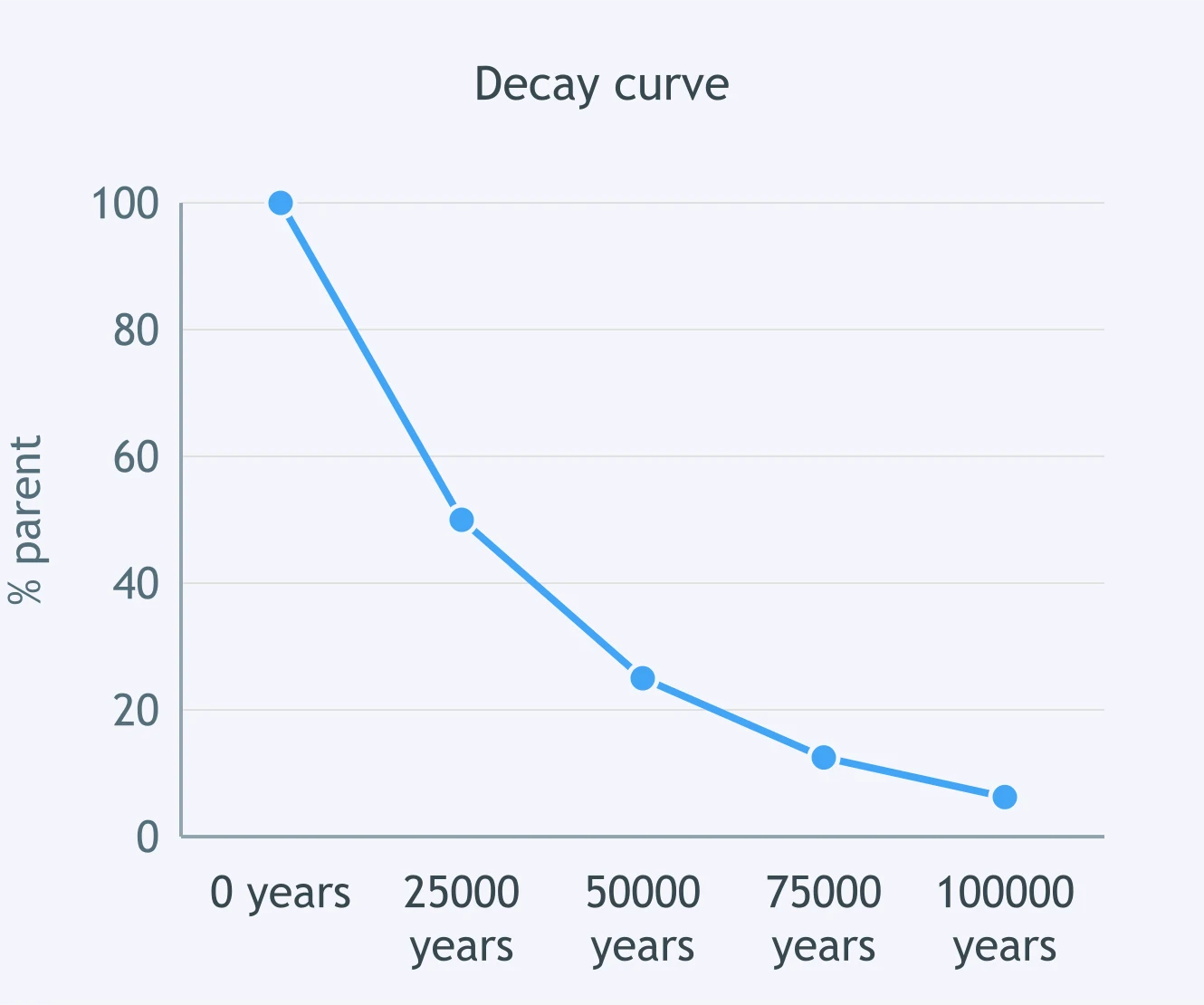
Use the potassium-40 decay curve. What half-life is shown by the first drop to 50% parent remaining?
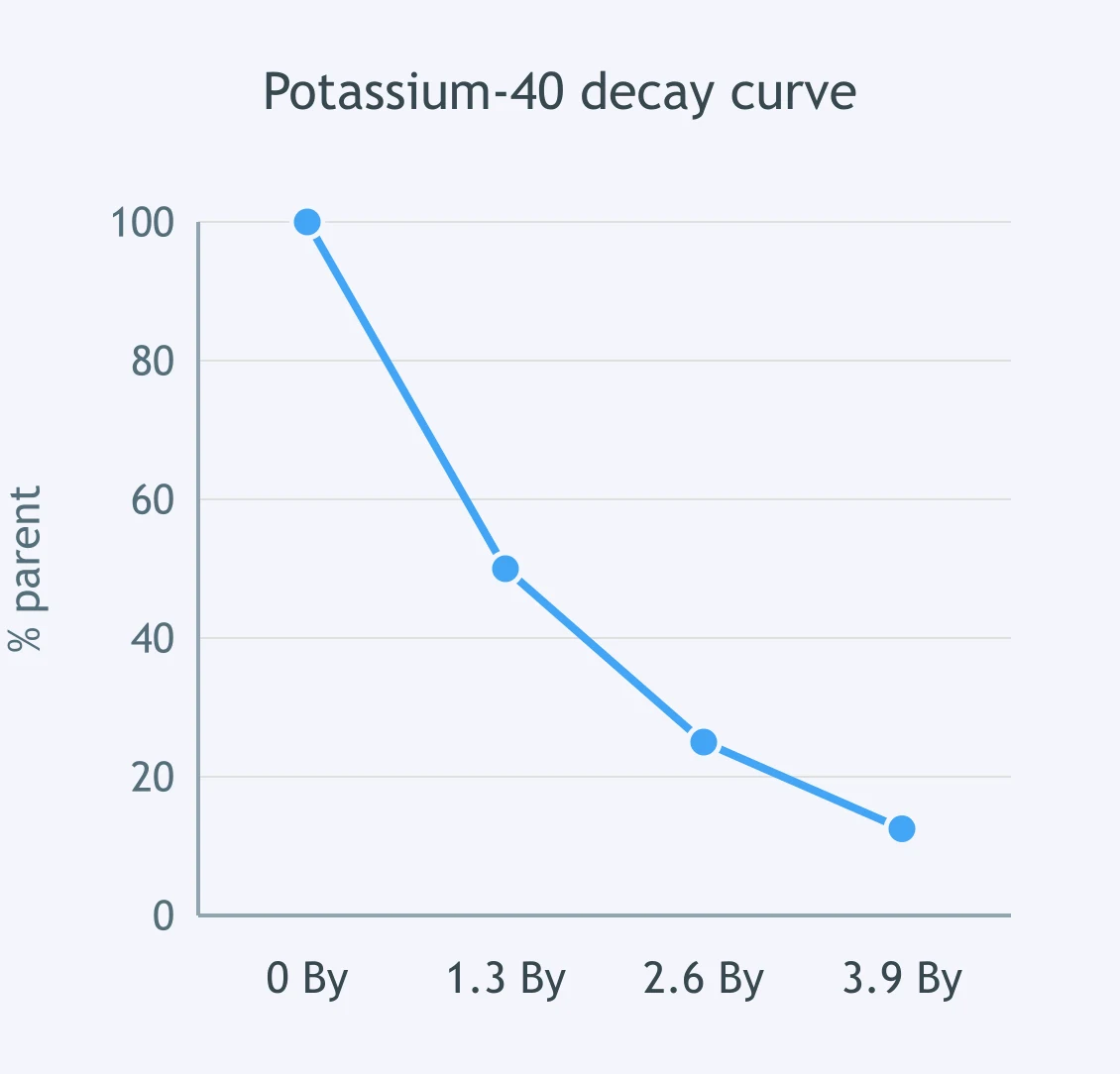
On the isotope N decay curve, what percentage of parent isotope remains at 12 million years?
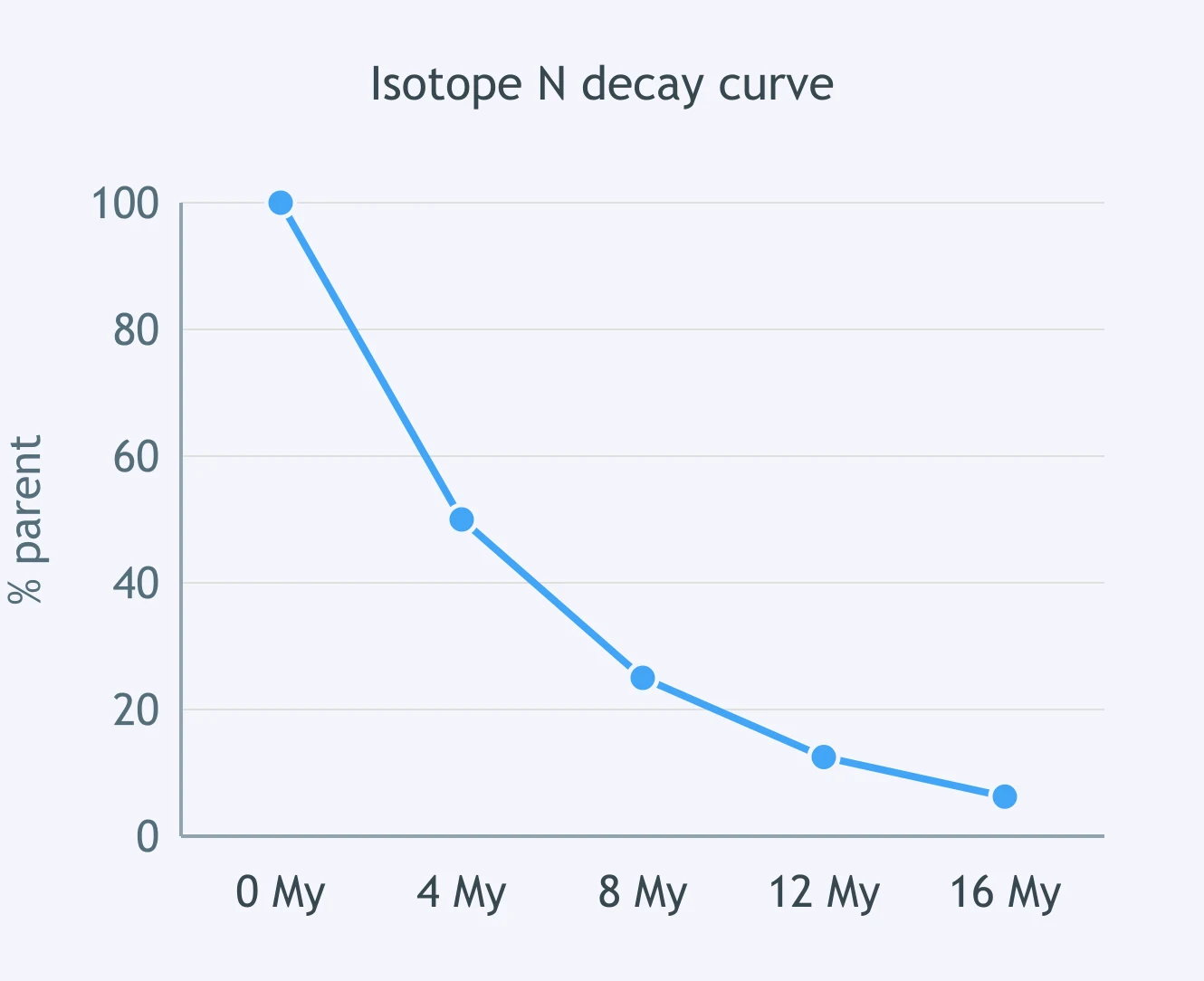
Use the parent-remaining curve. When the curve reaches 6.25% parent remaining, how many half-lives have elapsed?
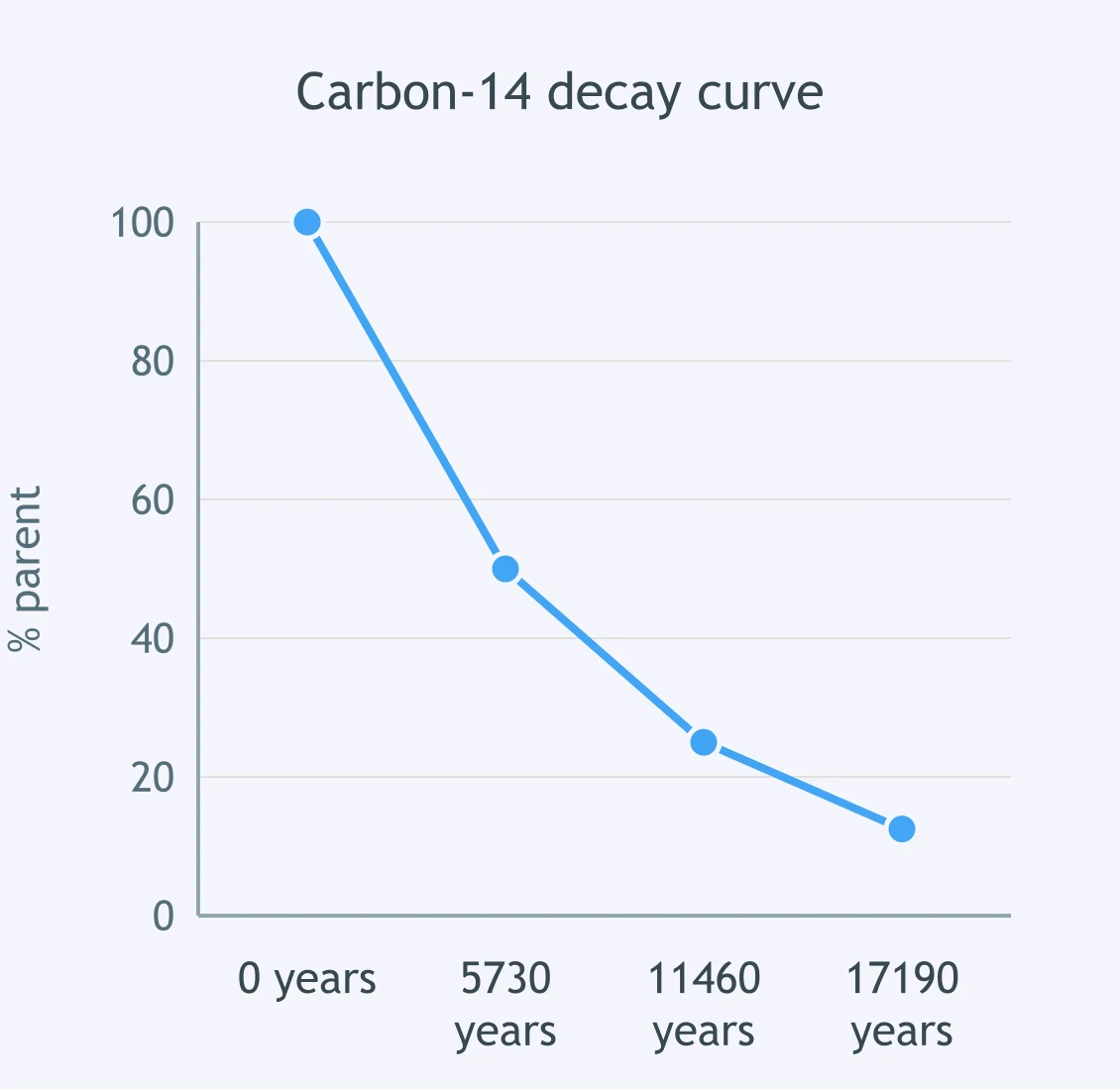
Use the carbon-14 decay curve. What parent-isotope percentage remains at 11460 years?
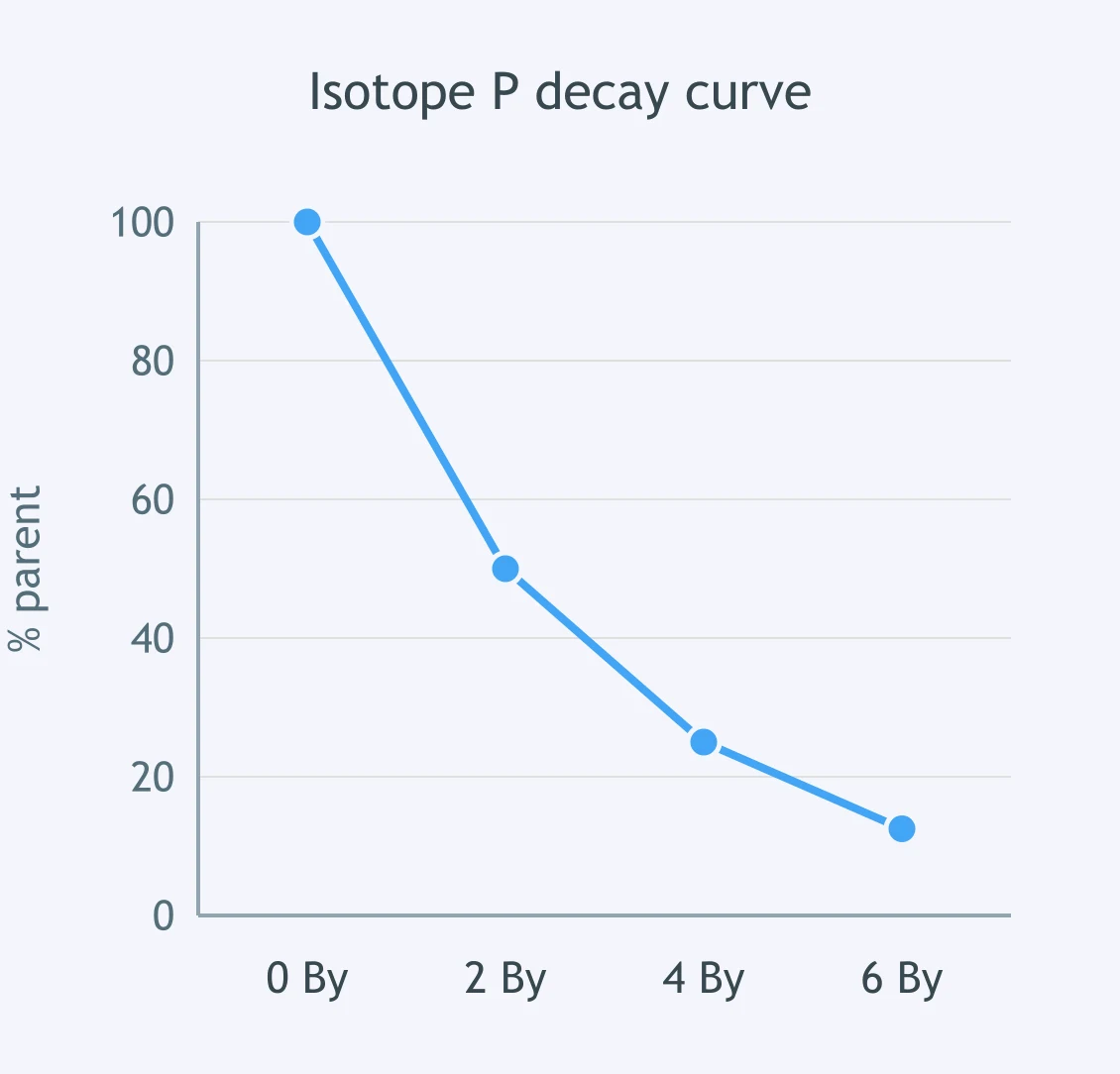
Use the decay curve for isotope P. What half-life is shown by the curve?
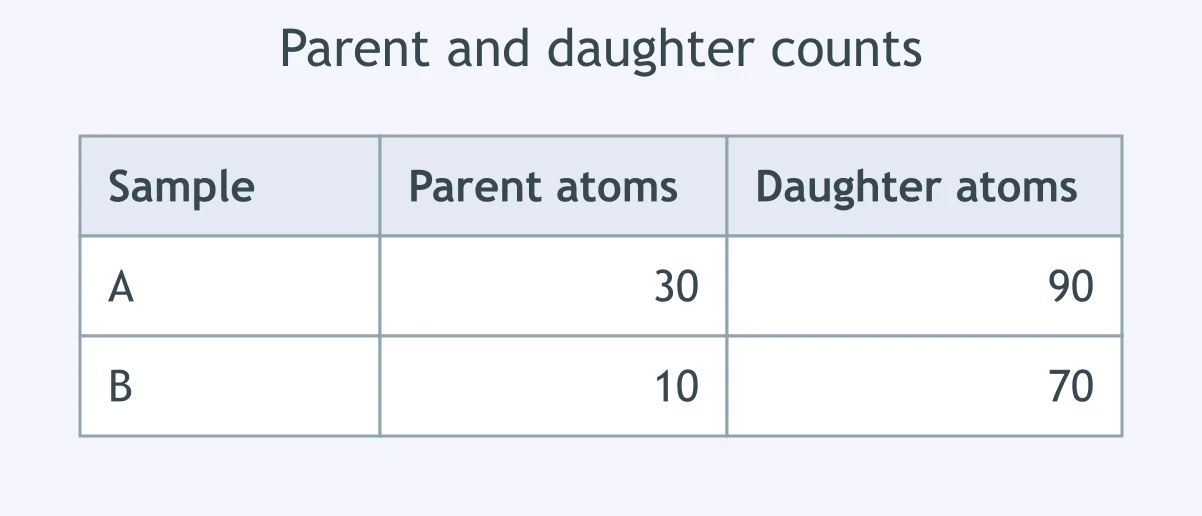
The table gives atom counts for a closed mineral that began with no daughter atoms. For sample A, how many half-lives have elapsed?
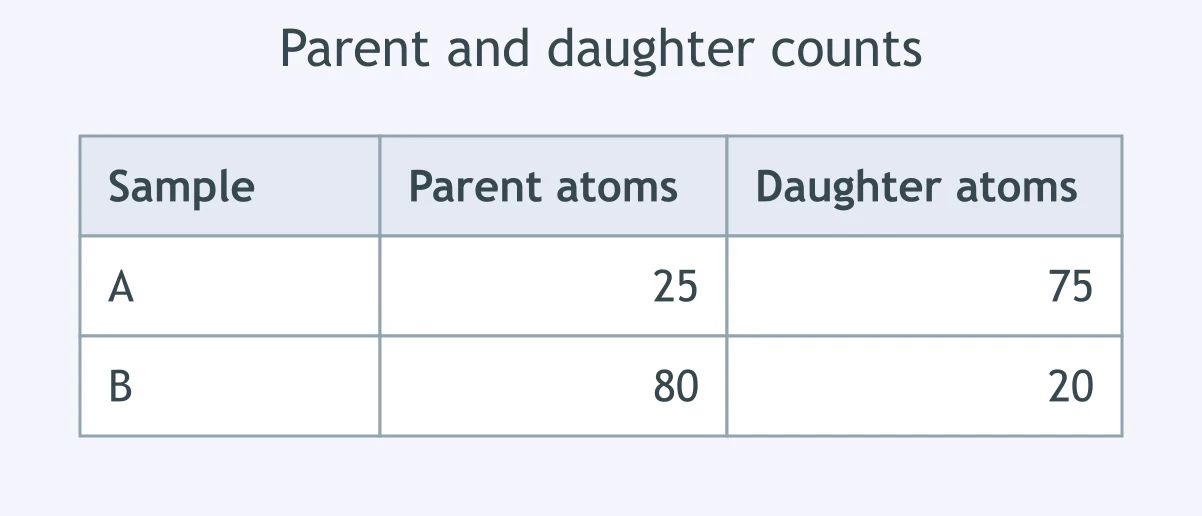
The table lists parent and daughter atoms in a closed sample. For sample B, how many half-lives have passed since crystallization?
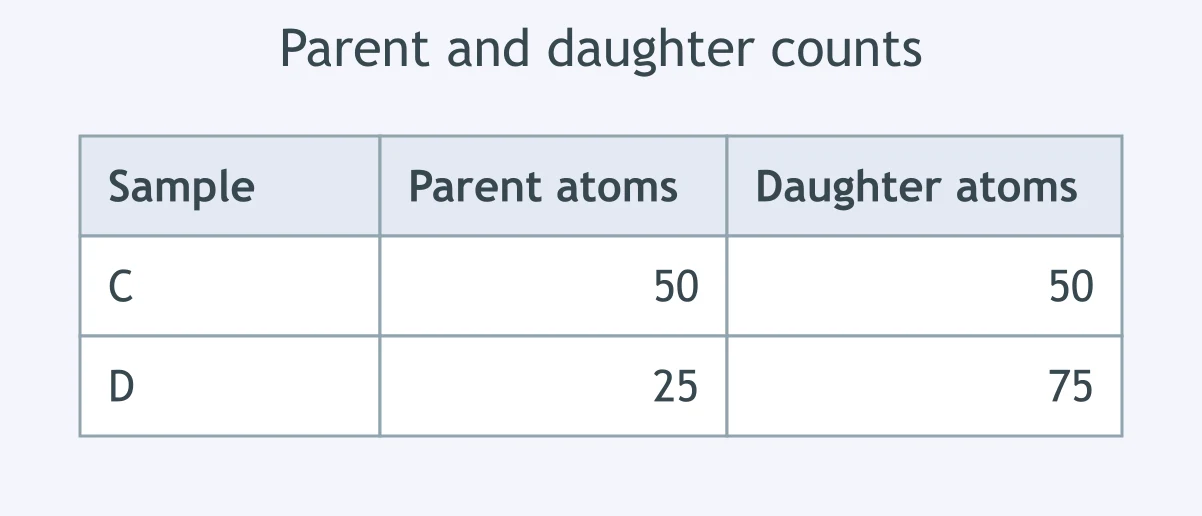
Use the atom-count table for a mineral that started with no daughter isotope. For sample C, how many half-lives are recorded?
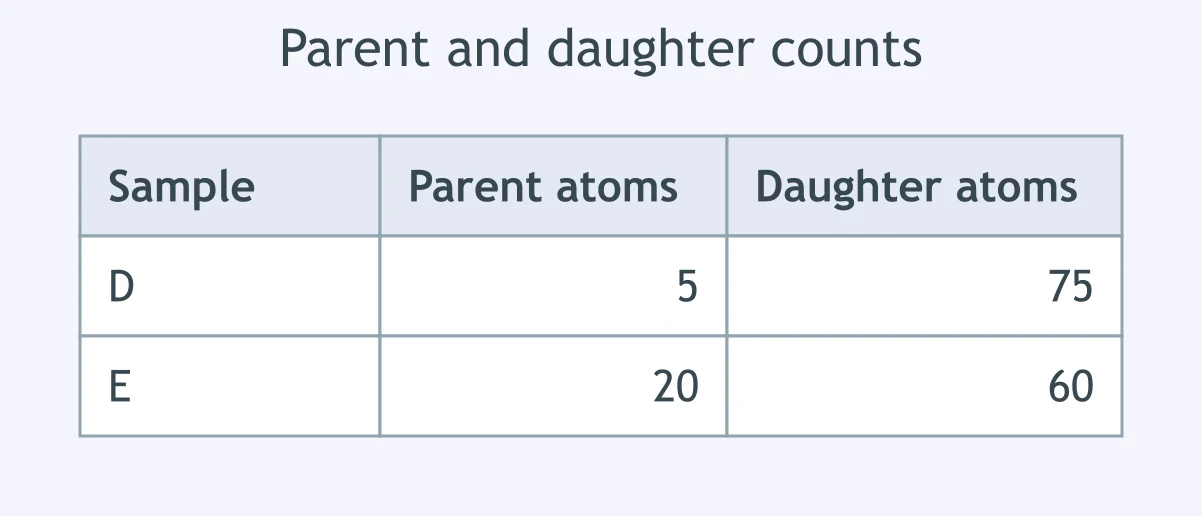
A closed mineral began with only parent isotope. The table shows sample D today. How many half-lives have elapsed?
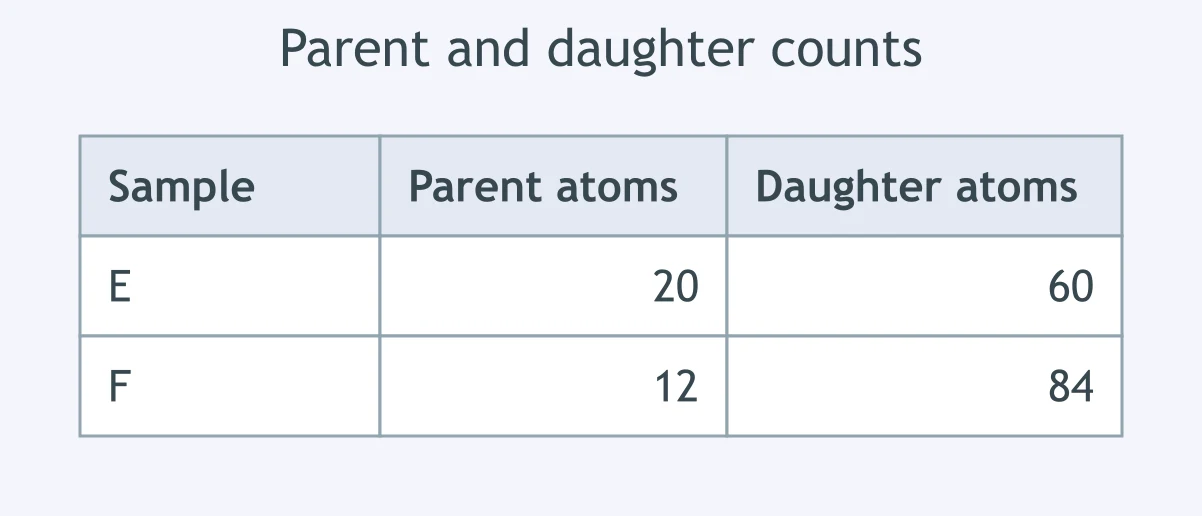
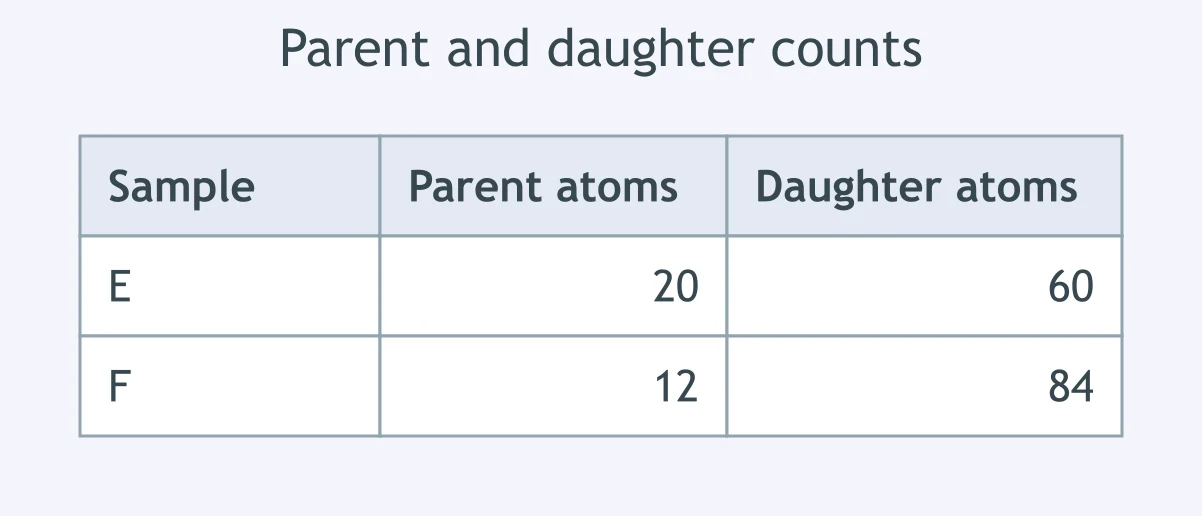
Use the parent-daughter table. Sample E formed with no daughter isotope and stayed closed. How many half-lives old is it?
The figure gives counts from a closed mineral. For sample F, what elapsed time should be counted in half-lives?
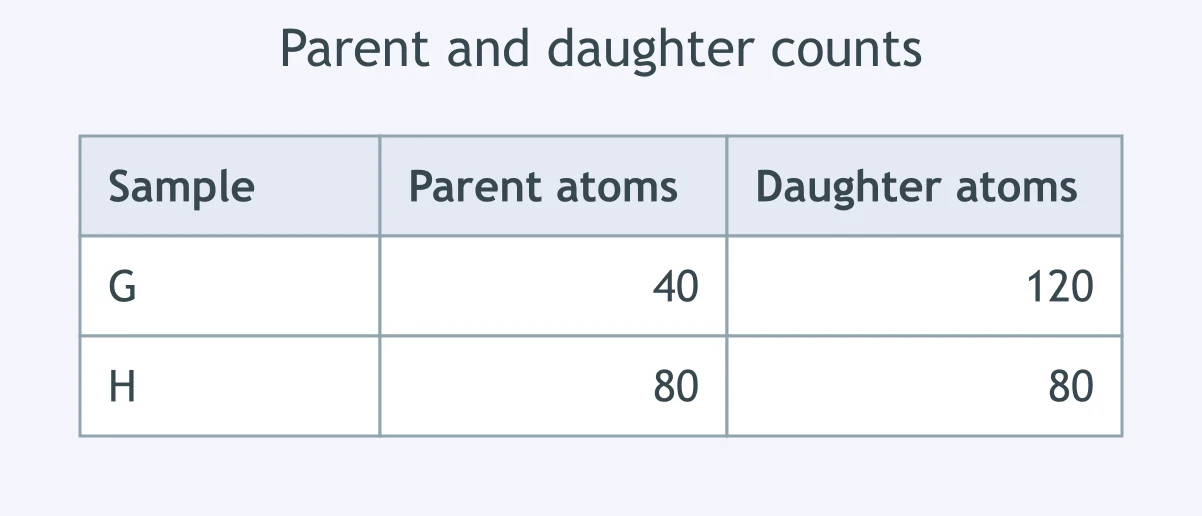
Read the atom-count table for sample G. The mineral was a closed system with no starting daughter isotope. How many half-lives passed?
A closed mineral contains parent and daughter atoms in a 1:15 ratio. How many half-lives have elapsed since the mineral crystallized?
A rock sample that began with no daughter isotope now has a parent-to-daughter ratio of 1:7. How many half-lives old is the sample?
A newly crystallized mineral began with only parent isotope. Today its parent-to-daughter ratio is 1:1. How many half-lives have passed?
Use the dating-method table. An 8000-year-old charcoal fragment from a cave campfire needs a numerical age. What isotope pair is most suitable?
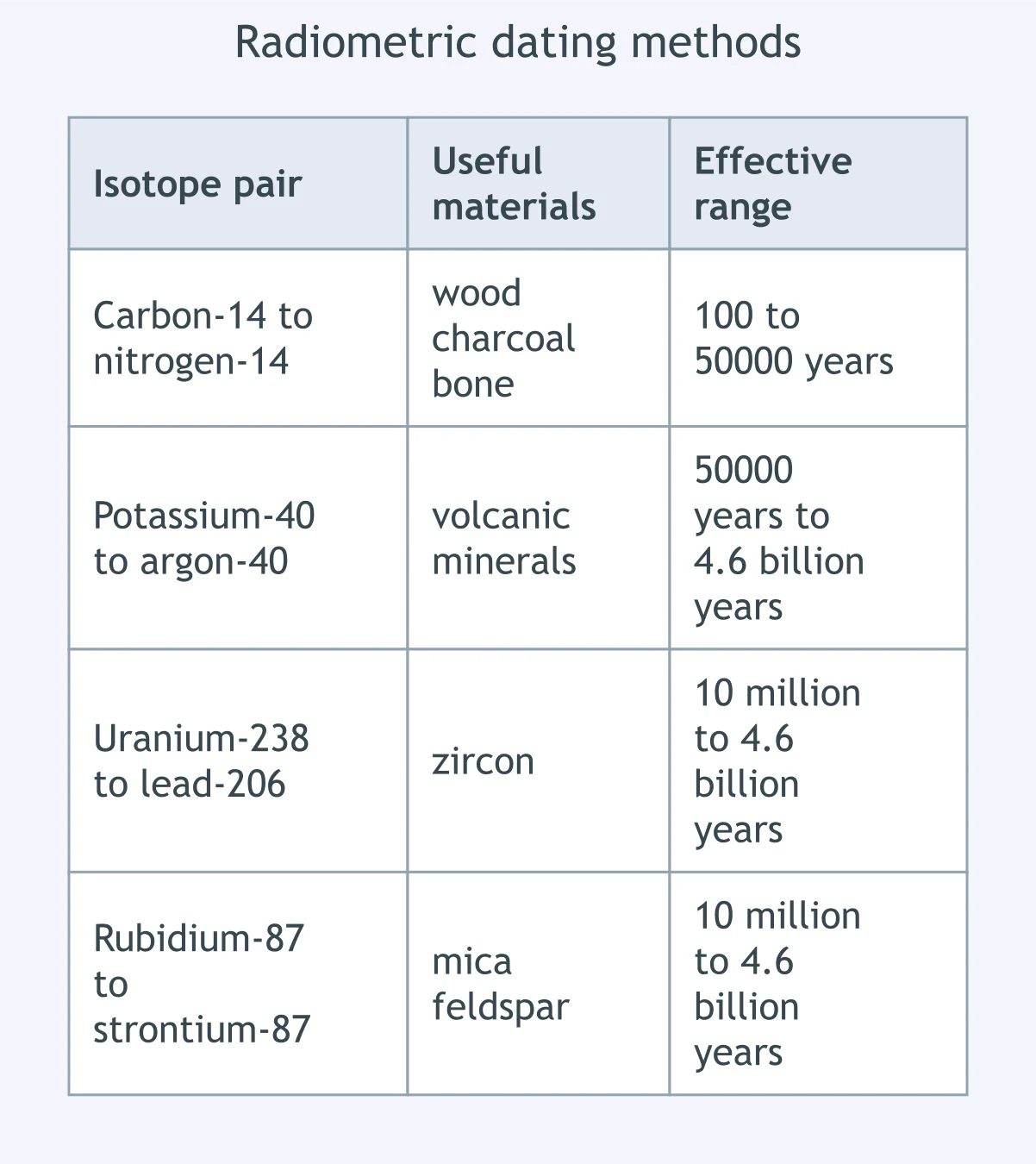
Use the dating-method table. A basalt lava flow is about 1.2 million years old. What isotope pair best dates volcanic minerals in the flow?
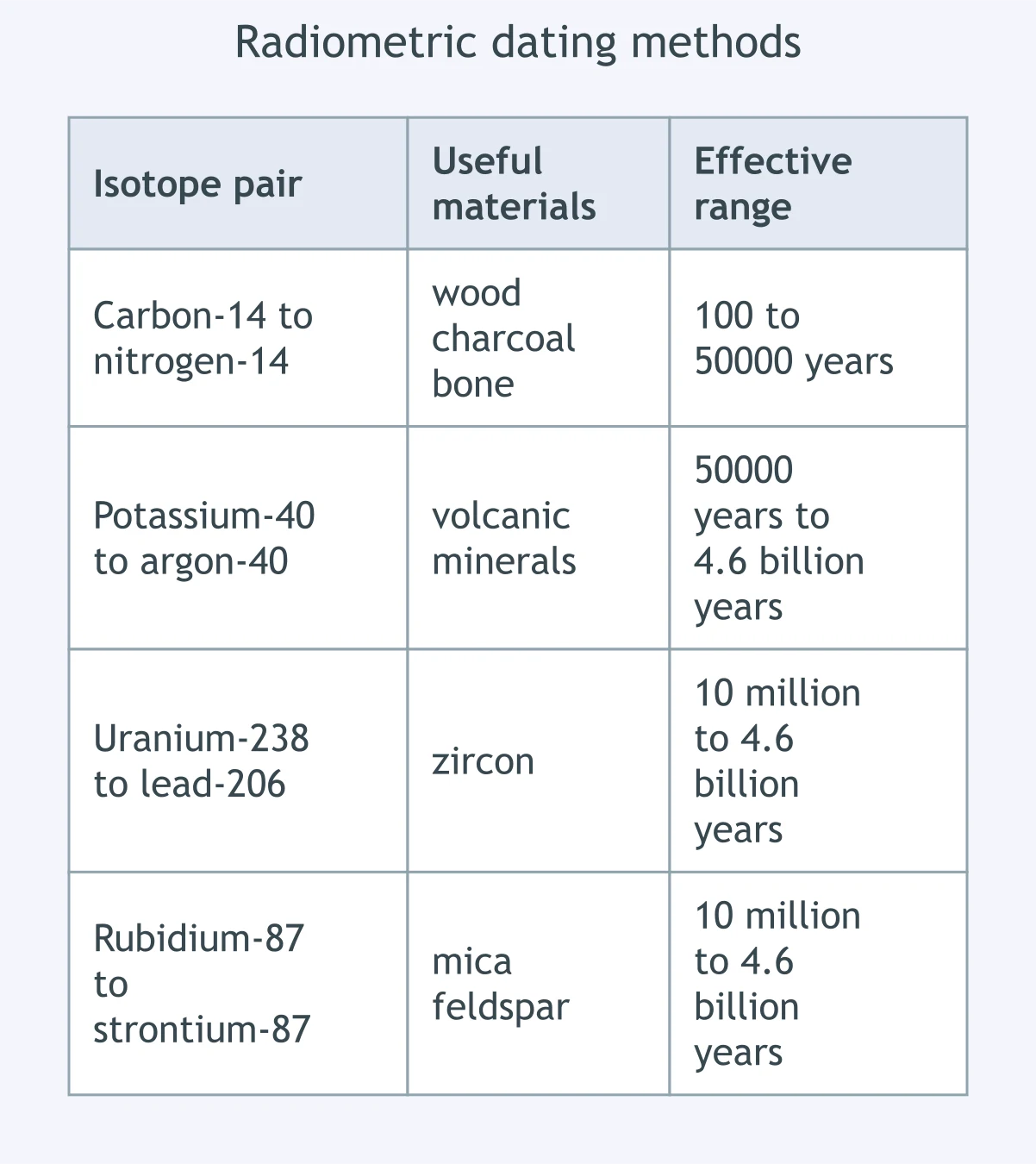
Use the dating-method table. A zircon crystal in ancient granite is about 3.6 billion years old. What isotope pair matches that material and age?
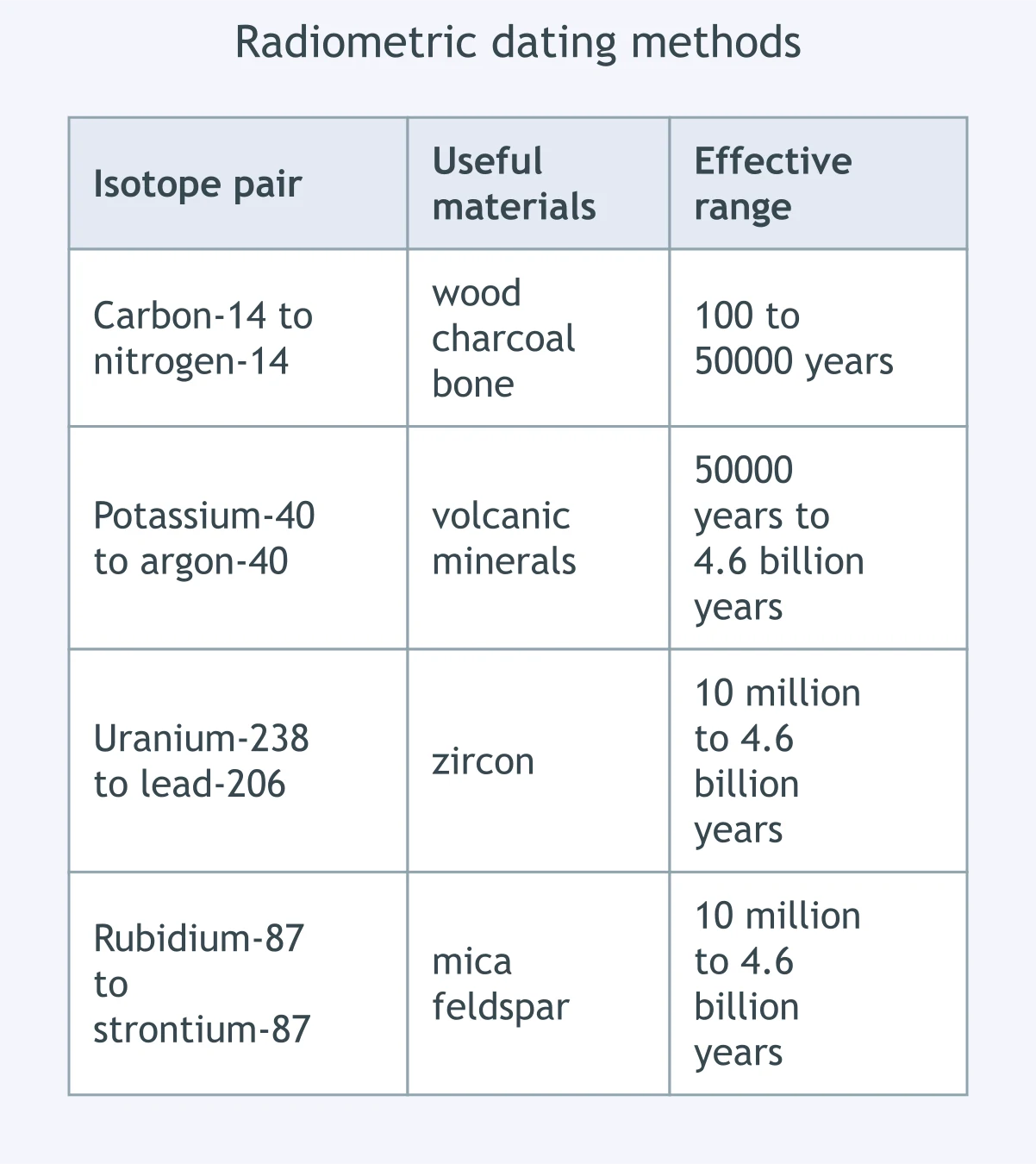
Use the dating-method table. A 1.1-billion-year muscovite grain grew during metamorphism. What isotope pair is best matched to that mineral and age?
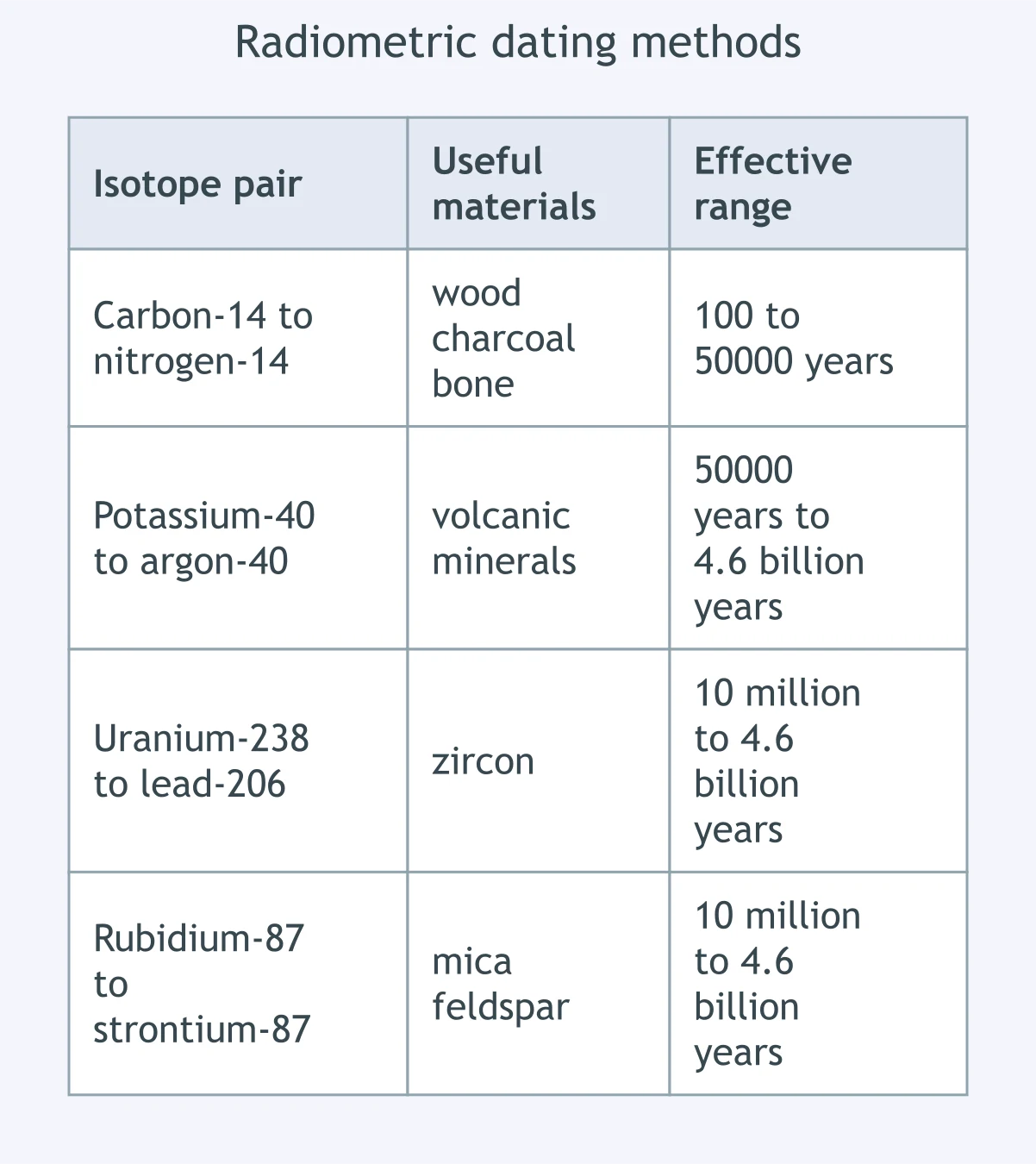
A peat layer from a retreating glacier is about 12000 years old. What isotope pair best dates the peat's once-living plant material?
A volcanic ash contains sanidine crystals and is roughly 700000 years old. What isotope pair is best suited to date the eruption?
Zircon crystals in an ancient granite are dated with uranium-238 and lead-206. Why is zircon so well suited to this method?
A radioactive mineral is heated to 900 °C and squeezed under high pressure in a lab press. What happens to its nuclear decay rate?
Carbon-14 atoms are locked in carbonate shell instead of charcoal. How does the chemical bonding change the half-life of carbon-14?
A mineral is crushed to powder before mass spectrometer analysis. What happens to the radioactive isotope's decay constant?
As a closed radioactive sample ages, fewer atoms decay during each equal time interval. What causes that decrease in total decays?
Metamorphism lets argon gas escape from a potassium-bearing mineral. What changes in the K-Ar dating system?
A frozen mammoth hair and a burned charcoal fragment are the same age and stayed closed after death. How do their carbon-14 decay rates per parent atom compare?
A teacher wants a numerical age for a sedimentary sandstone bed. In the sample table, which sample can directly date deposition most closely?
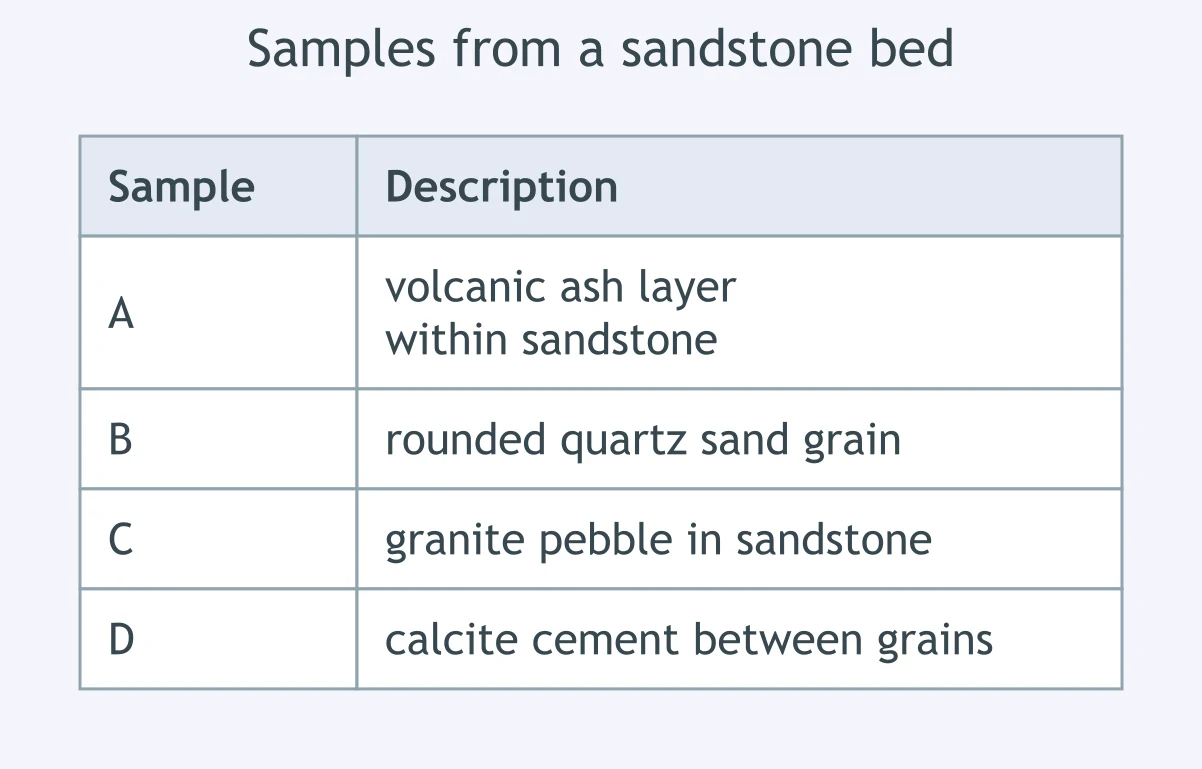
A basalt lava flow cooled at Earth's surface. What sample is best for a numerical age of the eruption?
A cave sediment layer contains a campfire hearth. What material from the hearth can give a numerical age for when people used the fire?
A geologist brackets a fossil bed using datable layers. For a maximum age of the fossil bed, which table sample is best?
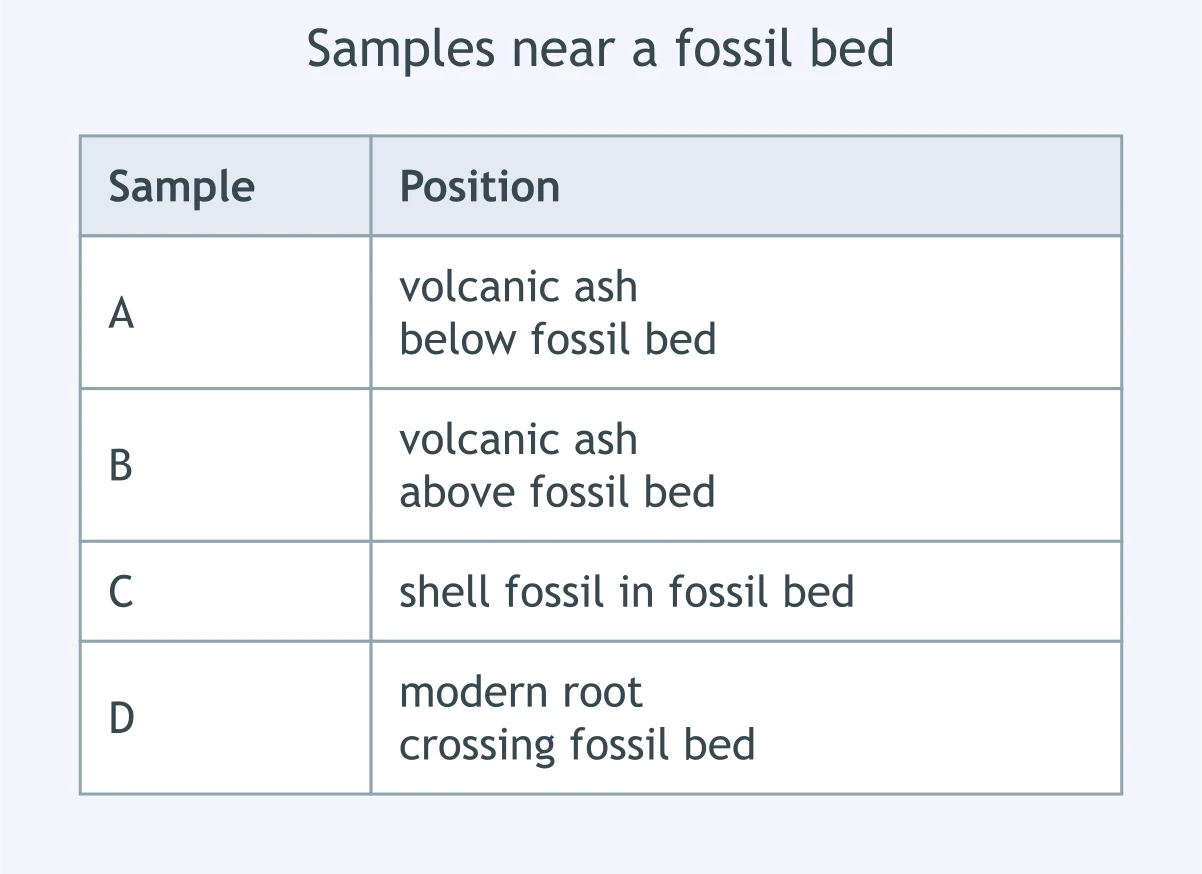
A schist developed new mica flakes during metamorphism. What sample best dates the metamorphic event numerically?
Crack the passcode before the zombies get in.
Answer, then swat bugs for bonus points.
Race through questions at your own speed.
Same question on every screen. Fastest wins.

Pick a tile, answer, hit bonuses and steals.
Reading Cross Sections
40 questions