Loading
by BlastRoom
What real spacecraft have found in the solar system and the mission designs that made those findings possible: matching a finding to its mission, choosing the design that answers a science question, and reading mission data off a figure.
#earth_space_science
25 questions
One question set, multiple game modes. Tap any game to see it in action. Not sure which to pick?
Answer to place stones and capture territory.
Outrun the snow together.
Earn blasts, then hunt the other team.
Answer to earn energy, then climb.

The class blasts through walls together.
Bid on mystery lots. Most money wins.
Sell tours. Nice, standard, or a total scam.

Answer, restock, and serve the rush.
More correct answers pulls the rope your way.
Answer, then shoot down the alien wave.
Answer, then tap to leap the frozen ridge.
A spacecraft in orbit around Venus bounced microwaves off the ground beneath the clouds and built a near-global map of the surface, showing that volcanic flows cover most of the planet. Which mission is described?
An orbiter reported that deposits on the floors of craters near Mercury's poles, in places where sunlight never reaches, are dominantly water ice. Which mission made that finding?
A rover in Gale crater photographed beds of smooth, rounded gravel cemented into rock, in sizes and shapes that only flowing water could have produced, and reported an ancient streambed. Which rover found it?
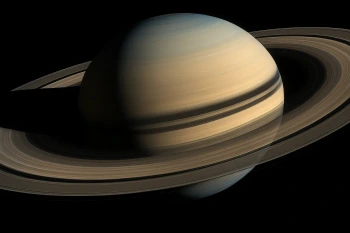
A Saturn orbiter photographed jets of ice and vapor erupting from fractures near the south pole of the moon Enceladus, then flew straight through them to sample the material. Which mission is described?
An orbiter's magnetometer found Jupiter's field lines bent around the moon Europa, the signature of an electrically conducting layer inside it and the strongest evidence for a salty ocean under Europa's ice. Which mission returned that data?
A lander in the Martian arctic scraped a shallow trench and photographed bright chunks in its floor. Four days later the chunks had vanished, too slow for carbon dioxide ice and exactly what water ice does. Which lander did this?
A flyby returned the first detailed pictures of Pluto, showing a frozen nitrogen plain roughly 1,000 km across in one lobe of a heart-shaped region, with no impact craters at all. Which mission took them?
Researchers want to know whether the carbon compounds in an asteroid have survived unchanged since the solar system formed. The instruments precise enough are room-sized and cannot fly. Which mission design answers the question?
A team wants to know what a comet is made of below the crust that sunlight has cooked, but the nucleus is too weak and too active to drill into. Which mission design gets at the buried material?
Scientists want to know how thick the crust of Mars is and how large its core is. Which mission design can deliver that measurement?
A study needs to follow how dust storms grow and fade across the whole of Mars over several years. Which mission design supplies that record?
Scientists want to sample the solar wind in the corona, where it is being accelerated, not after it reaches Earth. Which mission design can do that?
A spacecraft must orbit one asteroid for a year, then break out of that orbit and settle into orbit around a second body. No chemical engine it could carry holds enough propellant for both captures. What makes the plan possible?
A dust storm covered all of Mars in 2018, darkened the sky for weeks and starved the solar-powered rover Opportunity of power until it fell silent. Why do designers of a rover meant to last a decade fit a radioisotope generator instead of panels?
Venus is wrapped in an unbroken deck of sulfuric acid cloud that visible light cannot penetrate. Why did the team mapping its surface from orbit carry a radar instrument rather than a camera?
Air at the surface of Titan is about four times as dense as air at Earth's surface. Why could the probe that descended there in January 2005 reach the ground on a heat shield and parachutes alone, with no landing rockets?
A probe flying through the Sun's corona faces about 1,400 ℃ on its sunward face, while its instruments must stay near 30 ℃. What does that gap force into the design?
An orbiter arrives at Mars on a long elliptical orbit, but its cameras need a low, nearly circular one, and it has nowhere near enough propellant to circularize by engine burns. What does the thin Martian atmosphere let it do instead?
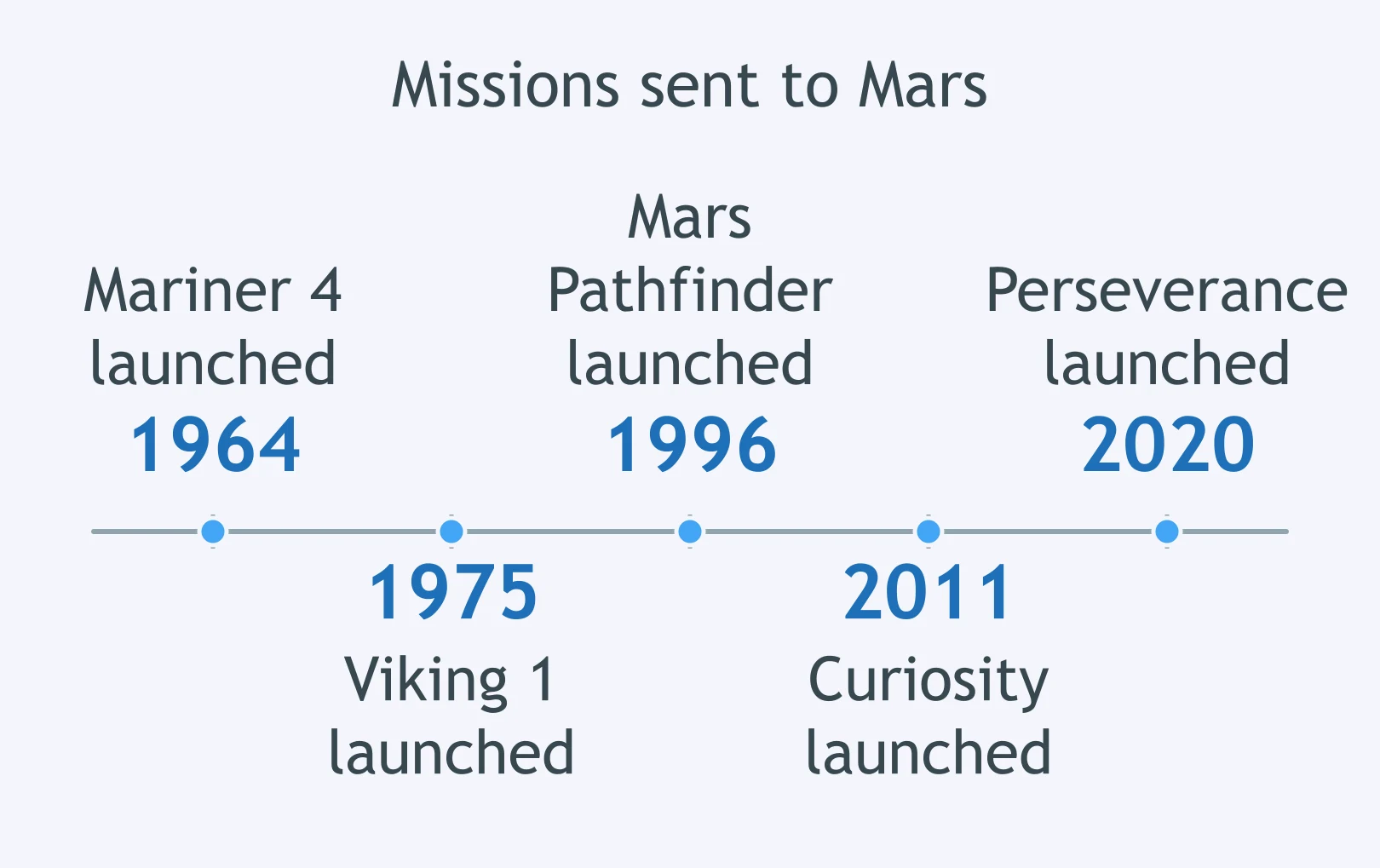
Use the timeline of Mars launch years. Which gap between two missions that launched one after the other is the longest, and about how long is it?
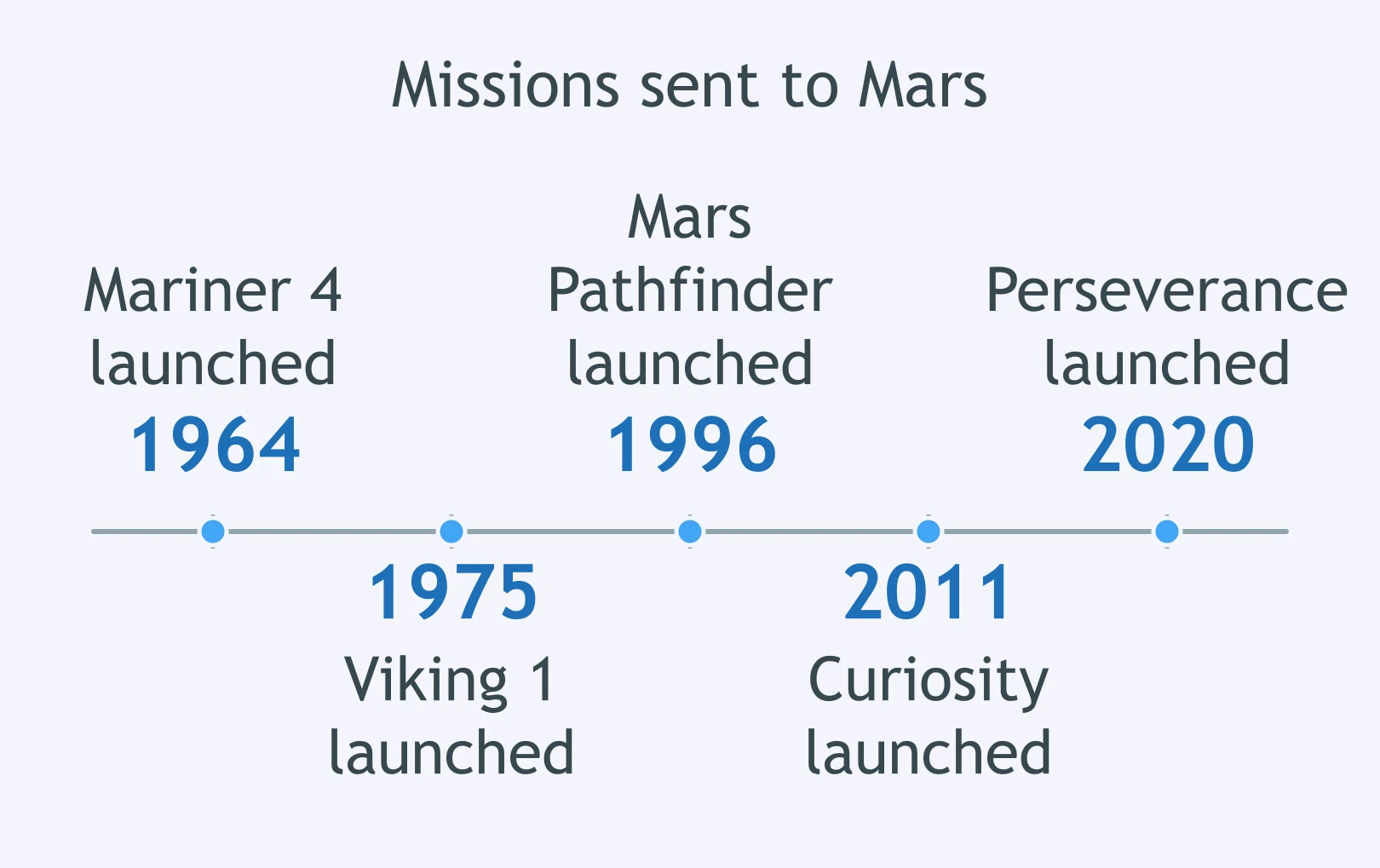
Use the timeline of Mars launch years. Which two of the missions shown left Earth less than ten years apart?
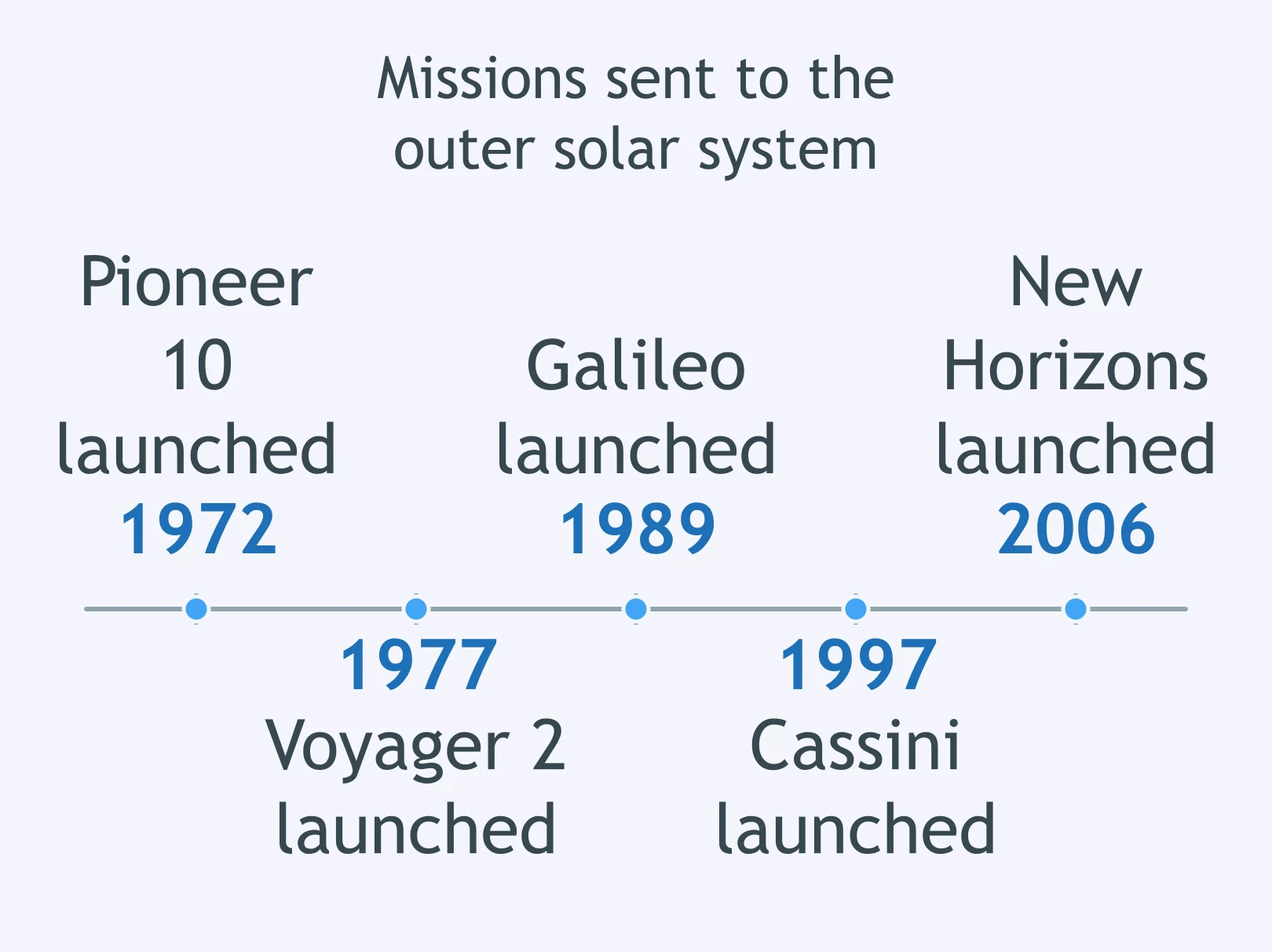
Use the timeline of launches to the outer solar system. Galileo reached Jupiter about six years after it left Earth. In which year did it arrive?
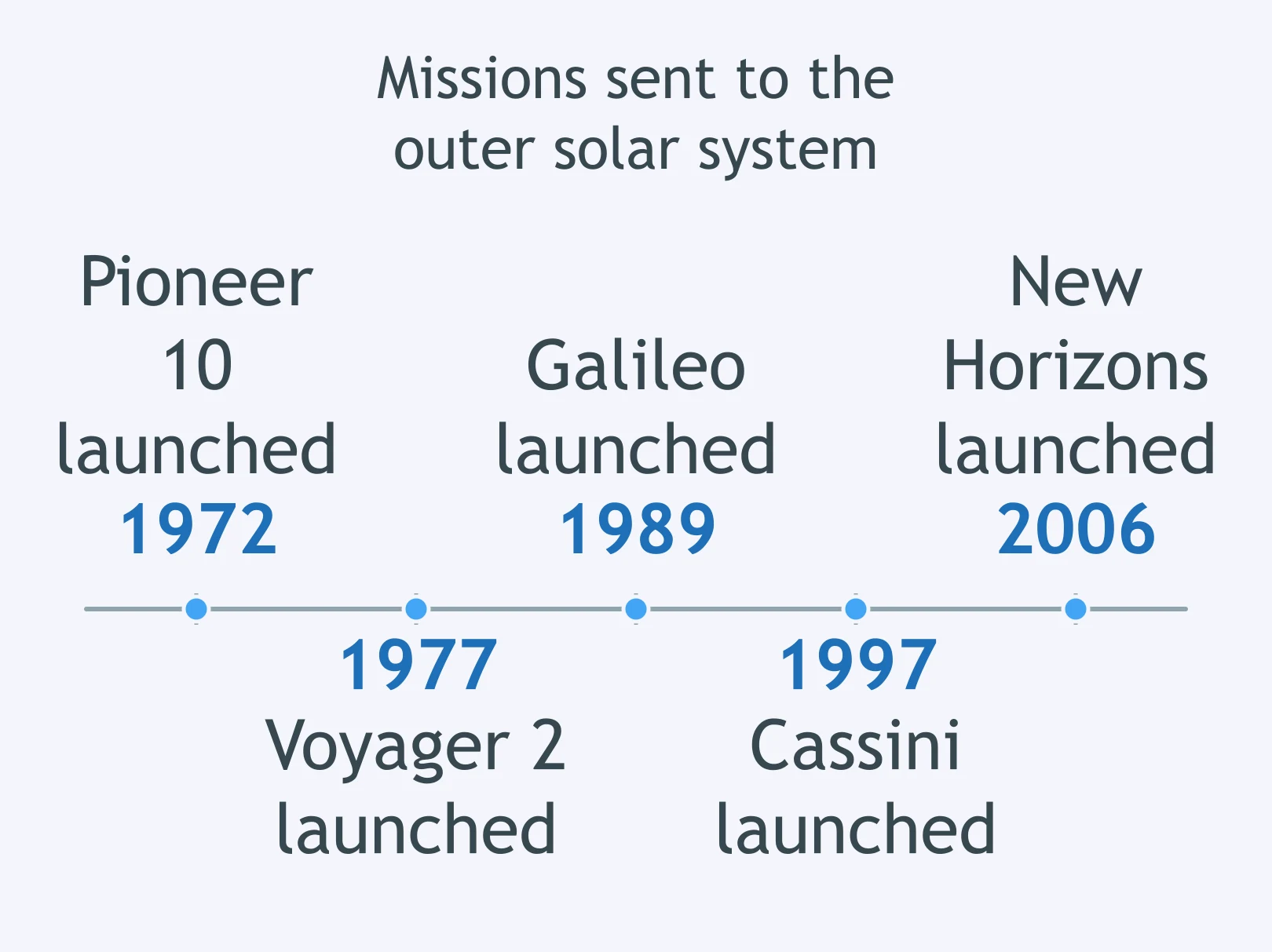
Use the timeline of launches to the outer solar system. How many of the missions shown had already left Earth before 1990?
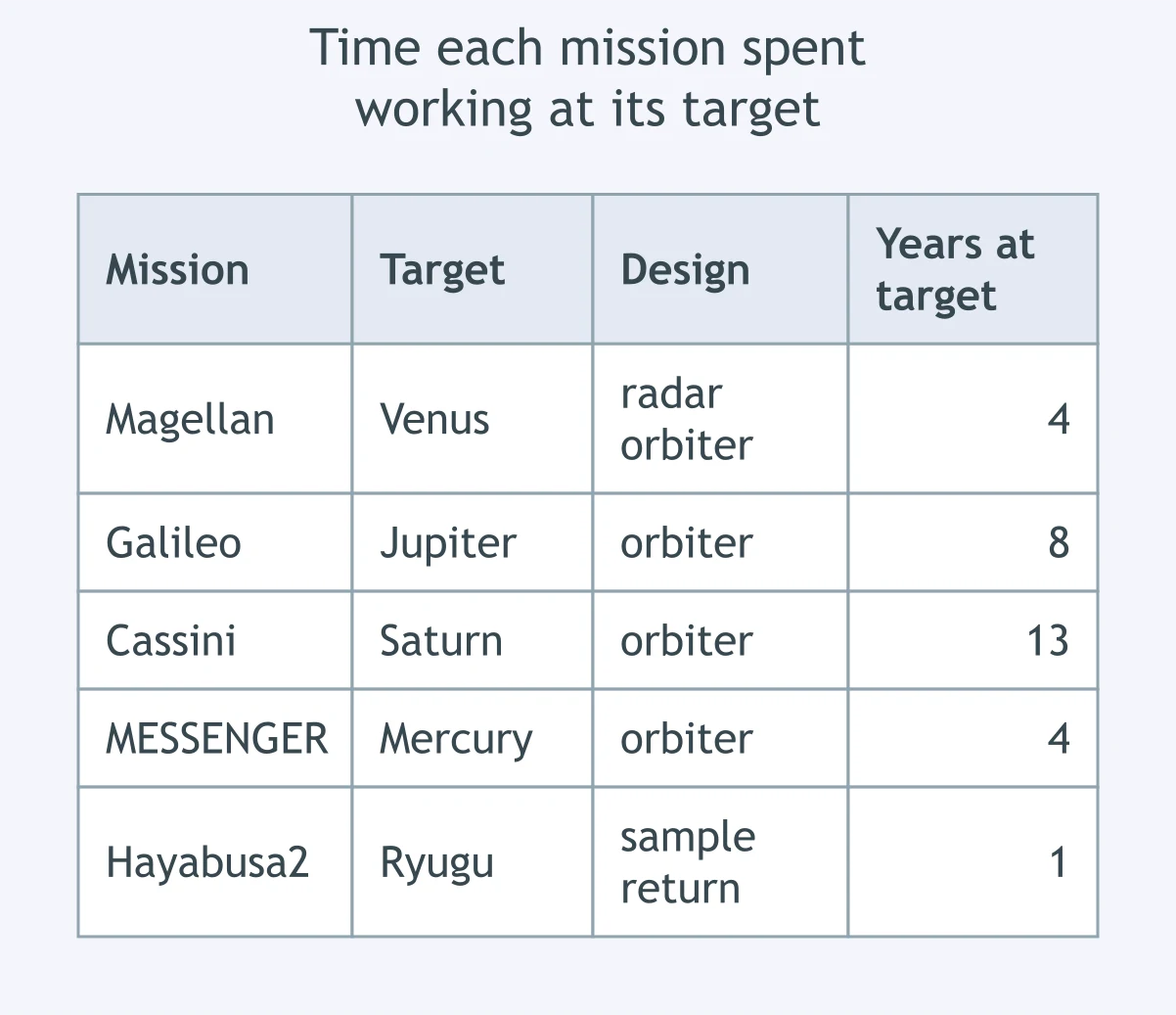
Use the mission table. Which mission worked at its target for the longest, and about how much longer than the next longest was it?
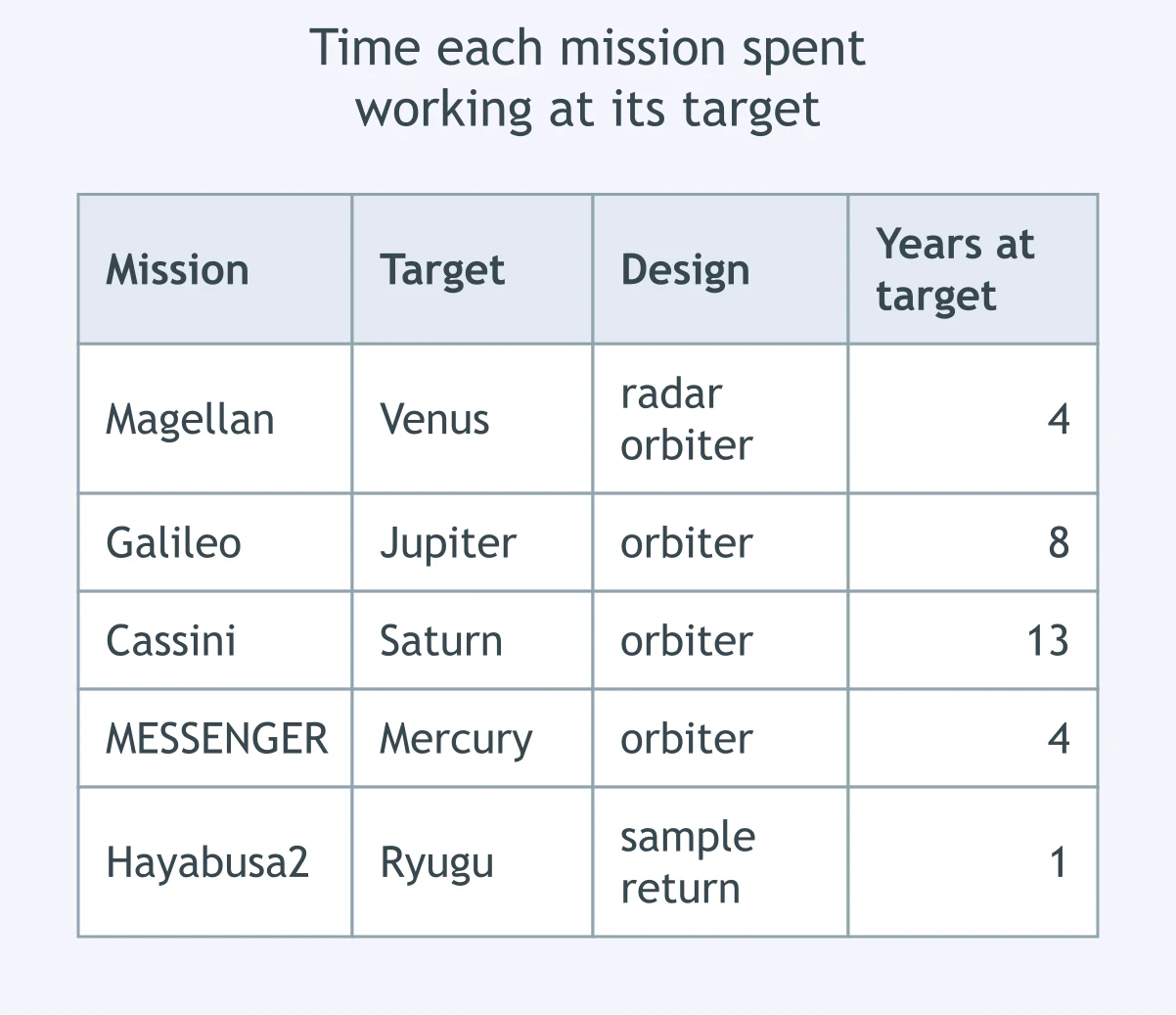
Use the mission table. Two of the listed missions worked at their targets for the same length of time. Which pair, and which two bodies were they studying?
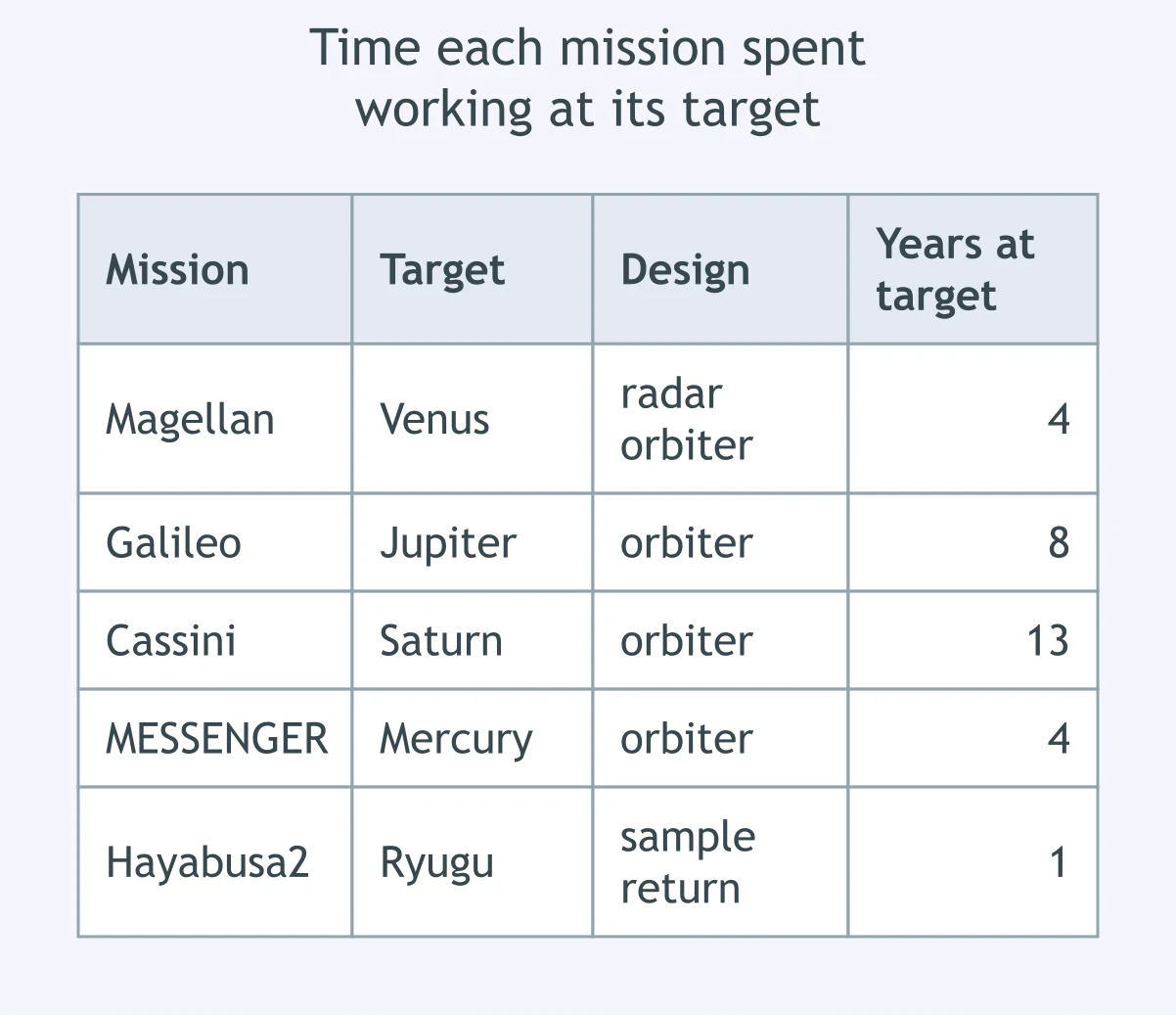
Use the mission table. One listed mission did not stay and send data for years but instead gathered material and carried it home. Which body did that mission visit?
Crack the passcode before the zombies get in.
Answer, then swat bugs for bonus points.
Race through questions at your own speed.
Same question on every screen. Fastest wins.

Pick a tile, answer, hit bonuses and steals.
30 questions