Loading
by BlastRoom
Humanism, patrons, and the art that came out of it.
#world_history
50 questions
One question set, multiple game modes. Tap any game to see it in action. Not sure which to pick?
Answer to place stones and capture territory.
Outrun the snow together.
Earn blasts, then hunt the other team.
Answer to earn energy, then climb.

The class blasts through walls together.
Bid on mystery lots. Most money wins.
Sell tours. Nice, standard, or a total scam.

Answer, restock, and serve the rush.
More correct answers pulls the rope your way.
Answer, then shoot down the alien wave.
Answer, then tap to leap the frozen ridge.
Petrarch searched for ancient letters and urged readers to imitate classical Latin. Which subjects became central to the education he helped inspire?
A scholar compared several manuscript copies of an ancient text to find scribal mistakes and restore the best wording. What skill was he using?
Greek manuscripts reached Italian scholars in greater numbers as Byzantine scholars came west. What did many humanists do with those texts?
Lorenzo Valla showed that a church document used words from centuries after Constantine. What did his analysis prove?
A Florentine teacher assigned Cicero, Livy, and Virgil instead of only medieval commentaries on Aristotle. What was he stressing?
Humanist schooling was meant to prepare educated laymen for speeches, letters, and public service in city-states. What ability did it prize?
A Renaissance writer praised a person skilled in letters, mathematics, music, and public affairs. Which ideal best fits that praise?
A student copied Cicero's sentence patterns to write persuasive letters for a city government. Which humanist goal did this serve?
Instead of relying only on summaries, a scholar tried to recover the earliest wording of Livy. Which habit of learning does that show?
A 1486 oration argued that people could shape themselves through choice and learning. Which thinker wrote it?
In fifteenth-century Florence, painters and sculptors usually earned a living when wealthy families, guilds, or churches ordered specific works. What were these orders called?
Which Italian city became a leading Renaissance center because craftsmanship, trade, and banking created strong demand for art?
Cosimo and Lorenzo used banking wealth and family networks to dominate politics while presenting themselves as leading citizens. Which family was this?
During the High Renaissance, Rome drew artists such as Michelangelo and Raphael for huge chapel and palace commissions. Which patron paid for most of this work?
Leonardo painted a famous dining-hall scene in Milan at the request of Ludovico il Moro. Which ruling family did Ludovico belong to?
A marchioness of Mantua commissioned portraits, collected antiquities, and corrected an artist's details by letter. Who was this famous patron?
Which pair of northern Italian courts became known for supporting artists, manuscripts, medals, and classical collecting?
Florence's Calimala guild of cloth merchants paid for gilded bronze doors for the city's Baptistery, finished in 1452. Which artist made them?
A ruler of Urbino hired artists and cultivated a learned court where a profile diptych showed him and his wife. Which ruler was he?
The ceiling frescoes of a Vatican chapel were painted from 1508 to 1512 for a Renaissance pope. Who painted them?
A colossal marble hero was carved in Florence from 1501 to 1504 and later placed by Palazzo Vecchio. Who carved it?
A Vatican fresco places Plato, Aristotle, Pythagoras, and other ancient thinkers inside grand architecture. Who painted it?
A goddess stands on a shell as winds blow her toward shore in a painting kept at the Uffizi. Who painted it?
A mythological scene with Venus, Cupid, the Three Graces, Mercury, Zephyrus, Chloris, and Flora was painted around 1480. Who made it?
A youthful oil painting at the Uffizi shows Gabriel kneeling before Mary in a garden, with architecture drawn to a central point. Who painted it?
A mural in the refectory of Santa Maria delle Grazie shows Jesus announcing betrayal as apostles react in groups. Who painted it?
A bronze statue of the biblical youth after defeating Goliath stood in Medici collections before going to the Bargello. Who made it?
Ten Old Testament panels in gilded bronze were made for the east portal of Florence's Baptistery between 1425 and 1452. Who made them?
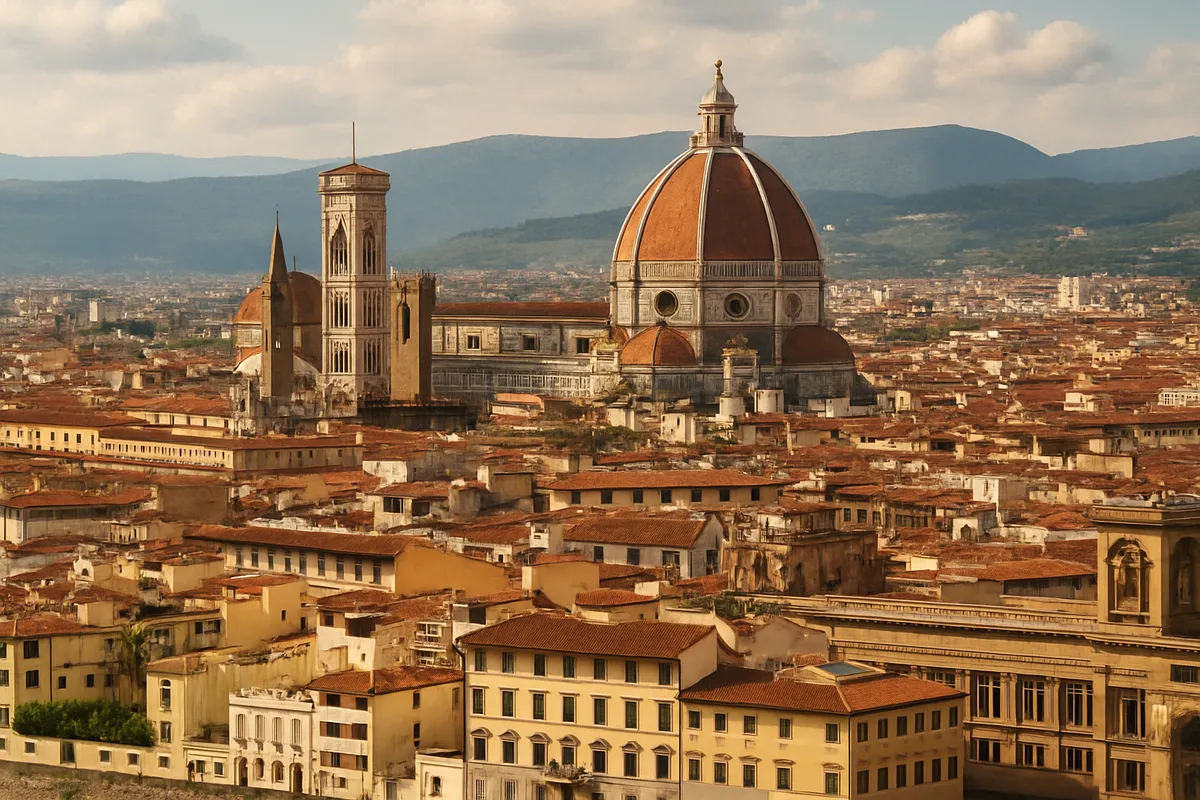
An architect solved the problem of roofing Florence Cathedral with a huge double-shell masonry cupola built from 1420 to 1436. Who was he?
A diptych shows Federico da Montefeltro and Battista Sforza in strict profile against a continuous landscape. Who painted it?
A 1538 Venetian painting shows a reclining nude in a refined domestic room with servants and a small dog. Who painted it?
Painters drew floor tiles and walls so parallel edges seemed to meet at one point, making a flat panel look deep. What method is this?
In a perspectival painting, the orthogonals of a pavement seem to converge at a single place on the horizon. What is that place called?
Leonardo softened outlines so faces and landscapes passed through hazy, gradual tonal shifts rather than hard edges. What technique was this?
A painter used strong contrasts of light and shadow to make figures seem rounded and solid. What term names that modeling?
A saint's arm is painted so it projects sharply toward the viewer, shortened to fit the illusion of depth. What is that effect called?
A sculpted figure stands with weight on one leg, hips and shoulders shifted for a natural pose. What classical device is being revived?
A painter made distant mountains bluish and hazy so they looked far away. Which method creates that depth effect?
A long poem about hell, purgatory, and paradise was written in Tuscan rather than Latin. Which author wrote it?
A frame story tells of ten young people leaving plague-stricken Florence and telling one hundred tales. Who wrote it?
A poet gathered 366 Italian lyrics, many addressed to Laura, in a collection later called the Canzoniere. Who was he?
A chivalric poem first printed in Ferrara in 1516 and revised in 1521 and 1532 helped move courtly Italian writing toward Tuscan literary forms. Who wrote it?
A 1525 treatise helped set Petrarch and Boccaccio as models for literary Italian. Who wrote Prose della volgar lingua?
Why did writing in Tuscan or another spoken Italian language matter for authors such as Dante and Boccaccio?
As print spread, works in Tuscan by Dante, Petrarch, and Boccaccio gained authority across the peninsula. What larger effect followed?
After losing office when the Medici returned to Florence, an ex-official wrote a short handbook on how rulers gain and keep power. Which work was it?
Which Florentine writer began The Prince in 1513 and saw it published only after his death in 1532?
A political writer commented on Livy to discuss republican rule, not just princely rule. Which work fits that description?
A dialogue printed in Venice in 1528 describes the manners, learning, and graceful conduct expected of someone serving a prince. Which book is it?
In Castiglione's courtly ideal, a noble should make difficult skills seem effortless rather than labored. What term names that studied ease?
Crack the passcode before the zombies get in.
Answer, then swat bugs for bonus points.
Race through questions at your own speed.
Same question on every screen. Fastest wins.

Pick a tile, answer, hit bonuses and steals.
The Protestant Reformation
40 questions