Loading
by BlastRoom
Compare Qin and Han China, classical Greece, and Rome one dimension at a time in the New York Eastern Hemisphere sequence.
#history#us_grade_6_social_studies
20 questions
One question set, multiple game modes. Tap any game to see it in action. Not sure which to pick?
Answer to place stones and capture territory.
Outrun the snow together.
Earn blasts, then hunt the other team.
Answer to earn energy, then climb.

The class blasts through walls together.
Bid on mystery lots. Most money wins.
Sell tours. Nice, standard, or a total scam.

Answer, restock, and serve the rush.
More correct answers pulls the rope your way.
Answer, then shoot down the alien wave.
Answer, then tap to leap the frozen ridge.
Han China and the Roman Empire each governed a large territory from one capital. Classical Greece was organized very differently. How was the Greek mainland organized politically?
In classical Athens, citizens voted in person on laws in the assembly. In the Roman Republic, how did citizens mainly take part in governing?
Rome changed from a republic into an empire, and China's warring states were unified under the Qin. What did these two political changes have in common?
The Roman Empire drew many officials from wealthy landowning families. Han China began recruiting officials in a different way. What were Han candidates for office tested on?
Qin rulers followed Legalism, while Han rulers leaned on Confucian teaching. According to Legalism, what was the surest way to keep order in a state?
The Qin standardized writing, weights and measures, while Rome spread a common coinage and language along its roads. What did both actions mainly make easier?
One classical state first linked older walls into one long northern frontier defense against nomadic peoples of the steppe. Which state did this?
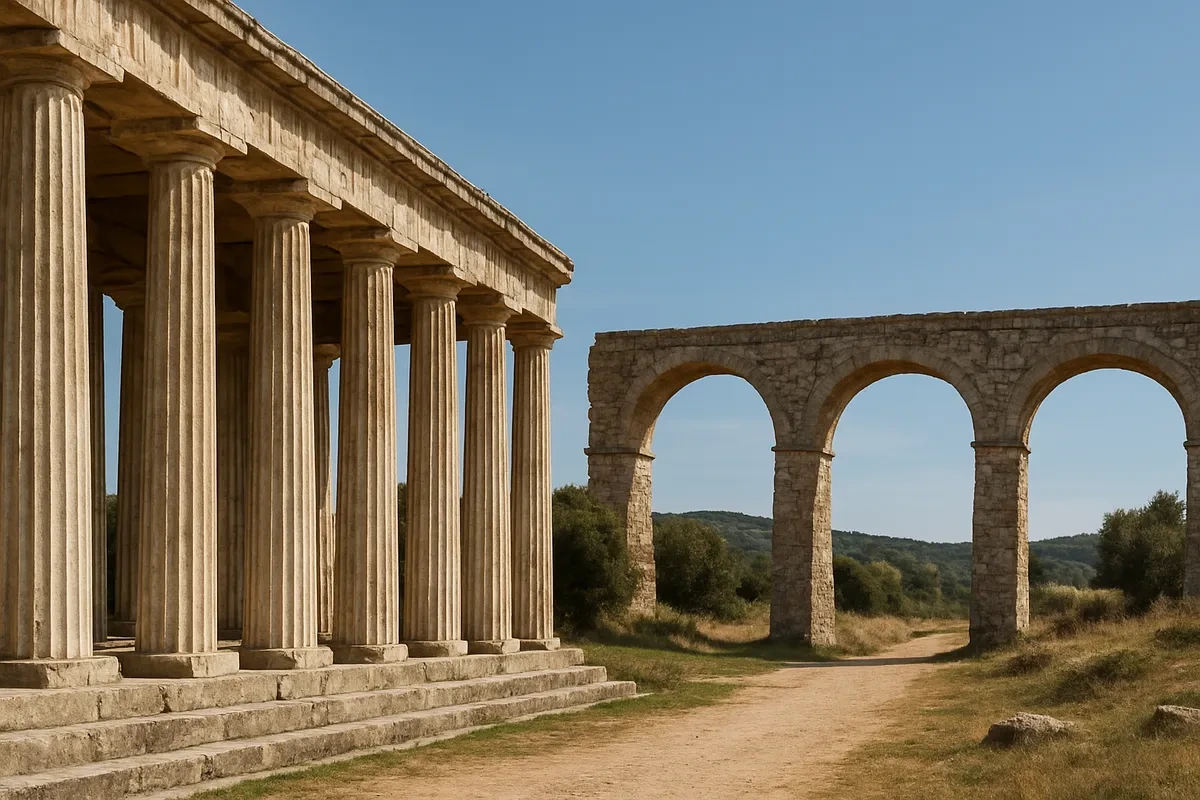
Han cities drew water mainly from canals and wells. One classical power instead built long stone channels carried on arches to bring water into its cities. Which power was that?
Overland trade routes linked Han China with lands to the west and eventually with traders supplying Rome. Which Chinese good was most prized by buyers along those routes?
Historians use one term for the long stretch of peace, trade and art under the Han, and for a similar stretch in the Roman Empire. What term is it?
In Han China, classical Greece and Rome alike, what made it possible for many people to work as artisans, soldiers or officials instead of farming?
Enslaved people performed much of the labor in both classical Athens and Rome.
Athens limited citizenship to free adult men born to Athenian parents. As Rome's territory grew over the centuries, what happened to Roman citizenship?
A Senate of leading families guided the Roman Republic. What group carried out day-to-day government across the provinces of Han China?
The Qin dynasty unified China but ruled for only about fifteen years. About how long did the Han dynasty that followed it rule?
The Qin unified China in about 221 BCE, and Rome became an empire in about 27 BCE. Roughly how many years separated these two events?
Greek city-states were defended by citizen-soldiers who bought their own armor and returned to their farms after a campaign. How did the army of the Roman Empire differ?
Rome paved long roads across its provinces, and Han China maintained imperial roads with relay stations. What did both road systems do for their empires?
Rome is credited with the arch and with concrete, and Greece with theater and philosophy. What enduring achievement is credited to Han China?
Classical Greek life centered on the polis, unlike the vast empires of Han China and Rome. What is a city-state?
Crack the passcode before the zombies get in.
Answer, then swat bugs for bonus points.
Race through questions at your own speed.
Same question on every screen. Fastest wins.

Pick a tile, answer, hit bonuses and steals.
Trade Networks and Migration
20 questions