Loading
by BlastRoom
Carrying Capacity and Limiting Factors for high school Environmental Science, on-level and AP. Covers AP Environmental Science Unit 3: Populations.
#environmental_science
30 questions
One question set, multiple game modes. Tap any game to see it in action. Not sure which to pick?
Answer to place stones and capture territory.
Outrun the snow together.
Earn blasts, then hunt the other team.
Answer to earn energy, then climb.

The class blasts through walls together.
Bid on mystery lots. Most money wins.
Sell tours. Nice, standard, or a total scam.

Answer, restock, and serve the rush.
More correct answers pulls the rope your way.
Answer, then shoot down the alien wave.
Answer, then tap to leap the frozen ridge.
In a crowded urban raccoon population, a contagious disease spreads more rapidly as more raccoons share den sites. How does disease act here?
A wildfire crosses a prairie and kills prairie dog colonies whether a colony was sparse or crowded. How does the wildfire act as a limiting factor?
A fish farm keeps adding trout to its ponds until oxygen becomes scarce and waste accumulates. Mortality rises most in the most crowded ponds. What type of limit is operating?
A hurricane storm surge washes mosquito larvae from coastal pools across an entire marsh. The surge affects pools regardless of larval density. How should it be classified?
After a landfill closes, gulls compete more intensely for the remaining food as their colony becomes larger. What kind of limiting factor is this competition?
A flash flood sweeps through a desert wash and kills kangaroo rats in both low- and high-density areas. How does the flood limit the population?
Ticks transmit a parasite among deer more often when deer are concentrated near a small watering hole. Which classification fits the parasite?
An herbicide drift reaches every section of a wildflower meadow and kills plants at similar rates in sparse and dense patches. How does the herbicide act?
Woodpecker holes are scarce in a forest, so a larger chickadee population has more conflict over nest cavities and fewer pairs breed. What type of limit is this?
A weeklong heat wave warms a pond enough to kill turtle eggs in every nest, regardless of how many turtles used the pond. What type of limiting factor is the heat wave?
As a rabbit population grows in a restored grassland, more foxes hunt there and rabbit mortality rises. How is predation acting in this case?
Mercury released into a river harms fish in both a sparse upstream population and a dense downstream population. How should this limiting factor be classified?
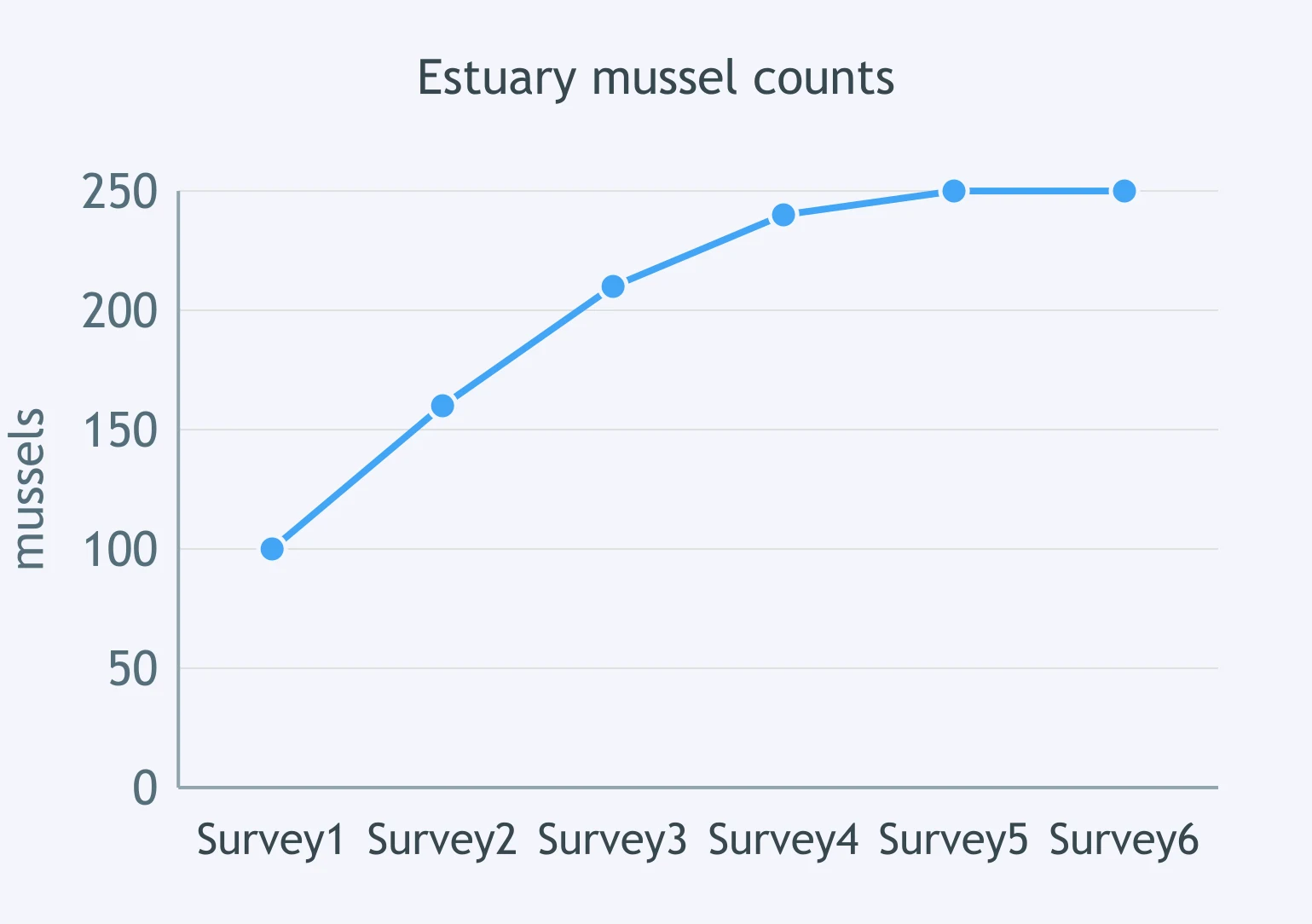
Use the graph of estuary mussel counts. The leveling trend near the end most directly identifies what?
An island goat herd declines each late summer after edible shrubs are grazed down, while freshwater remains plentiful. What most directly sets the herd's carrying capacity?
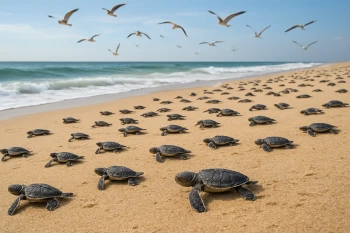
Coastal development removes much of the undisturbed beach used by nesting sea turtles. For nesting females, which resource now most directly sets carrying capacity?
A city withdraws water from a river, leaving fewer cool, fast-flowing riffles for trout. Which condition most directly sets the river's carrying capacity for trout?
Nutrient runoff causes an algal bloom in a lake. As the dead algae decompose, trout in the deep water begin to die. What is the immediate resource setting carrying capacity for trout?
On a dry rangeland, cattle numbers level off each year after grasses are grazed faster than they regrow. What sets the carrying capacity for the cattle?
A forest bird population increases after managers install nest boxes, while food and predators remain unchanged. What had most likely been setting the original carrying capacity?
A landowner fills seasonal wetlands, leaving fewer ponds that hold water through amphibian breeding season. What resource most directly sets carrying capacity for the amphibians?
A wetland is drained for development, and marsh birds lose most of their feeding ground. What happens to carrying capacity for those birds?
A dam is removed and salmon regain access to upstream spawning habitat. Assuming food is sufficient, how should carrying capacity for the salmon change?
Logging removes riparian trees along a trout stream, raising summer water temperature and reducing shade. What is the likely effect on carrying capacity for trout?
A wildlife agency provides a reliable supplemental feeder for an elk herd each winter. While that food supply continues, what is the likely effect on carrying capacity?
A seawall blocks access to tidal marsh used by salt marsh sparrows for feeding and nesting. What happens to carrying capacity for the sparrows in that area?
A city upgrades wastewater treatment, so a stream maintains higher dissolved oxygen and supports more aquatic insects. What is the likely effect on carrying capacity for fish?
A crowded seal colony experiences faster virus transmission as seal density rises. How should this limiting factor be classified?
A late frost kills butterfly larvae across a valley regardless of how many larvae occupied each patch. What kind of limit is the frost?
As an insect population becomes dense, the insects consume host plants until many starve. How should the food shortage be classified in this case?
Road-salt runoff raises pond salinity and kills amphibian eggs similarly in sparse and dense ponds. What kind of limit is elevated salinity?
Crack the passcode before the zombies get in.
Answer, then swat bugs for bonus points.
Race through questions at your own speed.
Same question on every screen. Fastest wins.

Pick a tile, answer, hit bonuses and steals.

Population Growth Calculations
20 questions