Loading
by BlastRoom
Groundwater and Aquifers for high school Environmental Science, on-level and AP. Covers AP Environmental Science Units 4 and 5: Earth Systems, Land and Water Use.
#environmental_science
30 questions
One question set, multiple game modes. Tap any game to see it in action. Not sure which to pick?
Answer to place stones and capture territory.
Outrun the snow together.
Earn blasts, then hunt the other team.
Answer to earn energy, then climb.

The class blasts through walls together.
Bid on mystery lots. Most money wins.
Sell tours. Nice, standard, or a total scam.

Answer, restock, and serve the rush.
More correct answers pulls the rope your way.
Answer, then shoot down the alien wave.
Answer, then tap to leap the frozen ridge.
Below a certain depth in a sandstone layer, every connected pore is filled with water. Above it, pores contain air and water. What is the boundary between these zones called?
A city well draws water from a saturated gravel layer that stores water and transmits it readily to the well. What groundwater feature is the gravel layer?
A shallow aquifer has its upper surface open to atmospheric pressure, so its water level rises after rain and falls during drought. What type of aquifer is it?
A permeable sandstone layer lies between low-permeability clay layers, and water rises in a new well above the top of the sandstone. What type of aquifer does the well tap?
A geologist finds a clay layer through which groundwater moves very slowly, separating two water-bearing layers. What is the clay layer called?
Rain infiltrates through permeable soil on an upland area and enters an aquifer below. What is this upland area called?
A well drilled into a pressurized aquifer has water that rises in the casing without being pumped. What type of well is this?
A community needs a shallow material that will transmit groundwater rapidly to production wells. Which material is most suitable?
A meadow over a recharge zone is paved for a business park. What change is most likely after the paving?
A neighborhood replaces a vegetated field with roofs, roads, and storm drains that carry rain to a river. How does this land-use change affect local aquifer recharge?
Construction equipment repeatedly compacts soil across an aquifer recharge area. What effect does the compaction have on recharge?
After several dry months, a water-table aquifer receives much less precipitation than usual while pumping stays constant. What is the likely effect?
A low-permeability clay bed covers a deeper aquifer across most of a watershed. What does the clay bed do to direct recharge from the surface?
A town routes treated stormwater into a basin placed on permeable soil above an aquifer. What process is the basin designed to increase?
An aquifer receives 4 million liters of recharge each year and has 3 million liters withdrawn each year. If all other inflows and outflows stay constant, what happens to its storage that year?
A new irrigation well is pumped intensely, and nearby water levels slope downward toward the well. What local groundwater feature has formed?
As a municipal aquifer is depleted, the water table drops from 20 meters to 70 meters below ground. What operational change is most likely for existing wells?
During a dry summer, a coastal well field is pumped heavily and its freshwater becomes brackish. What most likely occurred?
An agricultural region removes groundwater from a compressible aquifer faster than recharge replaces it. Which land-surface consequence can result?
A stream receives much of its summer flow from groundwater discharge. What is likely if nearby wells lower the water table below the streambed?
A spring-fed wetland lies downhill from an aquifer used for irrigation. What is a likely ecological result if over-pumping sharply lowers groundwater levels?
Why can land subsidence from heavy groundwater withdrawal make future recharge more difficult?
An inland freshwater aquifer lies beside a deeper formation containing saline groundwater. Pumping lowers freshwater pressure in the aquifer. What water-quality change can follow?
An aquifer holds about 140 billion cubic meters of usable water. Farms withdraw 8 billion cubic meters a year, and recharge adds 1 billion. At this rate, about how long will the usable water last?
A town's new well forms a cone of depression that spreads until it reaches a nearby household's shallow well. What is the most likely effect on the household well?
An aquifer recharges at 1.8 million cubic meters per year and is pumped at 2.4 million cubic meters per year. With no other flows, what is the annual change in storage?
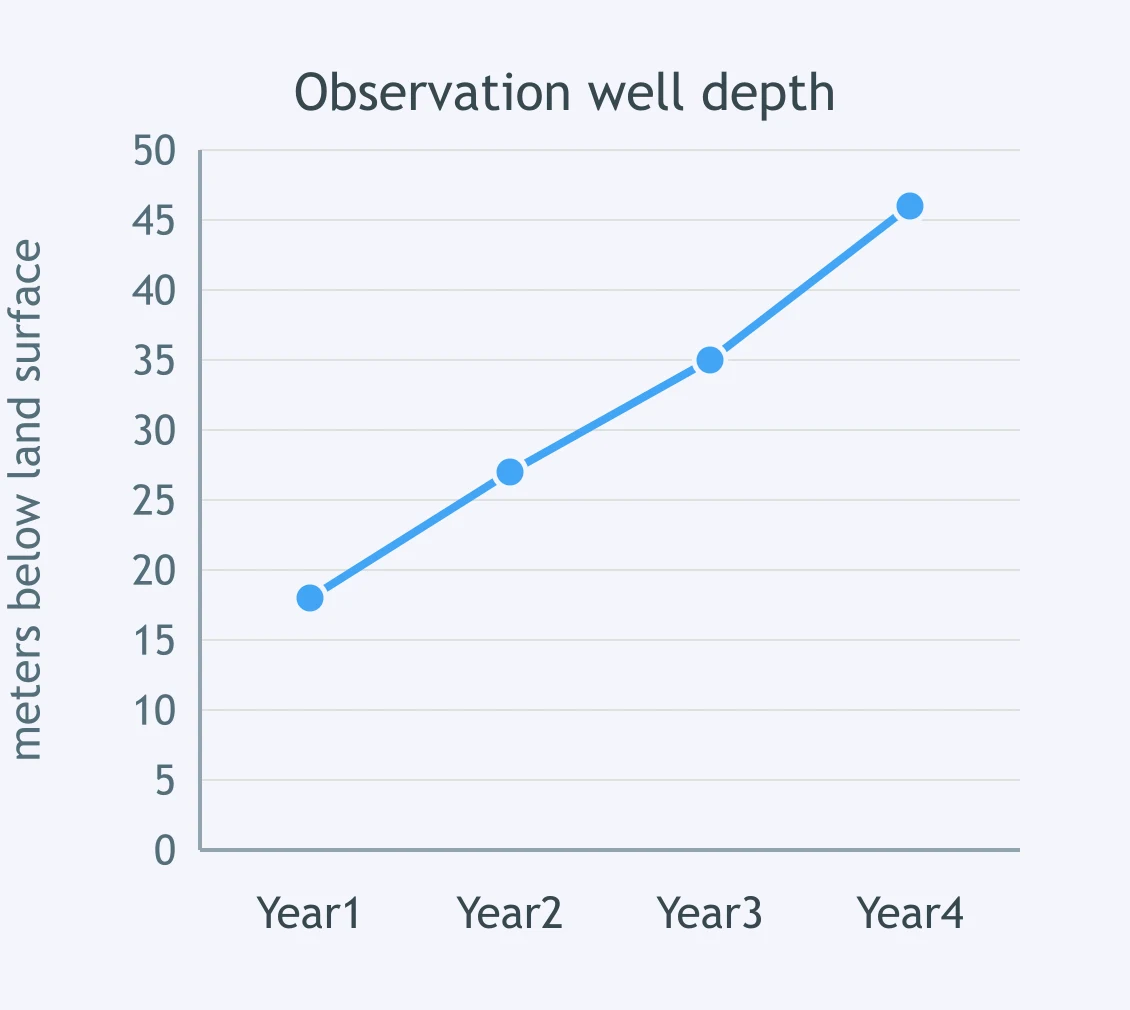
Use the observation-well graph. During which year would pumping groundwater require lifting it the farthest?
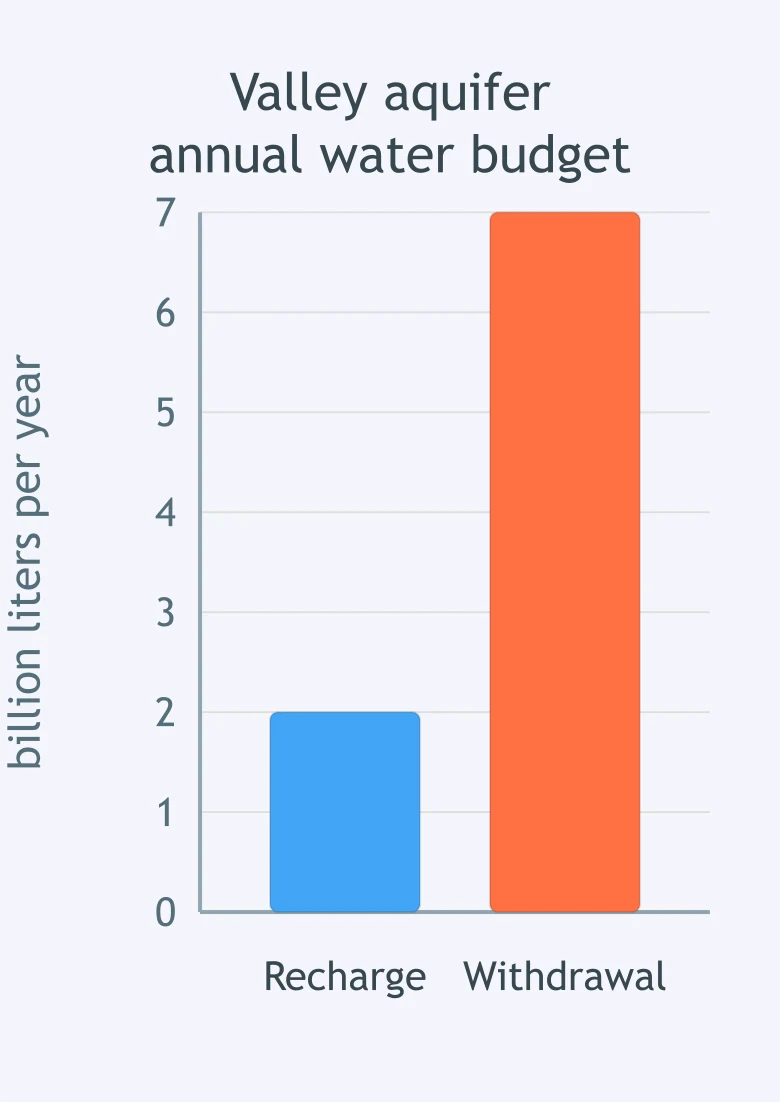
Use the aquifer water-budget graph. What does the relationship between annual recharge and withdrawal indicate?
Before a new well field began operating, two springs flowed through every dry season. After pumping starts, both springs stop flowing in dry seasons. Which evidence would best show that pumping, not drought, is the cause?
In one part of the High Plains (Ogallala) Aquifer, irrigation pumping greatly exceeds recharge and the water table has fallen 52 meters. Which outcome is most consistent with this depletion?
Crack the passcode before the zombies get in.
Answer, then swat bugs for bonus points.
Race through questions at your own speed.
Same question on every screen. Fastest wins.

Pick a tile, answer, hit bonuses and steals.
Irrigation and Water Conservation
25 questions