Loading
by BlastRoom
Distribution and Availability of Fresh Water for high school Environmental Science, on-level and AP. Covers AP Environmental Science Units 4 and 5: Earth Systems, Land and Water Use.
#environmental_science
25 questions
One question set, multiple game modes. Tap any game to see it in action. Not sure which to pick?
Answer to place stones and capture territory.
Outrun the snow together.
Earn blasts, then hunt the other team.
Answer to earn energy, then climb.

The class blasts through walls together.
Bid on mystery lots. Most money wins.
Sell tours. Nice, standard, or a total scam.

Answer, restock, and serve the rush.
More correct answers pulls the rope your way.
Answer, then shoot down the alien wave.
Answer, then tap to leap the frozen ridge.
USGS estimates that about 96.5% of all Earth’s water is held in a single store. Where is this largest store held?
Of all freshwater on Earth, the largest share is stored in which location?
About 30% of Earth’s freshwater is held in which store?
A global freshwater inventory lists a store containing about 0.26% of freshwater. Which store is this?
Although people often draw water from them, which store contains only about 0.006% of Earth’s freshwater?
Which freshwater store holds only about 0.04% of global freshwater, yet delivers water to the land as precipitation?
Water occupies pores and fractures in saturated sand and rock beneath a farming region. What water-holding feature supplies the wells?
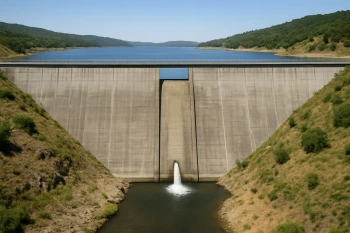
A dam stores river water behind it so a city can use it during a dry season. In which water store is that water held?
Imagine 100 L of all Earth’s water. Only about 2.5 L is freshwater, and most of that freshwater is unavailable for direct human use mainly because it is held where?
A town counts a deep aquifer in its freshwater total, but it lacks funds to drill deep wells, pump water, and build treatment systems. Why can the total overstate its usable supply?
A coastal city proposes using ocean water for its public supply. What step is required before the water becomes freshwater?
A watershed has abundant freshwater by volume, but fertilizer runoff causes harmful algal blooms and toxins in its reservoir. Why is less water available for drinking?
A mountain basin receives much of its annual precipitation as snow, then has very low streamflow late in summer. Why does annual precipitation alone not guarantee year-round water availability?
A city paves much of an aquifer's recharge zone with parking lots. What change most directly reduces future groundwater availability?
A region has large rivers, but its households lack pipes, pumps, and treatment plants to receive safe water. What kind of water scarcity is occurring?
After years of drought, a basin’s rivers and aquifers cannot supply enough good-quality water to meet irrigation, household, and ecosystem demand. What kind of scarcity is this?
Global water maps show areas where rivers and groundwater exist but people lack the infrastructure to use them. Which world region has the largest area of this economic water scarcity?
A city has modern pipes and a treatment plant, yet a multiyear drought and heavy withdrawals leave too little water in its source river. What limits the city?
A government funds wells and pipelines in a wet region where water is present but inaccessible to many residents. What type of scarcity does this investment primarily address?
In a coastal basin, groundwater pumping exceeds recharge and saltwater enters freshwater wells. Even with pipes and treatment plants, good-quality water is insufficient. What kind of scarcity results?
Country A has 400 km³ of renewable freshwater per year for 20 million people. Country B has 200 km³ for 40 million people. Which comparison is correct?
Region C has 120 km³ of renewable freshwater per year for 40 million people, and Region D has 90 km³ for 30 million people. How do their per-person supplies compare?
Nation M has 120 km³ of renewable freshwater per year and 10 million people. Nation N has 180 km³ and 30 million people. Which nation has more water per person?
Basin P has 100 km³ of renewable water for 10 million people, but 40% is too polluted for use. Basin Q has 60 km³ of usable water for 5 million people. Which basin has more usable water per person?
District X has 80 km³ of renewable freshwater per year for 20 million people. District Y has 75 km³ for 15 million people. Which statement accurately compares their supplies?
Crack the passcode before the zombies get in.
Answer, then swat bugs for bonus points.
Race through questions at your own speed.
Same question on every screen. Fastest wins.

Pick a tile, answer, hit bonuses and steals.
Groundwater and Aquifers
30 questions