Loading
by BlastRoom
Reactants, products, location and equation of photosynthesis, and what changes the rate.
#biology
40 questions
One question set, multiple game modes. Tap any game to see it in action. Not sure which to pick?
Answer to place stones and capture territory.
Outrun the snow together.
Earn blasts, then hunt the other team.
Answer to earn energy, then climb.

The class blasts through walls together.
Bid on mystery lots. Most money wins.
Sell tours. Nice, standard, or a total scam.

Answer, restock, and serve the rush.
More correct answers pulls the rope your way.
Answer, then shoot down the alien wave.
Answer, then tap to leap the frozen ridge.
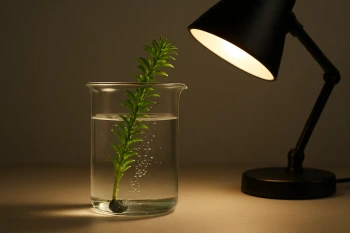
A piece of pond weed in bright light gives off bubbles from its cut stem. When the collected gas is tested, a glowing splint bursts back into flame. Which gas has the plant released?
A leaf is taking in the carbon dioxide it uses for photosynthesis. By what route does that gas get inside the leaf?
A plant is watered with water in which the oxygen atoms have been labeled with a heavy isotope. Where does that labeled oxygen first show up?
Which pair names the raw materials a green plant must take in to carry out photosynthesis?
Which product of photosynthesis stores the chemical energy that the plant can later release in cellular respiration?
A student says that in bright daylight a leaf takes in oxygen and gives out carbon dioxide. What is wrong with this claim?
In complete darkness, a leaf takes in carbon dioxide and gives out oxygen.
The air in a sealed planted terrarium is measured through a bright day. Carbon dioxide falls from 0.09% to 0.04% while oxygen rises. What best explains the change?
Which organelle in a leaf cell holds chlorophyll and is the site of photosynthesis?
Light energy is first captured inside a chloroplast. Which part of the chloroplast does the capturing?
Carbon dioxide is built into sugar in the fluid that surrounds the thylakoid stacks. What is that fluid called?
Leaves full of chlorophyll look green to us. Why?
A cross-section of a leaf is examined under a microscope. Which tissue contains the greatest number of chloroplasts?
A variegated leaf has green areas and white areas with no chlorophyll. After several hours in bright light the whole leaf is tested for starch. Which areas turn blue-black?
In which cells of a healthy plant does photosynthesis NOT take place?
Inside a chloroplast, chlorophyll sits in the membranes of flattened sacs piled into stacks called grana. What is the name of one of these flattened sacs?
Which equation summarizes photosynthesis?
In the equation for photosynthesis, one product is written C6H12O6. What substance is that?
According to the balanced equation for photosynthesis, how many oxygen molecules are released for every glucose molecule made?
A student writes the reactants and products of photosynthesis correctly but the teacher says something needed for the reaction is still missing. What should be added above the arrow?
Why must the number of carbon atoms on the left of the photosynthesis equation equal the number on the right?
A student writes: 6CO2 + 6H2O -> C6H12O6 + 6CO2. What is wrong with it?
In the overall equation for photosynthesis, water is written as a reactant.
How do the overall equations for photosynthesis and cellular respiration relate to each other?
A student counts bubbles from pond weed for one minute with a lamp at four distances: 10 cm gives 48 bubbles, 20 cm gives 22, 30 cm gives 12, and 40 cm gives 7. What do the data show?
A plant in a sealed chamber is given steadily brighter light. The rate of photosynthesis rises at first, then levels off and will not rise further however bright the lamp becomes. What is the most likely reason?
In a greenhouse trial, plants in air with 0.04% carbon dioxide level off at 12 bubbles per minute, while identical plants in air with 0.40% carbon dioxide keep rising to 31 bubbles per minute under the same lamp. What does this show?
The rate of photosynthesis in a plant rises steadily from 10 °C to 30 °C, then falls sharply above 40 °C even though the light and carbon dioxide supply stay the same. Why does it fall?
A greenhouse grower already runs bright lamps and keeps the air at 25 °C, but the crop's rate of photosynthesis has stopped rising. Which change is most likely to raise it further?
Just after dawn a plant reaches a point where the oxygen it releases exactly equals the oxygen it uses, so no net gas exchange can be measured. What is happening in the plant?
When does a green plant carry out cellular respiration?
Two identical plants are given steadily brighter light, one kept at 20 °C and the other at 30 °C. In dim light both photosynthesize at the same rate; in bright light the warmer plant is faster. Which factor is limiting the rate in dim light?
A potted plant is moved from bright light into complete darkness. Which process stops almost at once because its energy source is gone?
The light-independent reactions do not use light directly. What do they take from the light-dependent reactions in order to run?
Carbon dioxide taken in by a leaf is built into sugar. Which reactions do that work, and where?
The oxygen a plant gives off comes from one half of photosynthesis. Which half releases it, and from which substance?
For a short time after the light is switched off, the light-independent reactions can keep going using ATP made earlier in the light.
A plant is kept in darkness for 48 hours until its leaves contain no starch. One leaf is then half covered with foil and the plant is given 6 hours of bright light. Where will starch be found in that leaf?
In an experiment, a chemical blocks the splitting of water inside a leaf's chloroplasts. What happens to the light-independent reactions?
Which sequence correctly traces the energy in photosynthesis?
Crack the passcode before the zombies get in.
Answer, then swat bugs for bonus points.
Race through questions at your own speed.
Same question on every screen. Fastest wins.

Pick a tile, answer, hit bonuses and steals.
Cellular Respiration
40 questions