Loading
by BlastRoom
The Green Revolution and GMOs for high school Environmental Science, on-level and AP. Covers AP Environmental Science Units 4 and 5: Earth Systems, Land and Water Use.
#environmental_science

25 questions
One question set, multiple game modes. Tap any game to see it in action. Not sure which to pick?
Answer to place stones and capture territory.
Outrun the snow together.
Earn blasts, then hunt the other team.
Answer to earn energy, then climb.

The class blasts through walls together.
Bid on mystery lots. Most money wins.
Sell tours. Nice, standard, or a total scam.

Answer, restock, and serve the rush.
More correct answers pulls the rope your way.
Answer, then shoot down the alien wave.
Answer, then tap to leap the frozen ridge.
During the Green Revolution, what package most directly raised cereal yields on land already being farmed?
A farmer plants a modern wheat variety but supplies little irrigation or fertilizer, so the expected yield increase does not occur. What does this show about many Green Revolution varieties?
If food demand stays constant, how can a higher cereal yield per hectare affect pressure to convert forests or grasslands into cropland?
Use the table. By how much did world cereal yield increase from the early 1960s to 1989–91?
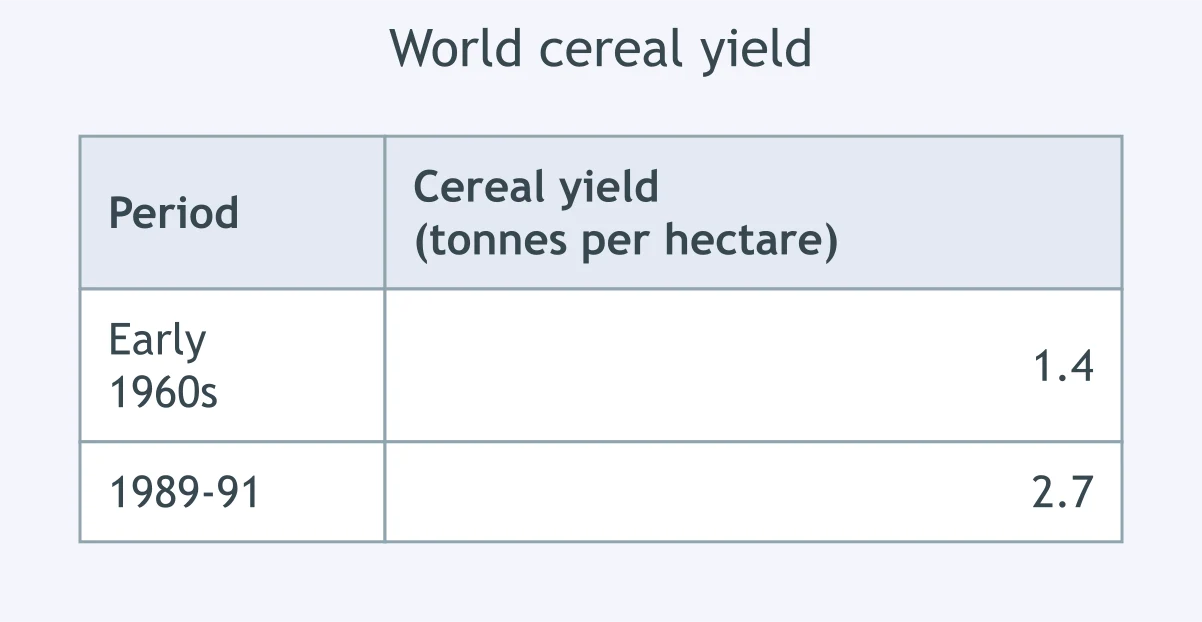
Why did irrigation become a central part of the Green Revolution package in many regions?
Farmers who adopted Green Revolution wheat often stopped saving their own seed. What new dependence could this system create?
A region produces more rice from the same cultivated area after adopting improved varieties and inputs. Which agricultural change has occurred?
Fertilizer from intensively managed fields enters a lake. Which downstream outcome most strongly indicates eutrophication?
Nitrate fertilizer leaches below crop roots into an aquifer used for drinking water. What Green Revolution-related environmental cost does this illustrate?
An irrigated field has poor drainage, and water evaporates from the soil surface season after season. What problem is most likely to develop?
Farmers pump groundwater for irrigation faster than the aquifer can recharge. What is the most direct result?
A farming region plants only a few genetically similar rice varieties over large areas. Why can this Green Revolution pattern be risky?
A smallholder cannot afford improved seed, fertilizer, or irrigation equipment. Which trade-off of the Green Revolution is illustrated?
Which description identifies a genetically modified organism rather than a conventionally bred crop?
Maize is engineered with a gene that causes it to produce a Bt protein toxic to certain insect larvae. What does this trait do for the grower?
A soybean is genetically engineered to tolerate a particular broad-spectrum herbicide. What can a farmer do after the crop emerges?
A crop receives a gene that confers resistance to a plant virus. What is the intended result?
A breeder introduces a drought-tolerance trait into a crop. What is the trait intended to change?
A crop is engineered to accumulate more β-carotene in its edible tissue. What modification outcome is intended?
A field of Bt maize is planted without a nearby non-Bt refuge. Which outcome becomes more likely over time?
A farmer repeatedly uses the same herbicide with herbicide-tolerant crops for many seasons. What trade-off may result?
Pollen from a herbicide-tolerant crop fertilizes a compatible wild relative nearby. What ecological concern does this illustrate?
When a crop is engineered to make a novel protein, which human-health concern is evaluated before food use?
GM and non-GM corn are harvested and transported in the same equipment without cleaning between loads. What concern does this most directly raise?
A farmer pays more for insect-resistant seed and a technology fee. In which situation is that added cost least likely to be offset by the trait's benefit?
Crack the passcode before the zombies get in.
Answer, then swat bugs for bonus points.
Race through questions at your own speed.
Same question on every screen. Fastest wins.

Pick a tile, answer, hit bonuses and steals.
Food Security and Malnutrition
25 questions