Loading
by BlastRoom
Industrial and Sustainable Agriculture for high school Environmental Science, on-level and AP. Covers AP Environmental Science Units 4 and 5: Earth Systems, Land and Water Use.
#environmental_science

30 questions
One question set, multiple game modes. Tap any game to see it in action. Not sure which to pick?
Answer to place stones and capture territory.
Outrun the snow together.
Earn blasts, then hunt the other team.
Answer to earn energy, then climb.

The class blasts through walls together.
Bid on mystery lots. Most money wins.
Sell tours. Nice, standard, or a total scam.

Answer, restock, and serve the rush.
More correct answers pulls the rope your way.
Answer, then shoot down the alien wave.
Answer, then tap to leap the frozen ridge.
A farm grows corn across thousands of hectares using heavy machinery, synthetic fertilizer, and one harvest schedule. What agricultural system is it using?
Thousands of cattle are confined in pens and fed delivered grain, while manure is collected in a nearby lagoon. What system is described?
A grower plants seeds directly into last season's crop residue and does not plow the field. Which practice is this?
After harvesting soybeans, a farmer plants rye solely to protect the field through winter before planting corn. What practice is being used?
On a sloping field, crop rows follow the land's elevation lines rather than running straight downhill. What erosion-control practice is this?
A farmer turns a steep hillside into a series of broad, level steps that can be planted. What practice is this?
One field is planted with corn one year, soybeans the next, and wheat the following year in a planned sequence. What system is this?
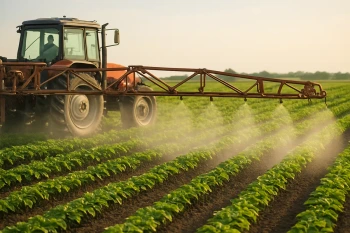
A grower scouts fields, identifies pests, uses action thresholds, and applies a targeted pesticide only when needed. What approach is this?
Heavy rain follows an excessive fertilizer application, and nitrogen and phosphorus enter a pond. What downstream effect is most likely?
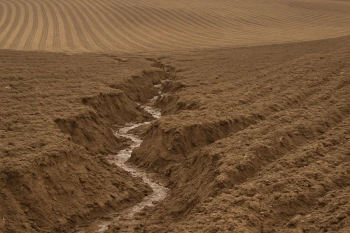
A farmer repeatedly plows a bare field before spring storms. What soil-related environmental cost is most likely?
In an arid irrigated field, water evaporates after each application and a white crust forms on the soil surface. What problem is developing?
A region plants the same susceptible crop year after year, and an insect pest becomes increasingly common. Which missing practice would most directly have helped disrupt the pest cycle?
An insecticide kills aphids but also kills ladybugs that prey on aphids. What environmental cost of this broad-spectrum pesticide is shown?
Goats graze the same dry rangeland continuously until little plant cover remains. After a storm, what impact is most likely?
A farmer uses the same herbicide every year. Resistant weeds survive and reproduce, so higher doses are needed later. What is this pattern called?
Manure from a feedlot is stockpiled on bare ground beside a creek. During rainfall, what is the main risk to the creek?
A farmer alternates a nitrogen-fixing legume with a cereal instead of growing the cereal every year. What benefit can follow?
Compared with conventional plowing, no-till leaves crop residue on the soil surface. What benefit does that residue provide?
How does planting a cover crop during a fallow season differ environmentally from leaving soil bare?
A sloping field is planted in rows running downhill, then converted to rows following contours. What change is expected?
Integrated pest management combines several kinds of pest control. Which IPM tactic is an example of biological control?
A ranch divides pasture into paddocks and moves cattle before plants are grazed to the ground. Compared with continuous grazing, what is a likely benefit?
A field uses drip irrigation instead of flooding the entire surface. What is the main water-use advantage?
A farmer replaces a single-crop system with a diverse crop rotation. Which comparison is accurate?
Use the table. A grower must reduce nutrient runoff by at least 50 percent. Which conclusion is supported?
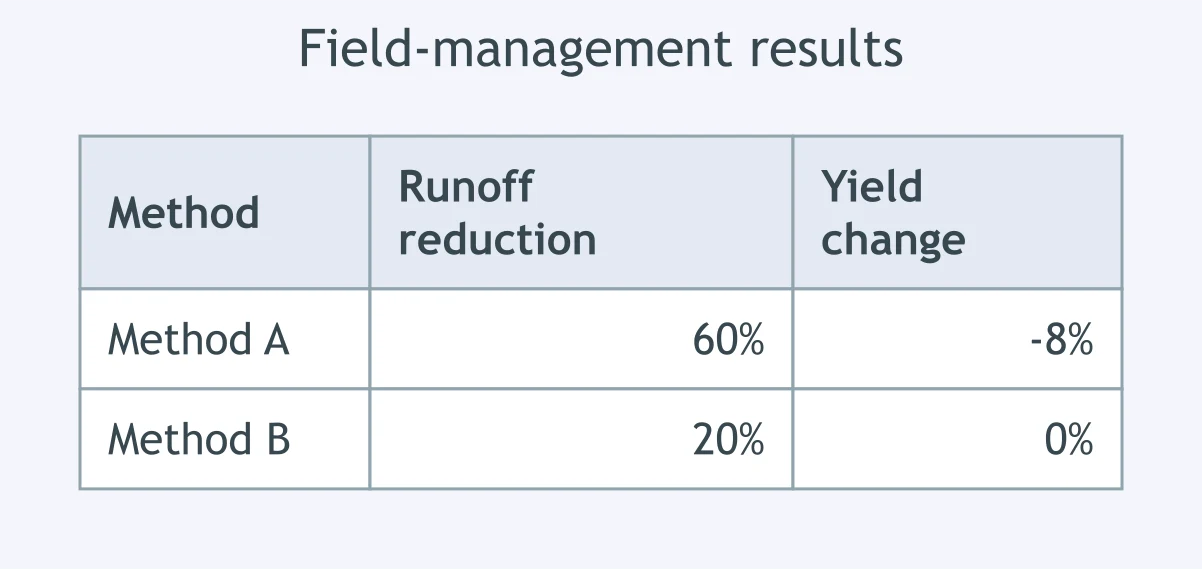
A farm needs both at least a 40% runoff reduction and at least 9.5 tonnes per hectare yield. Method A cuts runoff 45% but yields 9.3 tonnes; Method B cuts runoff 35% but yields 9.8 tonnes. What follows?
An organic row-crop farm replaces synthetic herbicides with repeated mechanical cultivation for weed control. What trade-off is most accurate?
A cotton farm adopts Bt seed, and insecticide sprays against its target pest decline. Years later, some target insects evolve resistance. What trade-off does this show?
A corn farm shifts to no-till, leaving residue and making fewer equipment passes, but relies mainly on herbicides for weed control. Which trade-off is accurate?
A farm must produce 800 tonnes of grain. System X yields 8 tonnes per hectare and uses 180 kg of synthetic nitrogen per hectare; System Y yields 5 tonnes per hectare and uses no synthetic nitrogen. If added land replaces grassland, what follows?
Crack the passcode before the zombies get in.
Answer, then swat bugs for bonus points.
Race through questions at your own speed.
Same question on every screen. Fastest wins.

Pick a tile, answer, hit bonuses and steals.
Pesticides, Pest Control and IPM
30 questions