Loading
by BlastRoom
Practice selecting, interpreting, and evaluating standard environmental field-sampling methods.
#environmental_science

25 questions
One question set, multiple game modes. Tap any game to see it in action. Not sure which to pick?
Answer to place stones and capture territory.
Outrun the snow together.
Earn blasts, then hunt the other team.
Answer to earn energy, then climb.

The class blasts through walls together.
Bid on mystery lots. Most money wins.
Sell tours. Nice, standard, or a total scam.

Answer, restock, and serve the rush.
More correct answers pulls the rope your way.
Answer, then shoot down the alien wave.
Answer, then tap to leap the frozen ridge.
A team wants to estimate plant species richness and the abundance of each species across a meadow without surveying the entire meadow. Which method best fits?
Biologists need an estimate of the population size of a mobile salamander species in a forest pond. Which field method should they use?
An ecologist wants to document how plant communities shift from a salt marsh shoreline to higher, drier ground. Which method is most suitable?
Residents suspect fertilizer runoff is raising nitrate concentration downstream of farms. What sampling approach best tests this claim?
A land manager needs to compare how quickly rainwater enters compacted trail soil versus nearby undisturbed soil. Which method fits this field question?
After road construction, a class wants to quantify suspended sediment in a nearby stream. Which measurement should they collect?
A stream survey seeks organisms that can help indicate whether water quality has been degraded by organic pollution. Which approach best fits?
Ecologists record every plant touching a tape stretched from a streambank into an adjacent forest. What does this transect primarily measure?
In a prairie, students count individuals of each plant species inside many equally sized quadrats. What can they estimate from these data?
A researcher marks 40 turtles, releases them, and later records the fraction of captured turtles that are marked. What is mark-recapture designed to estimate?
A probe reports 4 mg/L dissolved oxygen in a warm stream pool. What does this reading most likely suggest?
A field team uses a turbidity meter before and after a storm. What change is the meter intended to detect?
Students separate a soil sample into sand, silt, and clay fractions. What property are they determining?
For a mark-recapture estimate of a frog population, what must happen after the first capture before the second sample is collected?
What assumption about a mark is needed for a mark-recapture study to estimate population size accurately?
A class uses quadrats to estimate dandelion density throughout a school field. What assumption makes randomly located quadrats useful?
A team samples vegetation at fixed intervals along a transect from a shaded forest interior to an open clearing. What must be true for the transect to describe the gradient?
Before comparing dissolved oxygen at two stream sites, what assumption is required about the measuring probe?
A class compares nitrate at an upstream reference site and a downstream site. What assumption supports attributing a higher downstream value to runoff between the sites?
A student places every vegetation quadrat on the flat, mowed edge of a meadow rather than at random locations. How does this affect the estimate?
In a mark-recapture study, many marked fish leave a pond between sampling visits. Why is the population estimate invalid?
A team collects a nitrate sample in a bottle that previously held fertilizer and was not rinsed. What is the likely problem?
Students collect stream water for turbidity analysis but leave the container undisturbed overnight before measuring it. Why might the result be invalid?
A group compares soil percolation in two habitats but pours 500 mL of water into one test and 250 mL into the other. What makes the comparison invalid?
A stream team samples macroinvertebrates only from a slow, silty pool, then claims the results describe the entire stream reach. What is the flaw?
Crack the passcode before the zombies get in.
Answer, then swat bugs for bonus points.
Race through questions at your own speed.
Same question on every screen. Fastest wins.

Pick a tile, answer, hit bonuses and steals.
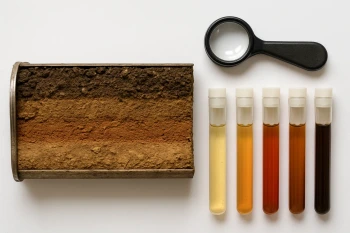
Soil Testing and Land Assessment
20 questions