Loading
by BlastRoom
Achievements in mathematics, medicine, astronomy, and the preservation of classical learning.
#world_history
30 questions
One question set, multiple game modes. Tap any game to see it in action. Not sure which to pick?
Answer to place stones and capture territory.
Outrun the snow together.
Earn blasts, then hunt the other team.
Answer to earn energy, then climb.

The class blasts through walls together.
Bid on mystery lots. Most money wins.
Sell tours. Nice, standard, or a total scam.

Answer, restock, and serve the rush.
More correct answers pulls the rope your way.
Answer, then shoot down the alien wave.
Answer, then tap to leap the frozen ridge.
A Persian physician finished a five-book medical encyclopedia around 1025 that European schools used for centuries. Who wrote it?
A 900s physician wrote a treatise that separated smallpox from measles rather than treating them as one eruptive fever. Who was he?
In the Book of Optics, a scholar argued that sight happens when light enters the eye from objects, not when rays leave the eye. Who made that argument?
Which scholar wrote the algebra treatise Hisab al-jabr wal-muqabala in Abbasid Baghdad around 820?
An 11th-century scholar completed al-Qanun al-Mas'udi, a large astronomy work with mathematical tables and derivations. Who was he?
Which mathematician's Treatise on Algebra gave a systematic geometric treatment of many cubic equations using conic sections?
Baghdad's most productive 9th-century medical translator made many Syriac and Arabic versions of Galen's works. Who was he?
A Harran-born mathematician and astronomer revised or translated Greek works such as Euclid, Archimedes, Apollonius, and Ptolemy into Arabic. Who was he?
In Córdoba around 1000, a physician ended Al-Tasrif with a surgical volume that illustrated many instruments. Who wrote it?
Which earlier source strongly shaped the numerals that Arabic mathematicians explained and later Europeans adopted?
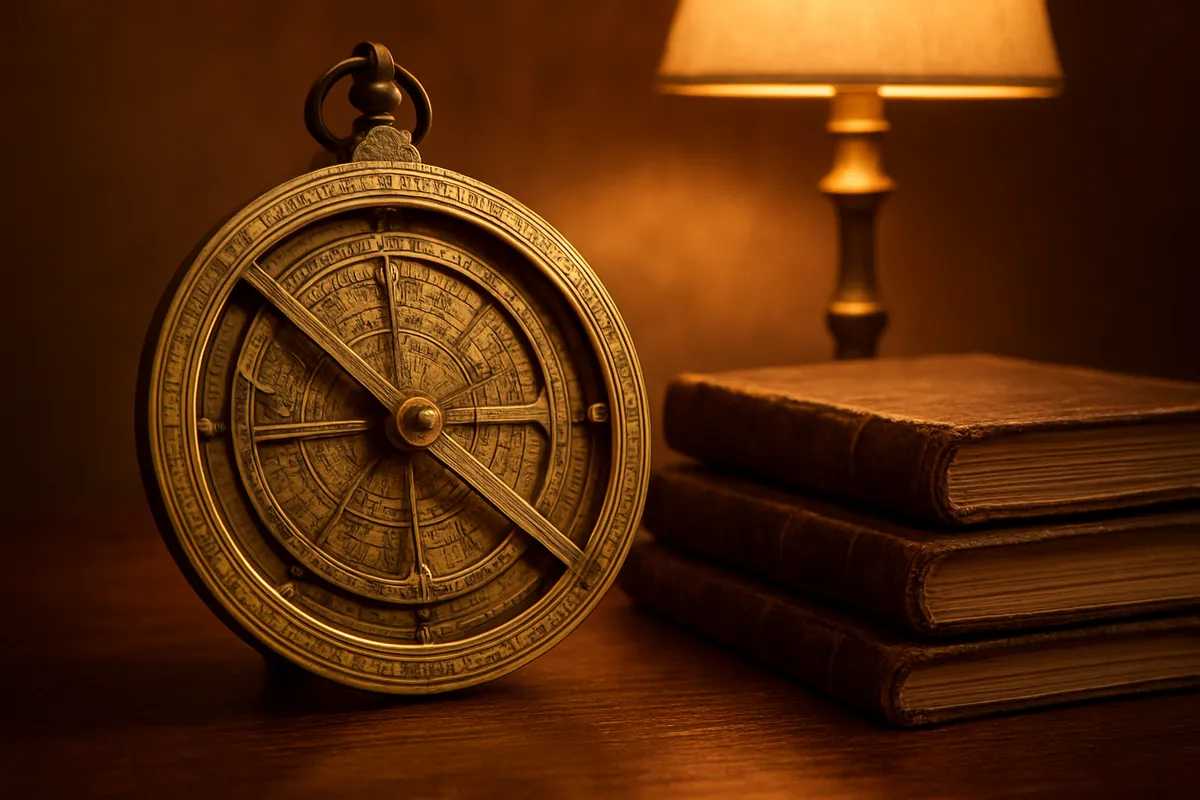
A brass disk with rotating plates could help an astronomer find time, star positions, and the direction of Mecca by sighting a star. What was it?
Medieval astronomers compiled works called zij. What did a zij usually provide?
Al-jabr and al-muqabala in al-Khwarizmi's algebra referred to what kind of work with equations?
Why did place-value numerals change calculation compared with Roman numerals?
An astronomer working at ar-Raqqa in the late 800s and early 900s calculated the length of the solar year to within about two minutes of the modern value. Who was he?
Which mathematical resource became central for computing arcs and angles in Islamic astronomy?
In medieval Islamic cities, what was a bimaristan?
Many hospitals were supported by permanent charitable endowments of property. What was that endowment called?
Which feature made major bimaristans centers of medical training, not just shelters for the sick?
Which physician described blood passing from the right side of the heart through the lungs before reaching the left side?
Hospital wards in large Islamic medical institutions were often organized by what practical need?
Under Abbasid patronage in Baghdad, scholars rendered Greek, Persian, and Indian learning into which scholarly language?
What technology reached Baghdad by the late 700s and made it cheaper to copy the growing number of translated manuscripts?
Which caliph is especially associated with expanding patronage for the House of Wisdom and observatories in the early 800s?
A Greek medical text by Galen entered Islamic medicine most directly when scholars did what with it?
Why is it misleading to say Islamic scholars only stored ancient learning?
In 12th-century Toledo, Gerard of Cremona became important because he did what?
Which classical geometry work reached Latin Europe through an Arabic-to-Latin tradition and appeared in a famous printed edition in 1482?
Fibonacci's Liber Abaci helped European merchants use what earlier-transmitted mathematical system?
The words algorithm and algebra show what kind of transmission from the Islamic world to Europe?
Crack the passcode before the zombies get in.
Answer, then swat bugs for bonus points.
Race through questions at your own speed.
Same question on every screen. Fastest wins.

Pick a tile, answer, hit bonuses and steals.
The Medieval Church and Monasticism
25 questions