Loading
by BlastRoom
Argue from evidence how the masses of interacting objects change the strength of gravitational attraction.
#us_grade_8_science

40 questions
One question set, multiple game modes. Tap any game to see it in action. Not sure which to pick?
Answer to place stones and capture territory.
Outrun the snow together.
Earn blasts, then hunt the other team.
Answer to earn energy, then climb.

The class blasts through walls together.
Bid on mystery lots. Most money wins.
Sell tours. Nice, standard, or a total scam.

Answer, restock, and serve the rush.
More correct answers pulls the rope your way.
Answer, then shoot down the alien wave.
Answer, then tap to leap the frozen ridge.
A student claims that a more massive object produces a stronger gravitational pull. Which observation best supports that claim?
A science club claims that gravitational attraction depends on mass. Which laboratory result best supports that claim?

A student claims that a planet with more mass pulls harder on objects at its surface. Which observation supports that claim?
A student claims that gravity acts between ordinary objects, not only planets, and grows with mass. Which observation best supports both parts of that claim?
A student claims that a more massive body pulls its moons more strongly. Which observation best supports that claim?
A student claims that the attraction depends on the masses of both objects, not just one. Which laboratory result supports that claim?
A student claims that Earth's pull on an object depends on the object's mass rather than its size. Which observation best supports that claim?
A student claims that attraction depends on how much mass an object has, not on what it is made of. Which measurement supports that claim?
A student claims that a body with less mass pulls objects toward it less strongly. Which observation from the Apollo missions supports that claim?
A student claims that even two people attract each other gravitationally, but far too weakly to notice. Which observation best supports that claim?
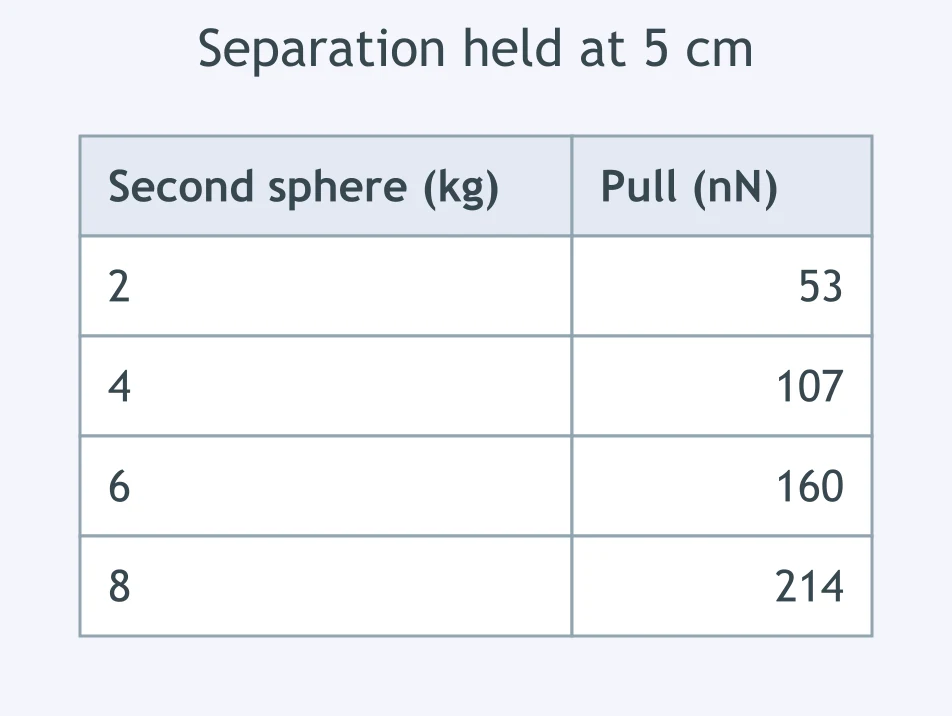
The table shows the pull measured between a fixed 1 kg sphere and second spheres of different mass, each held 5 cm away. Which claim do the data support?
A balance measures the pull between a fixed 3 kg sphere and second spheres 6 cm away: 1 kg, 56 nN; 2 kg, 111 nN; 3 kg, 167 nN. Which claim do these data support?
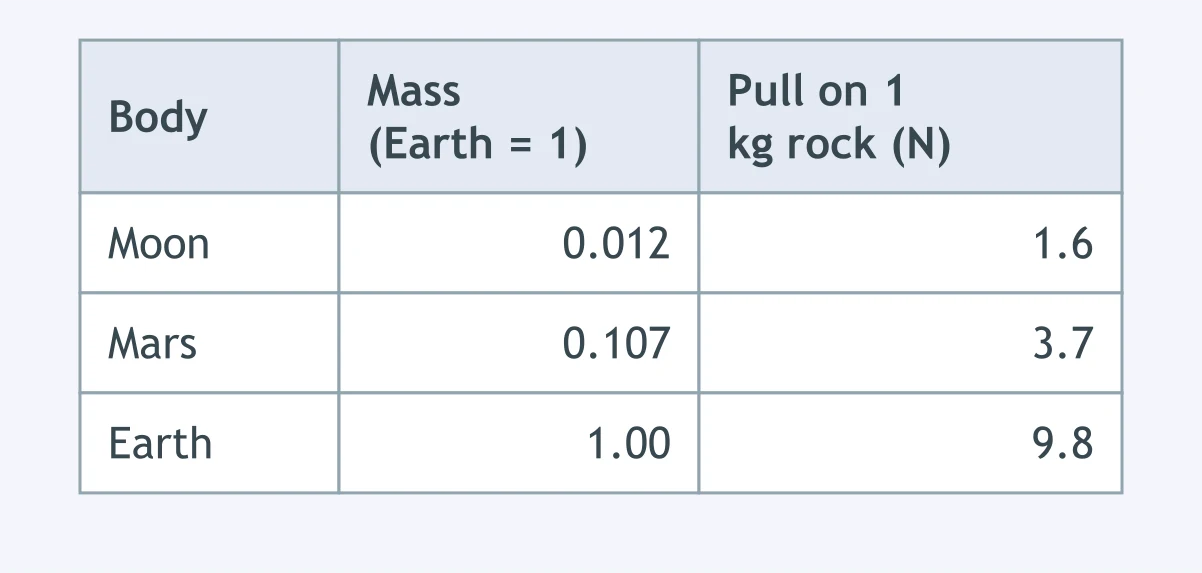
The table lists three bodies, their masses, and the pull each exerts on the same 1 kg rock resting at its surface. Which claim do the data support?
A balance measures the pull between a fixed 2 kg sphere and second spheres 10 cm away: 1 kg, 13 nN; 3 kg, 40 nN; 5 kg, 67 nN. Which claim goes beyond these data?
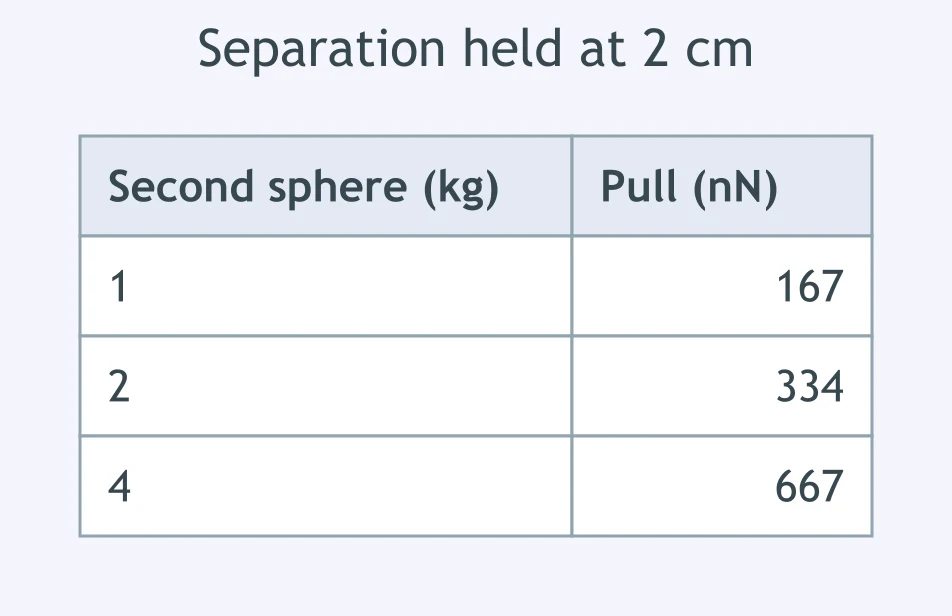
The table shows the attraction measured between a fixed 1 kg sphere and second spheres held 2 cm away. Which claim do the data support?
With separation fixed at 5 cm, a 0.5 kg sphere is attracted to second spheres of 2 kg (27 nN), 4 kg (53 nN), and 8 kg (107 nN). What do these data show?
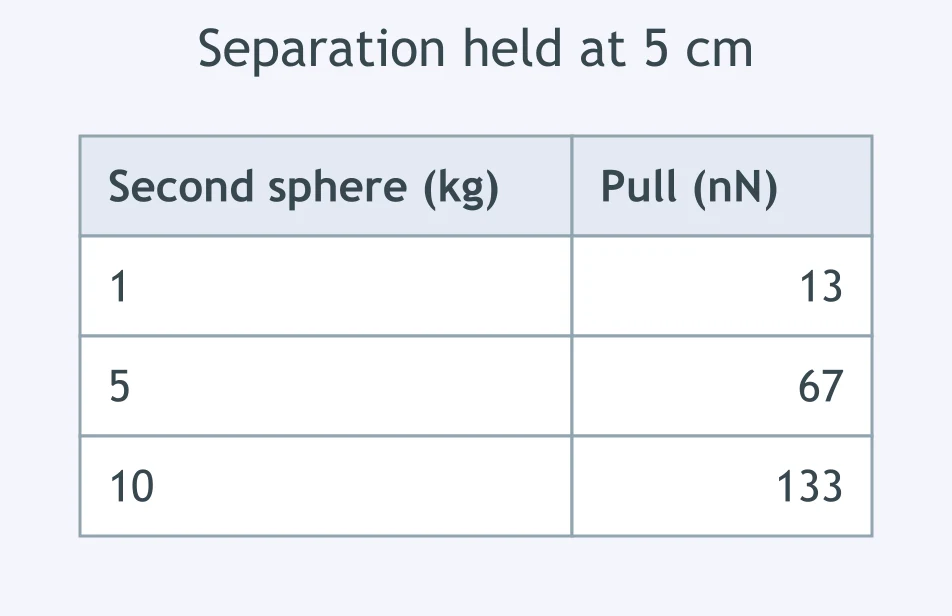
The table shows the pull between a fixed 5 kg sphere and second spheres held 20 cm away. Which conclusion is best supported by these measurements?
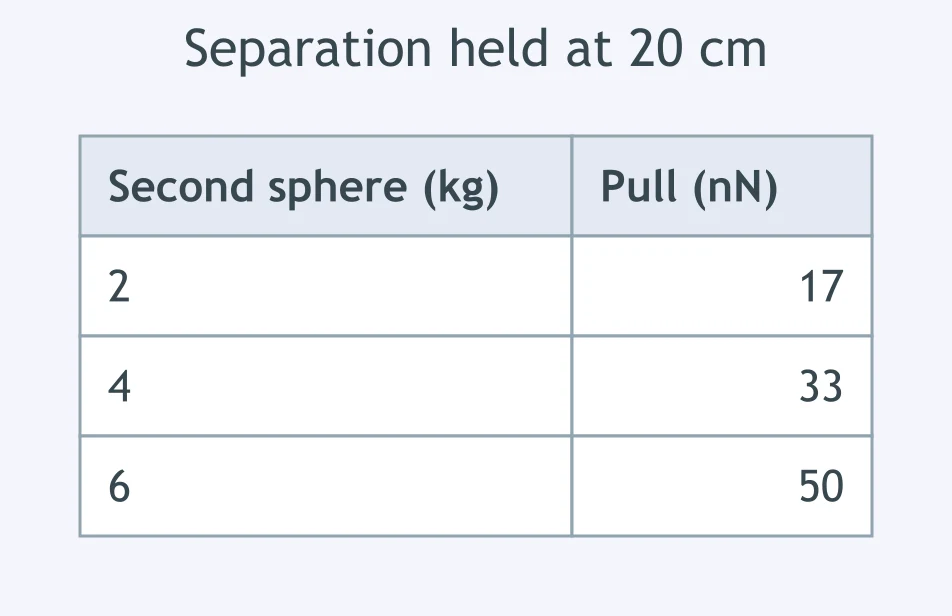
A fixed 4 kg sphere attracts second spheres held 8 cm away: 1 kg, 42 nN; 2 kg, 83 nN; 3 kg, 125 nN. Which claim do these measurements support?
With a 10 kg sphere fixed and second spheres 50 cm away, a balance reads 13 nN for 5 kg, 27 nN for 10 kg, and 53 nN for 20 kg. What do these readings show?
The table shows attraction measured between a fixed 1 kg sphere and second spheres at a constant 5 cm separation. Which statement about the data is accurate?
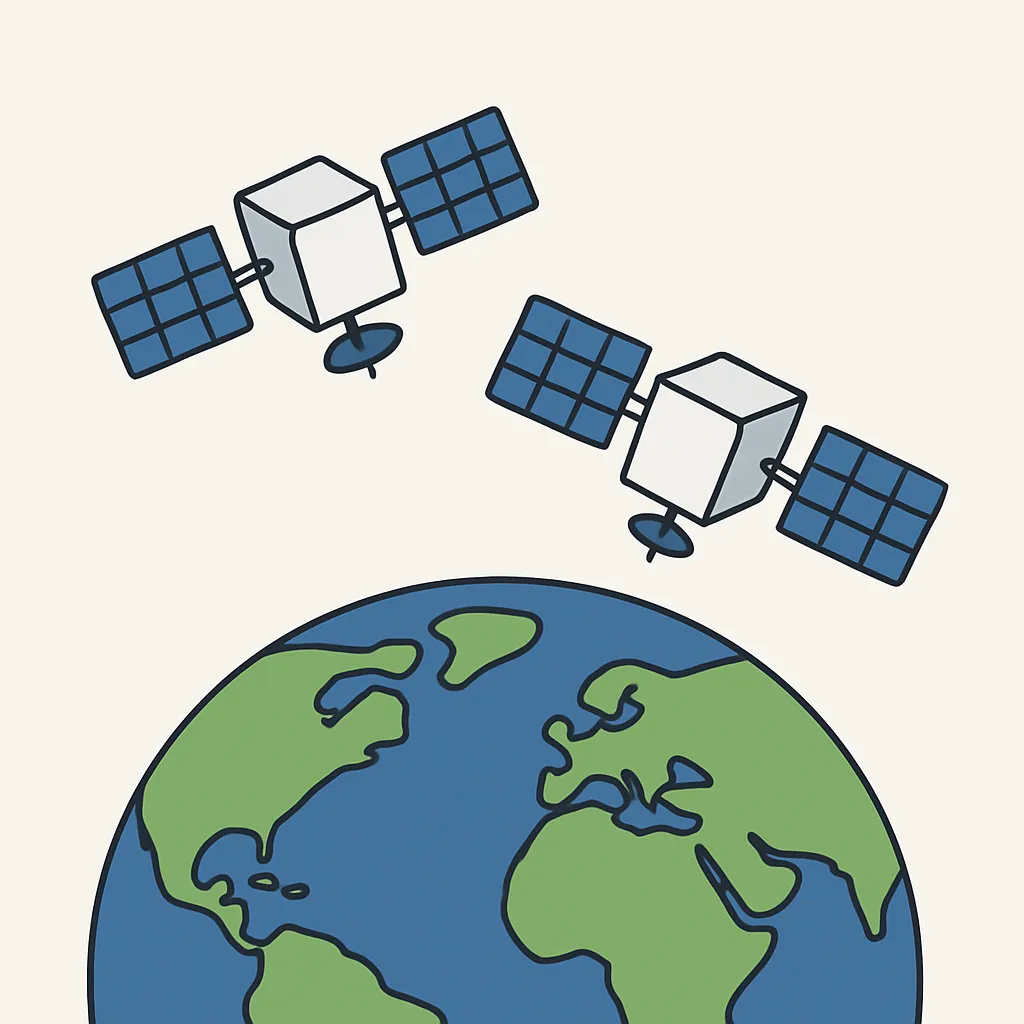
A student argues: Earth pulls on the Moon, but the Moon does not pull back on Earth, because Earth is far more massive. Which evidence shows this argument is wrong?
A student argues that gravity acts only on objects that are touching the ground or very close to it. Which evidence shows this argument is wrong?
A student argues that two bowling balls on a table have exactly zero gravitational attraction because neither one is a planet. Which evidence refutes this argument?
A student argues that Earth pulls harder on a heavy ball than a light one, so the heavy ball must reach the ground first. Which evidence refutes that argument?

A student argues that astronauts float inside the space station because there is no gravity 400 km above Earth. Which evidence shows this argument is wrong?

A student argues that gravity can push two objects apart when they are very far from each other. Which evidence shows this argument is wrong?
A student argues that the Sun cannot be pulling on Earth, because Earth never falls into the Sun. Which evidence refutes this argument?
A student argues that a dropped apple is pulled by Earth but does not pull back on Earth at all. Which evidence shows the argument is wrong?
Two pairs of objects sit the same distance apart. Pair 1 is a 3,000 kg elephant and a 60 kg student. Pair 2 is the same elephant and a 600 kg horse. Which pair attracts more strongly?
Two pairs of spheres are each held 10 cm apart. Pair 1 is 2 kg and 12 kg. Pair 2 is 4 kg and 6 kg. How do the gravitational forces in the two pairs compare?
Two 500 kg satellites drift 100 m apart. In a second test a 4,000 kg satellite replaces one of them, still 100 m away. What happens to the attraction between them?
A 2 kg sphere and a 3 kg sphere are held 5 cm apart. The 2 kg sphere is then swapped for a 6 kg sphere at the same 5 cm separation. How does the attraction change?
Two pairs of objects are the same distance apart. Pair 1 is a 7,000 kg school bus and a 1 kg book. Pair 2 is a 70 kg person and the same book. Which attraction is stronger?
Pair 1 is two 1 kg spheres and Pair 2 is two 2 kg spheres. Both pairs are held 8 cm apart. Which pair attracts more strongly, and why?
A 5,000 kg truck and a 70 kg person stand 3 m apart. The same person then stands 3 m from a 1,200 kg car. In which case is the gravitational attraction greater?

Four students write statements about gravity. Which statement is contradicted by what is observed?
Four claims are made about gravity acting on spacecraft. Which one is contradicted by what spacecraft are actually observed to do?
Students compare a 2 kg ball and a 10 kg ball on Earth. Which statement about the two balls is contradicted by measurement?
Four statements describe how gravitational attraction depends on mass. Which one is contradicted by laboratory observation?
Four statements describe objects falling near Earth's surface. Which one is contradicted by what students observe inside a sealed vacuum tube?

Crack the passcode before the zombies get in.
Answer, then swat bugs for bonus points.
Race through questions at your own speed.
Same question on every screen. Fastest wins.

Pick a tile, answer, hit bonuses and steals.
Magnets and Electromagnets
20 questions