Loading
by BlastRoom
The New Right, supply-side economics, deregulation and a rebuilt military in the Reagan years.
#united_states_history

30 questions
One question set, multiple game modes. Tap any game to see it in action. Not sure which to pick?
Answer to place stones and capture territory.
Outrun the snow together.
Earn blasts, then hunt the other team.
Answer to earn energy, then climb.

The class blasts through walls together.
Bid on mystery lots. Most money wins.
Sell tours. Nice, standard, or a total scam.

Answer, restock, and serve the rush.
More correct answers pulls the rope your way.
Answer, then shoot down the alien wave.
Answer, then tap to leap the frozen ridge.
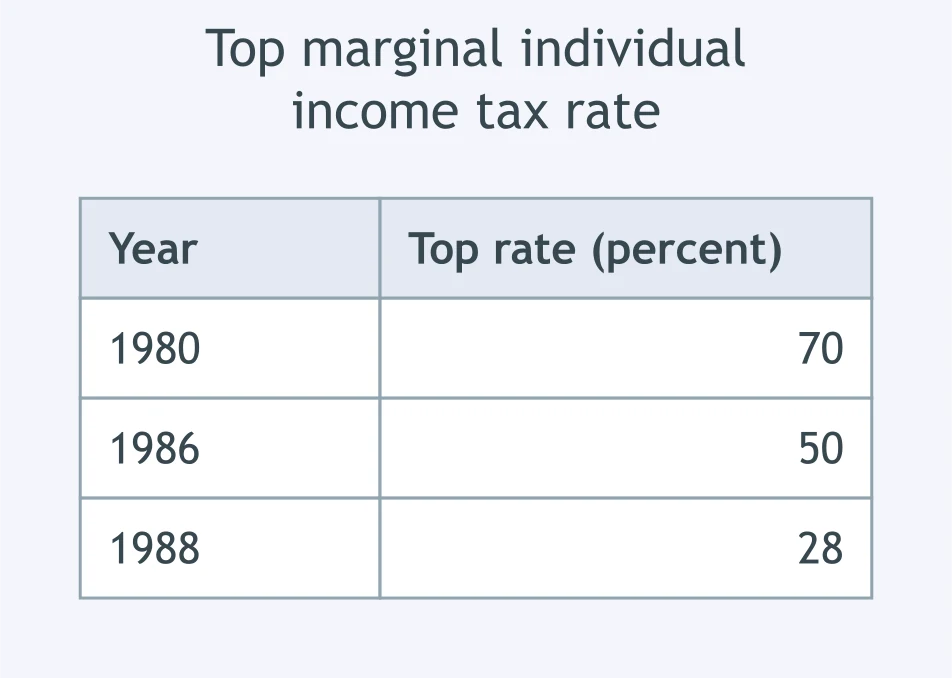
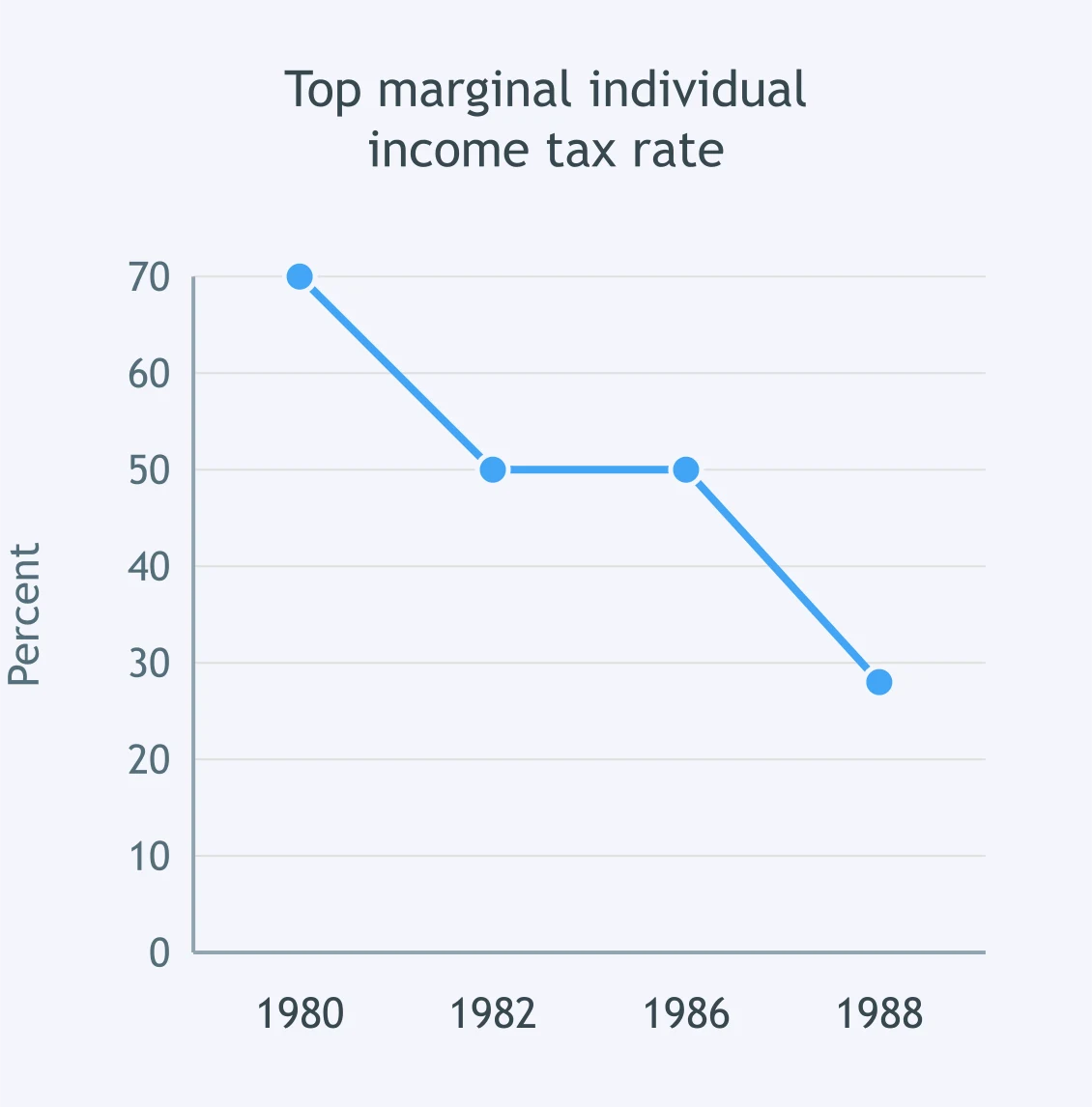
Use the table of the top marginal federal individual income tax rate. By how many percentage points did the top rate fall between 1986 and 1988?
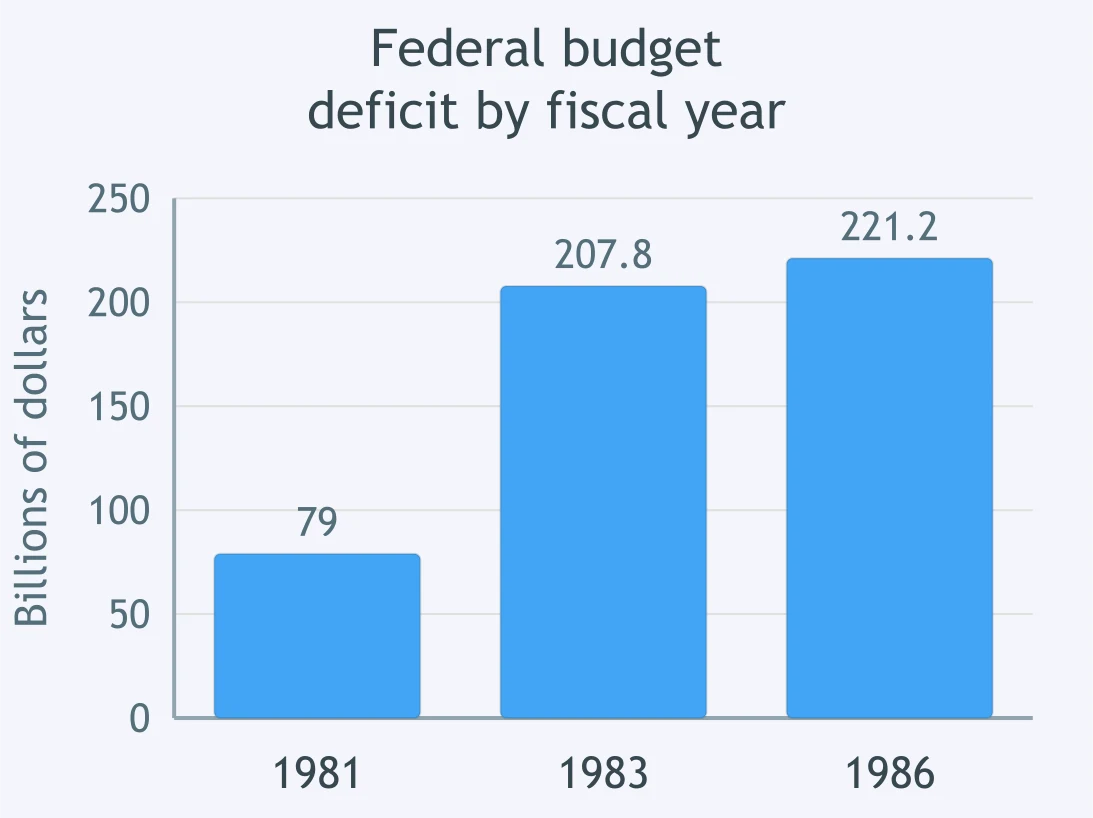
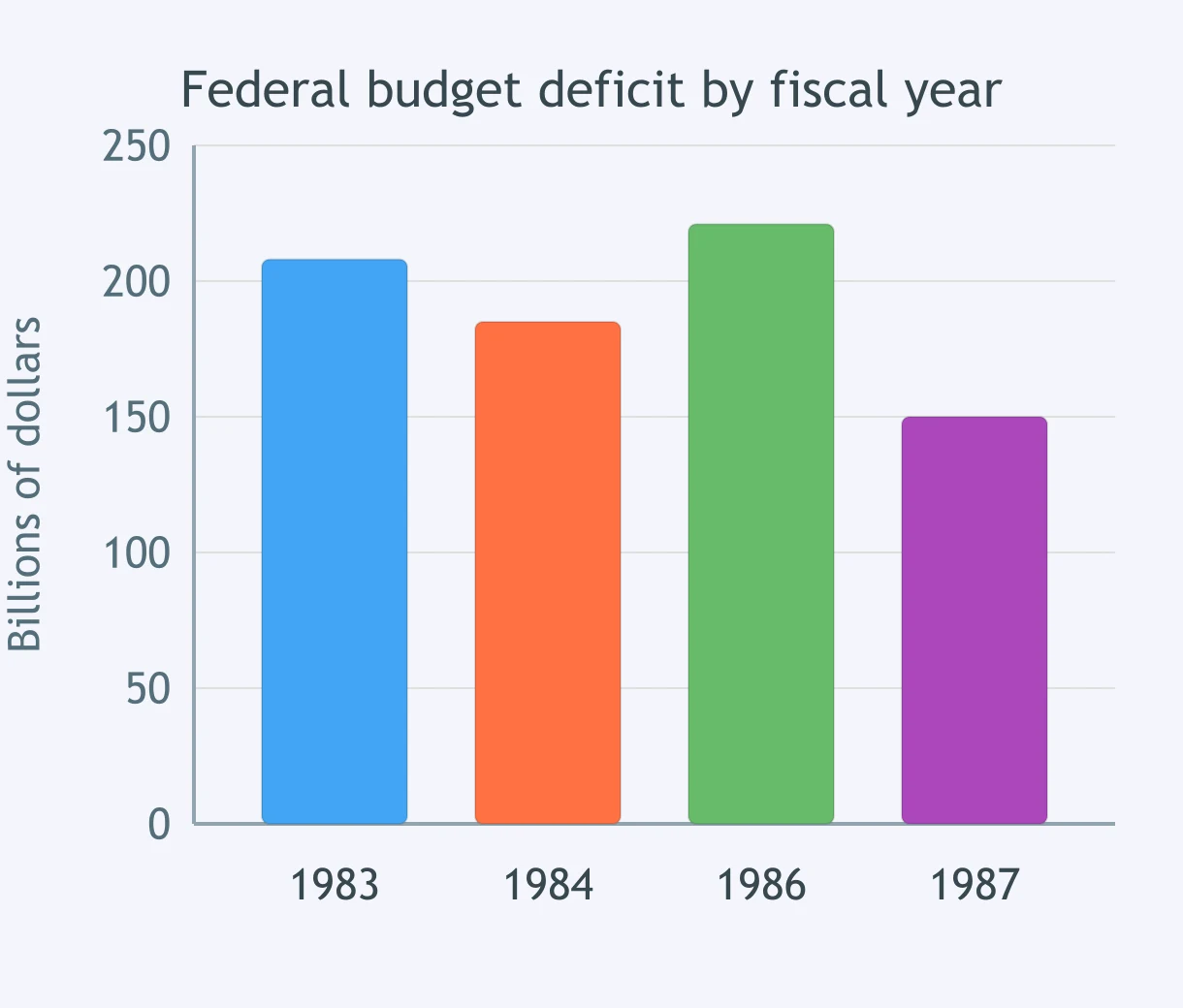
Use the bar chart of the federal budget deficit by fiscal year. How much larger was the deficit in fiscal year 1983 than in fiscal year 1981?
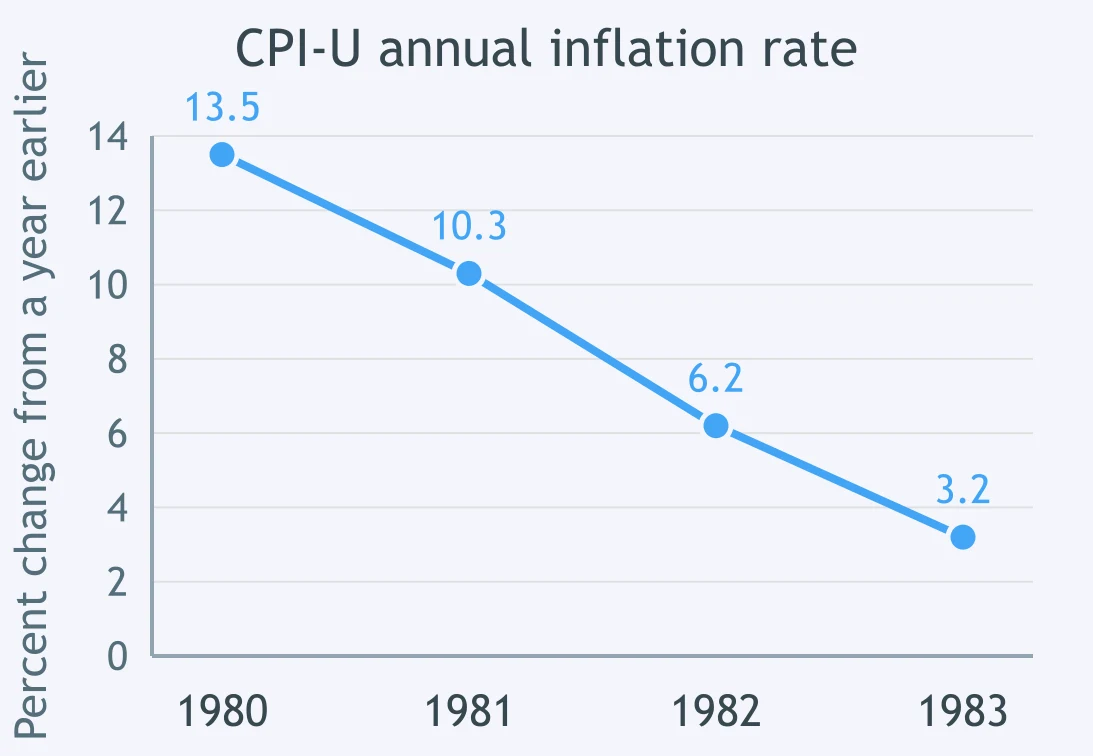
Use the line graph of the annual CPI-U inflation rate. By how many percentage points did the rate fall from 1980 to 1982?
Use the bar graph of the federal budget deficit. Which fiscal year shown had the smallest deficit?
Use the line graph of the top marginal federal individual income tax rate. What was the top rate in 1986?
In August 1981 about 13,000 federal air traffic controllers walked out, and the president fired roughly 11,000 of them who ignored his 48-hour order to return to work. Which union did the dismissed workers belong to?
Founded in 1979 by the Baptist minister Jerry Falwell, this group registered conservative evangelical voters and campaigned on abortion, school prayer and family policy. What was it called?
Signed in August 1981, this law cut individual income tax rates by roughly 25 percent phased over three years and was the centerpiece of the new administration's economic program. Which law was it?
This 1986 law lowered the top individual income tax rate to 28 percent while ending many deductions and tax shelters, so that lower rates applied to a broader base of income. Which law was it?
In 1981 Reagan nominated a judge of the Arizona Court of Appeals to the Supreme Court, and the Senate confirmed her 99-0, making her the first woman ever to sit on that Court. Who was she?
In a televised address in March 1983 the president proposed research on ground- and space-based systems meant to shoot down incoming ballistic missiles, a program critics nicknamed Star Wars. What was its official name?
This 1985 law set a falling deficit target for each year through 1991 and required automatic across-the-board spending cuts, called sequestration, whenever Congress missed a target. Which law was it?
In the 1984 presidential election the Democratic nominee carried only his home state of Minnesota and the District of Columbia, losing in the Electoral College 525 to 13. Who was that nominee?
In late 1986 it emerged that Reagan administration officials had secretly sold missiles to a Middle Eastern government to win the release of American hostages, and had sent part of the money to Nicaraguan rebels. What is this scandal called?
Backers of the 1981 tax cut argued that lower marginal rates would leave more with earners and investors, expand production, and in time bring in more revenue than the higher rates had. What is that argument called?
Eight days after taking office in January 1981 Reagan signed an executive order lifting the federal price and allocation controls placed on crude oil and gasoline during the 1970s energy crisis. What did the order do to those prices?
From 1982 Congress attached the Boland Amendment to spending bills, aimed at the US role in the war between the contras and Nicaragua's government. What was it designed to do?
To break double-digit inflation the Federal Reserve under Paul Volcker drove interest rates to record highs in 1980 and 1981. What happened in the US economy over the next two years?
The gross federal debt roughly tripled between 1981 and 1989.
The Garn-St Germain Act of 1982 let savings and loan associations move beyond home mortgages into commercial and construction lending while regulators eased their capital rules. What followed later in the decade?
The missile defense system Reagan proposed in 1983 was built and put into operation before he left office in January 1989.
Supporters of the Reagan economic program pointed to falling inflation and the recovery after 1982, while opponents pointed to annual deficits far above those of the 1970s. What were the two sides disagreeing about?
In his first inaugural address in January 1981, Reagan said government should "work with us, not over us" and "stand by our side, not ride on our back." What position does this state?
Standing at the Brandenburg Gate in West Berlin on June 12, 1987, Reagan made a direct public challenge to Mikhail Gorbachev in one of the best-known lines of his presidency. What did he call on the Soviet leader to do?
In a televised address on March 23, 1983, Reagan asked the scientific community "to give us the means of rendering these nuclear weapons impotent and obsolete." What was he proposing?
Speaking to the National Association of Evangelicals on March 8, 1983, Reagan warned against the temptation "to ignore the facts of history and the aggressive impulses of an evil empire." What position does the line state?
On December 8, 1987 Reagan and Gorbachev signed a treaty in Washington covering ground-launched missiles with ranges of 500 to 5,500 kilometers. What did the two countries agree to do with those missiles?
At their meeting in Reykjavik, Iceland in October 1986, Reagan and Gorbachev discussed deep cuts in nuclear arsenals but broke off without an agreement. Which issue blocked a deal?
Through the 1980s the United States sent money and weapons to anti-communist guerrillas fighting Soviet-backed governments in Afghanistan, Angola and Nicaragua. What is this policy of backing such movements called?
On October 25, 1983, days after a coup in which the prime minister was killed, US forces landed on this Caribbean island, citing the safety of American medical students and Cuban work on a large airstrip. Which island was it?
Crack the passcode before the zombies get in.
Answer, then swat bugs for bonus points.
Race through questions at your own speed.
Same question on every screen. Fastest wins.

Pick a tile, answer, hit bonuses and steals.
The 1990s: Globalization, Technology and a New World Order
30 questions