Loading
by BlastRoom
Practice using Q = mcΔT and explaining why water changes temperature slowly.
#physics
25 questions
One question set, multiple game modes. Tap any game to see it in action. Not sure which to pick?
Answer to place stones and capture territory.
Outrun the snow together.
Earn blasts, then hunt the other team.
Answer to earn energy, then climb.

The class blasts through walls together.
Bid on mystery lots. Most money wins.
Sell tours. Nice, standard, or a total scam.

Answer, restock, and serve the rush.
More correct answers pulls the rope your way.
Answer, then shoot down the alien wave.
Answer, then tap to leap the frozen ridge.
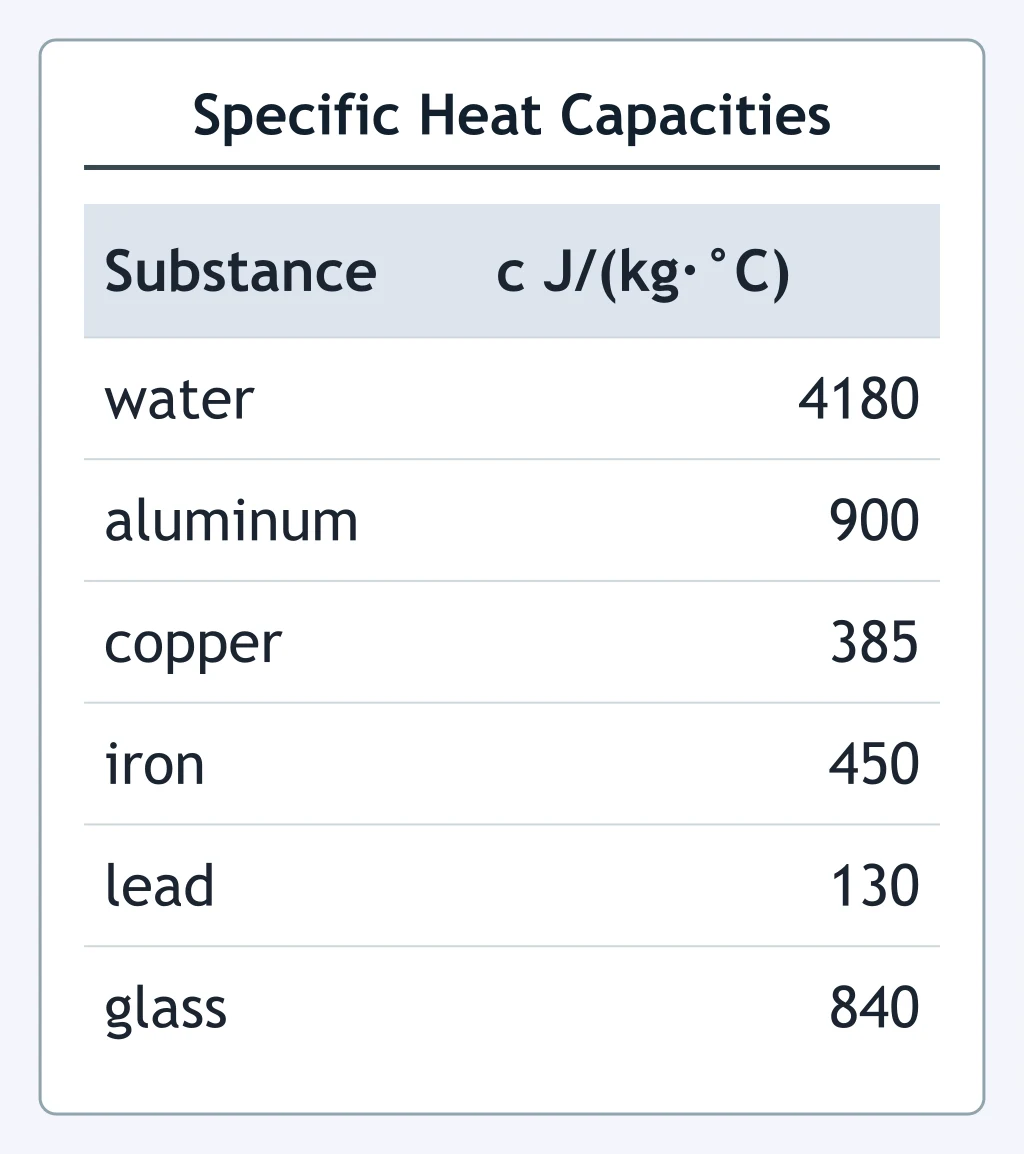
Use the table in the figure. A 0.30 kg block of aluminum is warmed from 20 °C to 45 °C with no energy escaping. How much energy does the block absorb?
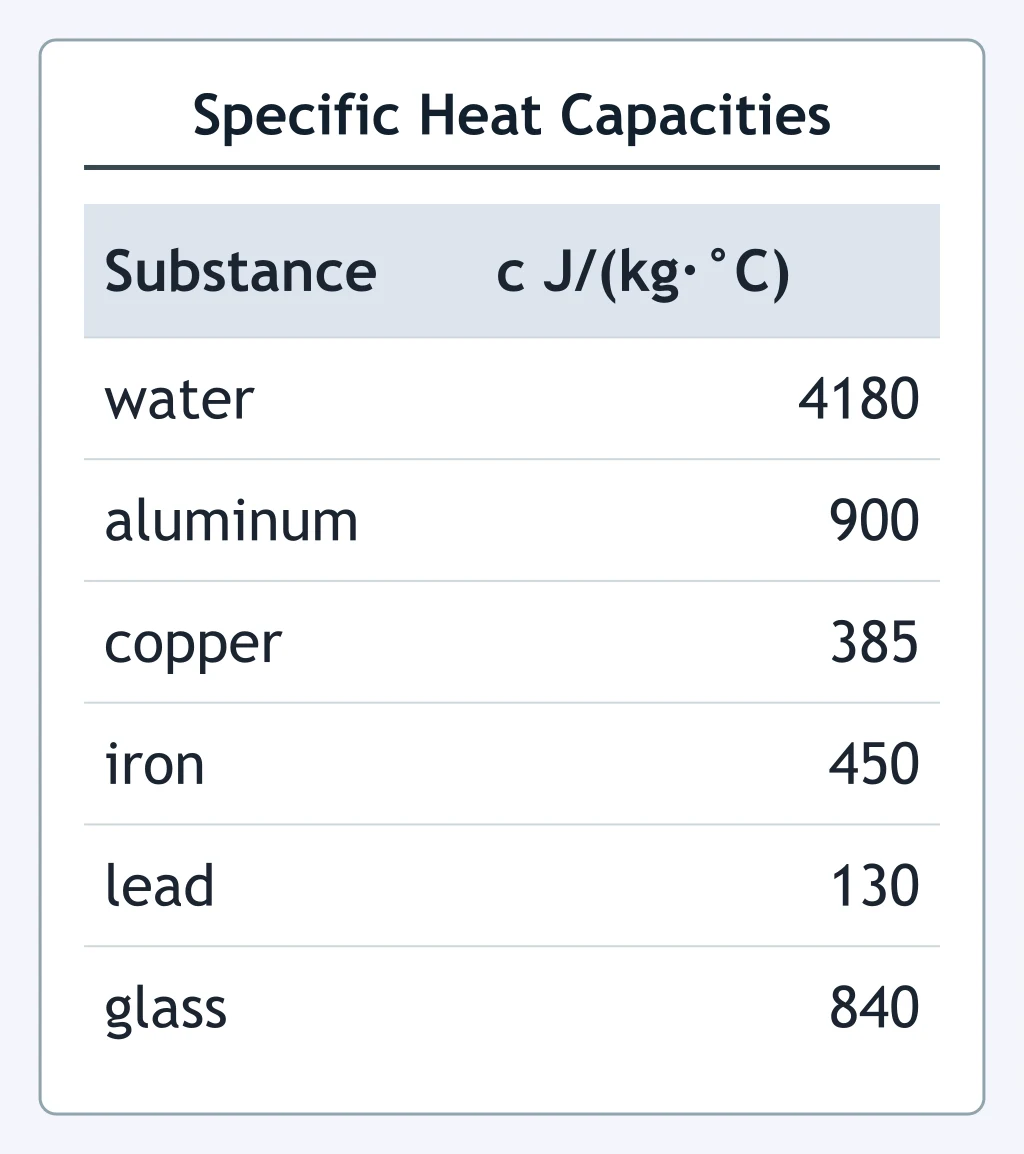
Use the table in the figure. A 2.0 kg copper block cools from 80 °C to 30 °C. What magnitude of thermal energy does it release?
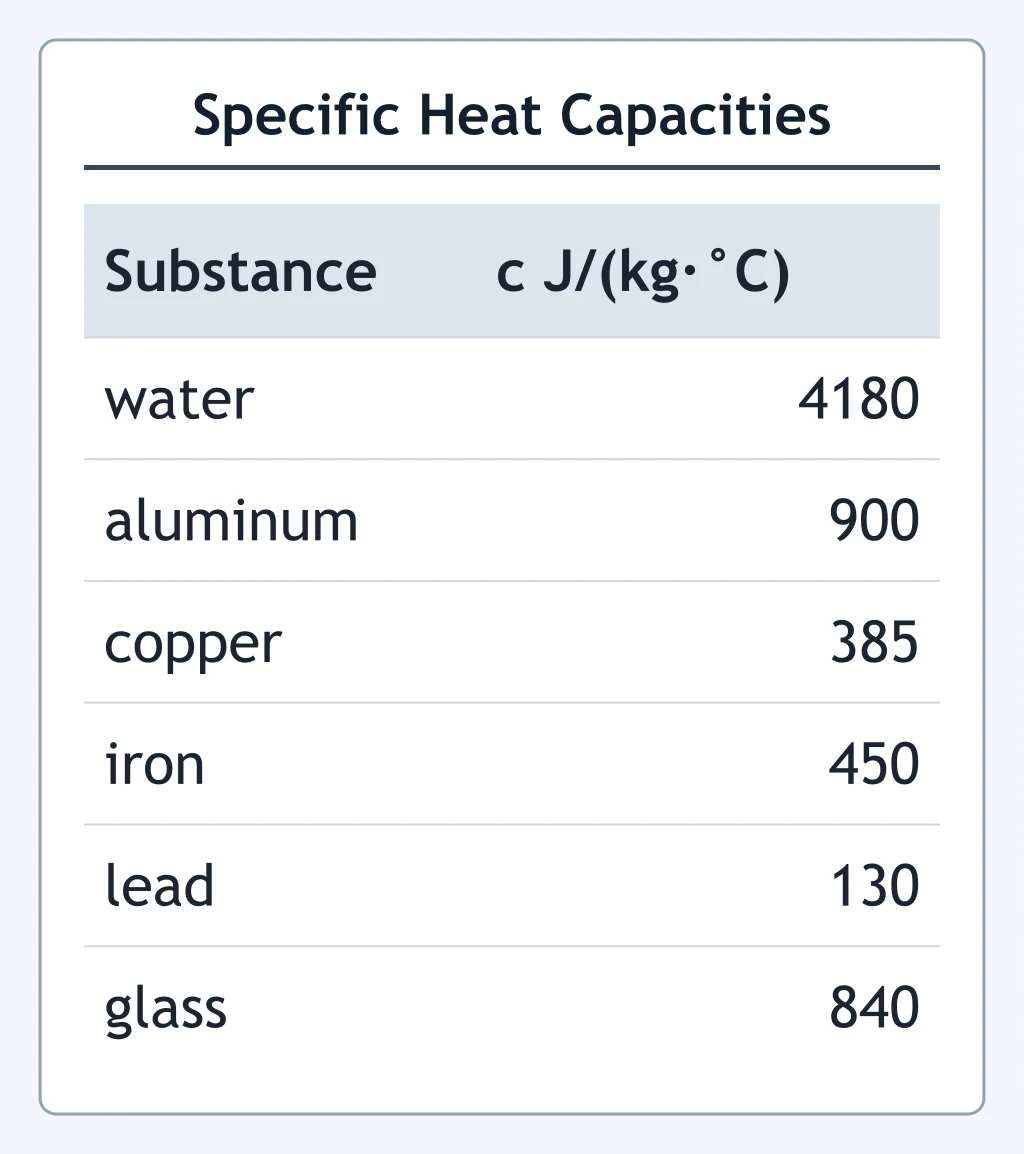
Use the table in the figure. A 0.75 kg sample of water warms from 18 °C to 28 °C. How much energy does the water absorb?
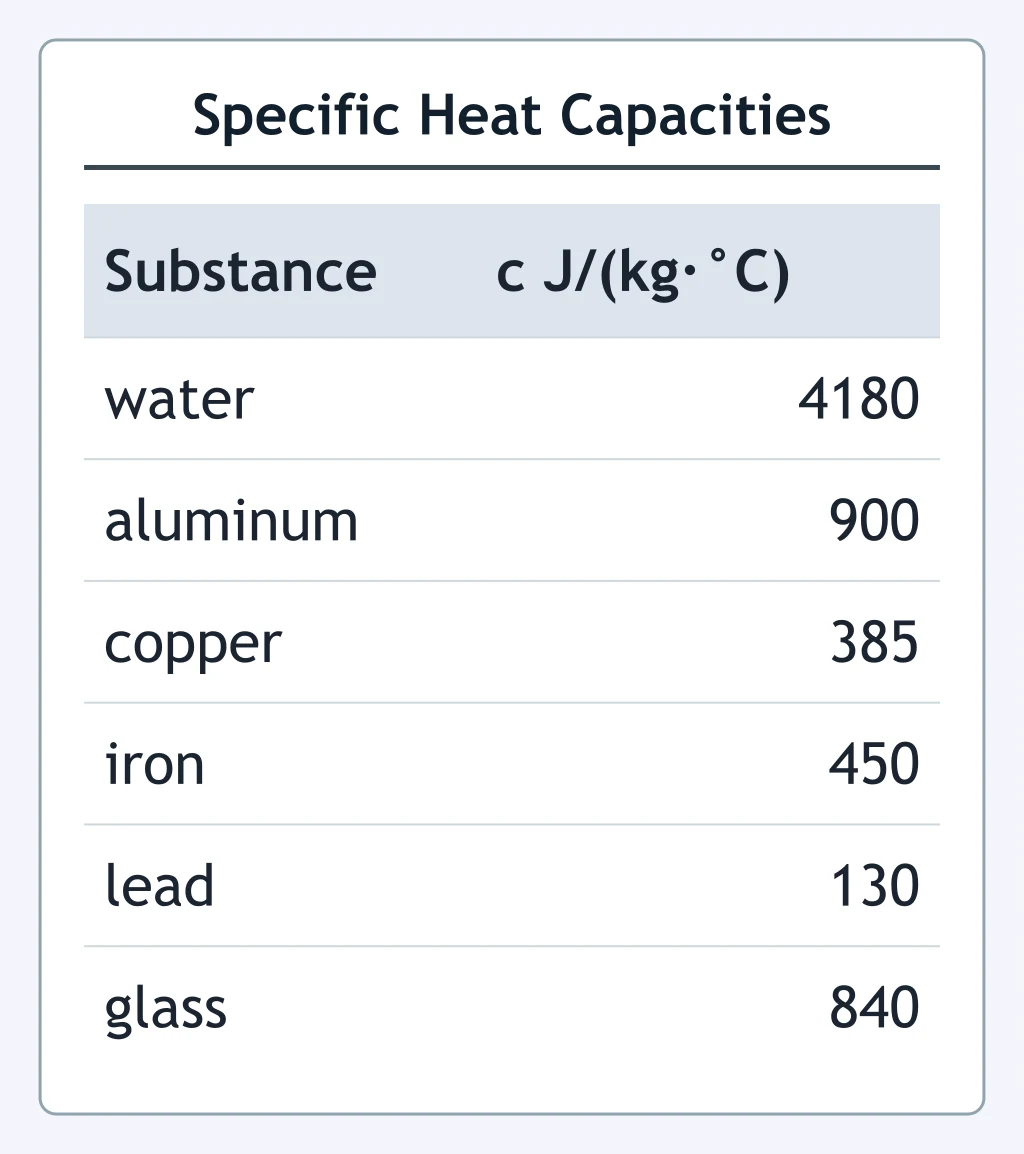
Use the table in the figure. An iron block of mass 1.5 kg absorbs 13,500 J and starts at 20 °C. What is its final temperature?
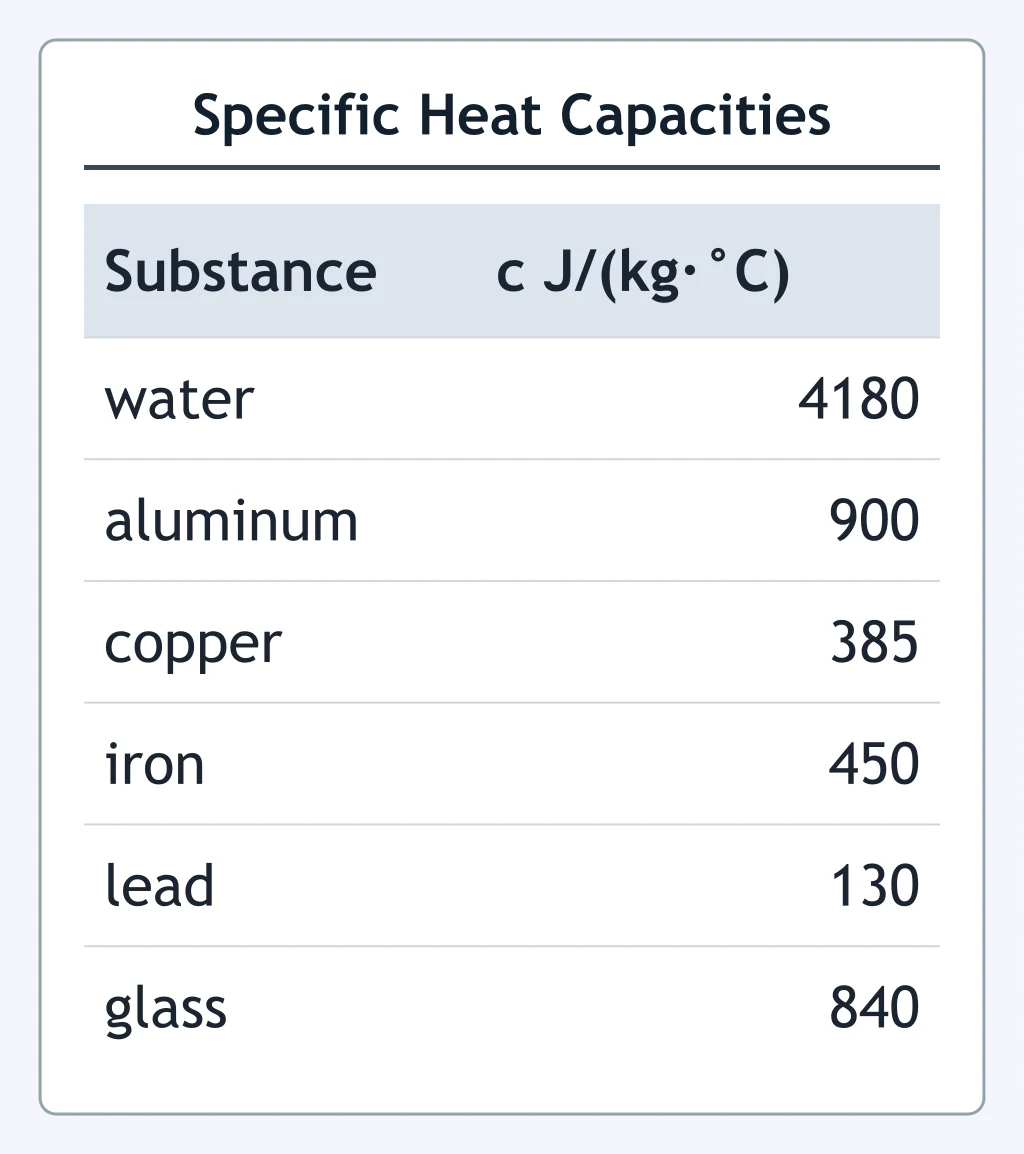
Use the table in the figure. A glass sample absorbs 10,500 J as it warms from 15 °C to 65 °C. What is the mass of the glass?
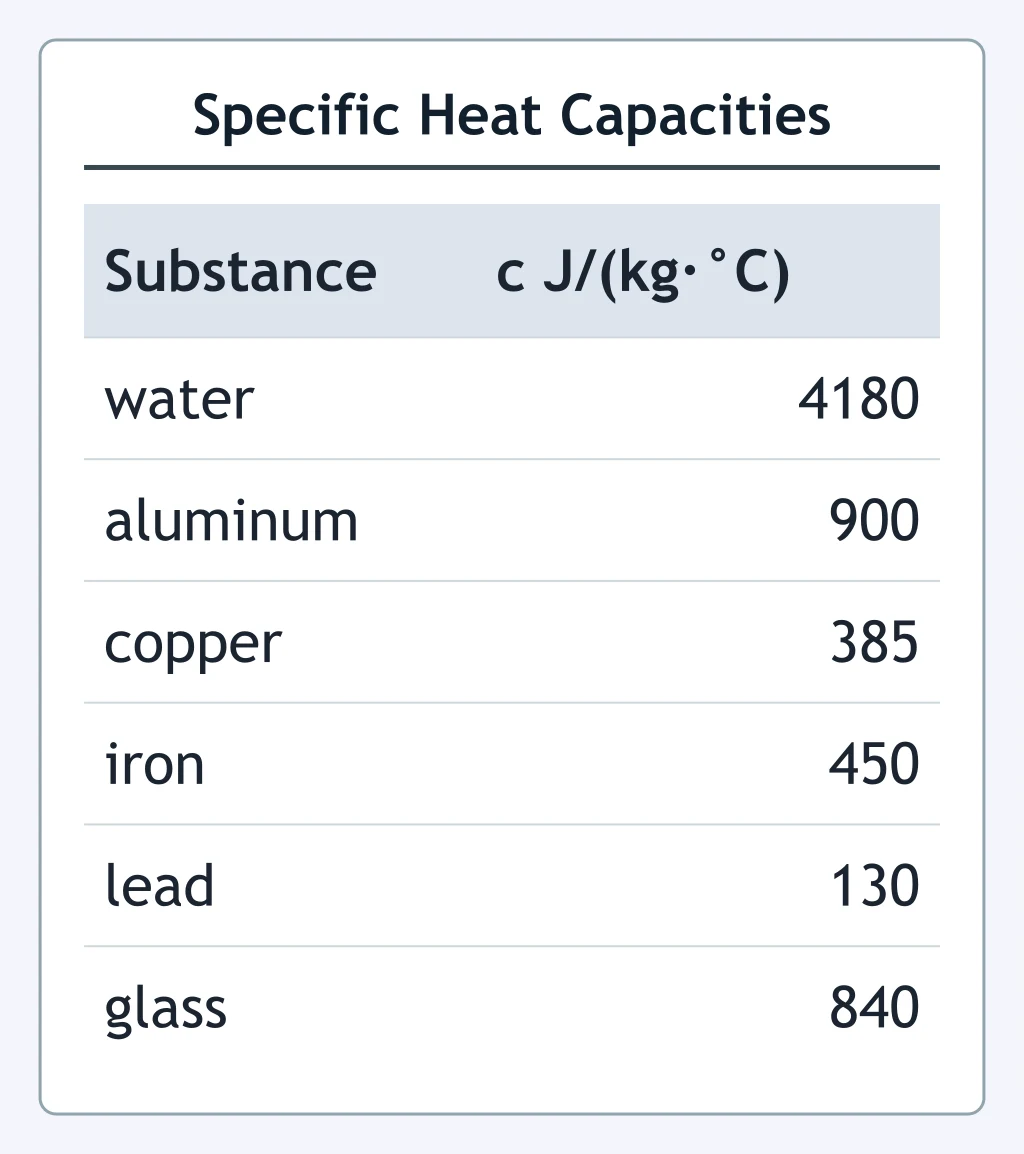
Use the table in the figure. What mass of lead absorbs 2,600 J while its temperature rises by 20 °C?
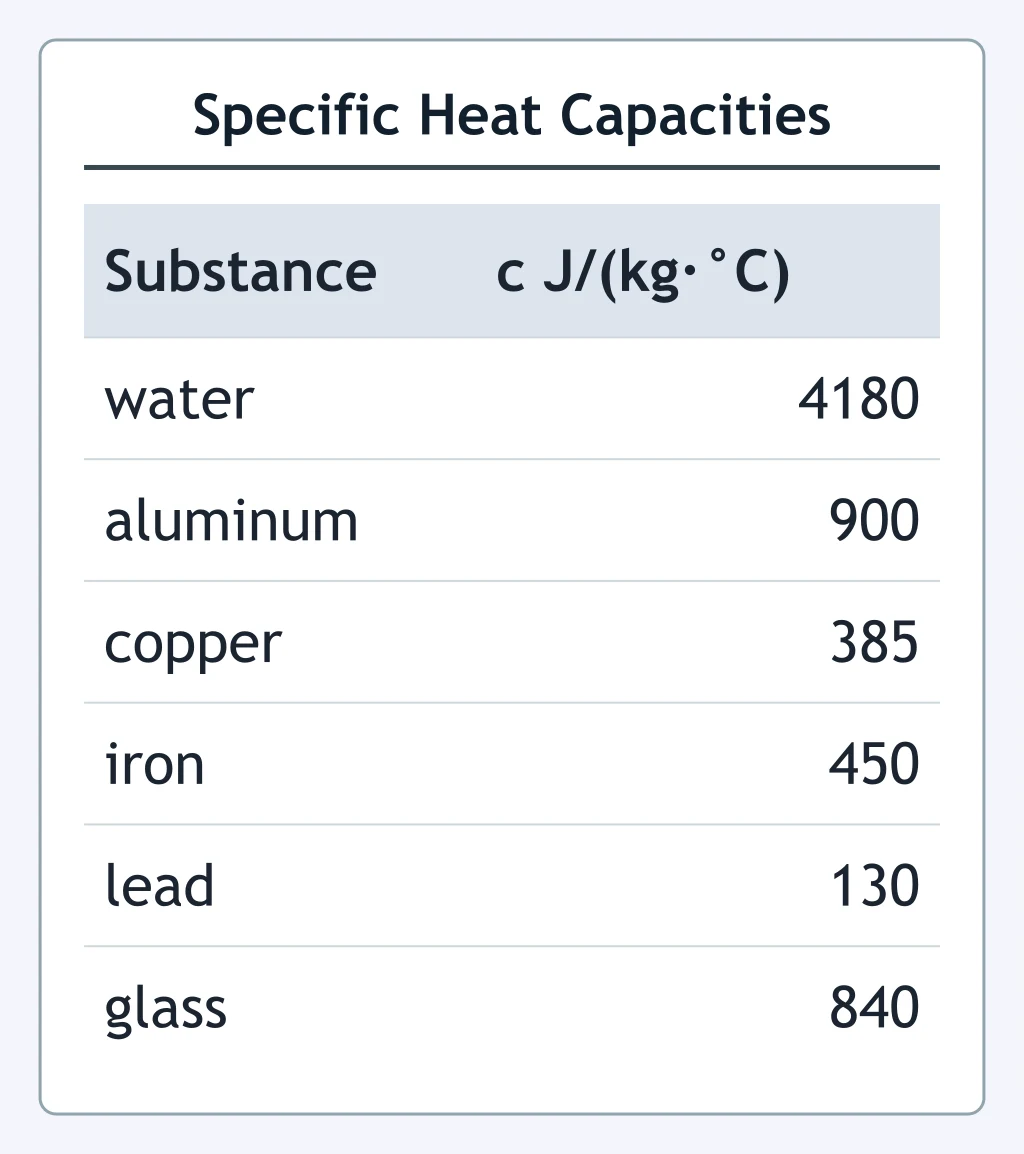
Use the table in the figure. An aluminum part absorbs 32,400 J while warming by 30 °C. What is the mass of the part?
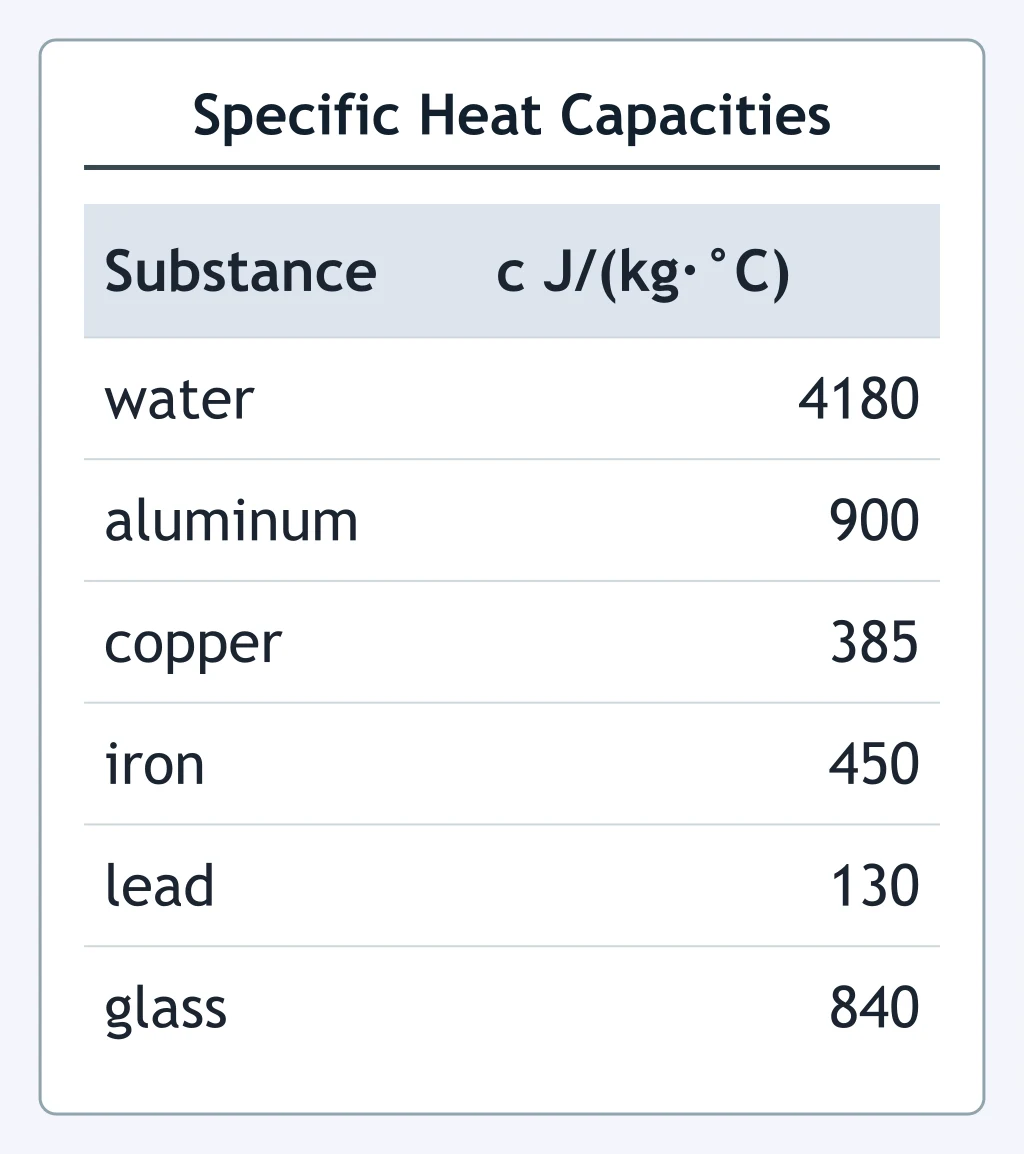
Use the table in the figure. A 0.40 kg copper sample is heated from 15 °C to 75 °C. How much energy is absorbed?
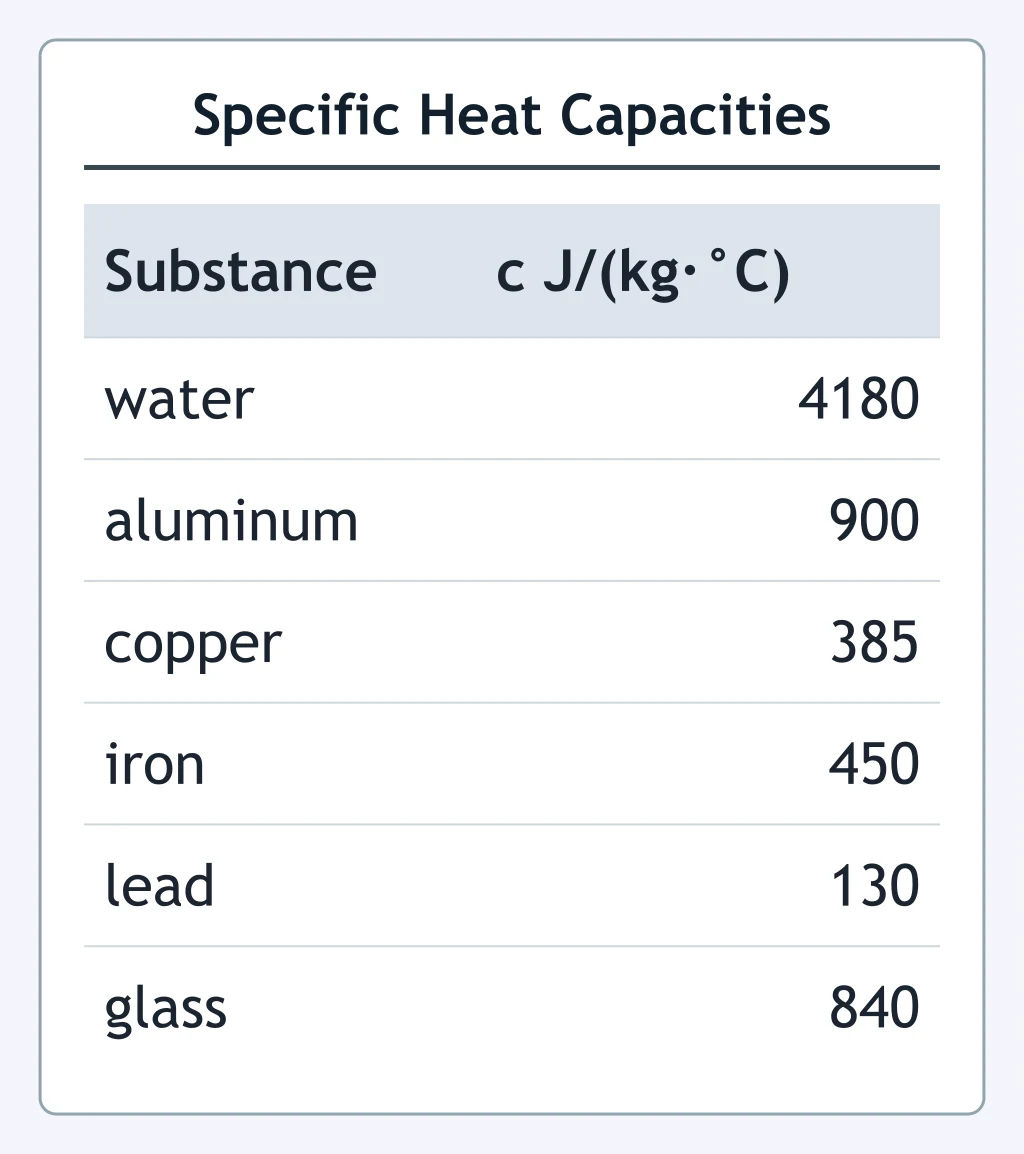
Use the table in the figure. A 0.60 kg iron sample absorbs 8,100 J. By how much does its temperature increase?
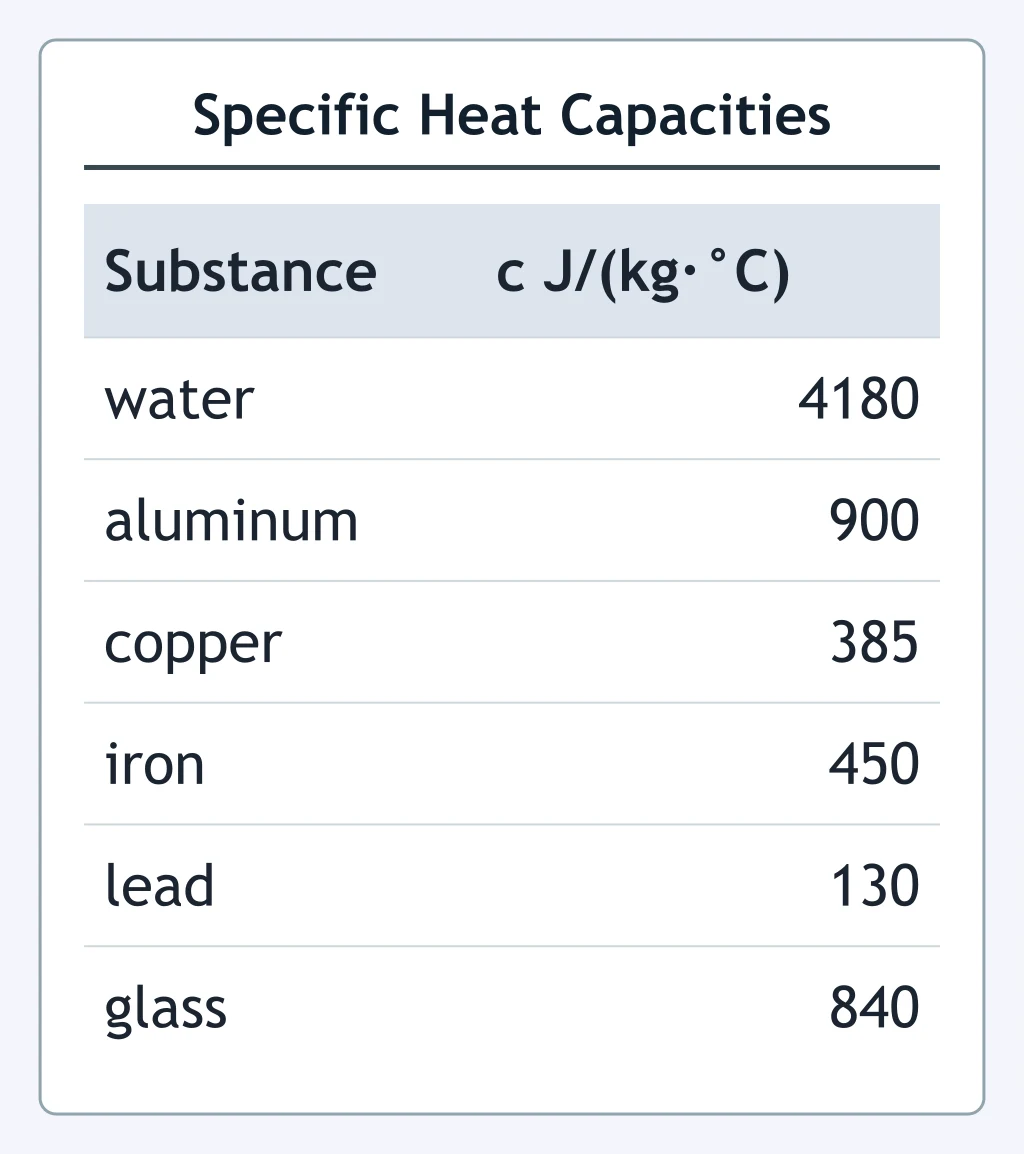
Use the table in the figure. A 2.0 kg lead weight warms from 25 °C to 60 °C. How much energy does it absorb?
A kettle heats 0.50 kg of water from 20 °C to 65 °C. The specific heat capacity of water is 4,180 J/(kg·°C), and the water does not boil. How much energy does it absorb?
A 1.2 kg liquid has a specific heat capacity of 2,000 J/(kg·°C). It absorbs 48,000 J with no phase change. What is its temperature increase?
A 0.80 kg steel part warms from 25 °C to 55 °C. Its specific heat capacity is 450 J/(kg·°C). How much energy does it absorb?
A ceramic tile absorbs 18,000 J as it warms by 40 °C. Its specific heat capacity is 750 J/(kg·°C). What is the tile's mass?
A 0.20 kg cup of water at 80 °C loses 16,720 J of thermal energy. The specific heat capacity of water is 4,180 J/(kg·°C). What is its final temperature?
A 0.40 kg sample warms from 10 °C to 35 °C after absorbing 7,500 J. What is its specific heat capacity?
An aluminum pan of mass 0.65 kg warms from 20 °C to 100 °C. Its specific heat capacity is 900 J/(kg·°C). How much energy does it absorb?
A block with specific heat capacity 500 J/(kg·°C) absorbs 30,000 J and warms from 15 °C to 45 °C. What is its mass?
A 2.5 kg metal block at 30 °C absorbs 19,000 J. Its specific heat capacity is 380 J/(kg·°C). What is its final temperature?
A 1.0 kg copper block and 1.0 kg of water receive the same energy from identical heaters. Copper has c = 385 J/(kg·°C), and water has c = 4,180 J/(kg·°C). Which statement is correct?
Why is water useful as a coolant in many systems?
Coastal towns often have smaller temperature swings than inland towns. Which explanation best connects this to specific heat capacity?
Two samples are made of the same metal, but one has twice the mass of the other. Which statement is true about specific heat capacity and heating them?
A data book lists a material property that tells how much energy 1 kg of a substance needs to become 1 °C warmer. Which unit matches that property?
What does the specific heat capacity of a substance describe?
Crack the passcode before the zombies get in.
Answer, then swat bugs for bonus points.
Race through questions at your own speed.
Same question on every screen. Fastest wins.

Pick a tile, answer, hit bonuses and steals.
Friction and Internal Energy
20 questions