Loading
by BlastRoom
Separate hotness, energy transfer, and the energy a sample already holds.
#physics
40 questions
One question set, multiple game modes. Tap any game to see it in action. Not sure which to pick?
Answer to place stones and capture territory.
Outrun the snow together.
Earn blasts, then hunt the other team.
Answer to earn energy, then climb.

The class blasts through walls together.
Bid on mystery lots. Most money wins.
Sell tours. Nice, standard, or a total scam.

Answer, restock, and serve the rush.
More correct answers pulls the rope your way.
Answer, then shoot down the alien wave.
Answer, then tap to leap the frozen ridge.
A teacher says, “This quantity tells how hot a sample is by relating to the average random kinetic energy of its particles.” Which quantity is described?
A lab note says, “This quantity is energy crossing from a hotter object to a cooler object because their readings are different.” Which quantity is described?
Which quantity names the sum of the random kinetic and potential energies of all the particles in a sample?
Ice at 0 °C absorbs energy and melts into water that is still at 0 °C. Which quantity of the sample increases?
When the average speed of molecules in a gas increases, which quantity rises most directly?
At the same 25 °C, a full bathtub of water has much more of which quantity than a cup of water?
A thermometer left in a beaker settles at 45 °C. Which quantity does the reading report?
Which quantity is not something an object stores, but a name for energy moving during a transfer?
Which quantity depends on how much substance is present as well as on the particles' motion and spacing?
A reading of 293 K is a value for which quantity?
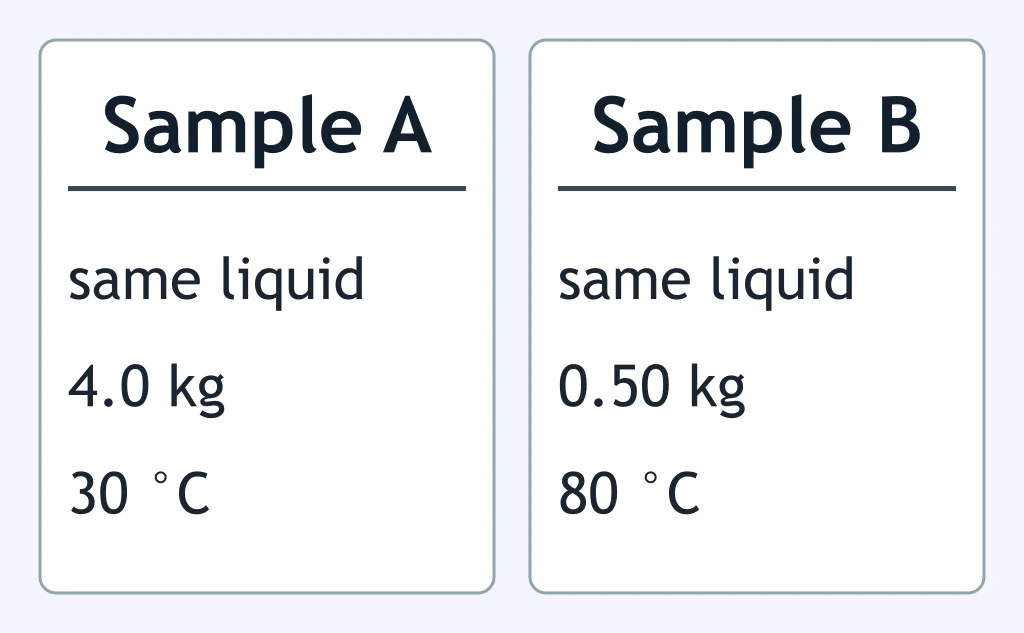
The figure shows two sealed containers of the same liquid. They have not touched. Which statement is correct?
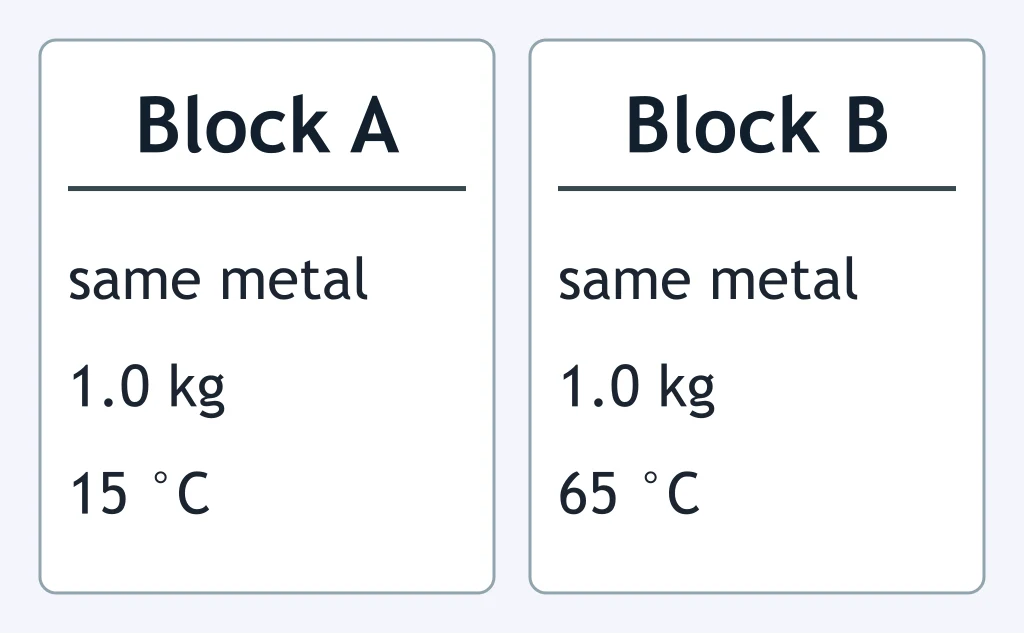
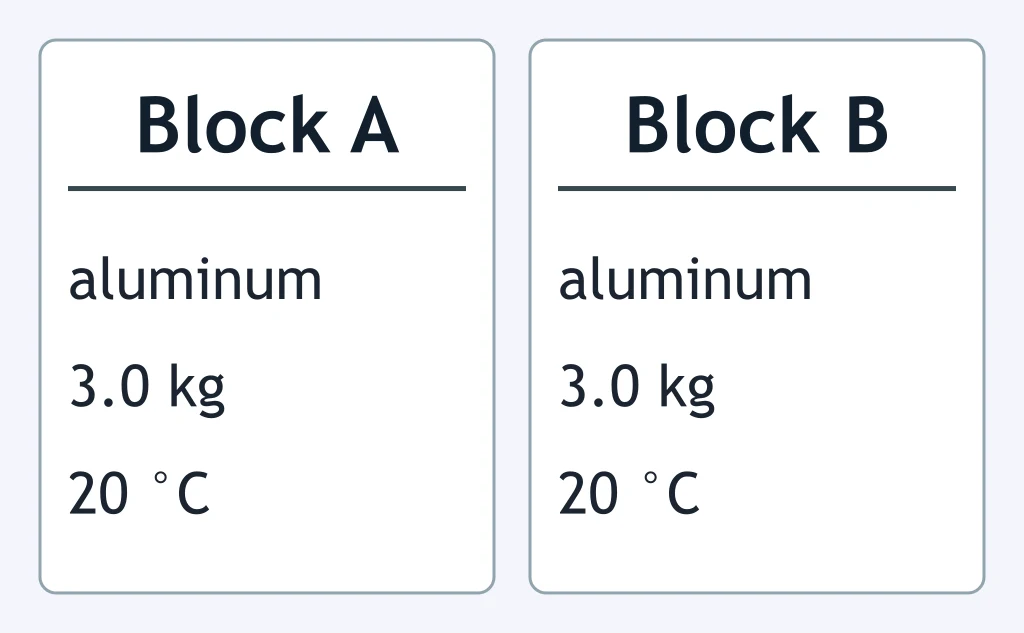
The figure shows two equal-mass blocks of the same metal. Which block has the greater internal energy?
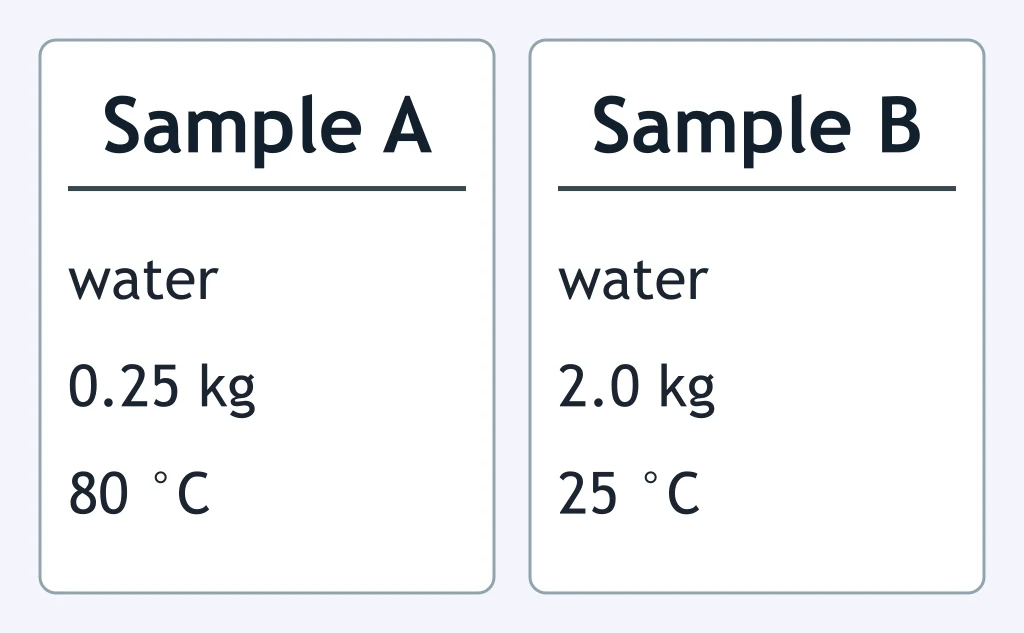
The two water samples in the figure are put in thermal contact. What is the initial direction of energy transfer by heat?
The two aluminum blocks in the figure are placed in contact. What happens initially?
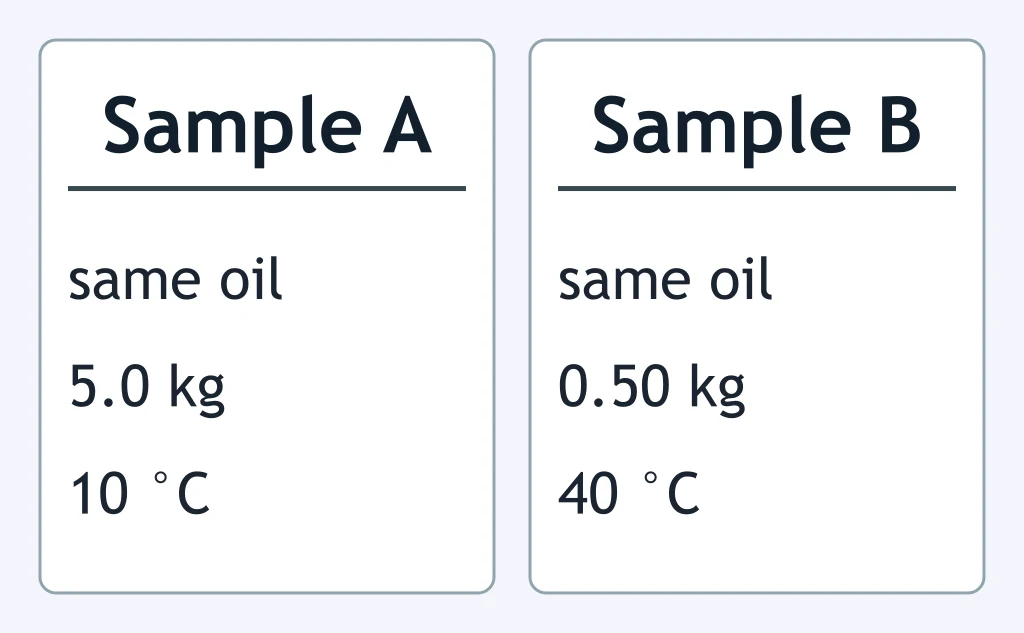
The figure shows two samples of the same oil before contact. Which statement about internal energy is best supported?
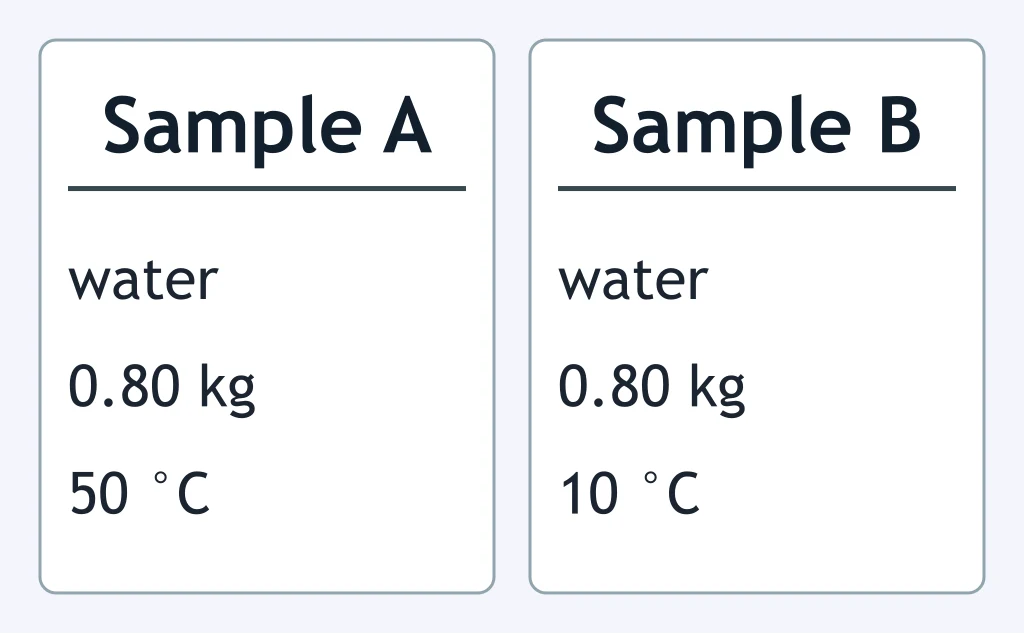
The two water samples in the figure are touched together. Which statement is correct at the start?
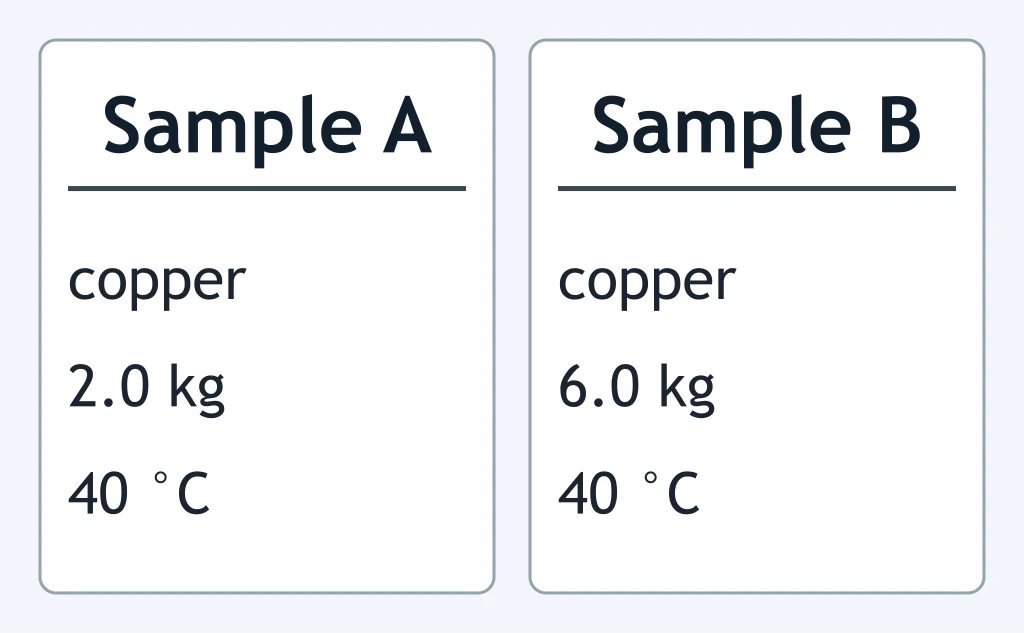
The figure shows two copper samples. Which statement is correct if they are placed in contact?
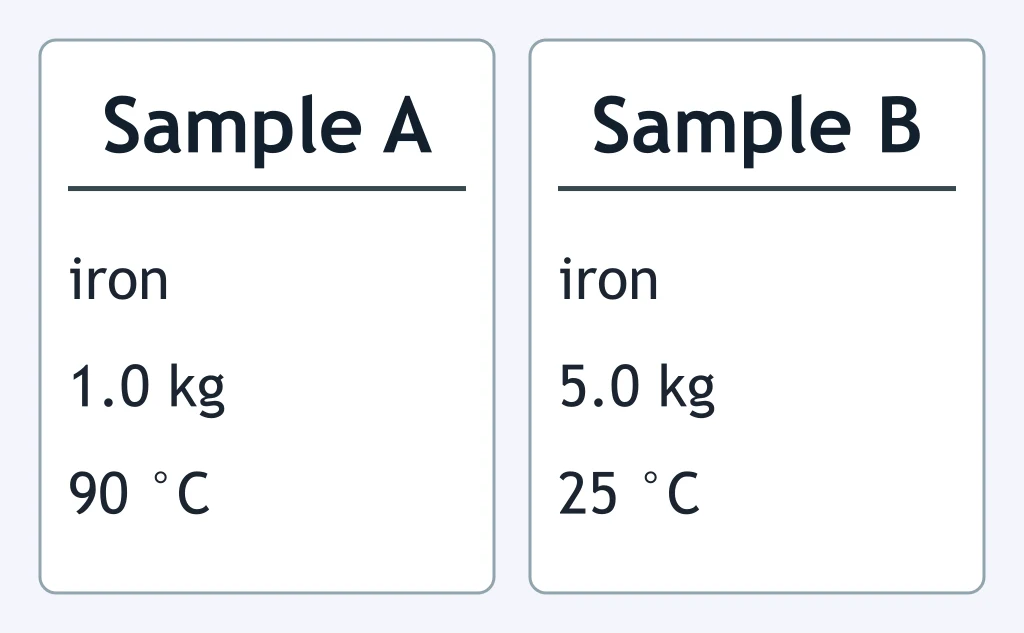
The iron samples in the figure are placed in contact. Which statement is correct at first?
A 20 °C metal spoon sits in 70 °C soup inside an insulated cup until both read 64 °C. What is true then?
Two blocks in contact inside an insulated box both eventually read 60 °C. What must be equal at that time?
A 90 °C brick touches a 10 °C brick. During the first moments, which description is correct?
A thermometer and a water sample both stay at 37 °C after being in contact. Which statement best describes them?
At thermal equilibrium between two objects, what has stopped?
A 90 °C copper piece is dropped into 20 °C water in an insulated cup. The masses are not given. What can the final shared temperature be?
An aluminum pan at 40 °C sits in oven air at 40 °C. Which statement is correct?
Two stones of different masses touch for a long time and both read 35 °C. Which statement can be true?
A 100 °C metal cube and a 25 °C metal cube touch in an insulated box. What happens as they approach equilibrium?
Two water samples in contact reach the same final temperature. Which statement is false?
A student writes, “The coffee has a lot of heat in it, and the heat leaks into the room.” Which revision is most accurate?
A report says, “Cold moved from the 5 °C spoon into the 30 °C hand.” Which wording fixes the physics?
A student says, “The large tank and small cup are both 22 °C, so they have the same energy in their particles.” What is the best correction?
After an electric heater transfers 2 000 J to water, a student writes, “The heat is now stored in the water.” Which wording is better?
A student says, “A hot end of a metal rod sends temperature along the rod.” Which statement is more accurate?
A classmate writes, “At equilibrium, all the heat is used up.” Which replacement is correct?
Two heaters each transfer 5 000 J to water starting at 20 °C: Cup X has 0.20 kg and Cup Y has 1.0 kg. X warms more. What does this show?
A mug holds 0.25 kg of water and a pot holds 2.5 kg of water. Both samples cool from 60 °C to 50 °C. Which statement is correct?
An iron nail and an iron block start at 20 °C. Each receives 800 J, and no energy leaves either one. Which statement is correct?
Two equal-mass water samples are at 80 °C and 30 °C. What is true before they touch?
A 5.0 kg water container at 25 °C and a 0.10 kg water cup at 90 °C are compared. Which statement can be correct?
Equal 1 000 J transfers into equal masses of water and cooking oil starting at 20 °C, and oil warms more. What explains this?
Crack the passcode before the zombies get in.
Answer, then swat bugs for bonus points.
Race through questions at your own speed.
Same question on every screen. Fastest wins.

Pick a tile, answer, hit bonuses and steals.
Conduction, Convection and Radiation
40 questions