Loading
by BlastRoom
Trace Achebe's recurring images in Things Fall Apart and connect the novel's title to its ending.
#motifs#matatag_english_8
20 questions
One question set, multiple game modes. Tap any game to see it in action. Not sure which to pick?
Achebe took his title from a line in W. B. Yeats's poem "The Second Coming," printed as the novel's epigraph. What does that line describe?
Okonkwo is called "Roaring Flame." Watching a log crumble in the fire, he thinks of his son Nwoye: "Living fire begets cold, impotent ash." What has the fire image come to stand for?
Locusts settle on Umuofia and the people happily gather them to eat. Later the white men arrive, come in greater numbers, and stay. What do the locusts stand for by then?
In Umuofia the yam is the king of crops and a man's crop. Okonkwo makes Nwoye and Ikemefuna count and prepare the seed-yams. What has the yam come to stand for?
The narrator says that among the Igbo "the art of conversation is regarded very highly, and proverbs are the palm-oil with which words are eaten." What does this show about the clan?
Obierika says of the white man, "He has put a knife on the things that held us together and we have fallen apart." How does this remark connect to the novel's title?
The last pages leave Okonkwo and follow the District Commissioner, who decides Okonkwo's whole life is worth "a reasonable paragraph" in his book. Why end in that voice?
The District Commissioner plans a book titled "The Pacification of the Primitive Tribes of the Lower Niger." What does naming that book on the last page do for the whole novel?
In Ekwefi's tale, Tortoise borrows feathers from the birds, takes the name "All of you," and eats the whole sky feast. What later event does this trick match?
Which recurring element gathers new meaning each time it returns, rather than repeating as ordinary custom?
At Ezeudu's funeral Okonkwo's gun explodes and kills the dead man's son, and Okonkwo is exiled for seven years. Why is this more than a stray accident?
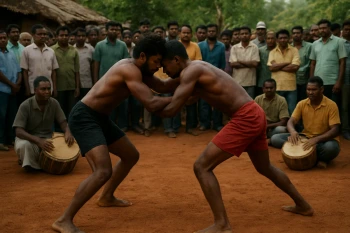
Drums beat through the day of the wrestling match, and the narrator says, "Their sound was no longer a separate thing from the living village." What do the drums stand for here?
Drums, guns and cannon fill Ezeudu's funeral. Then a cry of agony rises from the crowd, and Achebe writes, "All was silent." What does that sudden silence do for the scene?
Early on we learn that Okonkwo "had a slight stammer and whenever he was angry and could not get his words out quickly enough, he would use his fists." What does this set up?
Okonkwo cuts down the head messenger. The crowd breaks into noise, and he hears voices asking, "Why did he do it?" Why is this the moment his cause is lost?
Suppose the novel ended with Umuofia driving out the white men and honoring Okonkwo. What connection would that change break?
Suppose Achebe had nicknamed Okonkwo "Deep River" instead of "Roaring Flame." Which link in the novel would break?
The novel opens not with Okonkwo but with his father Unoka, who played the flute, owed debts he never paid, and turned a creditor aside with proverbs. Why begin there?
The locusts descend on Umuofia in the same chapter in which Ikemefuna is killed, so a scene of plenty sits right beside a scene of loss.
Which of these is a motif that runs through the novel rather than a single striking event?
Crack the passcode before the zombies get in.

Pick a tile, answer, hit bonuses and steals.
A Little Incident: Point of View and Style
20 questions