Loading
by BlastRoom
A mixed end-of-unit review across atomic structure, classification of matter, the periodic table and characteristic properties.
#us_grade_8_science
40 questions
One question set, multiple game modes. Tap any game to see it in action. Not sure which to pick?
Answer to place stones and capture territory.
Outrun the snow together.
Earn blasts, then hunt the other team.
Answer to earn energy, then climb.

The class blasts through walls together.
Bid on mystery lots. Most money wins.
Sell tours. Nice, standard, or a total scam.

Answer, restock, and serve the rush.
More correct answers pulls the rope your way.
Answer, then shoot down the alien wave.
Answer, then tap to leap the frozen ridge.
An atom of nitrogen has 7 protons, 7 neutrons and 7 electrons. What is the overall charge on this atom?
A fluorine atom starts with 9 protons and 9 electrons, then gains one extra electron. What is the charge on the particle now?
In an atom, protons and neutrons are packed into a tiny central region while electrons move through the much larger space around it. Where is nearly all of the atom's mass?
Which subatomic particle carries no electric charge at all?
A carbon atom has 6 protons and 8 neutrons in its nucleus. What is the mass number of this atom?
Two atoms each have 8 protons, but one has 8 neutrons and the other has 10 neutrons. What do these counts tell you about the two atoms?
The periodic table lists sodium with an atomic number of 11. How many electrons does a neutral sodium atom have?
A neutron has about the same mass as a proton.
A magnesium particle is measured and found to have 12 protons and 10 electrons. How is this particle best described?
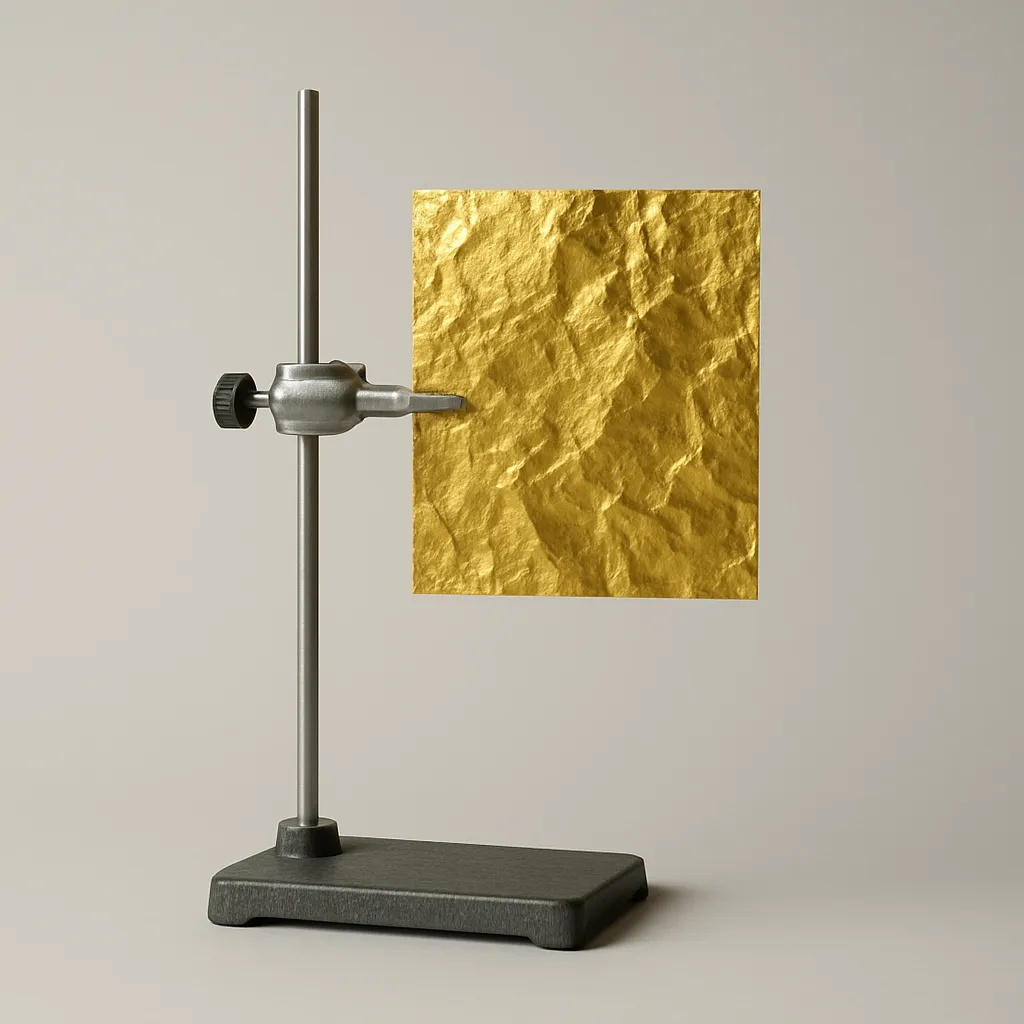
Most alpha particles fired at a thin sheet of gold foil passed straight through, but a few bounced sharply backward. What does this evidence show about an atom?
A gas is made only of particles that each contain one carbon atom joined to two oxygen atoms, and nothing else. How is this gas best classified?
A student stirs salt into a beaker of water until none is left on the bottom and the liquid looks exactly the same throughout. How is the result classified?
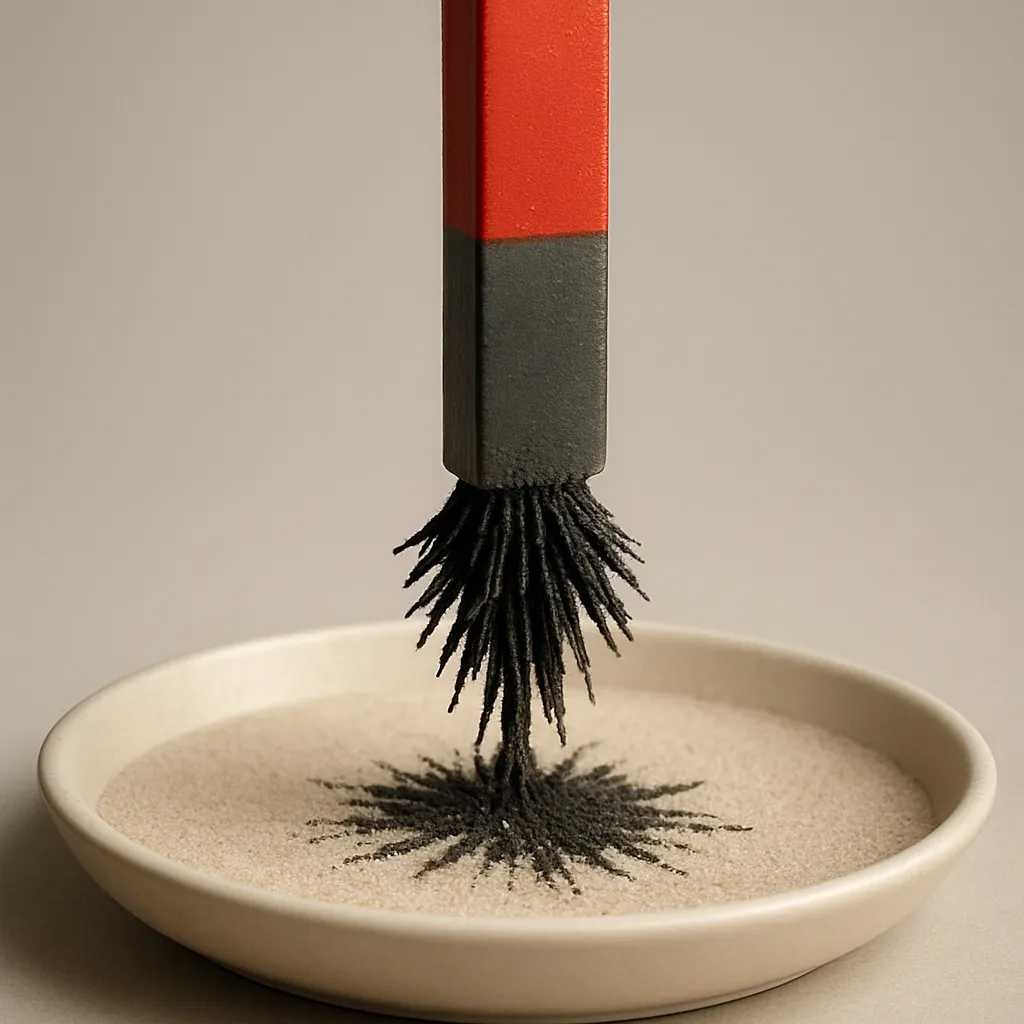
A magnet pulled through a dish of sand and iron filings lifts out the filings and leaves the sand behind. How is the material in the dish best classified?
A shiny reddish solid is made only of atoms that every test shows have 29 protons. How is this solid best classified?
A student boils a clear liquid until a white solid is left in the flask, and the escaping vapor condenses into pure water. What does this show about the original liquid?
Sugar is stirred into a glass of water until it disappears. In the solution that forms, which part is the solvent?
A compound can be broken into simpler substances only by a chemical change, not by a physical one.
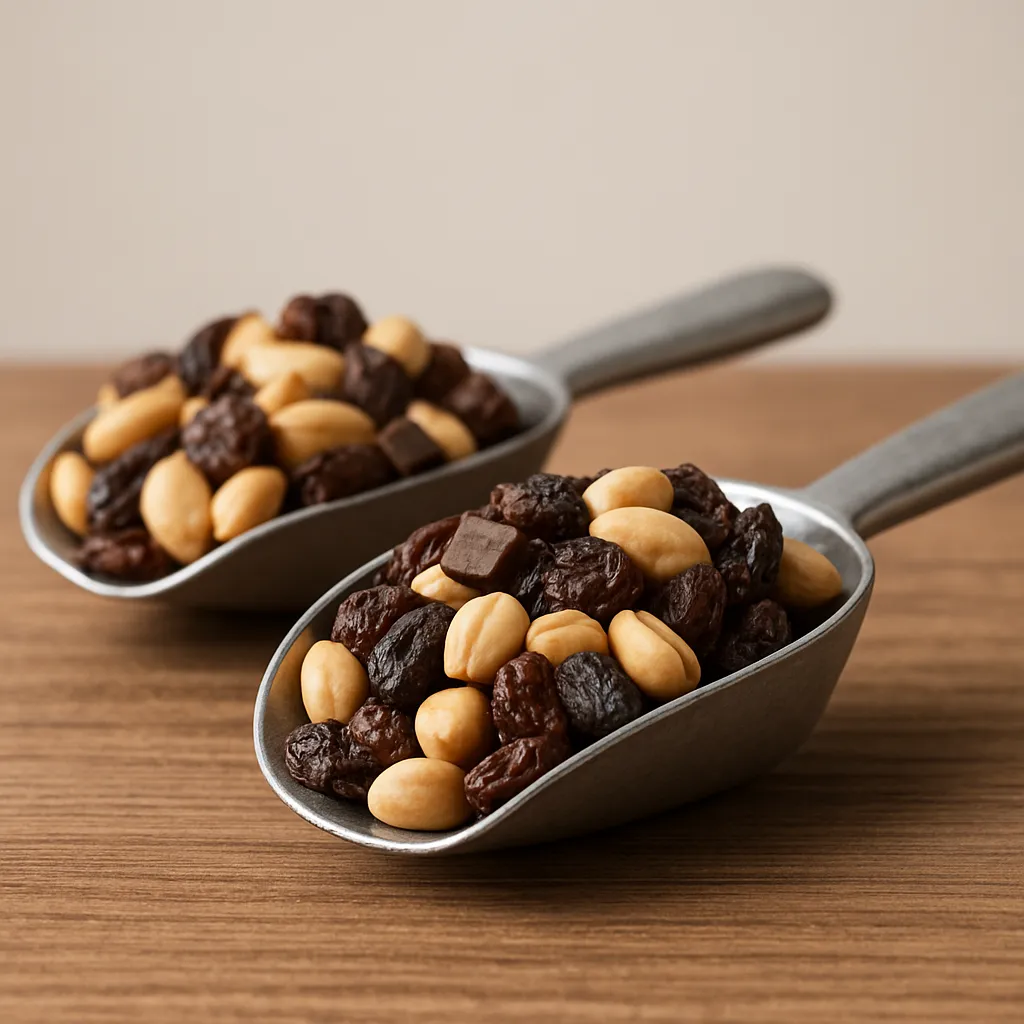
Two scoops taken from the same jar of trail mix hold different numbers of raisins and peanuts. What does that difference show about the trail mix?
Iron filings and sulfur powder are stirred together, then heated until they form a new gray solid that a magnet no longer attracts. What does the loss of magnetism show?
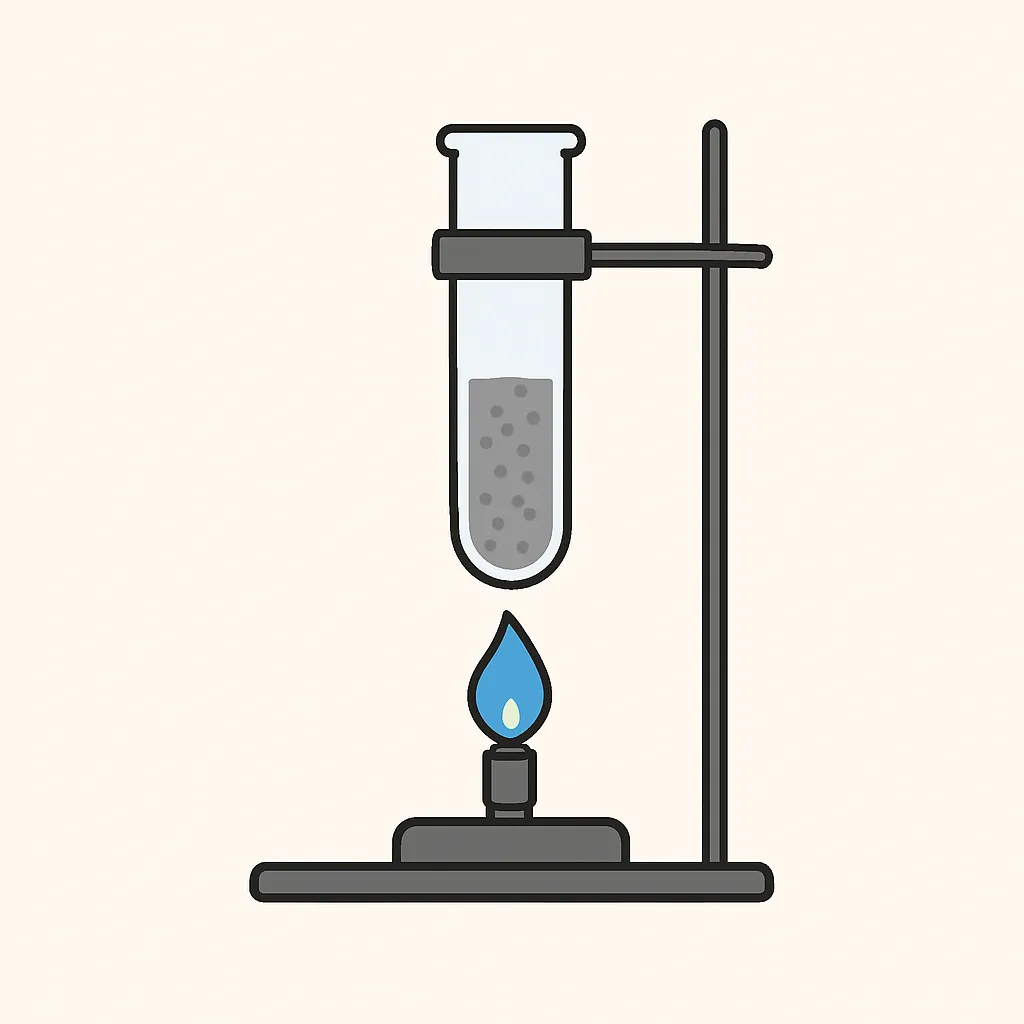
One liquid boils steadily at a single unchanging temperature, while a second liquid's temperature keeps climbing the whole time it boils. Which claim does this evidence support?
Lithium, sodium and potassium sit in the same column of the periodic table, and each reacts vigorously when dropped into water. What does their shared column tell you?
An element's square on the periodic table sits in period 3. What does that row position tell you about its atoms?
Silicon sits on the zigzag stair-step line of the periodic table, and it conducts electricity better than sulfur but far worse than copper. How is silicon classified?
Moving left to right across a row of the modern periodic table, one count rises by exactly one at every square. Which count is it?
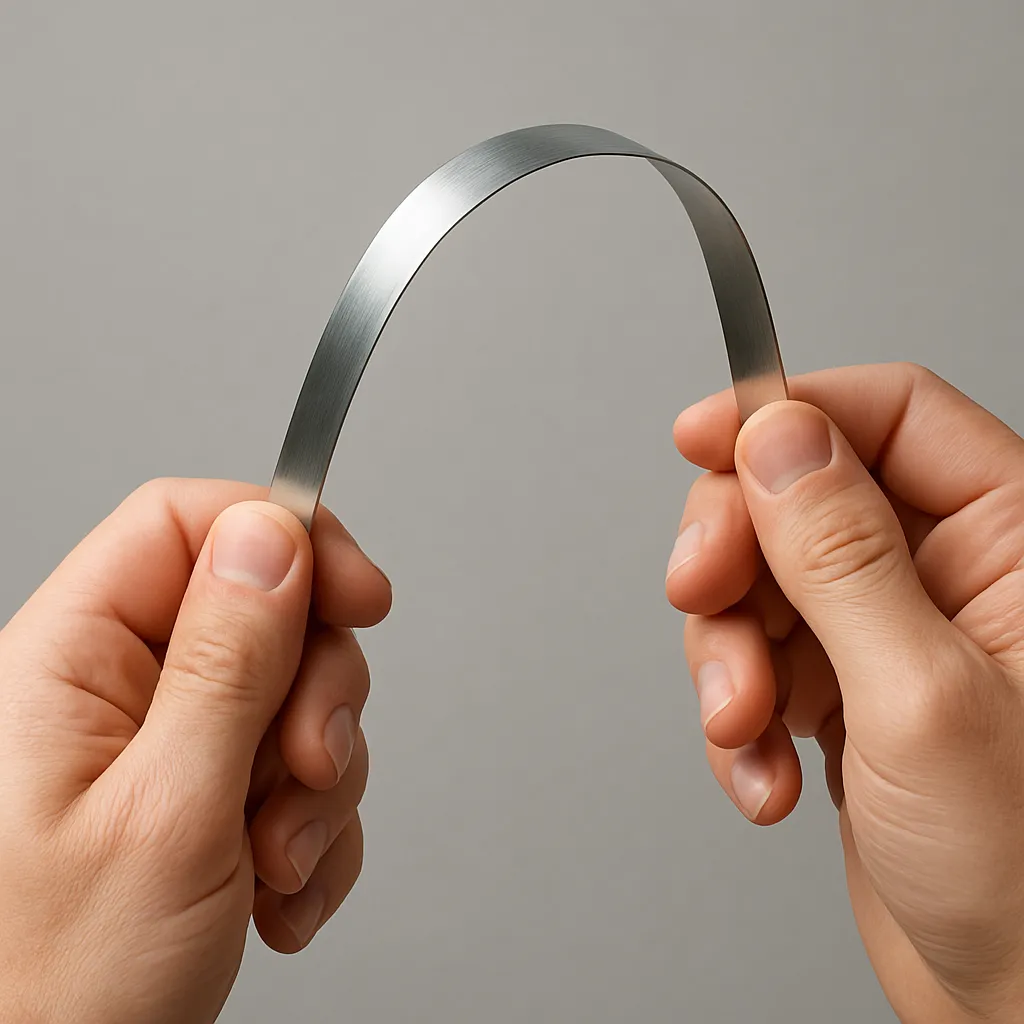
An unknown element sits on the far left of the periodic table. A sample of it is shiny, bends without shattering, and lights a bulb in a circuit. How is it classified?
Fluorine and chlorine sit together in the second-to-last column, and each one gains a single electron when it reacts. What atomic feature explains that shared behavior?
A periodic table square carries the chemical symbol Na. Which element does that symbol stand for?
A periodic table square shows the number 20 above the symbol Ca and the number 40.08 below it. What does the 20 tell you about a calcium atom?
Argon, an element in the final column of the periodic table, is sealed inside light bulbs so the hot filament does not burn away. Why is argon suited to that job?
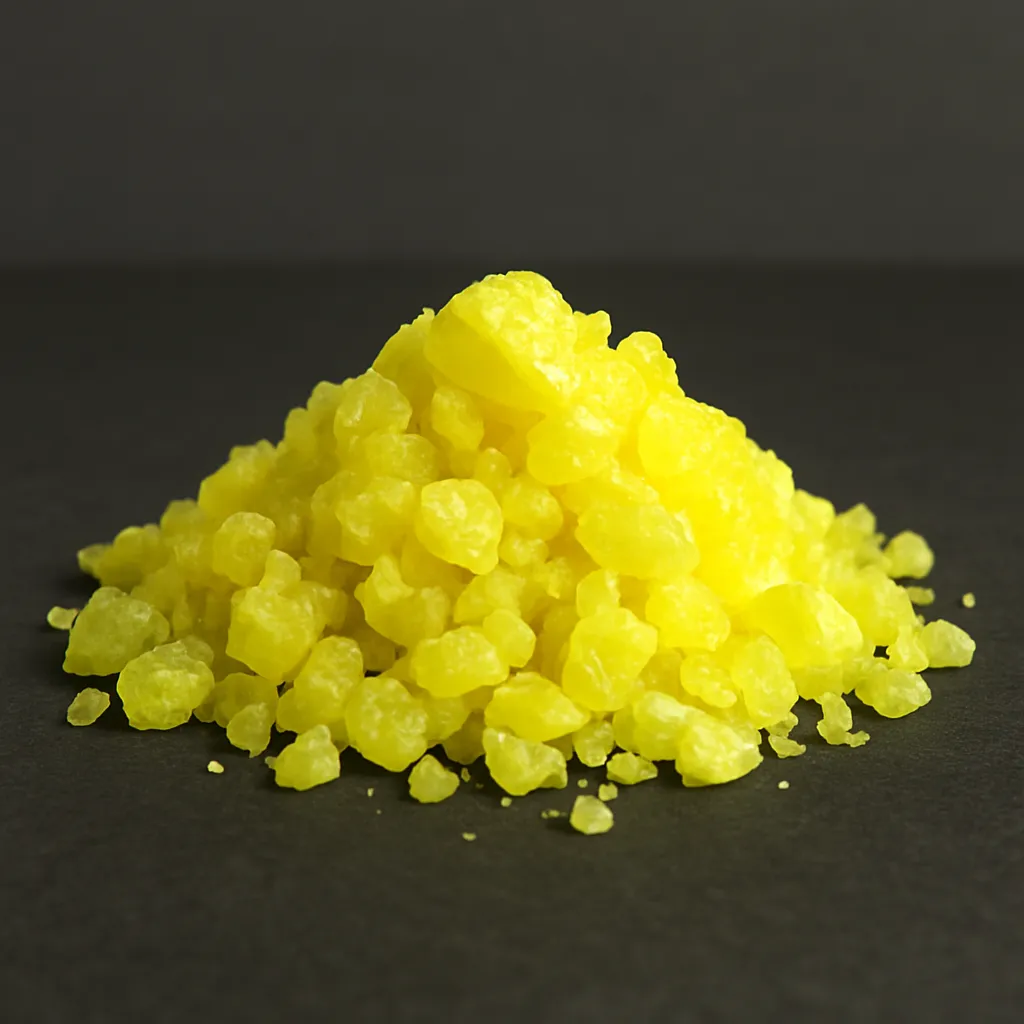
Sulfur is a brittle yellow solid that crumbles when hit and does not light a bulb in a circuit. Where does an element with these properties sit on the periodic table?
A student measures a metal sample and finds a mass of 54 grams and a volume of 20 cubic centimeters. What is the density of the sample?
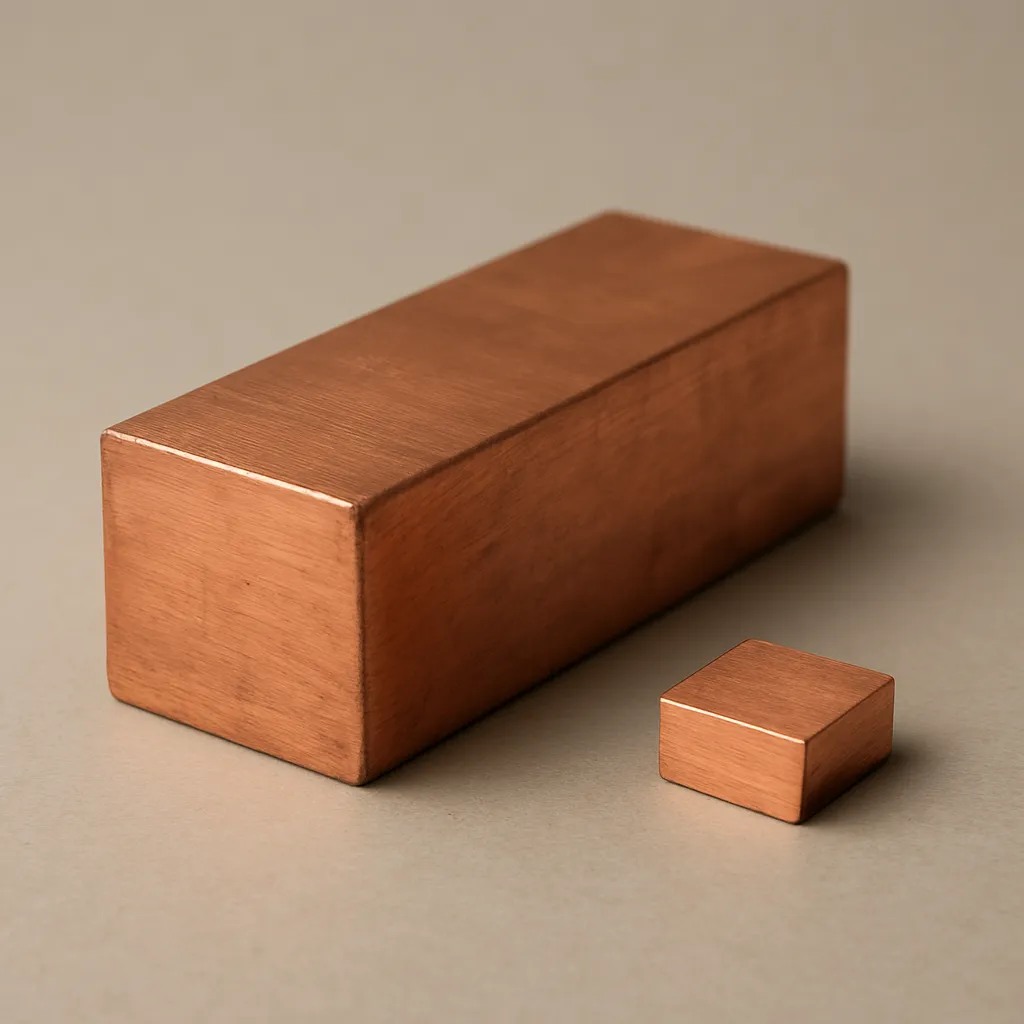
A large block and a small chip are cut from the same bar of pure copper. Which measured property has the same value for both pieces?
A solid block with a density of 0.8 grams per cubic centimeter is lowered into a tank of water, whose density is 1.0 grams per cubic centimeter. What happens to the block?
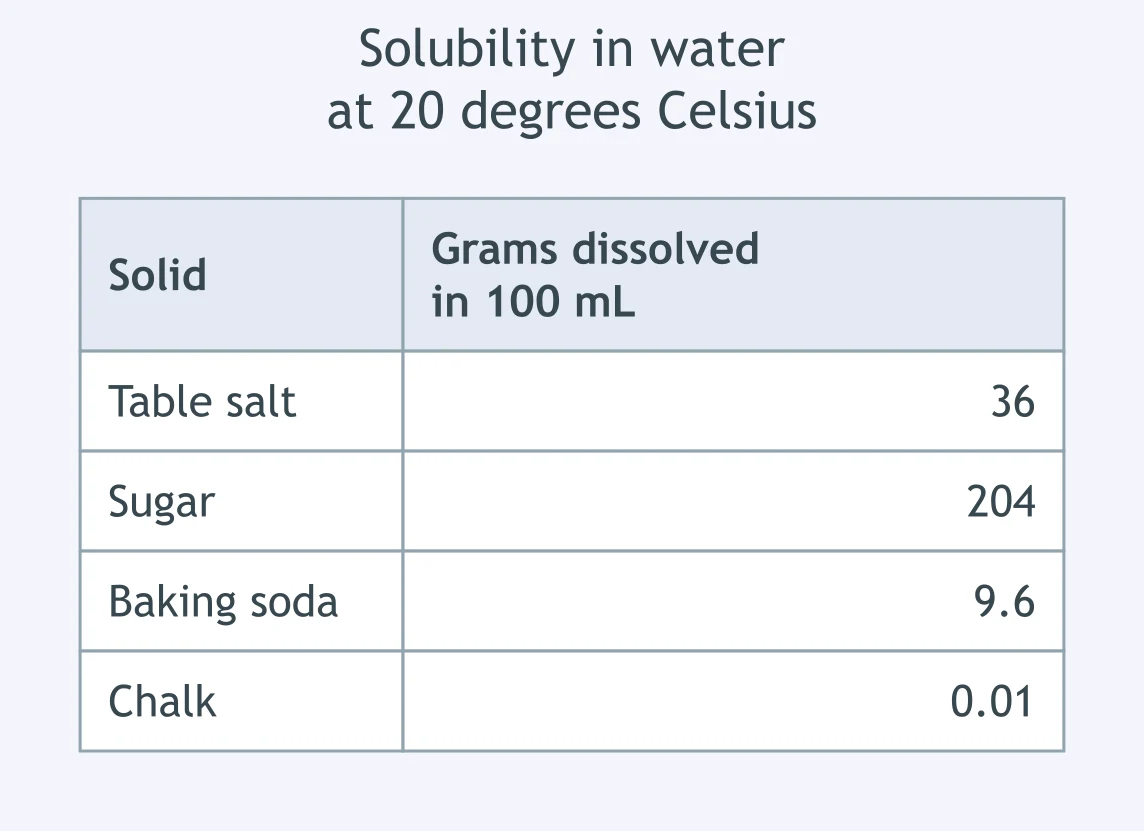
Look at the table. It shows how many grams of each solid will dissolve in 100 milliliters of water at 20 degrees Celsius. Which solid is the most soluble?
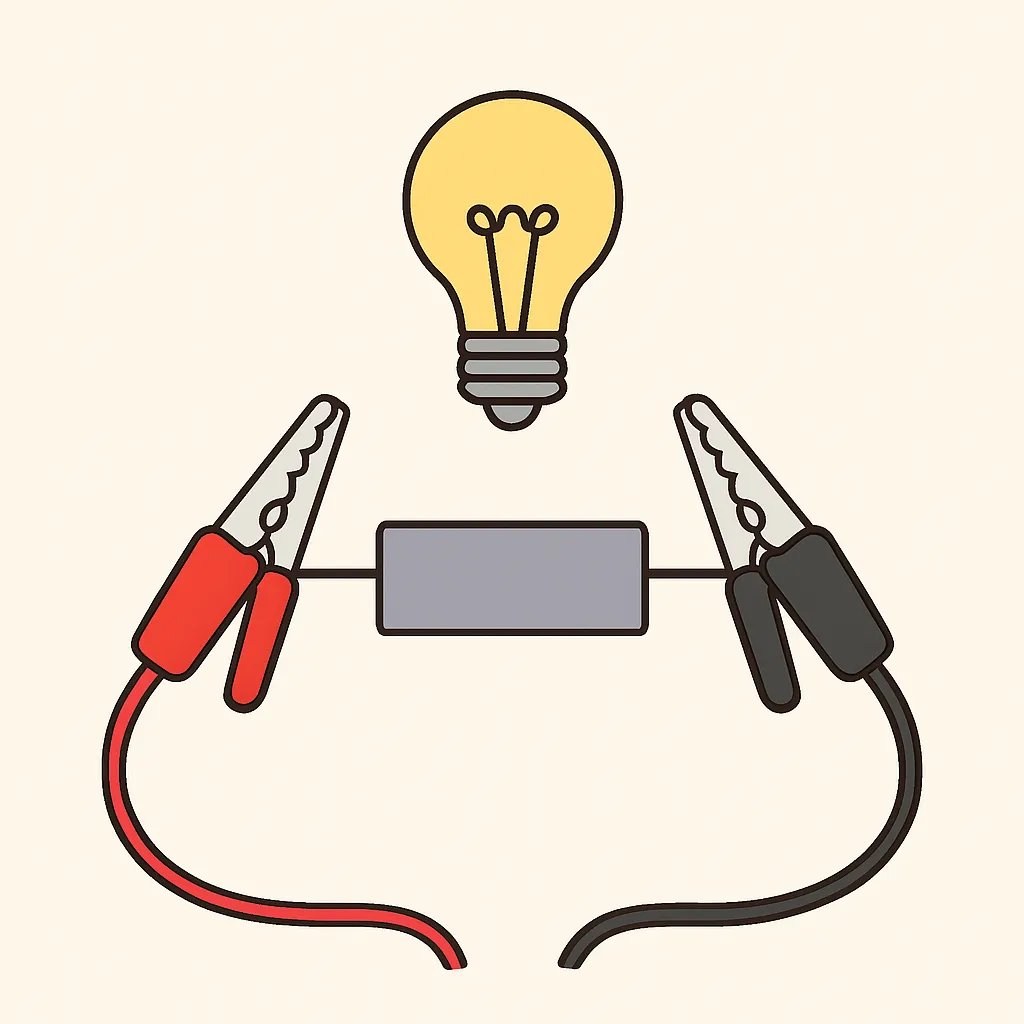
A student clips two solid samples in turn into a circuit with a bulb. The bulb lights brightly for the gray sample and stays dark for the white one. Which claim does this support?
One student pours 5 milliliters of a liquid and another pours 500 milliliters of the very same liquid. Which measured value will be identical for both samples?
Two white powders look alike. At 20 degrees Celsius, 25 grams of powder X dissolves fully in 100 milliliters of water, while most of powder Y stays undissolved. What does this show?
A rock with a mass of 90 grams is lowered into a graduated cylinder, and the water level rises from 50 milliliters to 80 milliliters. What is the rock's density?
Color is a reliable way to tell two different silvery metals apart.
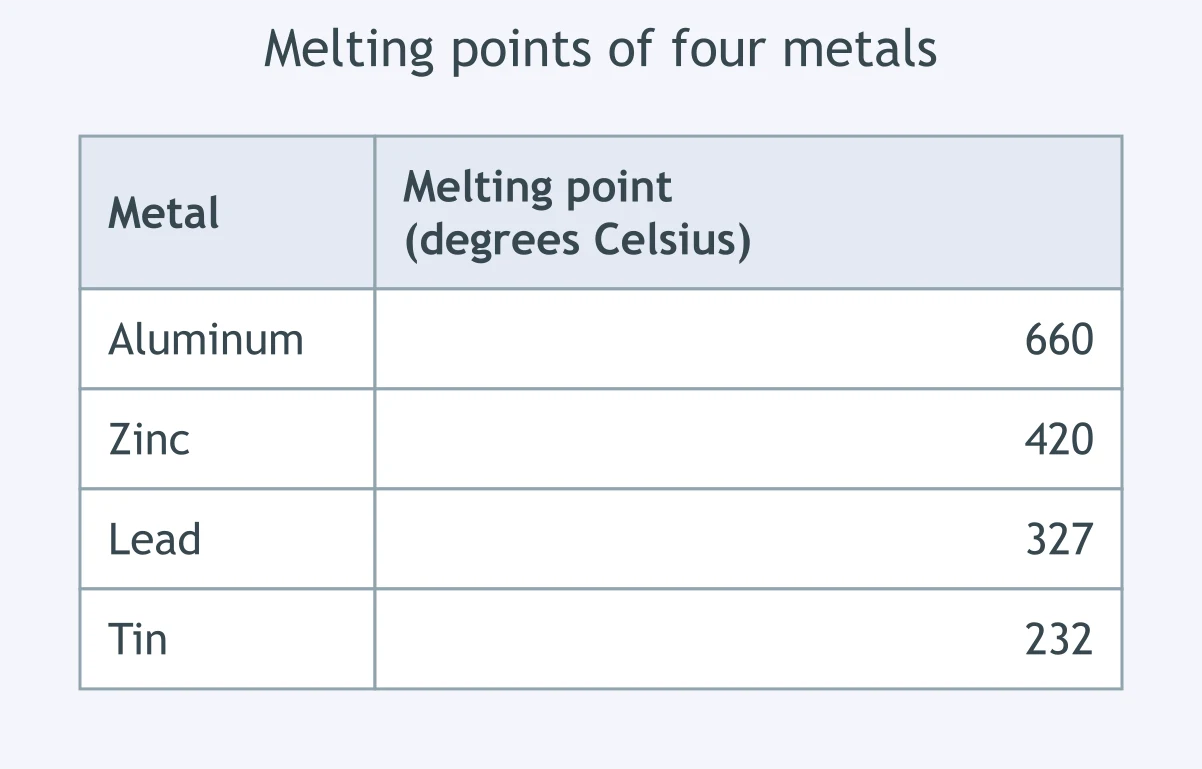
Look at the table of melting points. An unknown silvery solid is heated and melts at 660 degrees Celsius. Which metal is the unknown solid?
Crack the passcode before the zombies get in.
Answer, then swat bugs for bonus points.
Race through questions at your own speed.
Same question on every screen. Fastest wins.

Pick a tile, answer, hit bonuses and steals.
Earth, Sun and Moon Review
20 questions