Loading
by BlastRoom
Global contemporary works examined through material, process, site, identity, and media.
#us_hs_art_history
35 questions
One question set, multiple game modes. Tap any game to see it in action. Not sure which to pick?
Answer to place stones and capture territory.
Outrun the snow together.
Earn blasts, then hunt the other team.
Answer to earn energy, then climb.

The class blasts through walls together.
Bid on mystery lots. Most money wins.
Sell tours. Nice, standard, or a total scam.

Answer, restock, and serve the rush.
More correct answers pulls the rope your way.
Answer, then shoot down the alien wave.
Answer, then tap to leap the frozen ridge.
El Anatsui's Bleeding Takari II (2007) joins flattened liquor-bottle tops with copper wire. When installed, how can its metal surface behave?
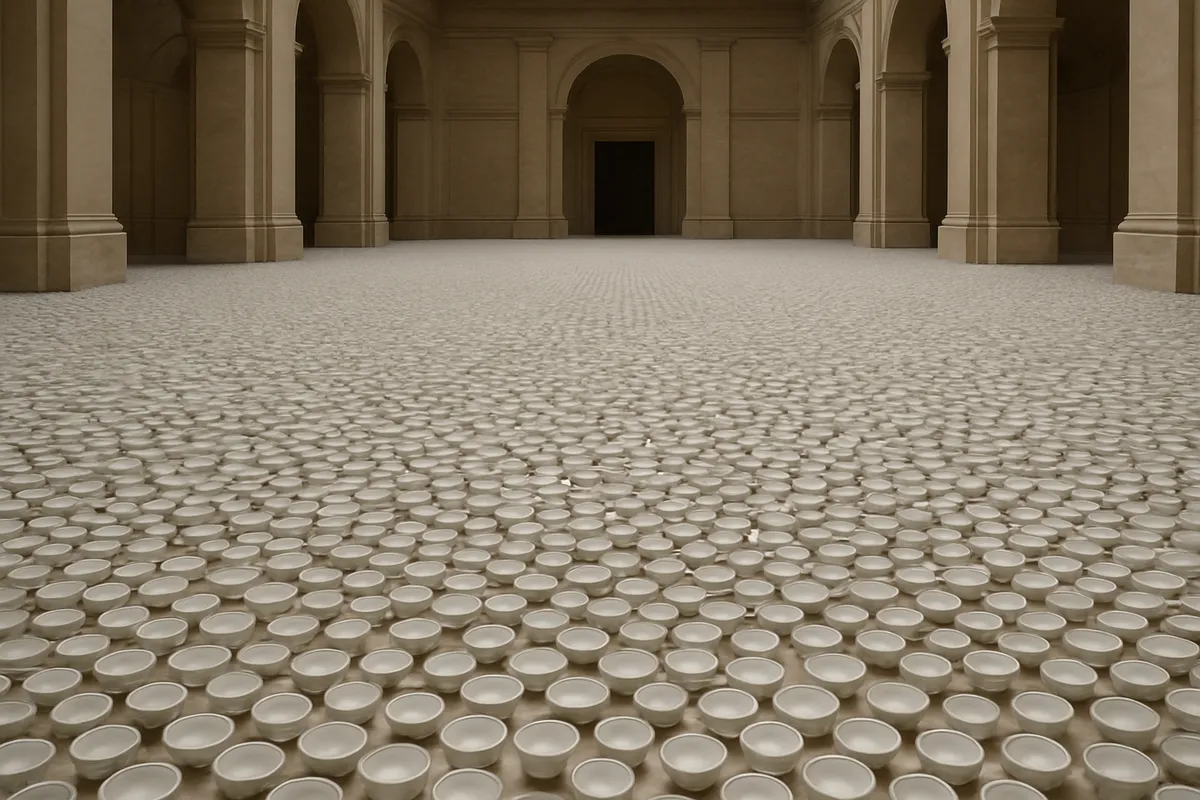
Ai Weiwei's Sunflower Seeds (2010) filled Tate Modern's Turbine Hall with more than 100 million hand-painted seeds. What material were the seeds made from?
Mona Hatoum's + and - (1994–2004) uses a circular bed that is continually grooved and smoothed by a motorized arm. What material receives those changing marks?
Yinka Shonibare's How Does a Girl Like You Get to Be a Girl Like You? (1995) dresses mannequins in Western-style costumes. What textile does he use?
Ai Weiwei's Map of China (2006) is assembled from material recovered from demolished Qing-dynasty temples. What is that material?
William Kentridge's Felix in Exile (1994) began as 35 mm film and was transferred into another medium. Which medium does the finished work use?
Nam June Paik's Electronic Superhighway: Continental U.S., Alaska, Hawaii (1995) combines screens, neon, electronics, steel, and wood. What kind of work is it?
In Sunflower Seeds, workers in Jingdezhen shaped and hand-painted each porcelain seed. Why is that extensive labor significant to the work?
For Bleeding Takari II, El Anatsui and assistants flatten, fold, and link discarded metal seals with copper wire. What does this process produce?
In Mona Hatoum's + and -, what does the motorized arm do to the sand as it turns?
Vik Muniz often forms recognizable images from materials such as chocolate, junk, or dust. What step turns these temporary arrangements into his finished pictures?
Kentridge made Felix in Exile by drawing in charcoal, then erasing and redrawing parts and filming each change. What is this process?
James Turrell's Frontal Passage (1994) asks visitors to enter a dark chamber divided by a sharply defined red wall of light. What is the viewer meant to experience?
Electronic Superhighway is approximately 15 by 40 feet and takes the form of a map of the United States. How does its scale affect a visitor's encounter?
Mona Hatoum's + and - is more than 13 feet across and uses a motorized mechanism. Why is it best understood as installation rather than a small tabletop sculpture?
El Anatsui, who made Bleeding Takari II, moved to Nigeria in 1975 to teach. In which country was he born?
A Turbine Hall commission is planned for Tate Modern's unusually vast former power-station space. What artistic concern does this setup emphasize?
El Anatsui uses liquor-bottle caps and seals in Bleeding Takari II. Beyond their discarded appearance, what history do those materials invoke?
Shonibare's Dutch wax-print costumes complicate the idea that a fabric has one pure national origin. What issue does their history bring forward?
Kara Walker uses the silhouette form in works about slavery and its aftermath. What tension makes this form especially pointed?
Mona Hatoum's Routes II (2002) alters airline-route maps with drawn lines. What concern is most central to this use of maps?
Sunflower Seeds presents a vast field of individually handmade objects. What social relationship does this contrast encourage viewers to consider?
The continual building and erasing in Hatoum's + and - evokes what pair of linked conditions?
In Electronic Superhighway, Paik includes a live camera feed for Washington, DC. What does this addition suggest about media?
Kara Walker's Harper's Pictorial History of the Civil War (Annotated) (2005) places silhouettes over images from an 1866 history. What strategy is she using?
Vik Muniz's Action Photo, after Hans Namuth (1997) translates a photograph of Jackson Pollock into chocolate syrup. What does this transformation do?
Shonibare cuts his Dutch wax-print fabric into clothing for headless mannequins. What clothing form does he quote and recontextualize?
Paik's Electronic Superhighway mixes borrowed film and television clips with original footage. Why does that borrowing matter?
At the Venice Biennale, permanent national pavilions allow participating countries to present artists. What does this exhibition structure foreground?
The first International Art Exhibition that became the Venice Biennale opened in which year?
Which country opened the first foreign national pavilion in Venice's Giardini in 1907?
At the 49th Venice Biennale in 2001, Vik Muniz served in what capacity?
Electronic Superhighway uses fifty-one video channels, neon outlines, and sound. Which feature makes it time-based rather than a static map?
Bill Viola's Slowly Turning Narrative (1992) projects video onto a freestanding wall that rotates on its vertical axis. How many video channels and sound systems does it use?
Kentridge's Felix in Exile lasts 8 minutes and 43 seconds. Why is duration important when analyzing it?
Crack the passcode before the zombies get in.
Answer, then swat bugs for bonus points.
Race through questions at your own speed.
Same question on every screen. Fastest wins.

Pick a tile, answer, hit bonuses and steals.
Mesoamerica: Olmec to Aztec
30 questions