Loading
One question set, multiple game modes. Tap any game to see it in action. Not sure which to pick?
Answer to place stones and capture territory.
Outrun the snow together.
Earn blasts, then hunt the other team.
Answer to earn energy, then climb.

The class blasts through walls together.
Bid on mystery lots. Most money wins.
Sell tours. Nice, standard, or a total scam.

Answer, restock, and serve the rush.
More correct answers pulls the rope your way.
Answer, then shoot down the alien wave.
Answer, then tap to leap the frozen ridge.
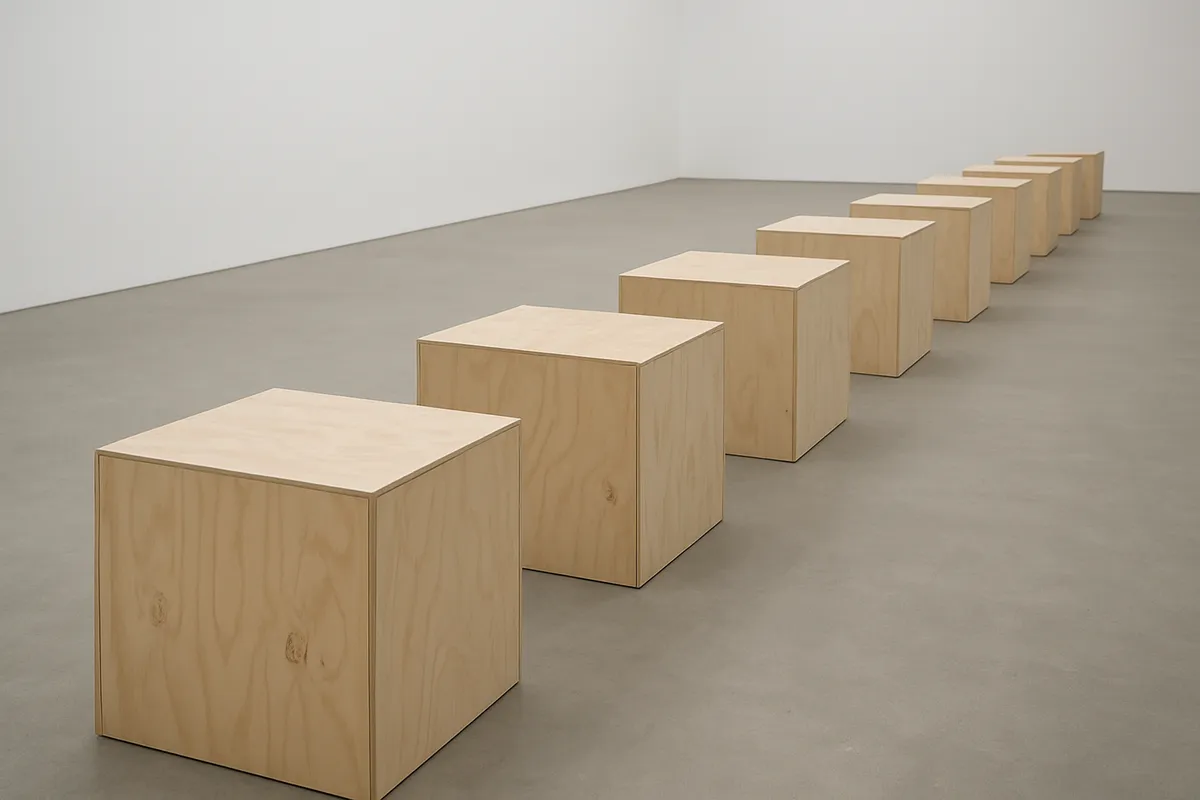
Donald Judd sent detailed plans to sheet-metal fabricators rather than shaping every surface himself. Which traditional expectation did this method most clearly minimize?
An artist authorizes a fabricator to produce open-ended modular units from plans instead of issuing a limited handmade edition. What claim about the art object does this practice support?
Carl Andre's Equivalents use identical sand-lime bricks laid directly on the floor. Which sculptural convention does this choice most clearly set aside?
Dan Flavin used commercially available fluorescent tubes without custom shaping them. What does that material choice challenge?
A sculpture has visible brushwork, irregular joins, and improvised shapes. Which revision would move it most toward the Minimalist approach to fabrication?
A Judd stack repeats boxlike units and equal intervals up a wall. What does that order reject most directly?
Andre's Equivalents can take different brick arrangements while keeping the same number of bricks and the same area. What does this make more important than a single preferred composition?
Sol LeWitt's Serial Project, I (ABCD) recombines open and closed units according to a grid. What governs the work's form?
Eva Hesse's Repetition Nineteen III repeats nineteen bucketlike fiberglass forms, each hand-formed so no two are quite alike. How does this Post-Minimalist use of seriality diverge from Judd's or LeWitt's?
Robert Morris's Untitled (3 Ls) uses three identical L-shaped beams in different orientations. Why must a viewer move around the work to grasp its point?
In “Art and Objecthood,” Michael Fried criticized literalist art as theatrical. What feature of Minimalist sculpture prompted that charge?
A large, simple sculpture changes in apparent scale as a student walks toward it, around it, and away from it. Which reading best fits Minimalist concerns?
A low field of bricks extends from a gallery wall across the floor rather than rising on a pedestal. What does this placement ask the viewer to notice?
Flavin placed fluorescent fixtures in a gallery corner so their colored light altered the walls and floor. What is part of the work's experience besides the fixtures themselves?
Frank Stella said of his paintings, "What you see is what you see." What attitude does this statement express?
A Sol LeWitt wall drawing is sold as written instructions and can be executed again after an earlier wall is painted over. What follows?
Critic Lucy Lippard described Conceptual art of the late 1960s as the "dematerialization" of the art object. What trend did she mean?
Joseph Kosuth's One and Three Chairs places a wooden chair beside its photograph and a dictionary definition. What question does this arrangement put in play?
Lawrence Weiner held that one of his statements could be fabricated, merely described, or left unrealized. What is the strongest implication?
An artist establishes a rule for collecting photographs and dates, then exhibits the resulting records rather than a crafted object. What is the documentation doing?
On Kawara's Today paintings show the date of their making and had to be finished that day or destroyed. What does this rule foreground?
Hans Haacke's Shapolsky et al. assembled photographs, maps, deeds, and transaction data about New York real estate. What becomes the artwork's subject?
For MoMA Poll, Hans Haacke asked museum visitors to vote on a current political question. What institutional assumption did the work test?
Daniel Buren's Peinture-Sculpture was a striped banner designed for the Guggenheim rotunda and removed after objections that it obstructed other works. What does this reveal about its strategy?
A work consists of factory-made aluminum boxes repeated at even intervals. The viewer encounters their scale while moving through the gallery. Which position does it most strongly exemplify?
Crack the passcode before the zombies get in.
Answer, then swat bugs for bonus points.
Race through questions at your own speed.
Same question on every screen. Fastest wins.

Pick a tile, answer, hit bonuses and steals.
Postmodern Architecture
25 questions