Loading
by BlastRoom
Find the critical angle and predict when light is trapped inside a medium.
#physics

20 questions
One question set, multiple game modes. Tap any game to see it in action. Not sure which to pick?
Answer to place stones and capture territory.
Outrun the snow together.
Earn blasts, then hunt the other team.
Answer to earn energy, then climb.

The class blasts through walls together.
Bid on mystery lots. Most money wins.
Sell tours. Nice, standard, or a total scam.

Answer, restock, and serve the rush.
More correct answers pulls the rope your way.
Answer, then shoot down the alien wave.
Answer, then tap to leap the frozen ridge.
A ray of light in water (n = 1.33) strikes a water-air boundary at 60.0 degrees from the normal. What happens to the ray?
A ray of light in glass (n = 1.50) strikes a glass-air boundary at 30.0 degrees from the normal. What happens to the ray?
A ray of light in a medium with n = 2.00 strikes a boundary with air at 30.0 degrees from the normal. What happens to the ray?
A ray of light inside a diamond (n = 2.42) strikes a diamond-air boundary at 20.0 degrees from the normal. What happens to the ray?
A ray of light in crown glass (n = 1.52) strikes a boundary with water (n = 1.33) at 70.0 degrees from the normal. What happens to the ray?
A ray of light in a medium with n = 1.25 strikes a boundary with air at 45.0 degrees from the normal. What happens to the ray?
Three rays of light in glass (n = 1.50) strike a glass-air boundary at 30.0, 41.8 and 55.0 degrees from the normal. Which ray is totally internally reflected?
Three rays of light in water (n = 1.33) strike a boundary with air (n = 1.00) at 35.0, 45.0 and 52.0 degrees from the normal. Which ray is totally internally reflected?
Three rays of light in flint glass (n = 1.66) strike a boundary with crown glass (n = 1.52) at 60.0, 64.0 and 70.0 degrees from the normal. Which ray is totally internally reflected?
Three rays of light in quartz (n = 1.54) strike a boundary with air (n = 1.00) at 35.0, 38.0 and 45.0 degrees from the normal. Which ray is totally internally reflected?
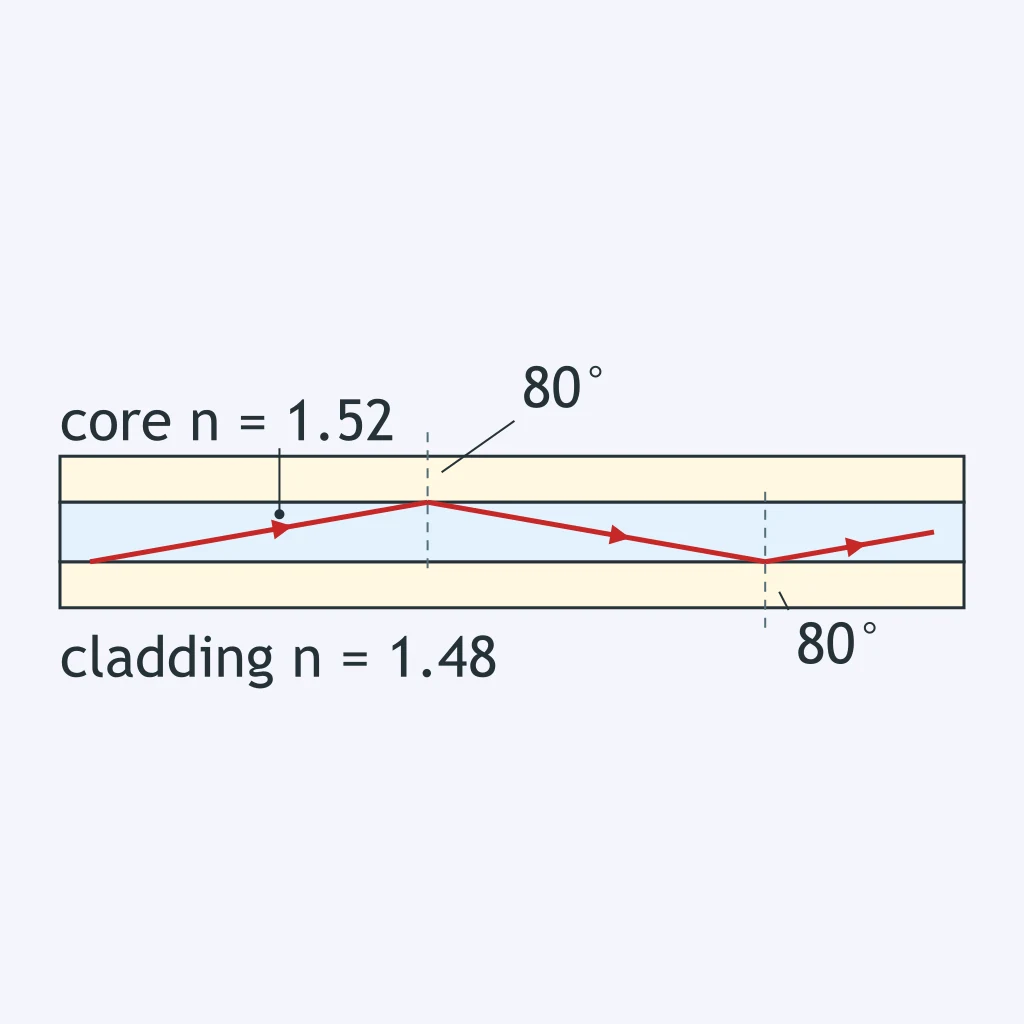
In the optical fiber shown, why does the ray stay inside the core?
A glass right-angle prism uses the glass-air boundary shown. Why can the internal 45.0-degree strike act like a mirror?
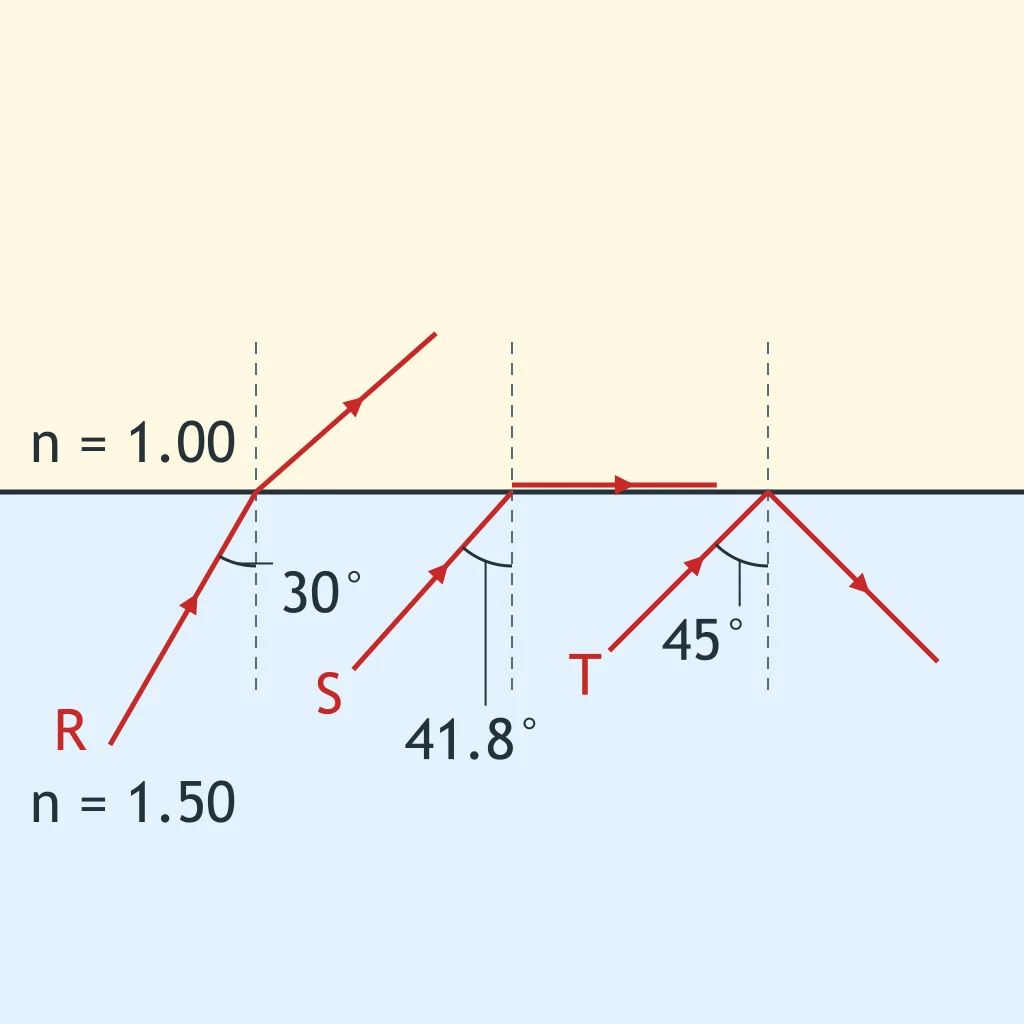
A ray inside glass (n = 1.50) reaches a boundary with air (n = 1.00). What is the critical angle?
Light travels from polystyrene (n = 1.49) toward air (n = 1.00). What critical angle should be used?
A ray in water (n = 1.33) is incident on a water-air boundary. What is the critical angle for this boundary?
Light travels from flint glass (n = 1.66) into crown glass (n = 1.52). What is the critical angle?
A ray in diamond (n = 2.42) reaches a diamond-air boundary. What is the critical angle?
A ray traveling in air (n = 1.00) meets diamond (n = 2.42) at 70.0 degrees from the normal. Can total internal reflection occur?
A ray in water (n = 1.33) strikes a water-air boundary at 48.0 degrees from the normal. Does total internal reflection occur?
A ray in glycerin (n = 1.47) reaches water (n = 1.33) at 70.0 degrees from the normal. Does total internal reflection occur?
Crack the passcode before the zombies get in.
Answer, then swat bugs for bonus points.
Race through questions at your own speed.
Same question on every screen. Fastest wins.

Pick a tile, answer, hit bonuses and steals.
Converging and Diverging Lenses
30 questions