Loading
by BlastRoom
State the postulates, identify inertial frames, and apply invariant light speed.
#physics

40 questions
One question set, multiple game modes. Tap any game to see it in action. Not sure which to pick?
Answer to place stones and capture territory.
Outrun the snow together.
Earn blasts, then hunt the other team.
Answer to earn energy, then climb.

The class blasts through walls together.
Bid on mystery lots. Most money wins.
Sell tours. Nice, standard, or a total scam.

Answer, restock, and serve the rush.
More correct answers pulls the rope your way.
Answer, then shoot down the alien wave.
Answer, then tap to leap the frozen ridge.
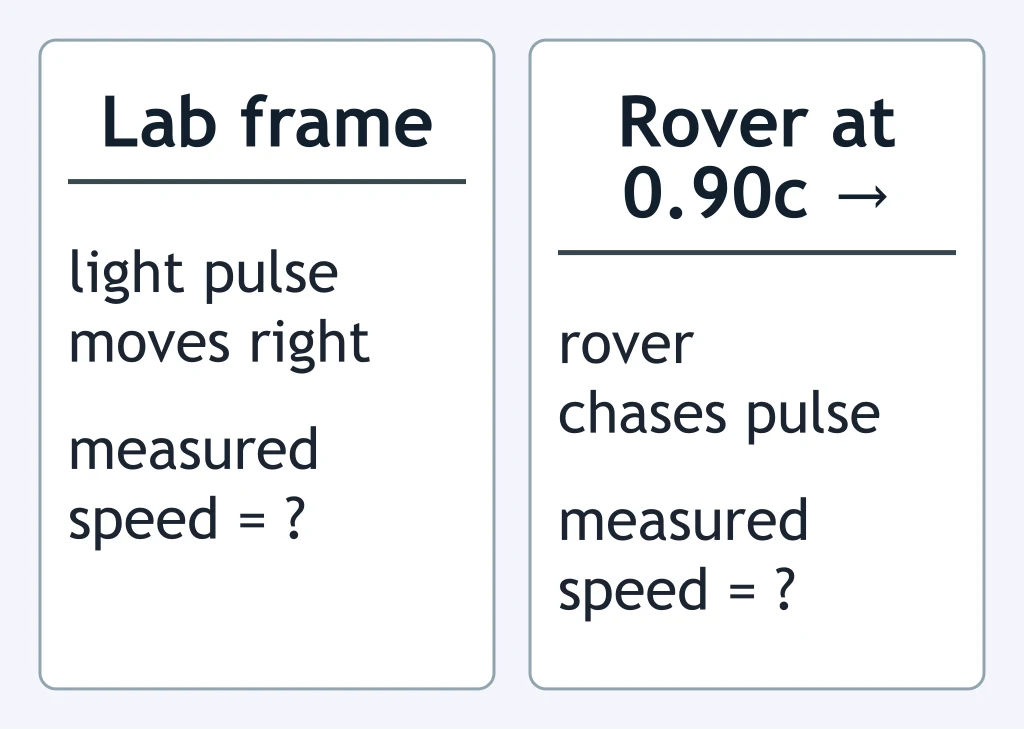
Use the two-frame figure. Which pair of measured speeds belongs in the two boxes?
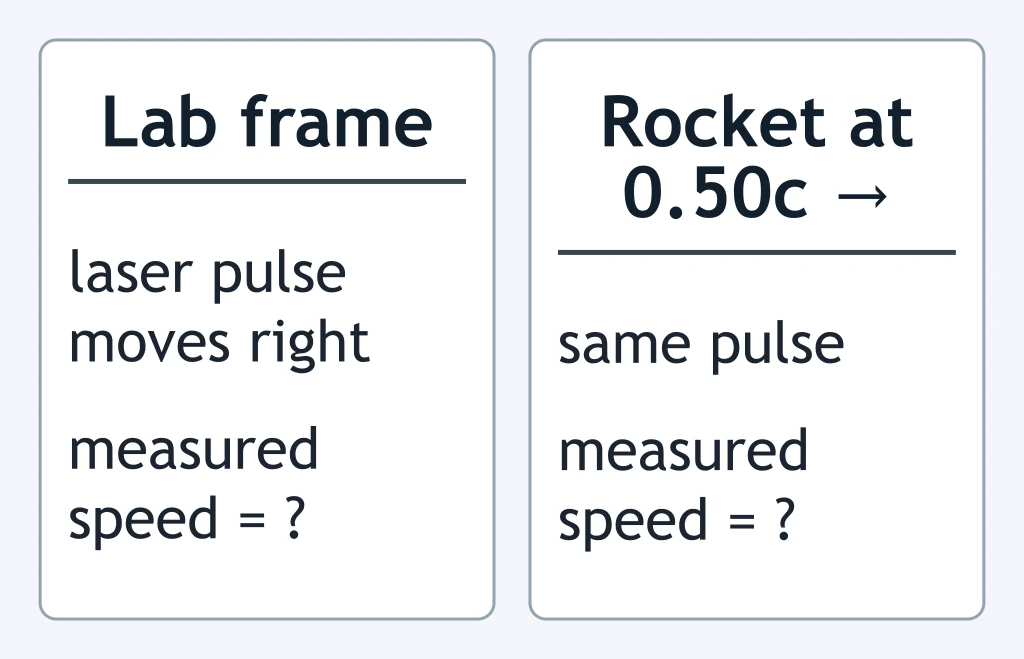
Use the two-frame figure. What speeds should the lab observer and the probe observer each record for the light pulse?
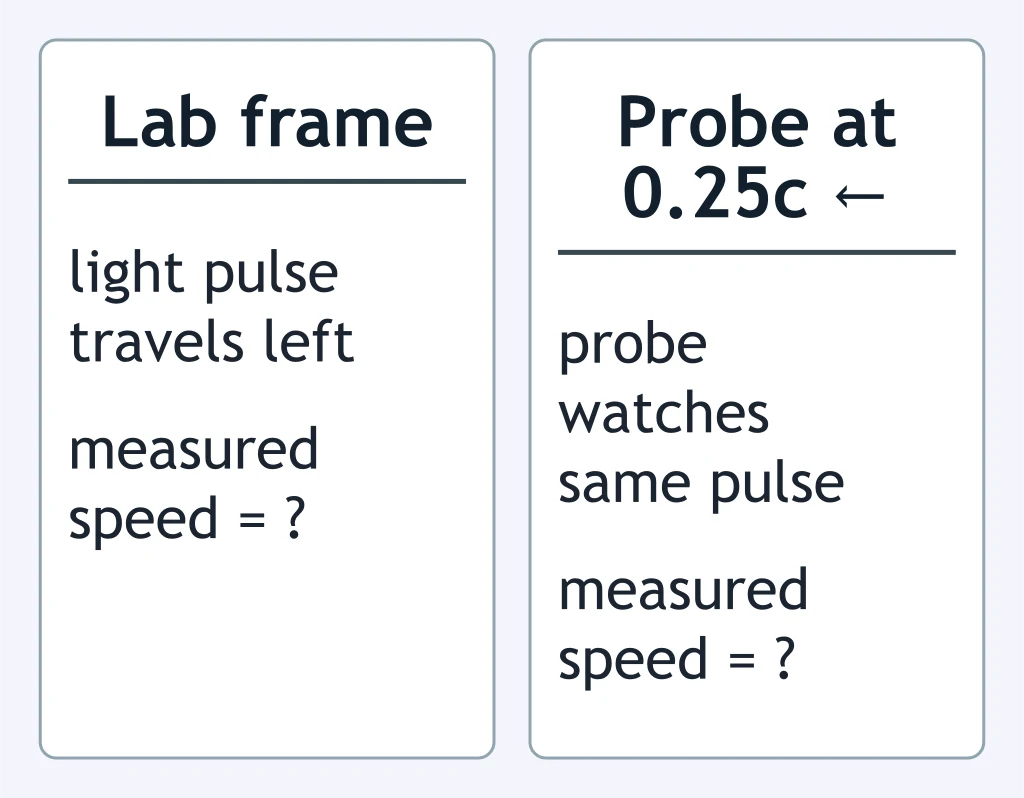
Use the two-frame figure. Which measured speeds match special relativity?
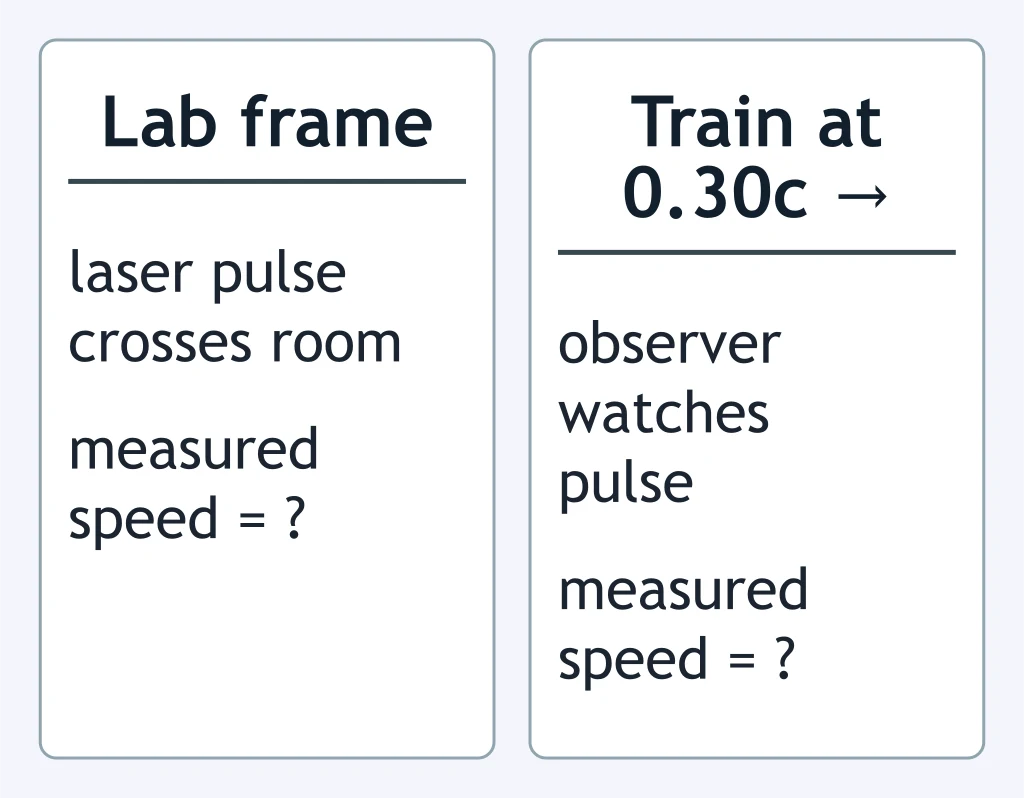
Use the two-frame figure. A laser pulse moves in vacuum while a shuttle frame moves at 0.80c. Which pair belongs in the boxes?
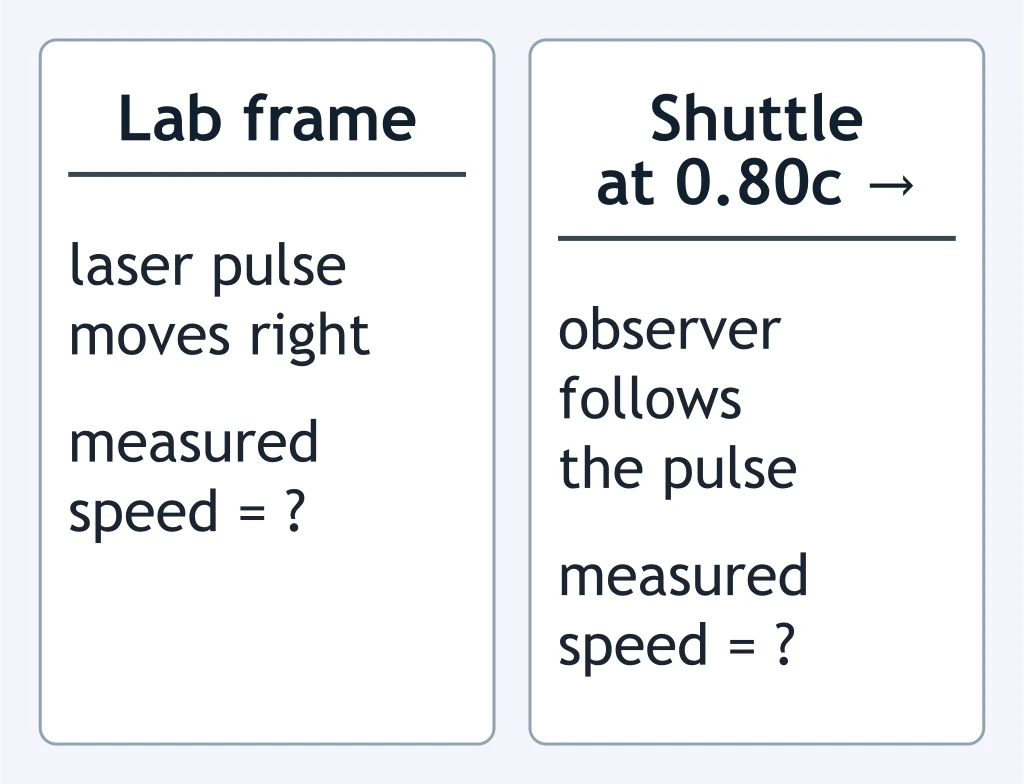
Use the two-frame figure. What does each observer measure for the speed of the same vacuum light pulse?
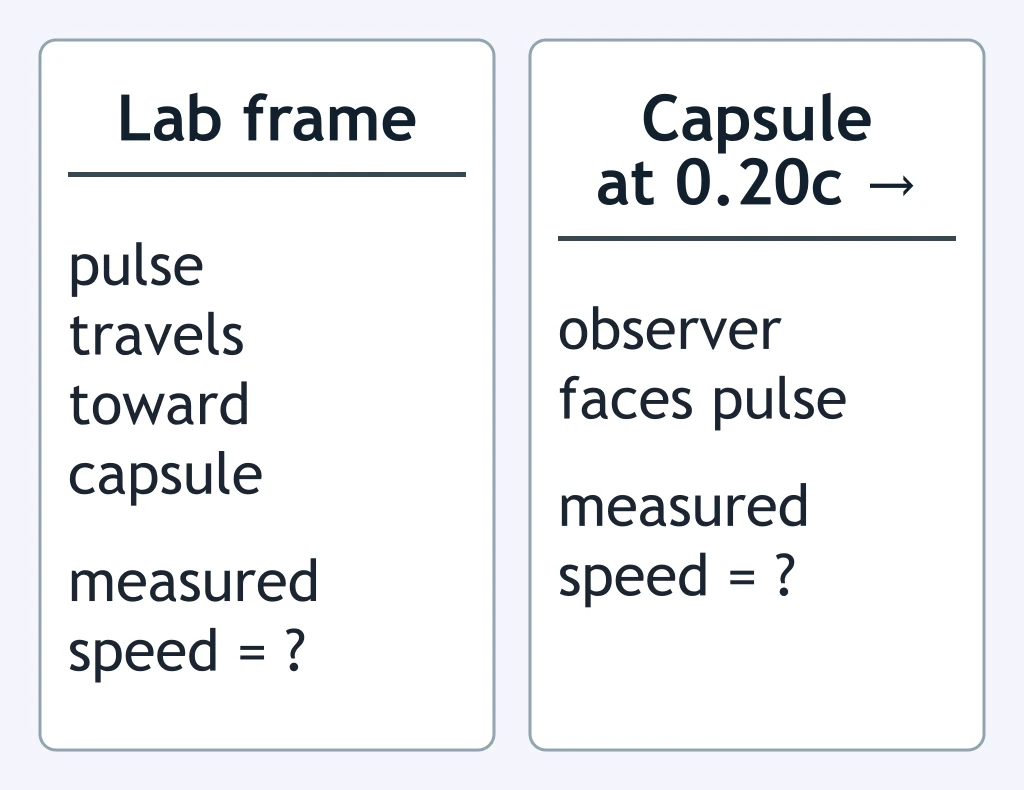
Use the two-frame figure. Which option gives the light speed measured in both inertial frames?
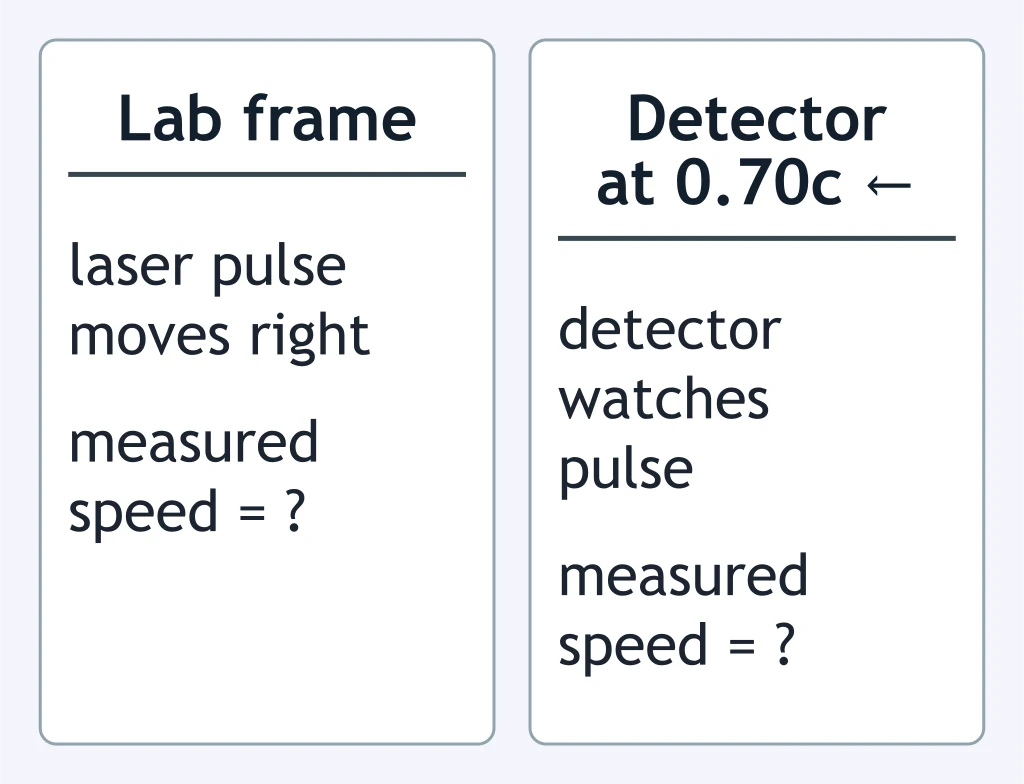
Use the two-frame figure. The detector frame moves opposite the pulse at 0.70c. What speeds should the two observers measure?
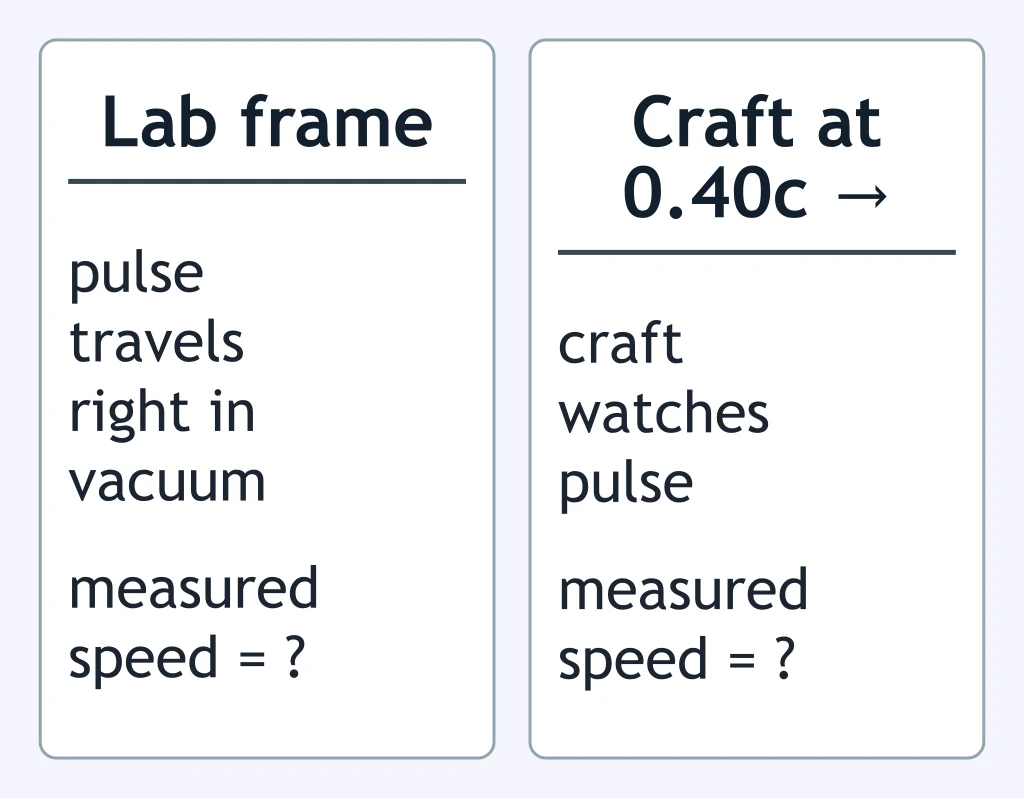
Use the two-frame figure. Which pair is consistent with the invariant speed of light?
Two laboratories perform the same electricity experiment. One is on the ground; the other coasts at constant velocity in a straight line. They get the same laws. Which postulate does this illustrate?
A spacecraft moving at steady velocity flashes a laser in vacuum. Observers on the spacecraft and on a passing inertial station both measure the beam. Which statement must be true?
Which sentence best states the first postulate of special relativity?
Which sentence best states the second postulate of special relativity?
A sealed railcar glides smoothly at constant 35 m/s on a straight track. No experiment inside can reveal whether it is moving or at rest relative to the ground. What principle is being used?
A star emits light while moving rapidly away from Earth. In vacuum, Earth observers still measure the light speed as c. Which postulate explains this?
A physics law written in a lab at rest has the same form in a rocket drifting at constant velocity far from thrust. Which postulate is this?
What value is normally used for c, the speed of light in vacuum, in high school special relativity problems?
Two inertial observers move relative to each other and watch the same light pulse in vacuum. Which quantity do they agree has the value c?
Which situation is directly ruled out by the second postulate of special relativity?
Special relativity's postulates are stated for inertial reference frames. Which frame is inertial?
Which observer is in a non-inertial reference frame?
A delivery van moves east at a steady 12 m/s on a straight road. For a short interval with no turns or speeding up, how should its frame be classified?
Which frame is not inertial?
A rider is in a car that turns left around a curve at constant 15 m/s. Why is the rider's frame non-inertial?
Which reference frame is best modeled as inertial during the stated interval?
A rocket fires its engines and increases speed from 0.10c to 0.20c. What kind of frame is attached to the rocket during the burn?
A train moves at constant speed but follows a circular test track. Is the train frame inertial?
A spacecraft flying directly toward Earth at 0.80c switches on a headlamp aimed at Earth. Classical addition predicts 1.80c. What does Earth measure?
A probe receding from Earth at 0.60c shines a laser backward toward Earth. Classical reasoning predicts 0.40c toward Earth. What speed does Earth measure for the beam?
An astronaut moves at 0.90c in the same direction as a vacuum light pulse. Classical relative motion suggests the pulse gets ahead at only 0.10c. What does the astronaut measure?
A train moving at 0.30c turns on a forward laser. A platform observer uses special relativity, not everyday addition. What speed is measured for the laser light?
Two spacecraft approach each other. Ship A moves at 0.40c and shines light toward Ship B, which moves toward A at 0.30c. What speed does Ship B measure for the incoming light?
A star moves away from Earth at 0.20c and emits light toward Earth. Which comparison is correct?
A detector moves toward a laser source at 0.50c. Everyday addition would predict the detector meets the light at 1.50c. In the detector's own inertial frame, what is the light speed?
A rocket moving right at 0.75c emits a light pulse to the right. Which statement contrasts the two predictions for a lab observer?
A ship traveling left at 0.45c sends a laser pulse to the right. Classical addition for a lab observer predicts 0.55c. What does special relativity predict?
A student says, "If I move at 0.99c beside a light beam, I should see it crawl ahead at 0.01c." What is the special-relativity correction?
Which publication fact about special relativity is correct?
In 1887, Albert Michelson and Edward Morley used an interferometer to compare light traveling along perpendicular paths. What result did they report?
Why does the Michelson-Morley null result fit the second postulate of special relativity?
Which historical statement is accurate?
Crack the passcode before the zombies get in.
Answer, then swat bugs for bonus points.
Race through questions at your own speed.
Same question on every screen. Fastest wins.

Pick a tile, answer, hit bonuses and steals.

Length Contraction
20 questions