Loading
by BlastRoom
Read science and technical passages to name their structure and purpose and to sort fact, reasoned judgment, and speculation.
#us_grade_7_english
40 questions
One question set, multiple game modes. Tap any game to see it in action. Not sure which to pick?
A lab report reads: "Each crushed leaf was dropped into a solvent, and the green color spread through the liquid until the leaf itself was pale." As used here, "solvent" means
A lab guide states: "Record each mass in grams (g) and each volume in milliliters (mL). Then report the density of the sample as g/mL." In this guide, "g/mL" stands for
"The stream slows where the valley widens, and the sand and silt it carried sink to the bottom. Year after year this sediment piles up until a bar blocks the channel." As used here, "sediment" means
A data table carries this note: "All temperatures below are in °C. A reading marked with an asterisk (*) was taken after the probe was replaced." A temperature marked with an asterisk is one that was
"We predicted 6 grams of crystals, but our yield was only 4 grams. A wet filter is the likely reason the yield fell short." As used here, "yield" means
"Unlike copper, which carries heat quickly, wood carries heat slowly. Whereas a copper spoon left in hot soup warms in seconds, a wooden spoon stays cool." How does this passage present its information?
"Because the crew spread salt at dawn, the ice on the bridge melted before traffic built up. As a result, the county reported no crashes there that morning." How does this passage present its information?
An article on road salt runs four sections: "What Salt Does to Ice," "How Crews Spread It," "Salt in Streams," and "Mixes Being Tested Now." What does "Salt in Streams" contribute to the article?
A report on a school garden has these sections: "Why We Tested the Soil," "How We Took Samples," "What the Samples Showed," and "What We Still Do Not Know." What does the last section contribute?
"1. Fill the tube to the 10 mL line. 2. Add two drops of dye. 3. Cap the tube and turn it over three times. 4. Wait one minute, then record the color." The author's purpose in this passage is to
"Four sealed jars sat in sunlight for six hours. The water in the black jar reached 41°C, the water in the gray jar reached 36°C, and the water in the clear jar reached 32°C." The author's purpose here is to
"A metal rail and a wooden bench in the same yard are at the same temperature, yet the rail feels colder. Metal carries heat away from your skin faster, so the skin cools and reports cold." The author's purpose is to
A manual's page on a hot plate ends: "Never leave the plate heating on an unattended bench. Wait until the surface reads below 40°C before you move it." The author includes these two sentences in order to
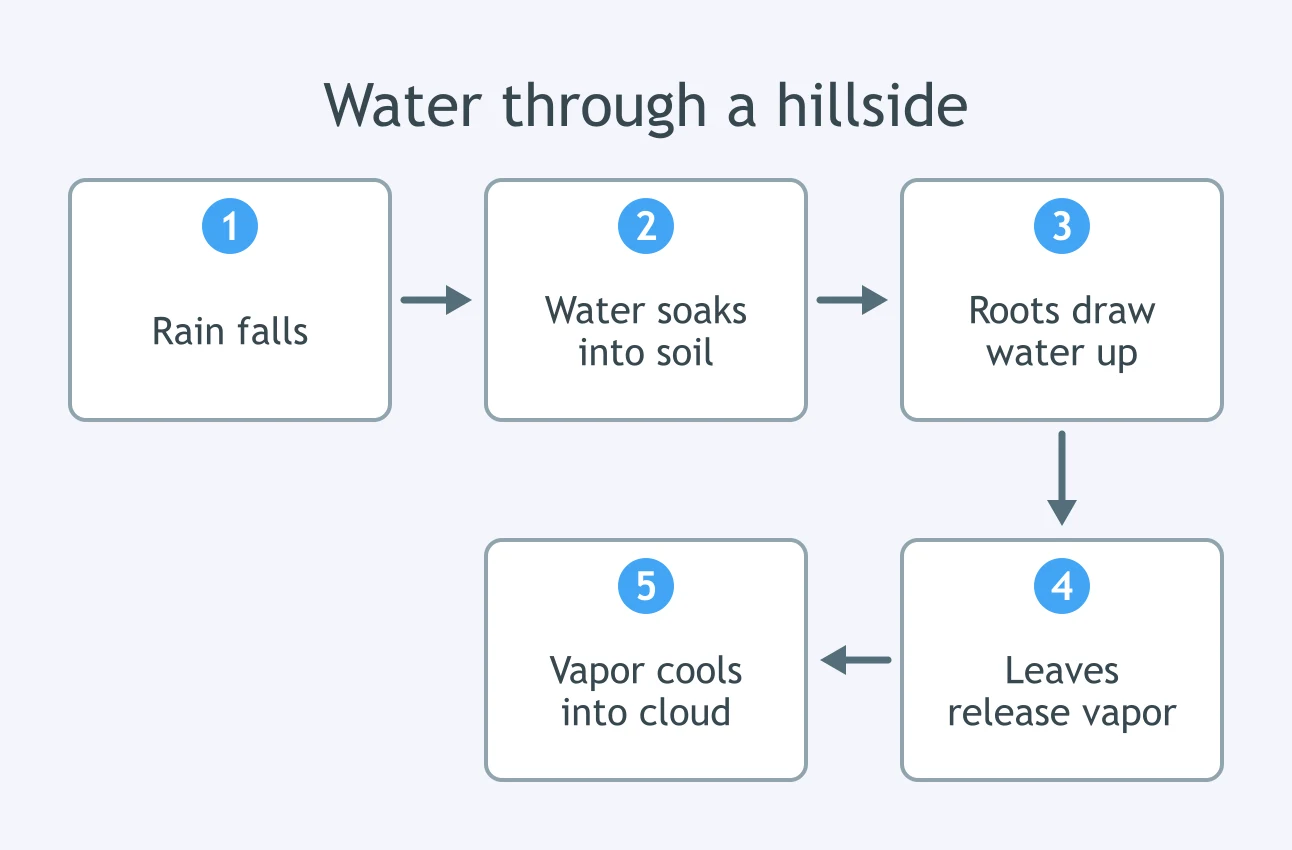
A flowchart beside the article traces what happens to rain falling on a hillside. The article only names these parts. What does the flowchart add?
"The pond dropped 14 cm in August. Samples suggest most of the loss was evaporation. The town may have pumped more than it reported. Nearby wells might have been deepened." Which sentence is a verifiable fact?
"Beetle counts fell 60% from 2019 to 2024. The trap data indicate the loss followed two dry summers. The beetles may have moved to wetter fields. Farmers might welcome the change." Which sentence is a reasoned judgment based on findings?
"The channel held 2 meters of silt. The cores show the silt settled before the flood, not after. The villagers may have hoped the river would come back. Their wells were dug into the old bank." Which sentence is speculation?
A report states: "The cores show that the ash fell in a single night. The herders may have watched the mountain for weeks beforehand." Which word marks the second sentence as speculation rather than a finding?
A study reports: "The water samples suggest that the fish decline began before the mill opened." The word "suggest" shows that the writer is
A report states: "The core data indicate that the lake froze earlier in the 1800s than it does now." True or False: because it rests on core data, this sentence is a verifiable fact rather than a reasoned judgment.
"1. Clamp the holder to the bench. 2. Slide the cell in, flat end up. 3. Close the lid. 4. Connect the meter leads." How does this passage present its information?
An article reports: "In 1974 the river ran gray below the mill. By 1991 the mill had closed and trout returned to the lower bend. In 2008 the town reopened the swimming beach." How is this passage organized?
"Unlike granite, sandstone soaks up rain. Whereas a granite block sheds water, a sandstone block darkens because its pores fill." Which words show that this passage is organized by comparison?
"The pump ran dry, so the bearing overheated. Because the bearing seized, the belt snapped, and the line stopped for two hours." How does this passage present its information?
An article about tides has these sections: "What a Tide Is," "Why the Moon Pulls the Ocean," "Reading a Tide Table," and "Tides and Harbor Traffic." What does "Reading a Tide Table" contribute?
A wind-power report has these sections: "How a Turbine Turns Wind into Current," "Choosing a Ridge Site," "Noise Complaints from Two Towns," and "Next Steps." What does the third section add to the report?
"Steel expands as it warms. Engineers leave a gap at each end of a bridge deck so that on a 35°C afternoon the growing steel has somewhere to go instead of buckling." The author's purpose here is to
A water-test procedure reads: "2. Measure 50 mL of pond water into the beaker. 3. Add one tablet and stir for 30 seconds." Why does the author print the exact volume and the exact time?
A lab procedure ends: "Rinse the probe with distilled water between samples." The author includes this sentence in order to
An article opens: "Viscosity is a liquid's resistance to flowing." The rest of the article explains why cold syrup pours slowly. The author includes this opening sentence in order to
"Ten seeds went into each of three trays, held at 10°C, 20°C, and 30°C. After 12 days, 2 seeds had sprouted at 10°C, 9 at 20°C, and 6 at 30°C." The author reports all three counts in order to
"Salt water freezes below 0°C. That is why the road crew's brine stays liquid at −6°C while puddles beside it turn to ice." The author's purpose in this passage is to
A soil report reads: "The plot lost 4 kg of topsoil per square meter. The core depths indicate the loss began before the April rain. The rows may have been plowed early. Farmers might fence the slope." Which sentence is a verifiable fact?
Air report: "Sensors logged 31 micrograms of dust per cubic meter in May. The readings indicate dust rose after the quarry widened its pit. Trucks may have used a back road. Residents may stay indoors." Which is a reasoned judgment based on findings?
A field report reads: "The colony covered 40 square meters. Bands show the birds arrived three weeks early. The pair may have lost an earlier nest elsewhere. Two chicks fledged in June." Which sentence is speculation?
A tank report states: "The tank lost 3 liters overnight, and the pressure drop points to a leak in the lower seam. The crew might have overtightened the valve last week." The second sentence is best described as
A glacier study states: "The ice front retreated 120 meters between 2015 and 2024. The core layers indicate that summer melting, not calving, drove most of that retreat." How do these two sentences differ?
A forest report says: "The fungus may have arrived on imported logs." The report includes no shipping or log records. Why is this sentence speculation rather than a reasoned judgment?
A well report states: "Chloride in the north well measured 210 milligrams per liter in March." A reader who doubted this sentence could settle the question by
"Nylon rope stretches under a jerk, but steel cable does not. Unlike nylon, steel transmits the jerk straight through." How does this passage organize its information?

Integrating Information from Media, Charts, and Quantitative Displays
40 questions
History/Social Studies Literacy: Evidence, Central Ideas, and Primary Versus Secondary Sources
40 questions
History/Social Studies Literacy: Text Structure, Point of View, and Fact, Opinion, and Reasoned Judgment
40 questions
Science and Technical Literacy: Evidence, Central Ideas or Conclusions, and Following a Procedure
40 questions
Crack the passcode before the zombies get in.

Pick a tile, answer, hit bonuses and steals.
Comparing an Experiment, Simulation, or Multimedia Source with a Written Account
40 questions