Loading
by BlastRoom
Predict how waves behave when they meet boundaries and explain the speed changes behind them.
#physics
30 questions
One question set, multiple game modes. Tap any game to see it in action. Not sure which to pick?
Answer to place stones and capture territory.
Outrun the snow together.
Earn blasts, then hunt the other team.
Answer to earn energy, then climb.

The class blasts through walls together.
Bid on mystery lots. Most money wins.
Sell tours. Nice, standard, or a total scam.

Answer, restock, and serve the rush.
More correct answers pulls the rope your way.
Answer, then shoot down the alien wave.
Answer, then tap to leap the frozen ridge.
Plane water waves cross from deep water into shallow water at an angle. Shallow-water waves travel more slowly. What happens to the waves after the boundary?
A ripple-tank wave crosses from shallow water into deep water at an angle. The wave speed is greater in deep water. Which prediction matches the boundary behavior?
Water waves from a 2.0 Hz source travel at 0.40 m/s in deep water, then slow to 0.20 m/s in shallow water. What is the wavelength in the shallow water?
Straight wavefronts cross at an angle into a region where the wave speed is twice as great. The source frequency does not change. What happens to the wavelength?
Ocean waves approach a straight beach at an angle. The water gets shallower near shore, so the waves slow down. How do the crests change direction as they come in?
A wave crosses from a slower region into a faster region traveling straight along the normal, head-on to the boundary. What happens to its direction and wavelength?
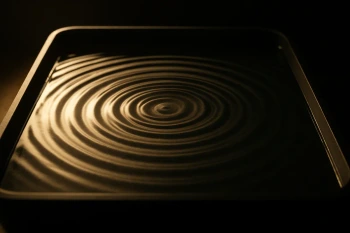
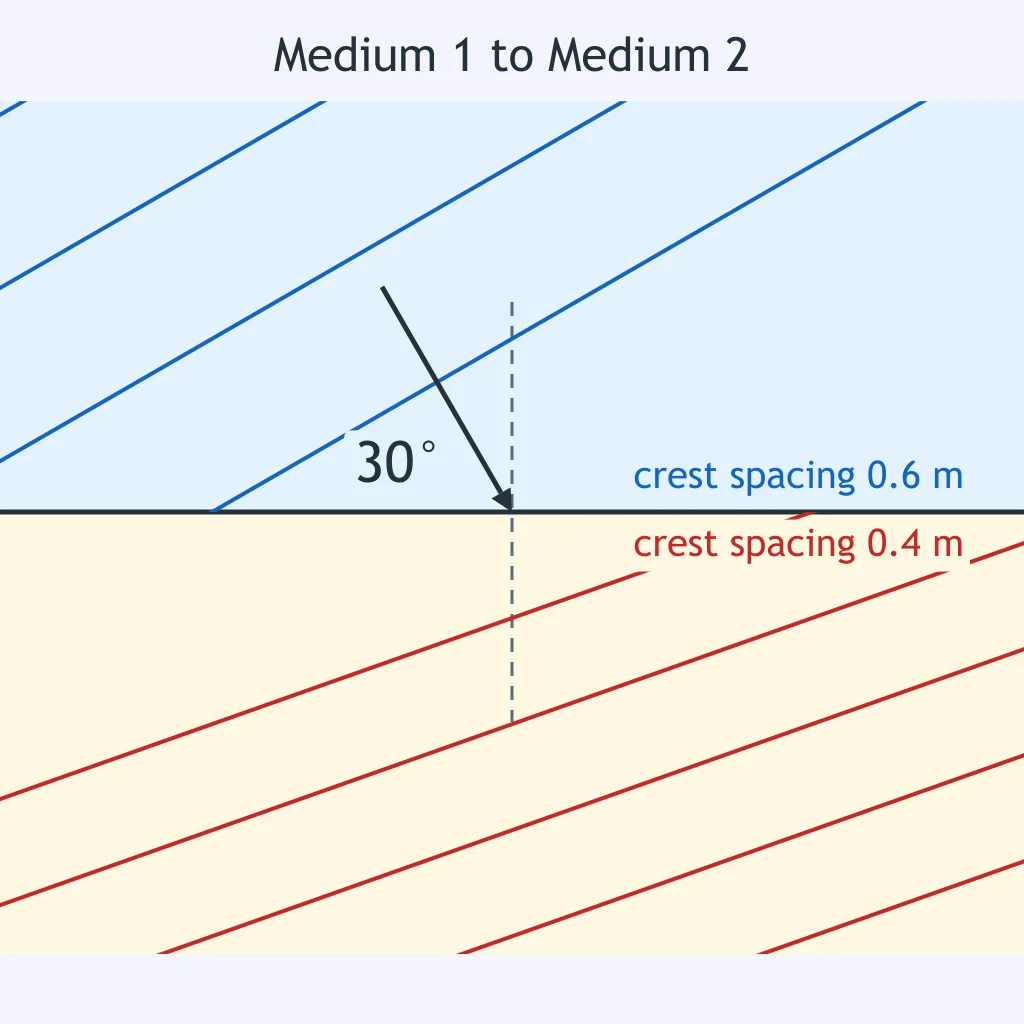
In the figure, a wave from the same source crosses into a new medium at an angle. What does the change in crest spacing tell you about why the wave bends?
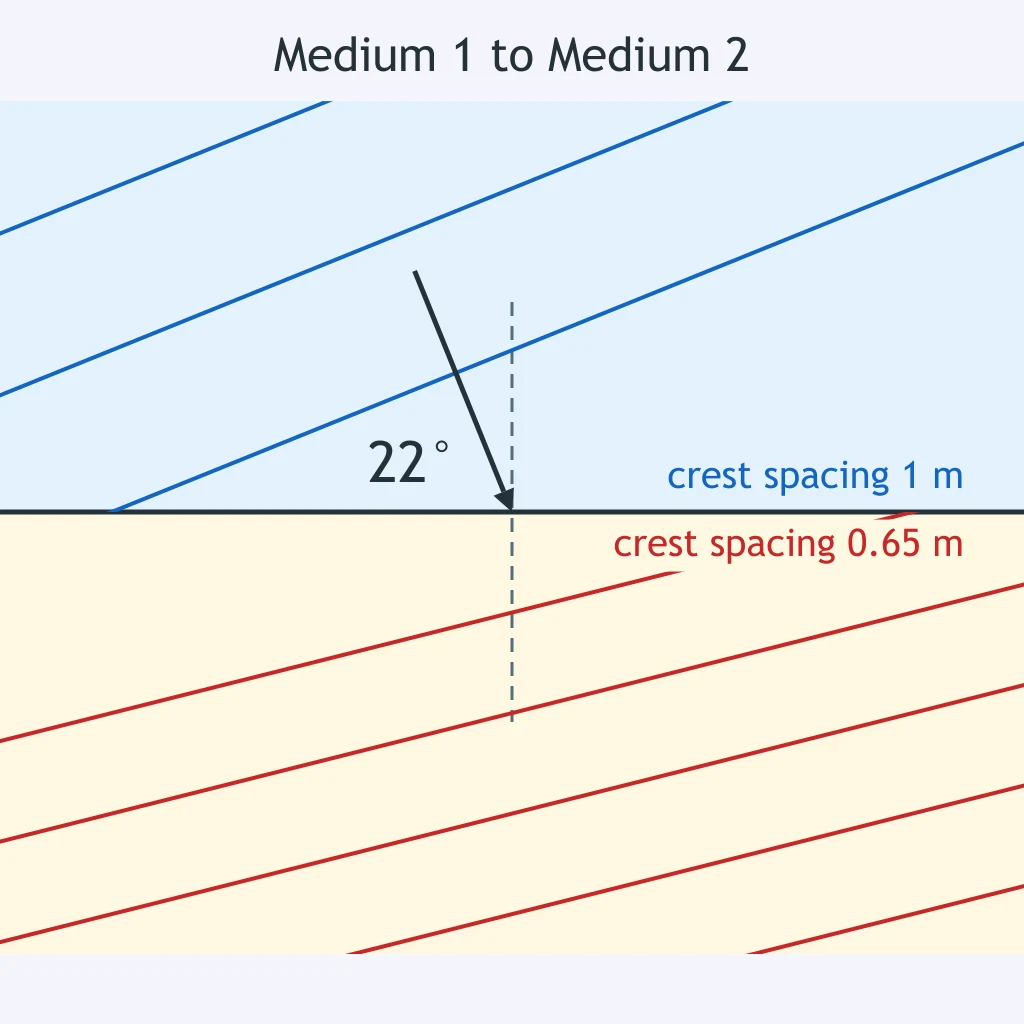
In the figure, the source keeps the same frequency as the wave crosses the boundary. What does the change in crest spacing show about the wave?
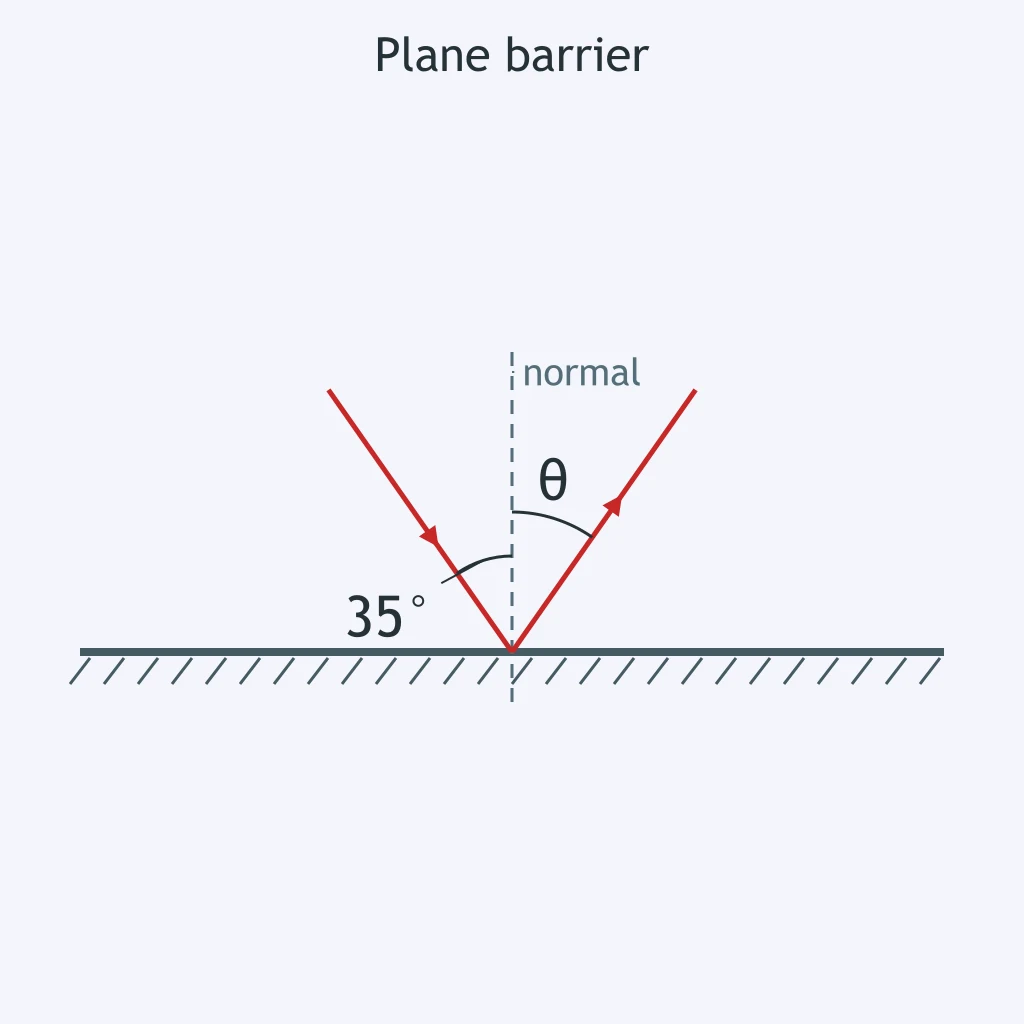
A wave ray reflects from a plane barrier. The figure marks the incident angle from the dashed normal as 35 degrees. What are the reflected angle and wavelength after reflection?
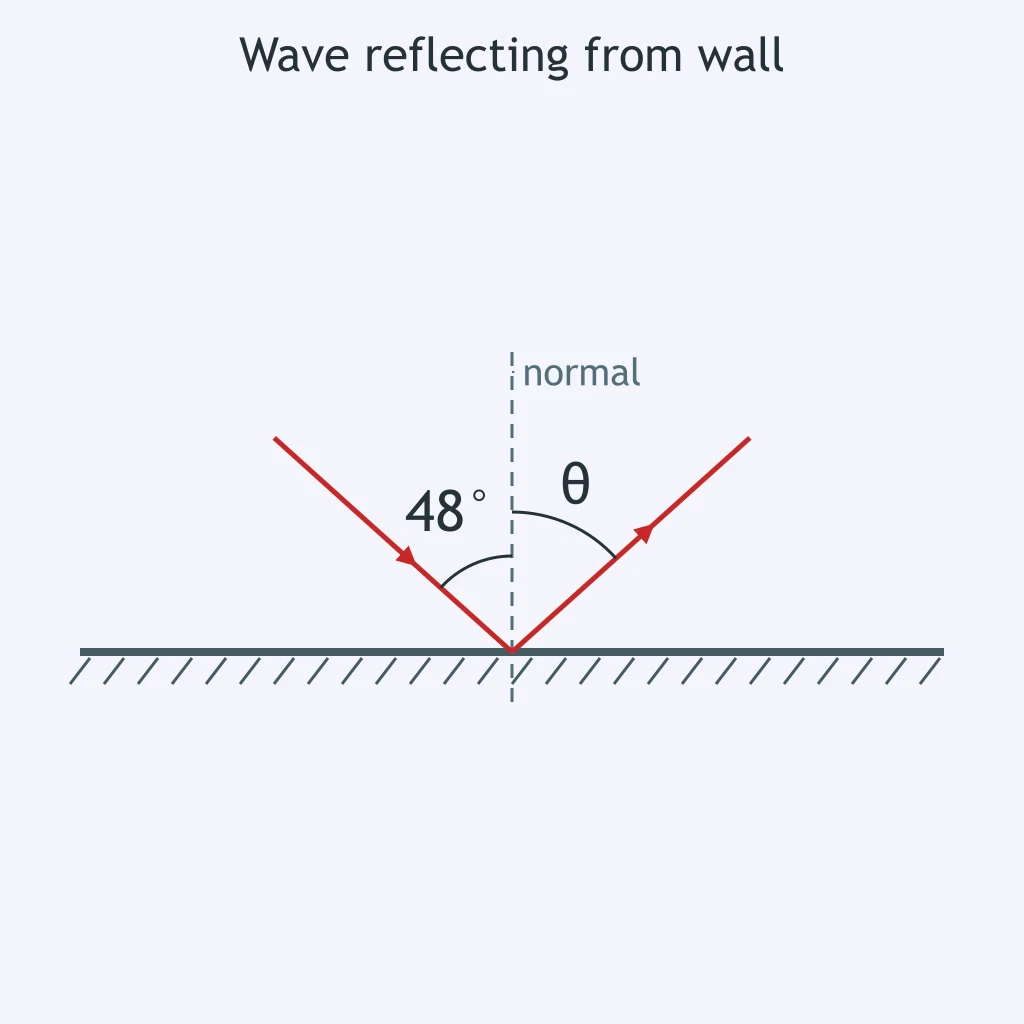
The incident ray in the figure strikes a flat wall at 48 degrees to the normal. What reflected angle should be drawn, and what happens to wave speed?
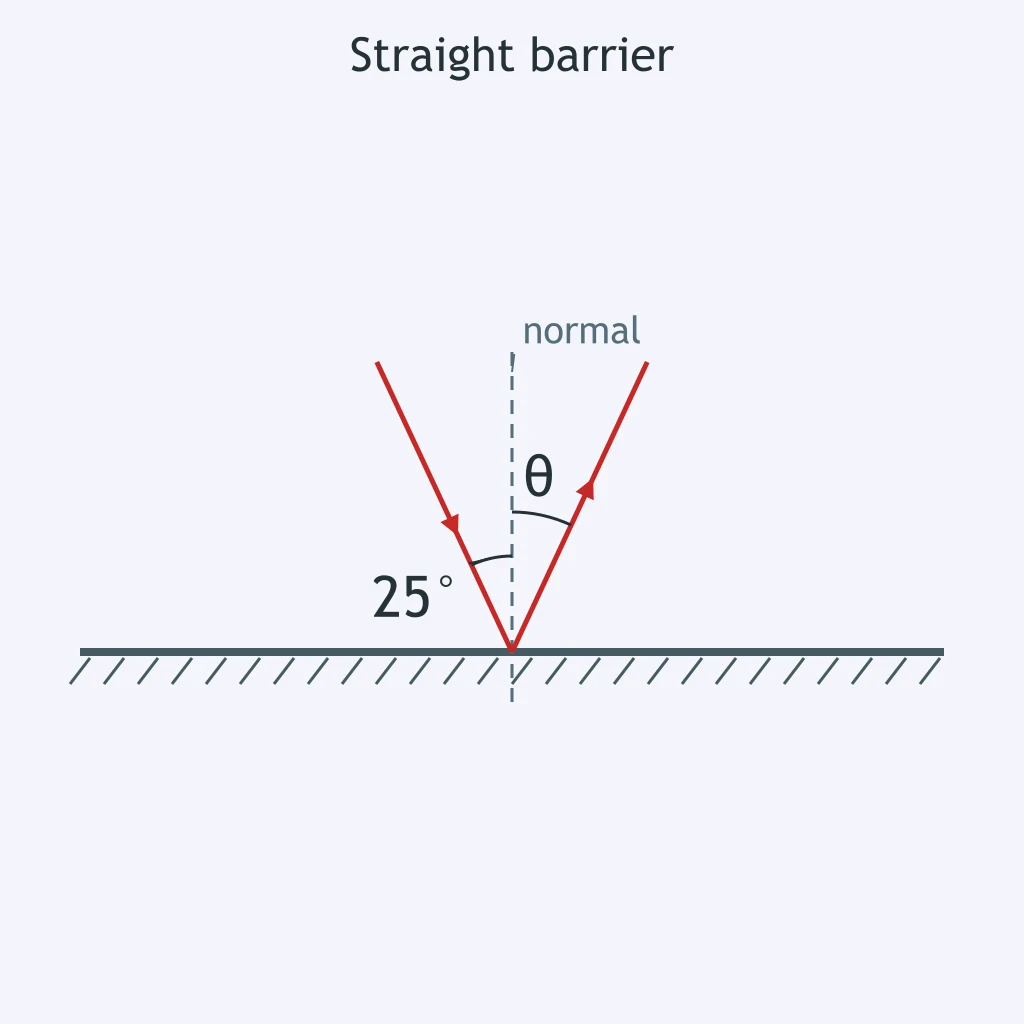
A wave reflects from the straight barrier shown. If the angle of incidence is 25 degrees from the normal, which statement is correct?
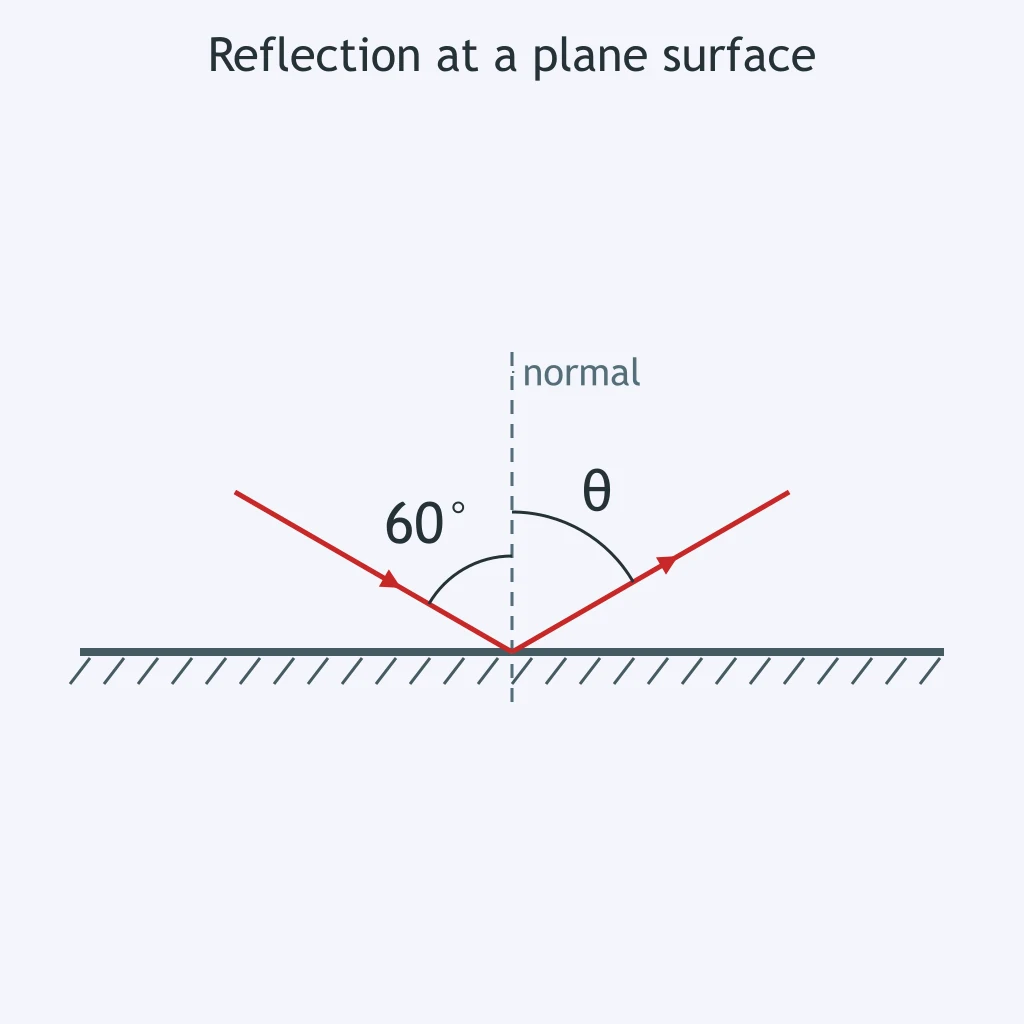
The figure marks a 60-degree angle of incidence from the normal. What angle should the reflected ray make with the normal, and what happens to wavelength?
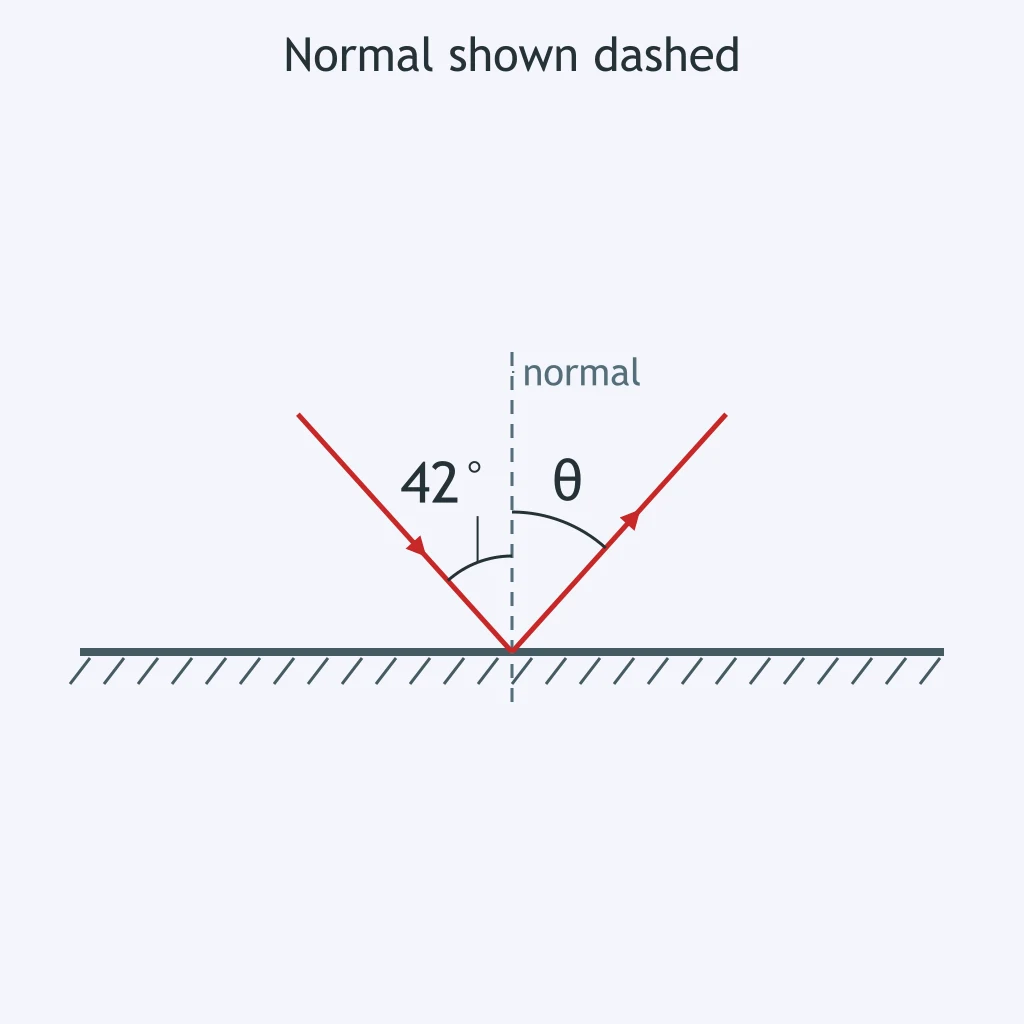
A student measures the incident angle in the figure from the dashed normal, not from the surface. If that angle is 42 degrees, what should the reflected wave do?
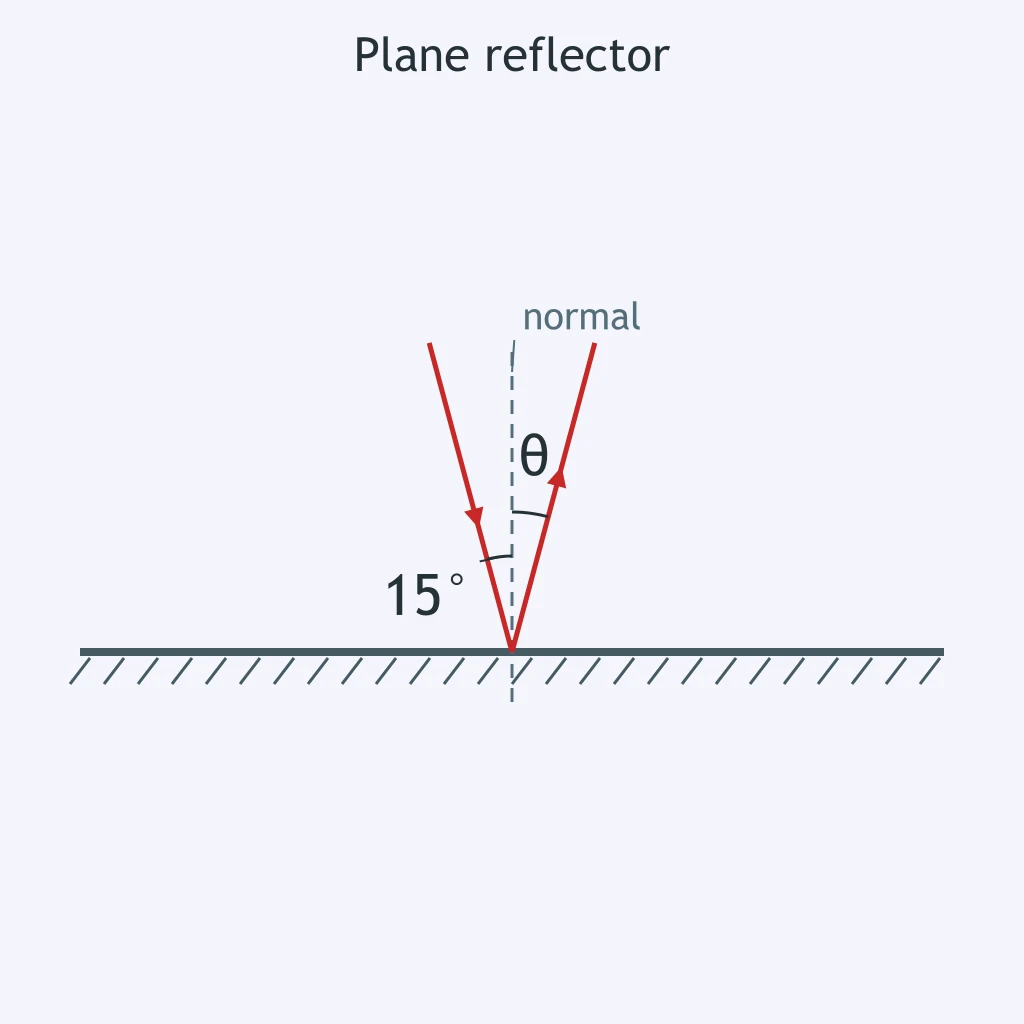
The figure shows a wave ray reflecting from a plane reflector. Which result follows from the law of reflection?
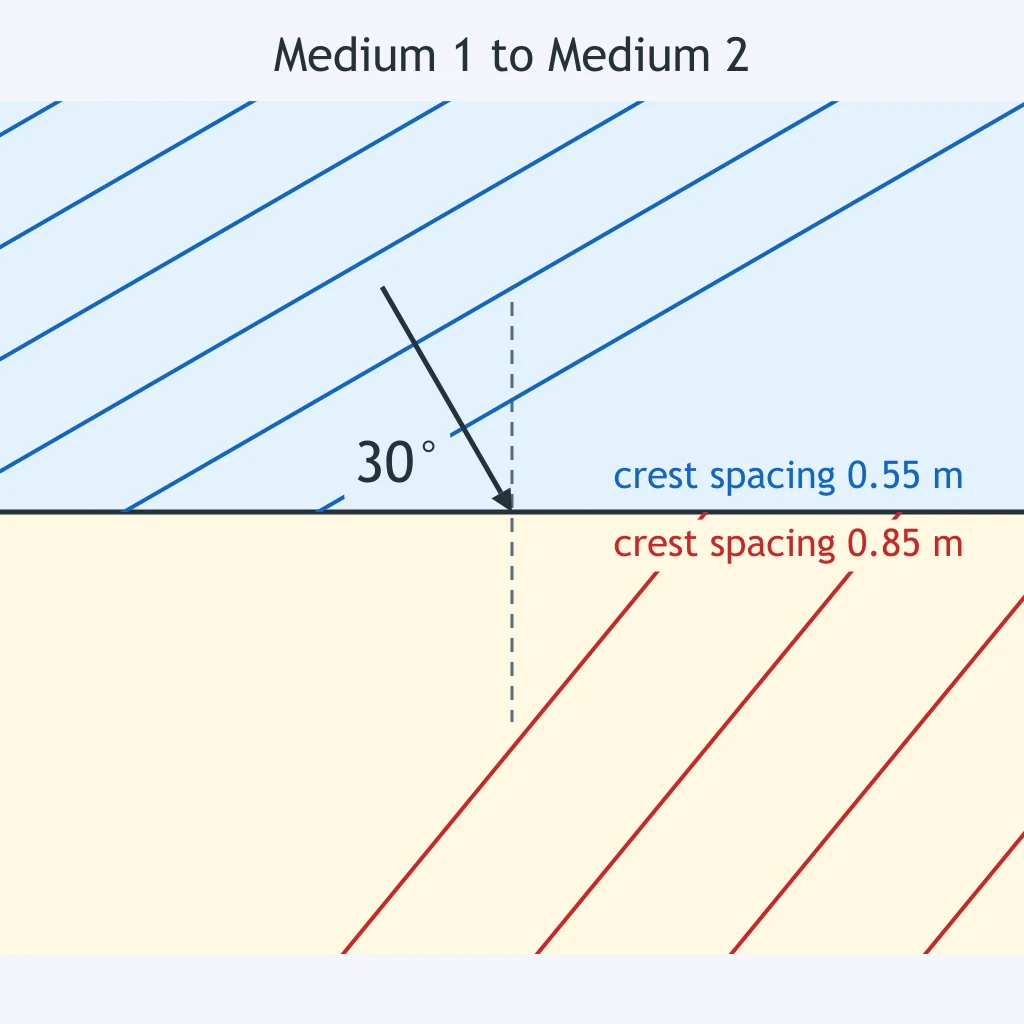
The figure shows a wave crossing a boundary while the source keeps vibrating at 5.0 Hz. Which quantities are different in Medium 2?
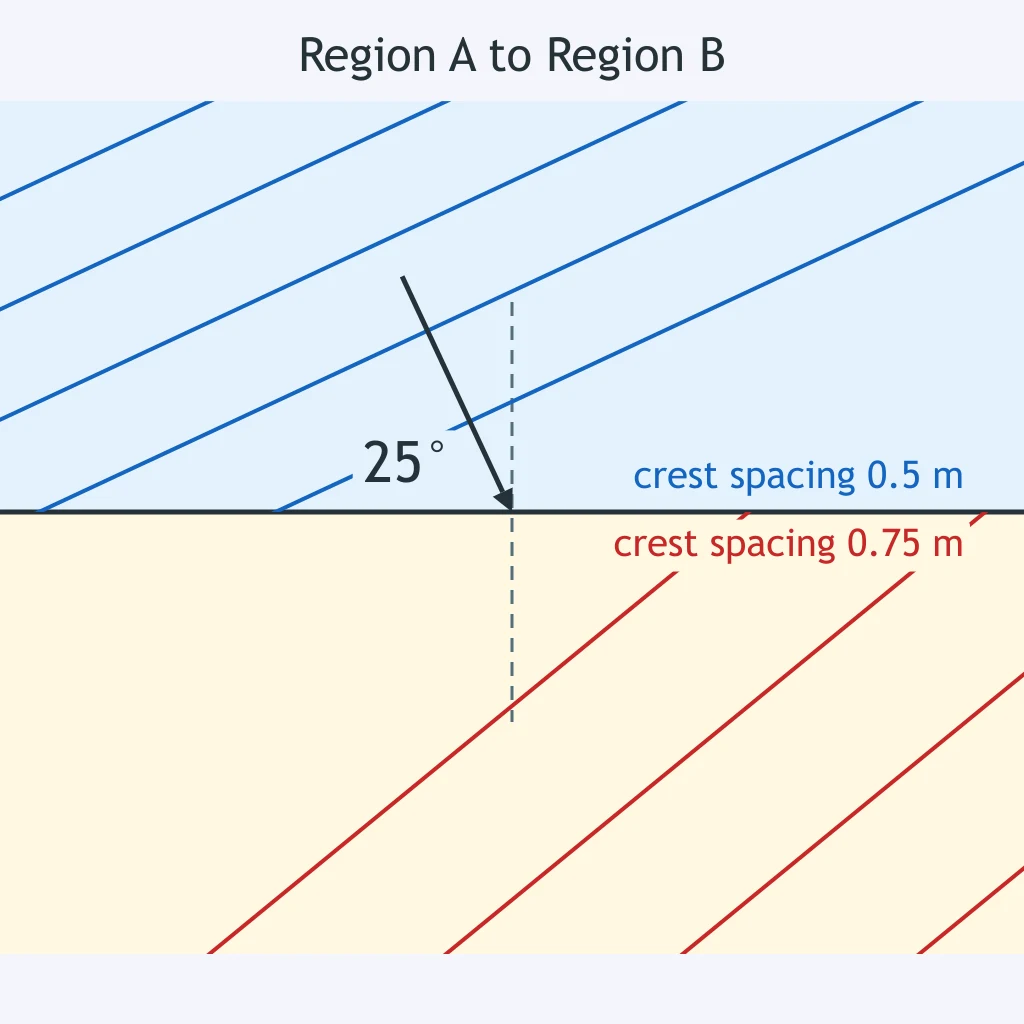
The figure shows waves from one vibrator crossing from Region A into Region B. What changed in Region B?
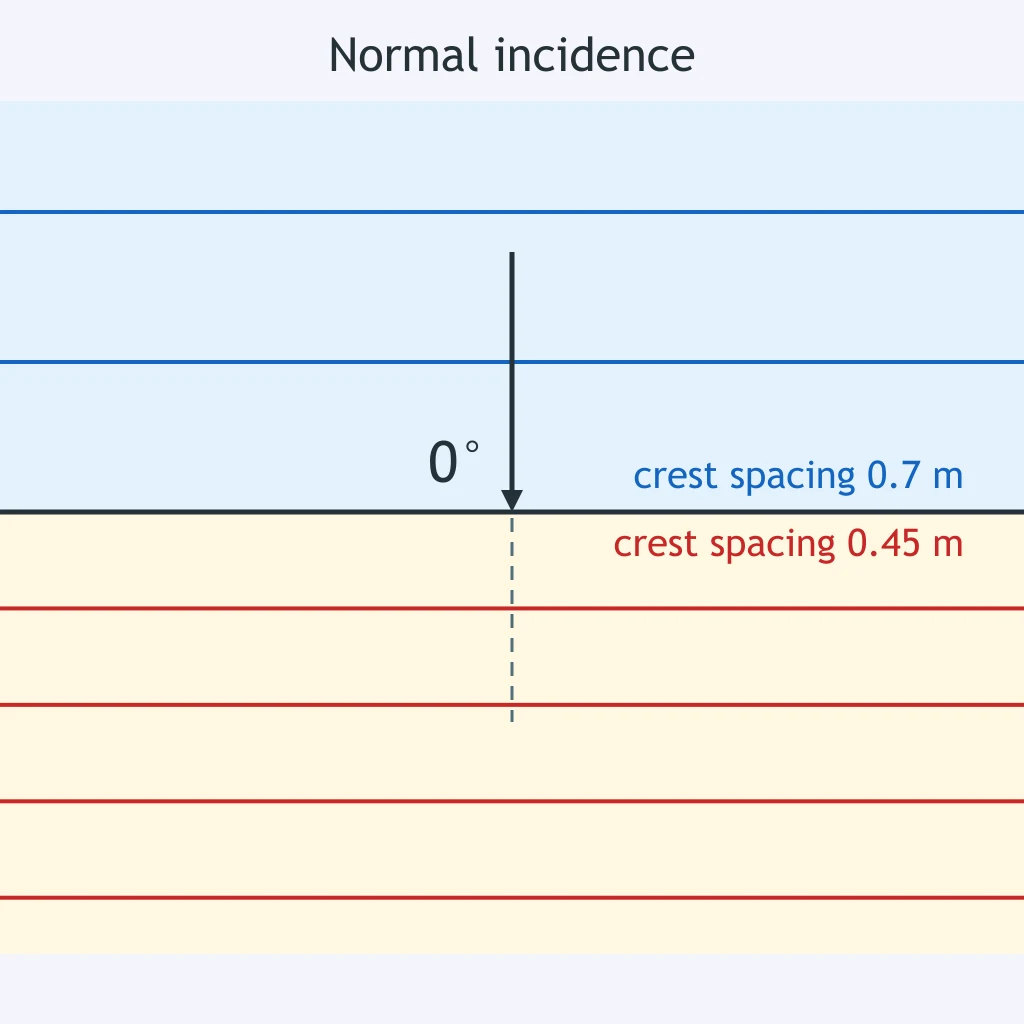
The figure shows waves from one source meeting a boundary head-on. Which quantities changed after the boundary?
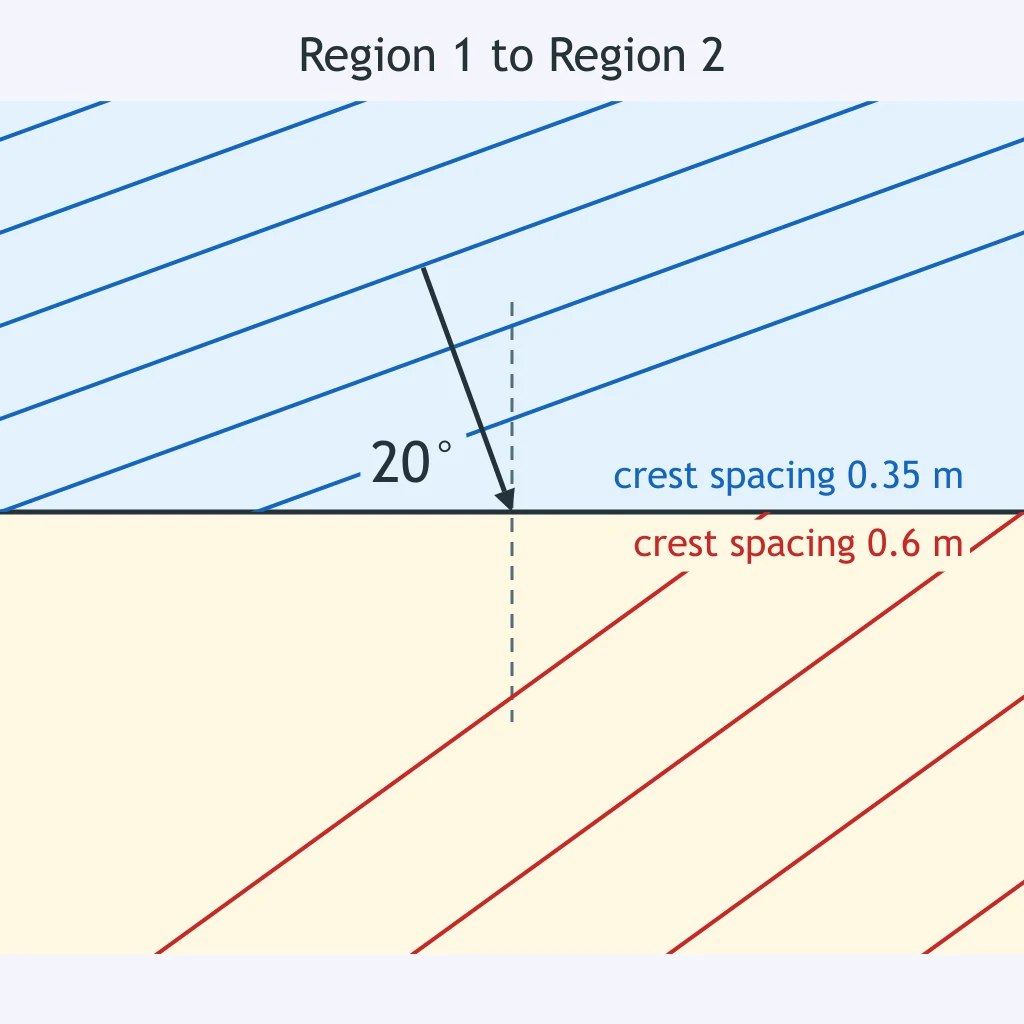
A source produces 8.0 Hz waves. The figure shows the waves crossing from Region 1 into Region 2. Which quantities differ in Region 2?
A student sends a single upward pulse along a rope whose far end is tied firmly to a post. How does the pulse return from that fixed end?
A rope pulse reaches a light ring that can slide freely up and down on a frictionless pole. An upward pulse reflects. What should the reflected pulse look like?
A downward pulse travels along a light rope toward a junction with a much heavier rope. What reflected pulse returns along the light rope?
A downward pulse travels along a heavy rope toward a junction with a much lighter rope. What reflected pulse returns along the heavy rope?
Two lab groups send identical upward pulses toward different rope ends. Group A uses a fixed clamp; Group B uses a sliding ring. Which result is correct?
A pulse returns upright from the far end of a rope. Which boundary condition best explains the observation?
Why does a fixed end invert a reflected rope pulse?
A wave changes direction as it crosses from one medium into another at an angle. Which quantity's change is responsible for that refraction?
A water wave enters a shallow region and slows down while the source frequency stays constant. Which change explains the shorter crest spacing?
Ocean waves spread strongly after passing through a narrow opening in a breakwater. Which comparison best explains the diffraction?
Two equal water waves meet crest-to-trough at the same place. Which result describes their interference at that instant?
A sound wave reflects from a hard wall and returns as an echo. Which quantity mainly changes at the wall?
Crack the passcode before the zombies get in.
Answer, then swat bugs for bonus points.
Race through questions at your own speed.
Same question on every screen. Fastest wins.

Pick a tile, answer, hit bonuses and steals.
Standing Waves and Superposition
30 questions