Loading
by BlastRoom
Solar Energy for high school Environmental Science, on-level and AP. Covers AP Environmental Science Unit 6: Energy Resources and Consumption.
#environmental_science
30 questions
One question set, multiple game modes. Tap any game to see it in action. Not sure which to pick?
Answer to place stones and capture territory.
Outrun the snow together.
Earn blasts, then hunt the other team.
Answer to earn energy, then climb.

The class blasts through walls together.
Bid on mystery lots. Most money wins.
Sell tours. Nice, standard, or a total scam.

Answer, restock, and serve the rush.
More correct answers pulls the rope your way.
Answer, then shoot down the alien wave.
Answer, then tap to leap the frozen ridge.
A rooftop panel produces electric current when sunlight creates moving charges in semiconductor cells. What technology is it?
At a solar tower plant, mirrors focus sunlight onto a receiver that heats a fluid. What happens next to generate electricity?
A homeowner wants panels that make electricity directly on a small roof without a steam turbine. Which solar technology fits?
Which solar system is generally designed as a large utility-scale plant using mirrors and a heat-transfer fluid?
A solar facility stores energy in a hot fluid before using that heat to make steam. Which technology does this describe?
Collectors on a building heat water that is stored in an insulated tank for showers. What type of solar system is this?
Why does a PV system usually include an inverter between its panels and most home appliances?
A factory needs very high-temperature heat for a process during sunny hours. Which solar technology can supply that heat directly?
A northern-hemisphere house has large south-facing windows and a thick masonry floor. What is the main passive-solar purpose of the masonry?
A designer adds a roof overhang above south-facing windows in the northern hemisphere. What seasonal effect is the design intended to produce?
A school adds a dark masonry wall behind south-facing glazing so the wall absorbs solar radiation and warms the interior later. This is an example of what strategy?
In a passive-solar home, deciduous trees are planted outside south-facing windows. Why can this reduce cooling demand without blocking winter heating?
A building uses window placement, insulation, shading, and thermal mass but has no solar cells. What energy service can this passive design provide?
What distinguishes passive solar design from a rooftop PV array?
For the highest annual output from a fixed PV array in the northern hemisphere, which orientation is generally used?
A tree shades one part of a PV array each afternoon. Which change most directly addresses the lost output from that recurring shade?
Site A receives 5.4 kWh/m²/day of solar resource and Site B receives 3.6 kWh/m²/day. Identical arrays are installed. About what fraction of A's output should B produce, other factors equal?
A 4 kW PV array receives an average of 5 peak-sun-hours per day. Ignoring losses, how much electrical energy can it produce per day?
Two identical PV arrays are installed at the same location. Array B receives 25% less sunlight because of its orientation. About how does B's output compare with A's, other factors equal?
Why are clear, sunny regions especially suitable for concentrating solar-thermal power plants?
A ground-mounted PV array adds single-axis trackers. What is the purpose of the trackers?
A PV array's output falls during a dusty season even though its panels and inverter are undamaged. Which factor best explains the decline?
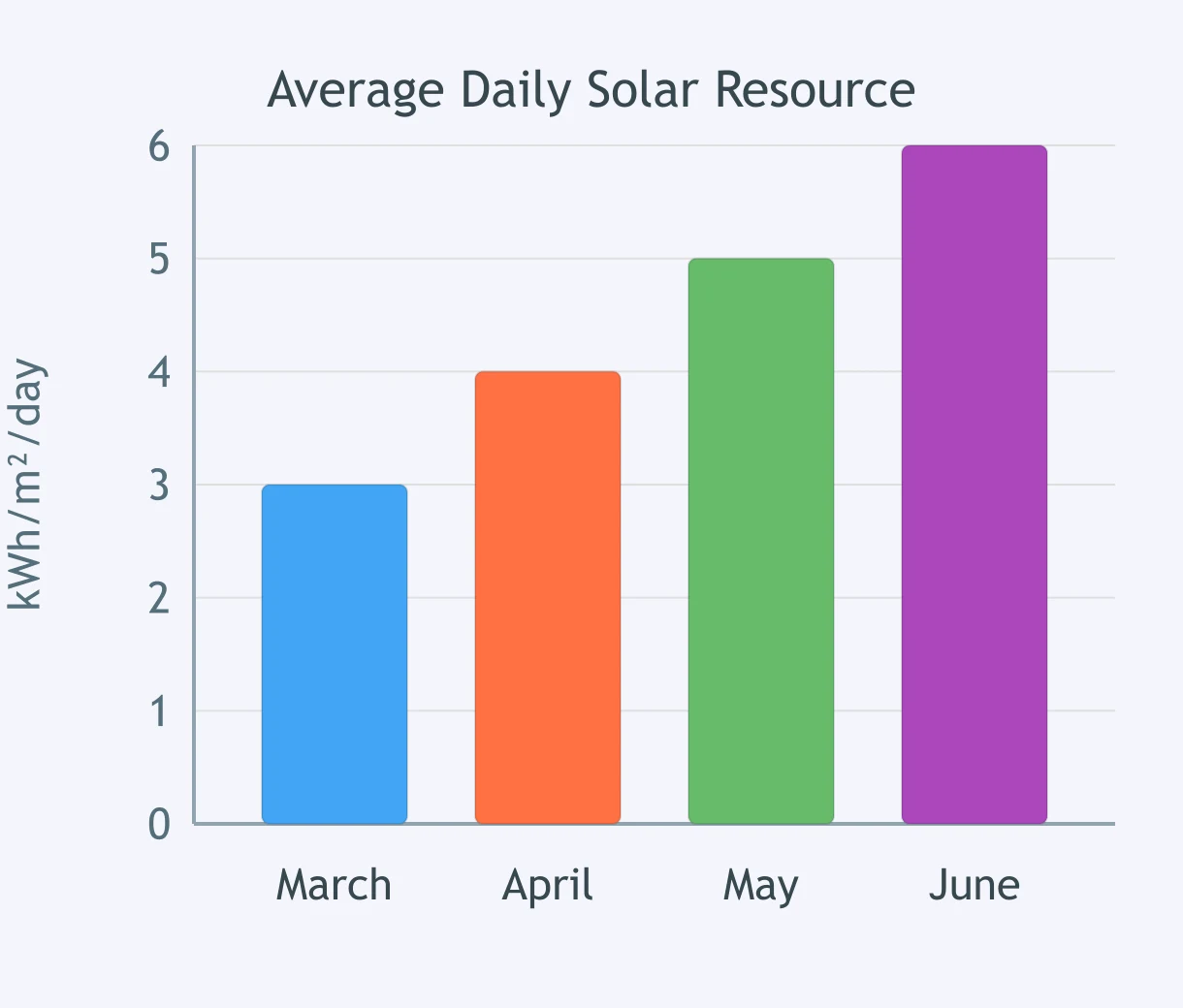
Use the bar graph. During which month would an identical PV array receive the greatest average daily solar resource?
A utility has abundant solar electricity at noon but needs power after sunset. Which measure most directly shifts that daytime energy to the evening?
A CSP plant heats molten salt during sunny hours and later uses the stored heat to make steam. What solar limitation does this thermal storage address?
Clouds cause a neighborhood PV system's output to change rapidly. What grid feature can help smooth these short-term variations?
A utility-scale PV plant is rated at 5 MW, but its yearly capacity factor is only about 20-25%. What mainly explains why its actual output is so far below its rated capacity?
A utility expects evening demand to rise as solar generation is falling. Which demand-side action can reduce the mismatch without creating more daytime solar electricity?
At noon, a solar-rich grid has more generation than it can use immediately. Which storage approach uses the excess electricity to move water uphill for later generation?
Why does adding more PV panels alone not guarantee electricity will be available at night?
Crack the passcode before the zombies get in.
Answer, then swat bugs for bonus points.
Race through questions at your own speed.
Same question on every screen. Fastest wins.

Pick a tile, answer, hit bonuses and steals.
Hydroelectric and Tidal Power
30 questions