Loading
by BlastRoom
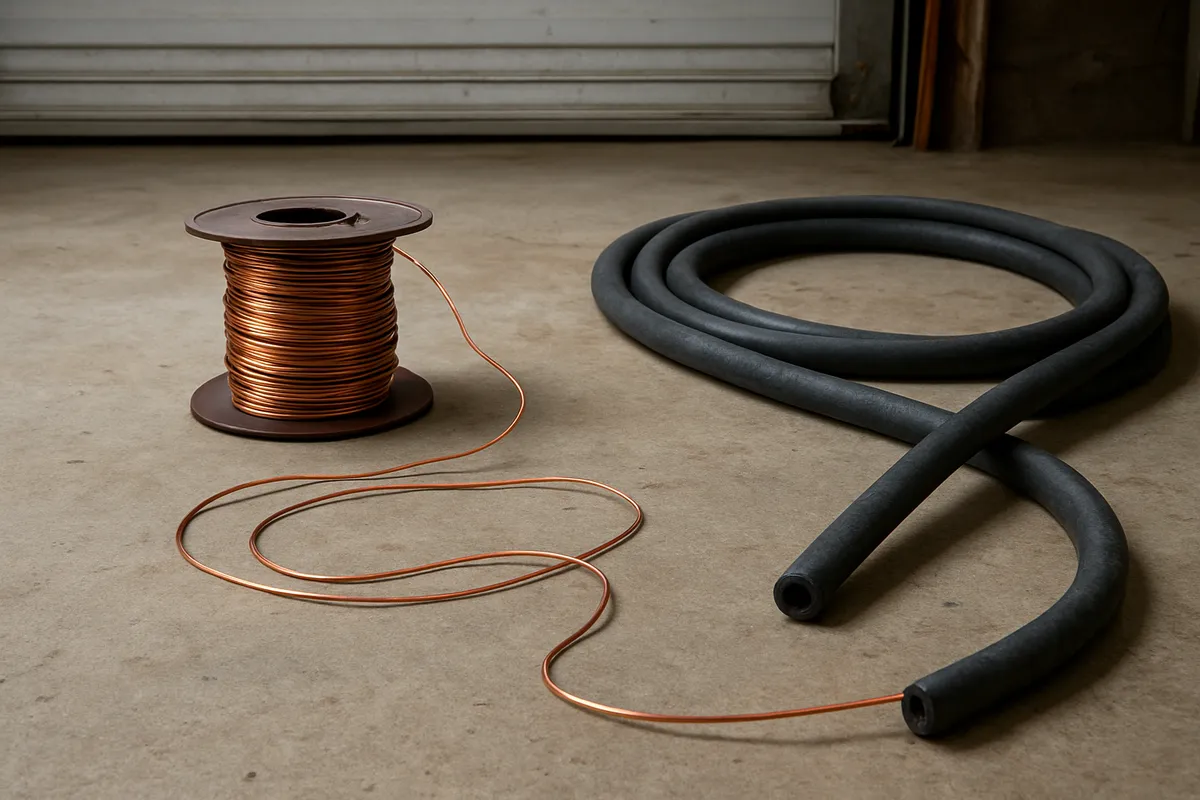
Practice how length, area, material, and temperature affect conductor resistance.
#physics
30 questions
One question set, multiple game modes. Tap any game to see it in action. Not sure which to pick?
Answer to place stones and capture territory.
Outrun the snow together.
Earn blasts, then hunt the other team.
Answer to earn energy, then climb.

The class blasts through walls together.
Bid on mystery lots. Most money wins.
Sell tours. Nice, standard, or a total scam.

Answer, restock, and serve the rush.
More correct answers pulls the rope your way.
Answer, then shoot down the alien wave.
Answer, then tap to leap the frozen ridge.
Two copper wires have the same diameter and are at the same temperature. Wire Q is twice as long as Wire P. How does Q's resistance compare with P's?
A 4.0 m aluminum wire is cut in half, and one 2.0 m piece is used at the same temperature with the same cross-sectional area. What happens to the resistance?
Two nichrome wires have the same length and temperature. Wire B has twice the diameter of Wire A. How does B's resistance compare with A's?
A metal wire is replaced by one of the same material, length, and temperature but with three times the diameter. What is the new resistance?
A copper bus bar is made with the same length and temperature but twice the cross-sectional area. How does its resistance change?
A wire's material, length, and temperature stay fixed, but its cross-sectional area is reduced to one third of its original value. What happens to its resistance?
A copper wire and a nichrome wire have the same length, diameter, and temperature. Nichrome has a higher resistivity than copper. Which wire has greater resistance?
A silver wire and an aluminum wire have the same length, cross-sectional area, and temperature. Silver has the lower resistivity. Which wire has less resistance?
A copper wire is warmed from 20 degrees C to 60 degrees C, with its length and area effectively unchanged. What happens to the resistance of the metal wire?
A metal filament is cooled while its material, length, and cross-sectional area stay the same. What happens to its resistance over this ordinary temperature range?
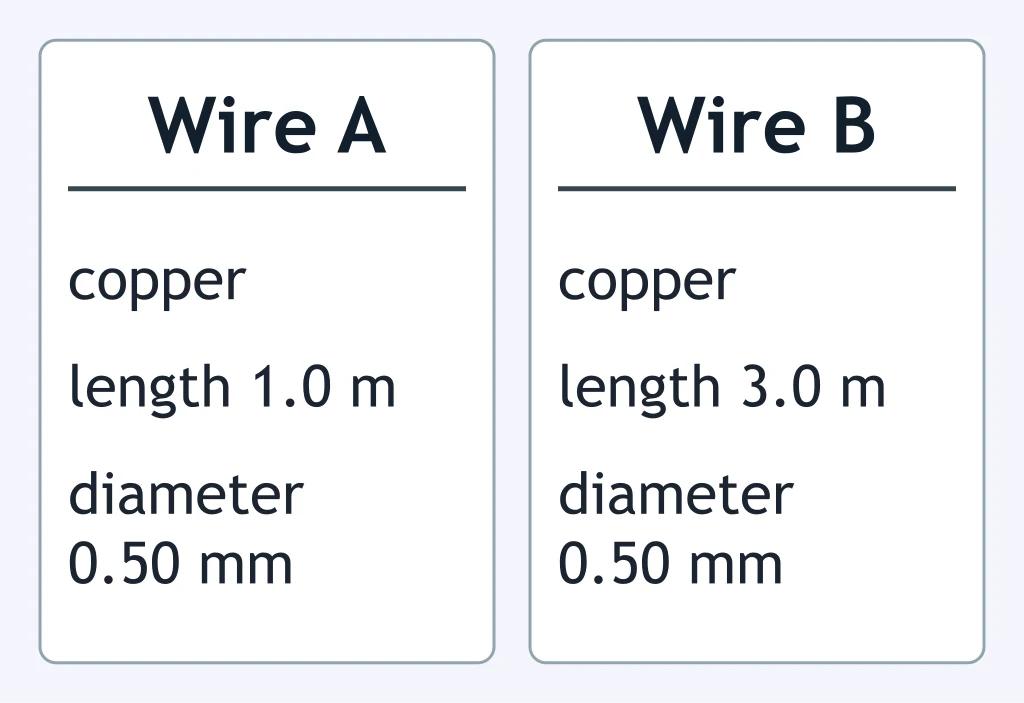
Use the figure. The two copper wires are at the same temperature. How does Wire B's resistance compare with Wire A's?
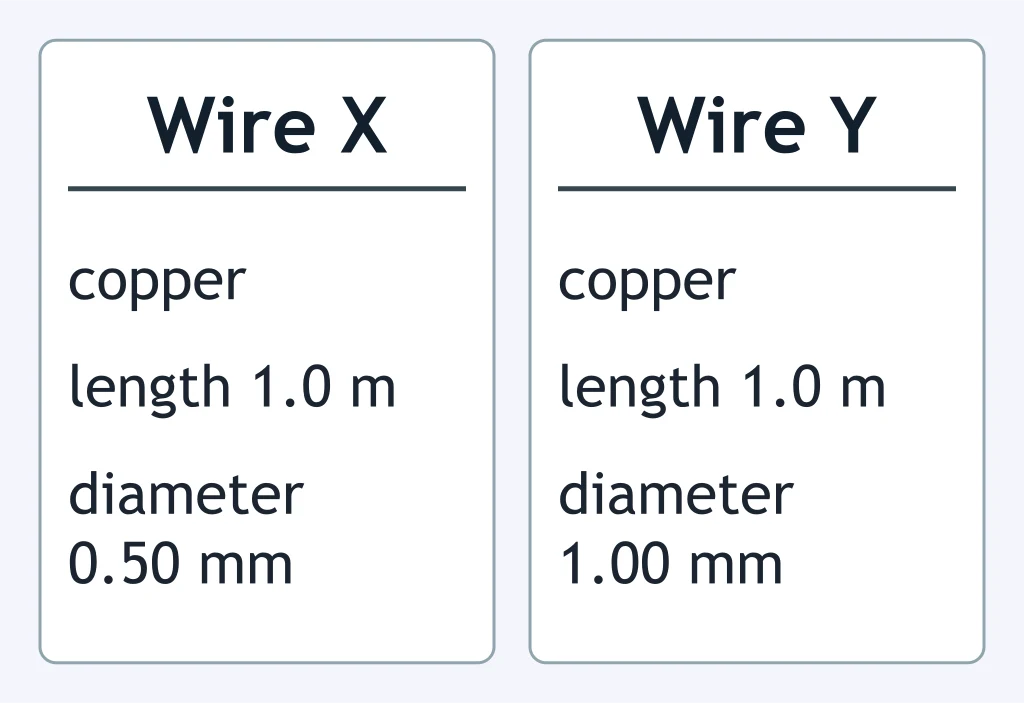
Use the figure. The two copper wires are at the same temperature. How does Wire Y's resistance compare with Wire X's?
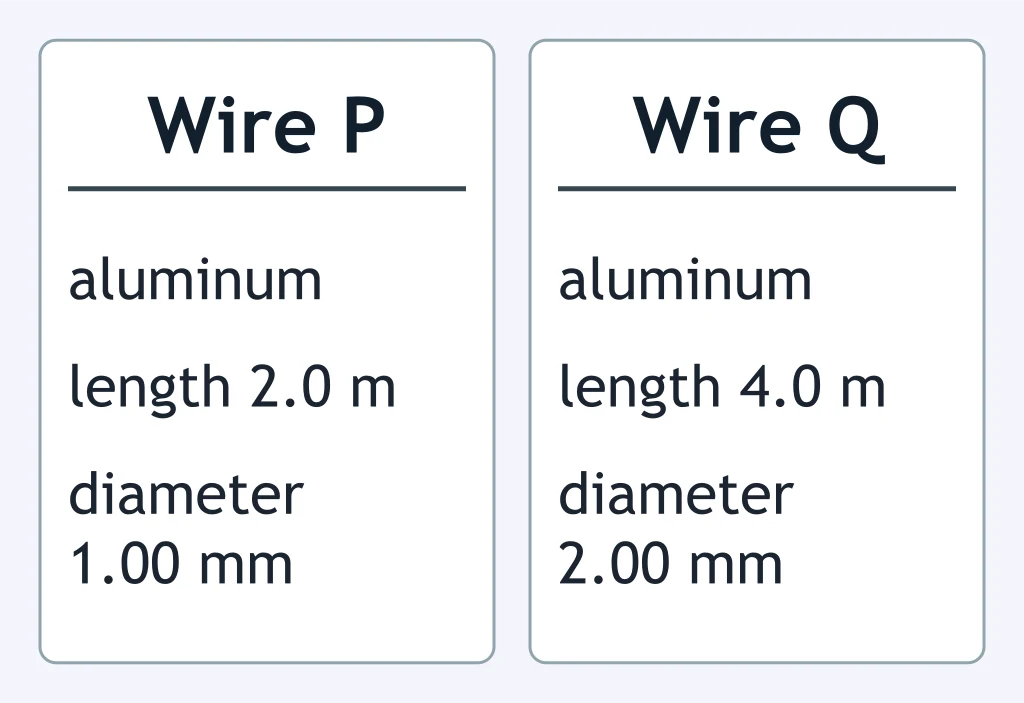
The figure shows two aluminum wires at the same temperature. How does Wire Q's resistance compare with Wire P's?
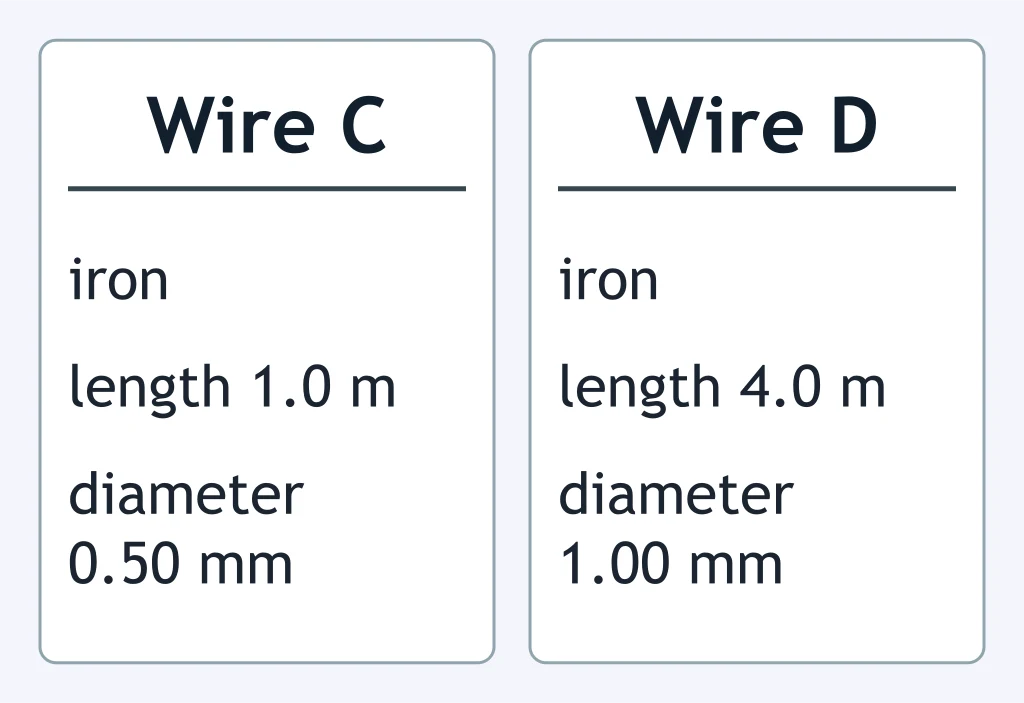
The figure shows two iron wires at the same temperature. Which comparison is correct?
Use the figure for two copper wires at the same temperature. How does Wire N's resistance compare with Wire M's?
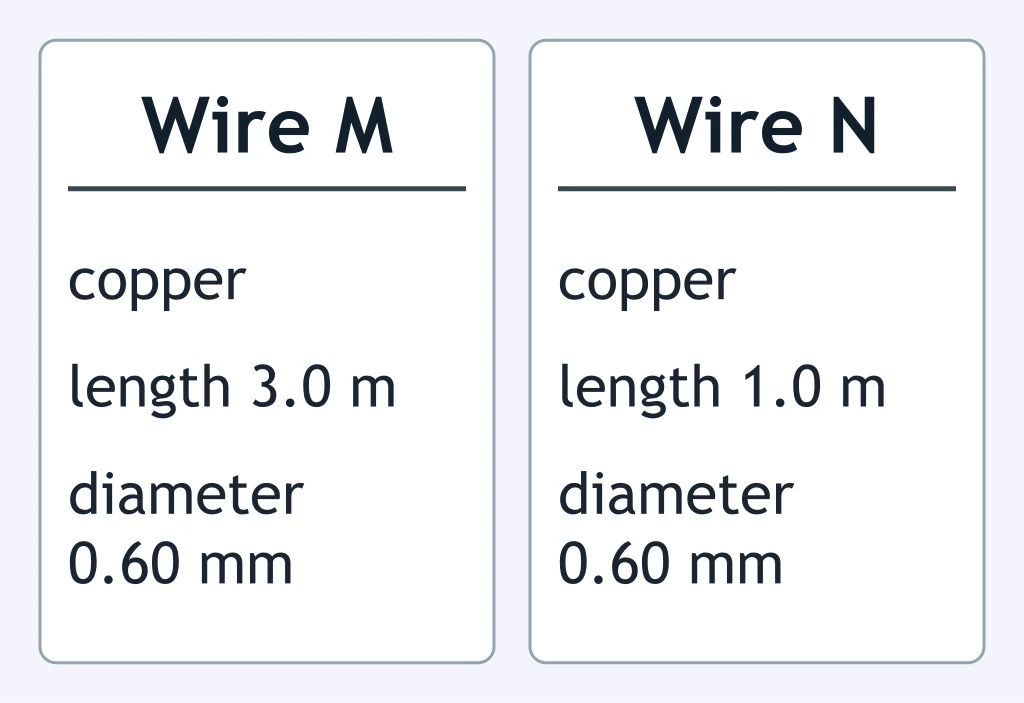
The figure shows two nichrome wires at the same temperature. Which statement correctly compares their resistances?
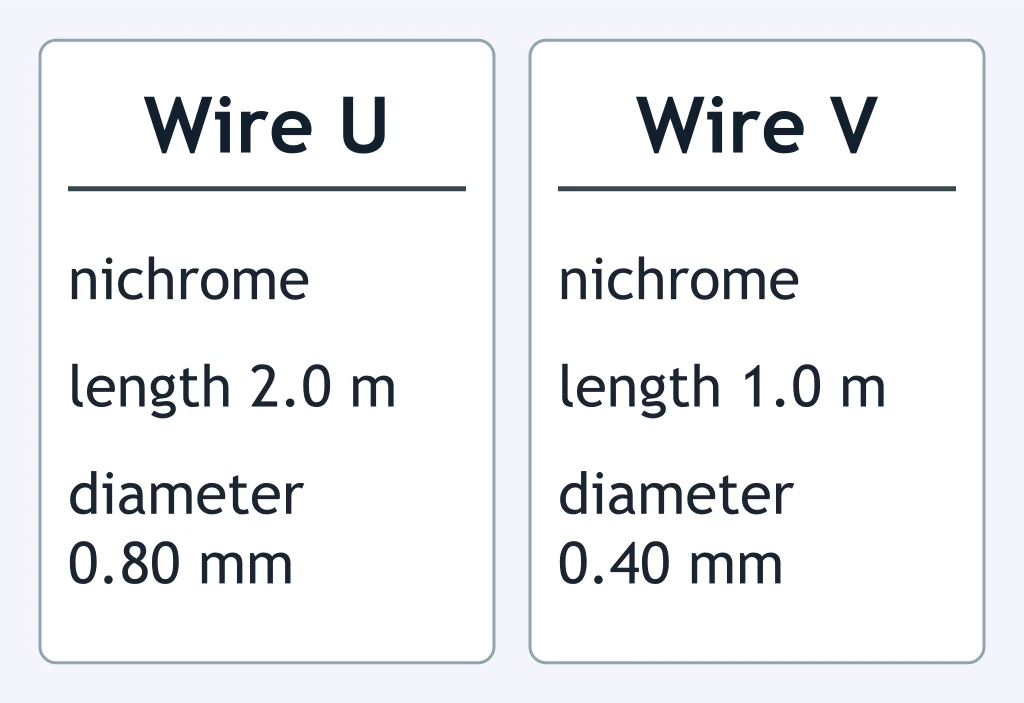
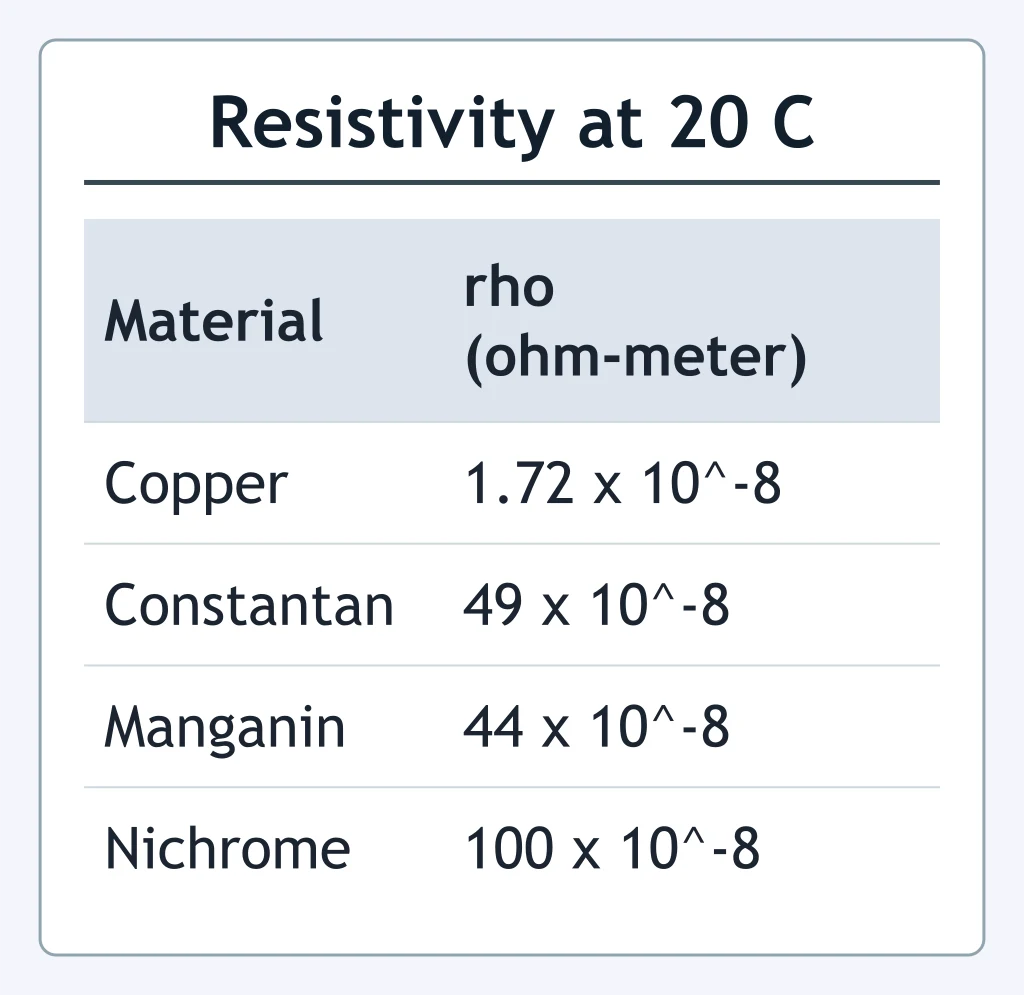
Use the resistivity table. If wires of these materials have the same length, area, and temperature, which has the greatest resistance?
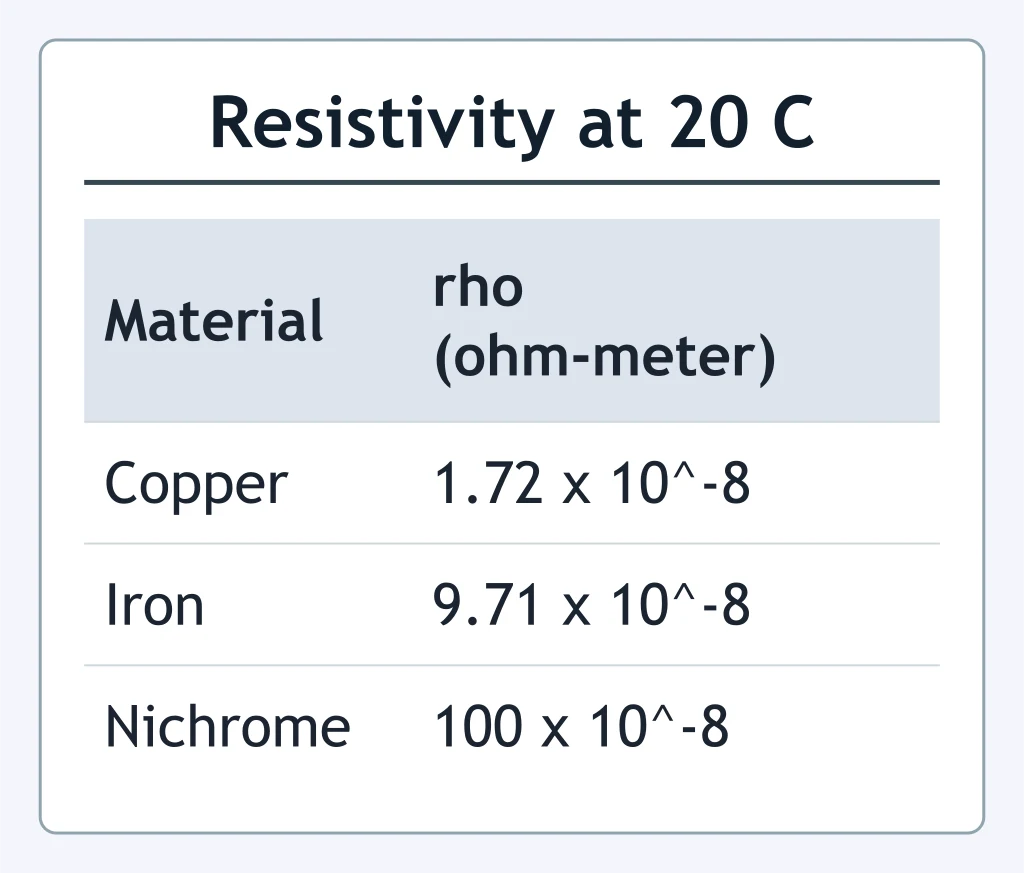
Use the resistivity table. Same-size wires of these materials are at 20 degrees C. Which wire has the least resistance?
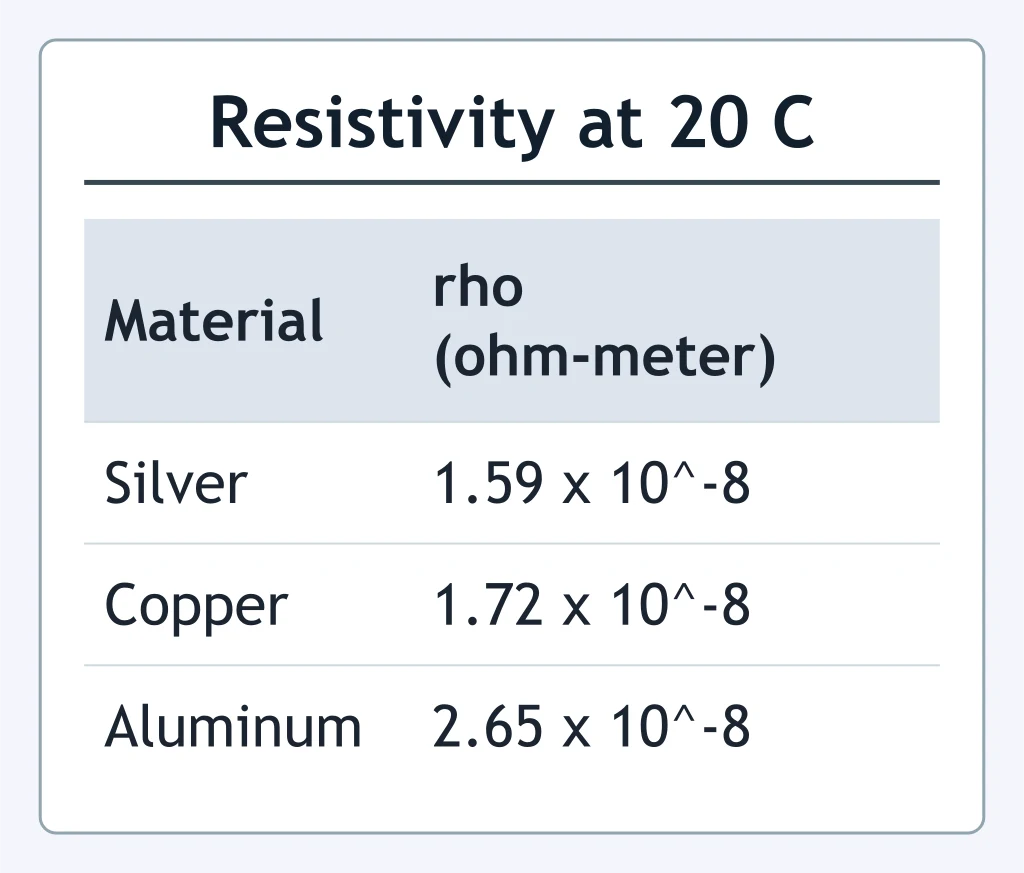
Use the table. For same-size wires at the same temperature, which order ranks resistance from least to greatest?
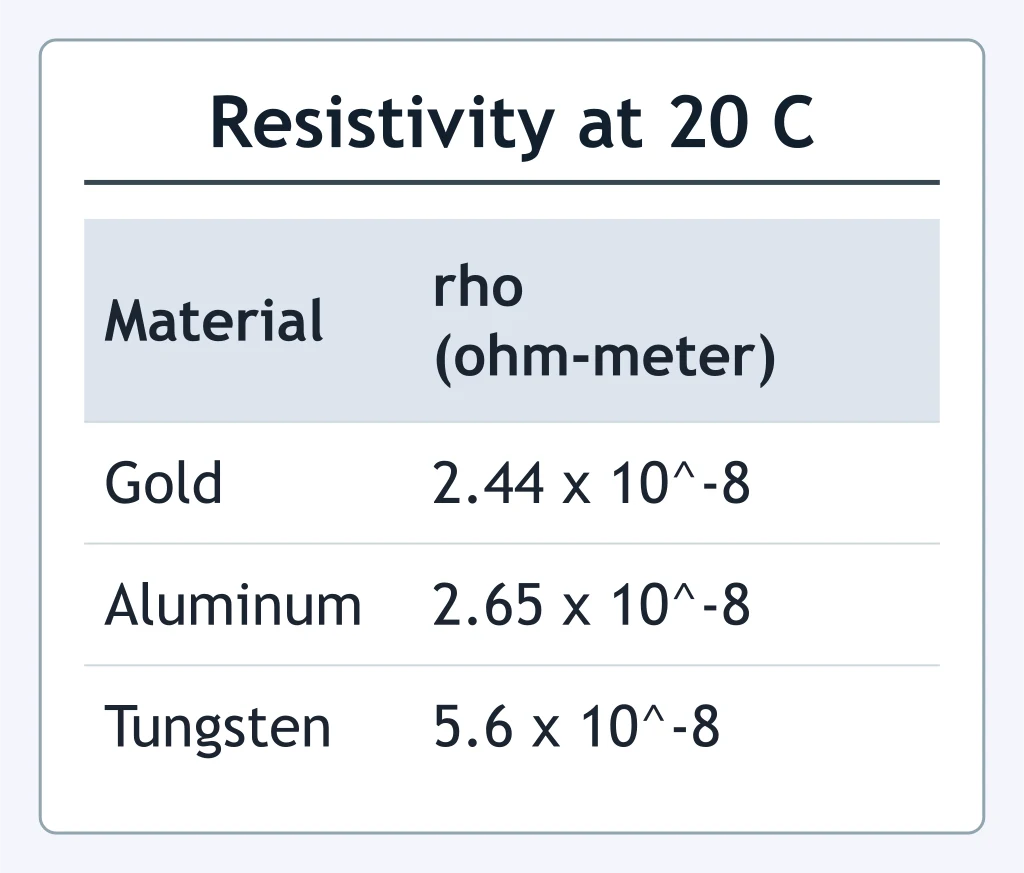
Use the table. Same-size wires are made from copper and one listed alloy. Which alloy wire has about 58 times the resistance of copper?
A copper wire is 2.0 m long and has area . Copper's resistivity is ohm-meter. What is its resistance?
A wire has resistivity ohm-meter, length 0.50 m, and cross-sectional area . What is its resistance?
A uniform wire has resistivity ohm-meter, length 4.0 m, and area . What is the resistance?
A gold wire is 3.0 m long with area . Its resistivity is ohm-meter. What is the wire's resistance?
A short alloy wire has resistivity ohm-meter, length 0.20 m, and area . What is its resistance?
An iron wire has resistivity ohm-meter, length 5.0 m, and cross-sectional area . What is its resistance?
Which list contains the main factors that set the resistance of a uniform conducting wire?
Resistivity is best described as a property of what?
A student measures a wire's resistance, then uses a larger battery at the same temperature. Which change would actually change the wire's resistance?
In the equation R = rho L/A for a uniform wire, what does A represent?
Crack the passcode before the zombies get in.
Answer, then swat bugs for bonus points.
Race through questions at your own speed.
Same question on every screen. Fastest wins.

Pick a tile, answer, hit bonuses and steals.
Series Circuits
30 questions