Loading
by BlastRoom
Read short lab and device procedures and decide step order, key steps, safety cautions, and what goes wrong when a step is skipped.
#procedures#us_grade_8_english
20 questions
One question set, multiple game modes. Tap any game to see it in action. Not sure which to pick?
A method reads: 1. Zero the balance. 2. Record the empty flask's mass. 3. Add 25 mL of solution. 4. Record the new mass. What goes wrong if step 2 is done after step 3?
1. Click the lowest-power objective into place. 2. Set the slide on the stage. 3. Focus with the coarse knob. 4. Switch to high power. 5. Focus with the fine knob only. Why does step 5 forbid the coarse knob?
A lab card reads: 1. Set the hot plate to 60 degrees Celsius. 2. Never touch the hot plate surface. 3. Set the beaker on the plate. 4. Stir until the crystals dissolve. Which line is a safety caution, not a step?
Purpose: find a rock's density. 1. Weigh the rock. 2. Fill a cylinder to the 50 mL mark. 3. Lower the rock in. 4. Read the new volume. 5. Divide mass by the volume change. Why must step 2 precede step 3?
1. Label two cups A and B. 2. Pour 100 mL of water into each. 3. Stir 5 g of salt into cup A. 4. Chill both cups for an hour. 5. Record both temperatures. Which step could be done later without changing the result?
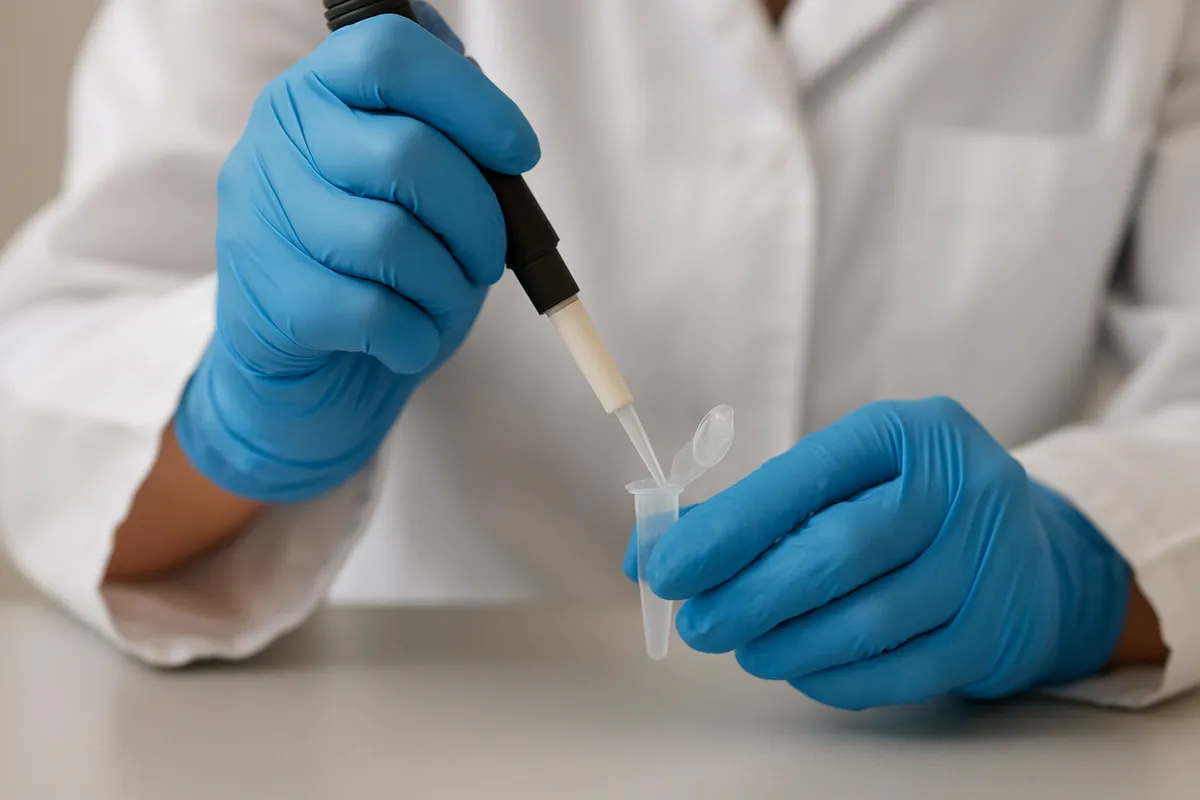
1. Rinse the pipette with distilled water. 2. Rinse it with the sample solution. 3. Draw 10 mL of sample. 4. Release it into the flask. What happens if step 2 is skipped?
1. Line four cups with damp paper towels. 2. Put 5 bean seeds in each. 3. Keep two cups in light, two in a dark box. 4. Add 10 mL of water daily to all four. 5. Count sprouts on day 7. Why must step 4 treat all four alike?
1. Switch the power supply off. 2. Wire the bulb and switch into one loop. 3. Set the meter to its 10 A range. 4. Put the meter in the loop. 5. Switch the power on. Why is step 1 placed first?
1. Rinse the burette with the base. 2. Fill it and record the start reading. 3. Add 3 drops of indicator to the acid. 4. Run in base until the color first changes. 5. Record the end reading. What does subtracting the readings give?
Purpose: test whether a mineral is calcite. 1. Wash and dry the sample. 2. Set it in a dish. 3. Add two drops of dilute acid. 4. Watch for fizzing. 5. Rinse the sample. Which step actually tests the mineral's identity?
In a procedure, the line "Wear heat-resistant gloves throughout" is a safety caution rather than a numbered action that moves the method forward.
A method reads: 1. Weigh the empty crucible. 2. Add the powder. 3. Weigh the crucible again. Step 1 may be skipped whenever the crucible already looks clean and dry.
Stream study: 1. Mark a 10 m stretch of bank. 2. Drop a float at the upstream mark. 3. Start the stopwatch as it passes. 4. Stop it at the downstream mark. 5. Divide 10 by the seconds. What does step 5 produce?
1. Calibrate the pH meter in a buffer. 2. Rinse the probe with distilled water. 3. Put the probe in the sample. 4. Wait for a steady reading. 5. Record the pH. Why must step 1 come before step 3?
3D printer setup: 1. Level the print bed. 2. Heat the nozzle to 200 degrees Celsius. 3. Push filament into the feeder. 4. Start the print. What goes wrong if steps 2 and 3 are swapped?
1. Draw a pencil line 1 cm above the paper's bottom edge. 2. Spot ink on the line. 3. Stand the paper in water that stays below the line. 4. Lift it out when the water nears the top. Why must the water start below the line?
1. Heat the crucible for 5 minutes. 2. Turn off the burner. 3. Cool the crucible on a mat for 10 minutes. 4. Weigh the crucible. What goes wrong if step 3 is skipped?
1. Zero the spring scale with nothing hanging on it. 2. Hang the mass from the hook. 3. Read the scale at eye level. 4. Record the force in newtons. Why does step 3 specify eye level?
1. Put on gloves. 2. Measure 50 mL of vinegar into a flask. 3. Weigh out 2 g of baking soda. 4. Tip the soda into the vinegar. 5. Time the fizzing. Which two steps could be swapped with no effect on the result?
1. Pour 100 mL of water into the pot. 2. Record the water's starting temperature. 3. Switch on the hot plate. 4. Record the temperature every minute for 10 minutes. What happens if step 2 is moved after step 3?
Distinguishing Fact, Judgment and Speculation in History
20 questions
Comparing Primary and Secondary Historical Sources
20 questions

Point of View and Loaded Language in Historical Text
20 questions
Analyzing the Structure of Historical Text
20 questions
Domain-Specific Scientific Vocabulary and Symbols
40 questions
Crack the passcode before the zombies get in.

Pick a tile, answer, hit bonuses and steals.