Loading
by BlastRoom
From advisers to escalation to Tet to withdrawal, and why the war ended as it did.
#united_states_history

35 questions
One question set, multiple game modes. Tap any game to see it in action. Not sure which to pick?
Answer to place stones and capture territory.
Outrun the snow together.
Earn blasts, then hunt the other team.
Answer to earn energy, then climb.

The class blasts through walls together.
Bid on mystery lots. Most money wins.
Sell tours. Nice, standard, or a total scam.

Answer, restock, and serve the rush.
More correct answers pulls the rope your way.
Answer, then shoot down the alien wave.
Answer, then tap to leap the frozen ridge.
In 1954 a French garrison dug in at a remote valley in northwestern Vietnam was surrounded by Viet Minh artillery on the hills above it and surrendered after a siege of about eight weeks. Which battle ended French rule in Indochina?
Read the map. Hanoi and Saigon are named; the drawn line is not. Talks in Geneva in 1954 put that line where it is. What did it mark?
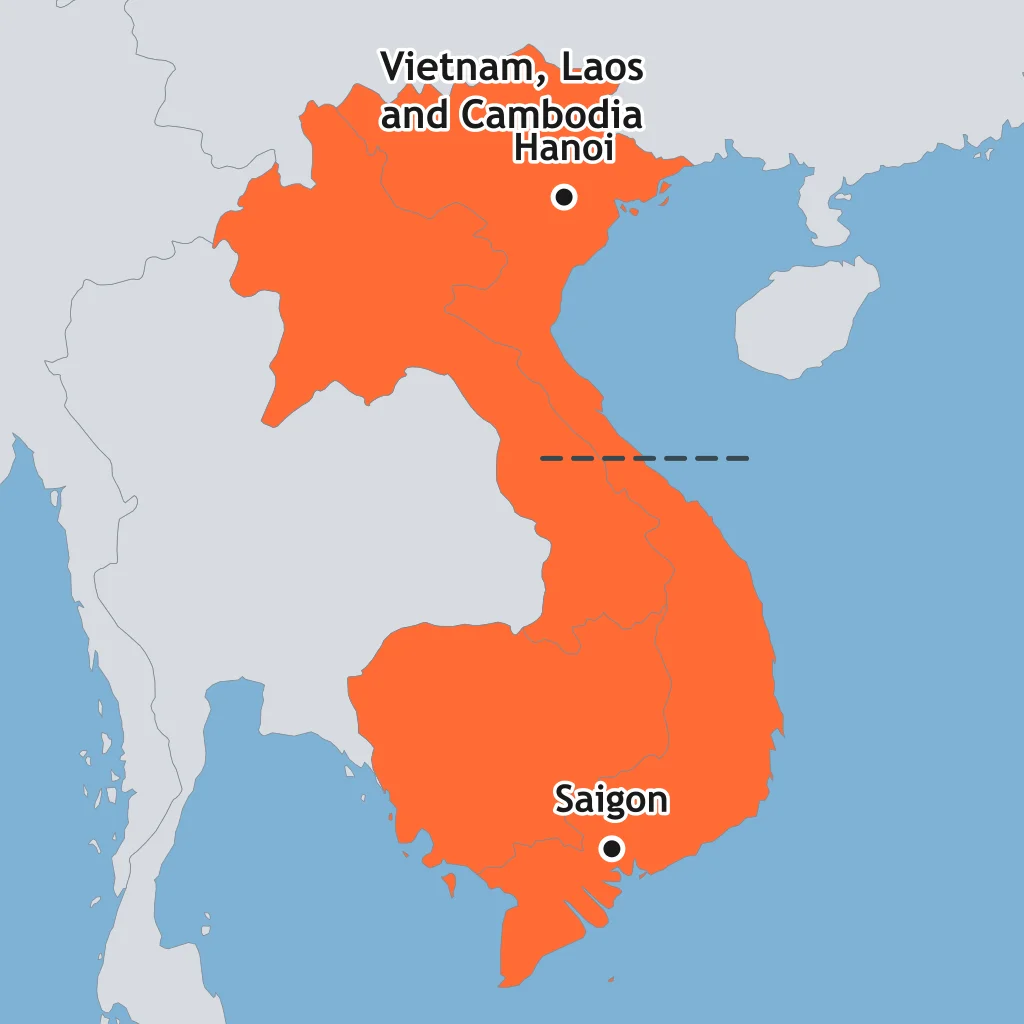
The 1954 Geneva agreement divided Vietnam at the 17th parallel. What did it provide for next?
Eisenhower compared the countries of Southeast Asia to a row of dominoes: knock the first one over and the last would go over very quickly. What did that reasoning lead American administrations to do?
In November 1963 South Vietnam's generals overthrew and killed the president the United States had backed since 1955, a Catholic ruler in a largely Buddhist country whose government had grown deeply unpopular. Who was killed in that coup?
Read the map. Hanoi and Saigon are named; the marked waters are not. American destroyers reported attacks there in August 1964, and Congress acted within days. Which waters are marked?
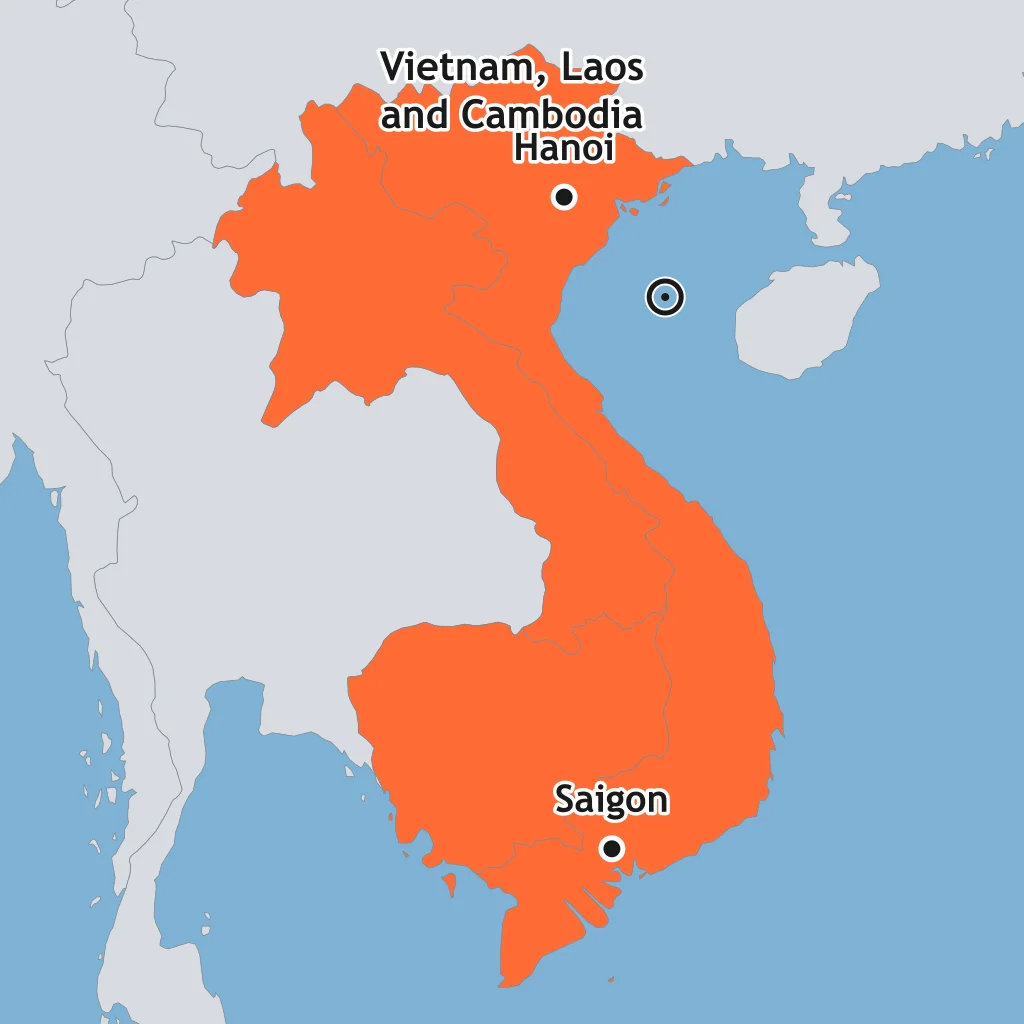
A joint resolution passed on August 7, 1964 authorized the president to take all necessary measures to repel armed attack on US forces and to prevent further aggression in Southeast Asia. The House voted 416-0 and the Senate 88-2. What did it permit?
Beginning in March 1965 the United States flew a sustained bombing campaign against targets in North Vietnam that continued for more than three years. What was that campaign called?
Read the map. Hanoi and Saigon are named; the marked coastal place is not. In March 1965 the first US Marine combat units waded ashore there to guard the air base. Which city is marked?
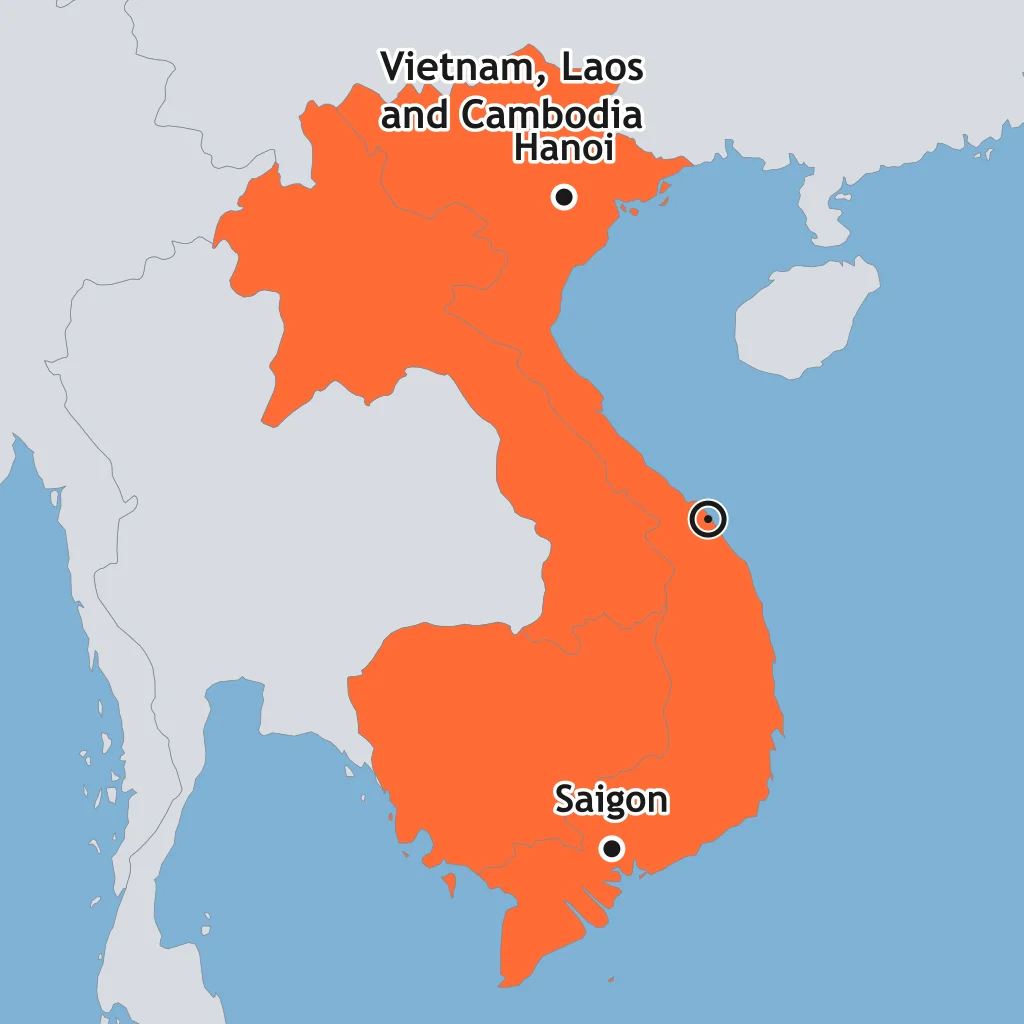
American strength in Vietnam grew from roughly 16,000 advisers at the end of 1963 to more than half a million personnel by 1968, and over 58,000 Americans died in the war. What best explains the buildup after 1964?
Read the map. Vietnam is the darker country, and Hanoi and Saigon are named, but the arrowed route is not. What is it, and why did it run that way?
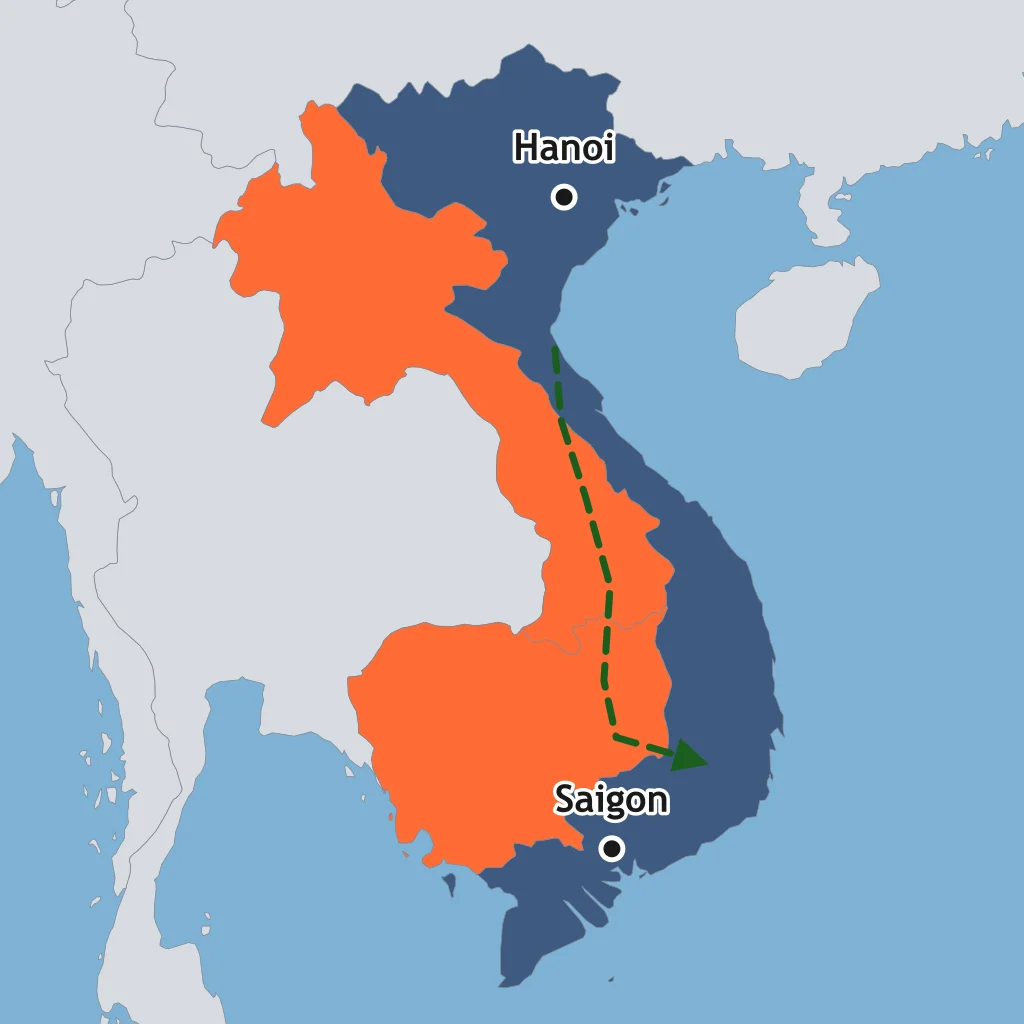
American units patrolled the countryside to find enemy forces, called in artillery and air strikes, then left the ground they had fought over. Progress was reported as a count of enemy dead. What was this way of fighting called?
American aircraft dropped more bomb tonnage on Southeast Asia than all sides dropped in the Second World War, and Vietnamese deaths ran into the millions, yet men and supplies kept reaching the South. Why did the bombing not cut the flow?
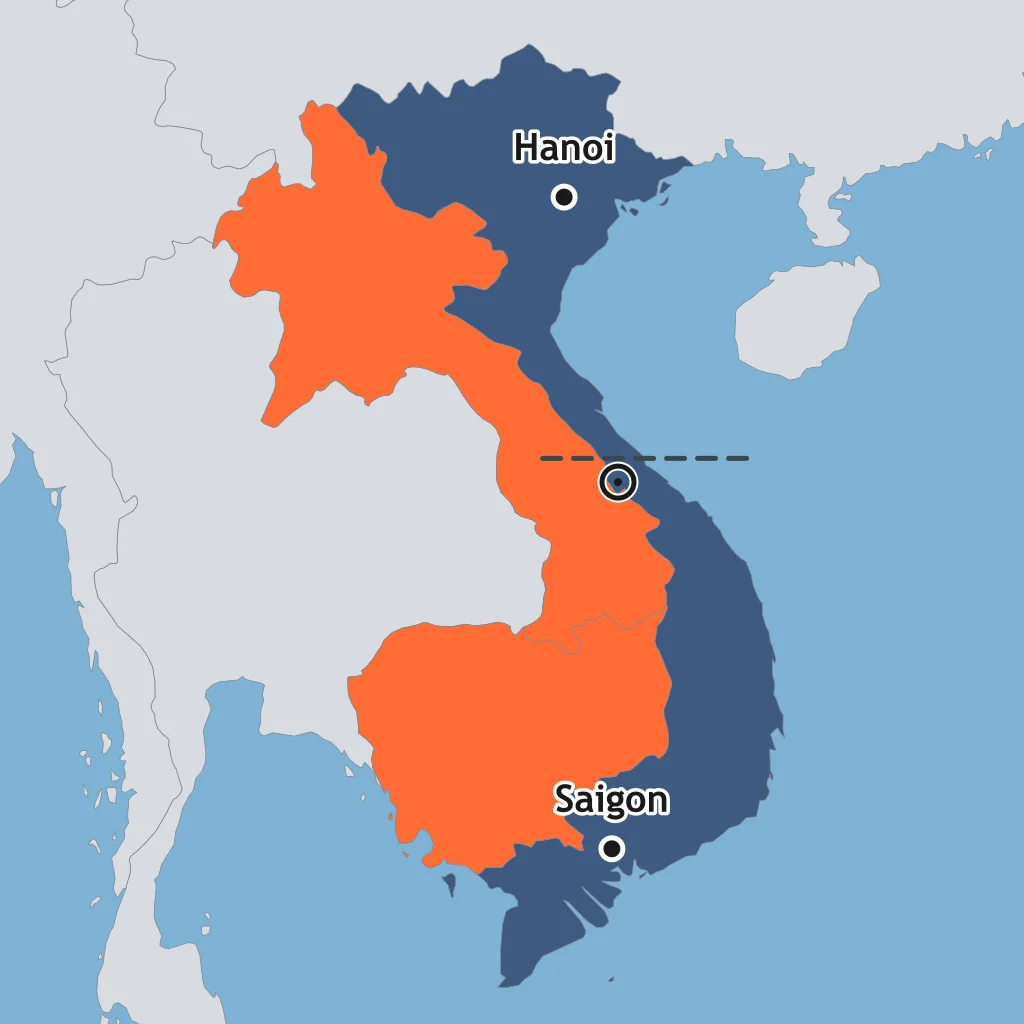
Read the map. Vietnam is the darker country. Hanoi and Saigon are named, but the marked base is not. It sat just south of the drawn line, close to the Laotian border, and was surrounded and shelled for 77 days in early 1968. Which base is marked?
Read the map. Only Hanoi is named. Every marked place was attacked within about a day of January 30, 1968. What does the spread of the marks show about that offensive?
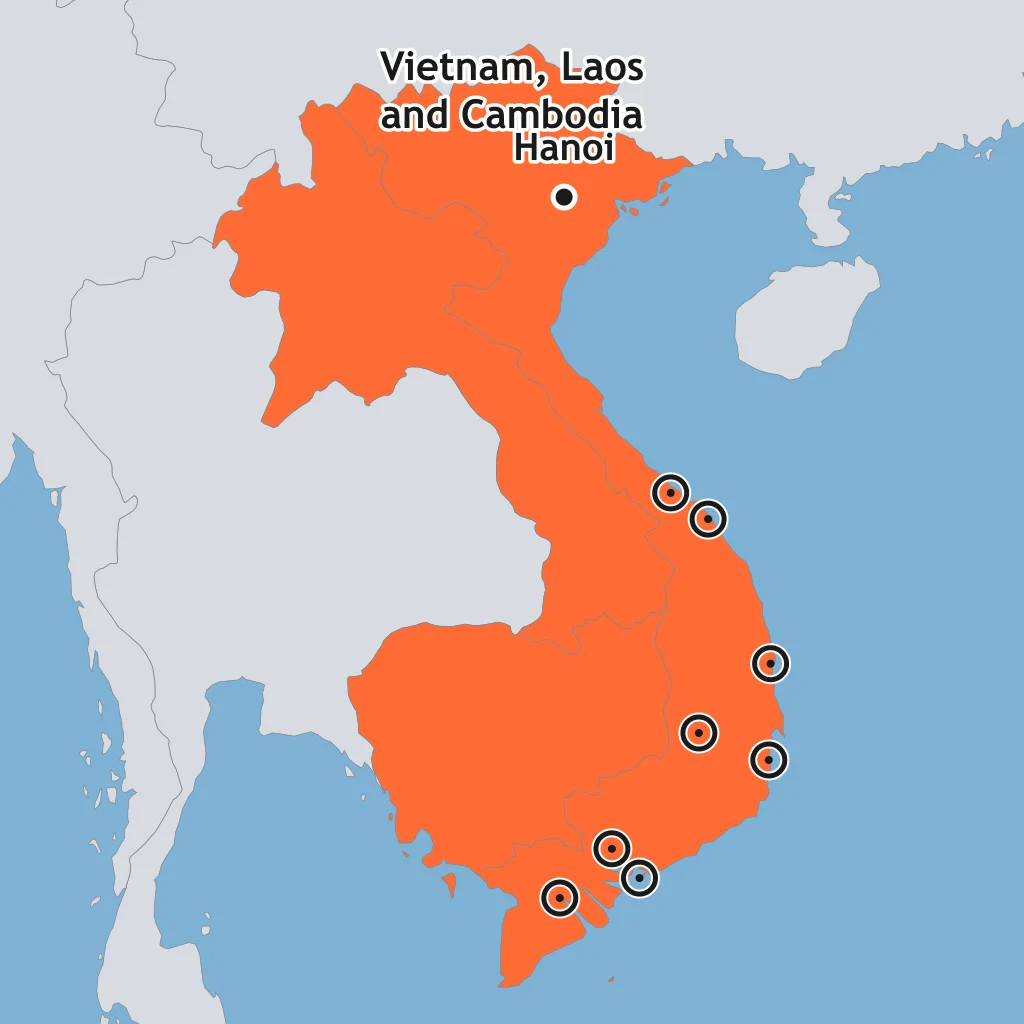
In late March 1968 Johnson halted most bombing of North Vietnam, called for talks, and announced he would not seek another term. What in the previous two months had brought him to that?
Officials had reported through 1967 that the enemy was steadily weakening. Reporting from Vietnam and the scale of the 1968 attacks said otherwise. What term names the gap that opened between official statements and what Americans believed?
On March 16, 1968 an American infantry company entered a hamlet in Quang Ngai province and killed more than 300 unarmed villagers, most of them women, children and old people. The army did not disclose it until November 1969. What is this called?
When the killings at My Lai became public knowledge in November 1969, what followed?
On December 1, 1969 numbers were drawn against birth dates to set the order in which men would be called up for military service, replacing a system in which local draft boards chose whom to call. What was this called?
Nixon's plan was to hand the ground fighting over to South Vietnam's army, arming and training it while American troops were pulled out year by year. What was this policy named?
In April 1970, while American troops were being withdrawn under Vietnamization, Nixon sent US and South Vietnamese forces across a neighboring country's border to attack enemy base areas there. Which country did they enter?
A secret Defense Department history of American decision-making in Vietnam reached the press in 1971. What did it disclose?
In December 1972, after talks broke down, the United States bombed Hanoi and Haiphong for eleven days with B-52s and other aircraft. Talks resumed in January. What was the immediate result of the return to the table?
The Paris agreement of January 1973 provided for a ceasefire in place, the withdrawal of all American forces within 60 days and the return of American prisoners of war. What did it not require?
Because the 1973 agreement let North Vietnamese divisions stay where they stood in the South, and Congress then cut back aid to Saigon, what happened over the next two years?
A joint resolution passed over Nixon's veto in November 1973 requires a president to report a commitment of forces to Congress within 48 hours and to end it within 60 days unless Congress authorizes it. What power does it limit?
Read the map. Hanoi and Da Nang are named; the city at the arrow's point is not. The arrow traces the final offensive of the spring of 1975. Which city fell at its end, on April 30?
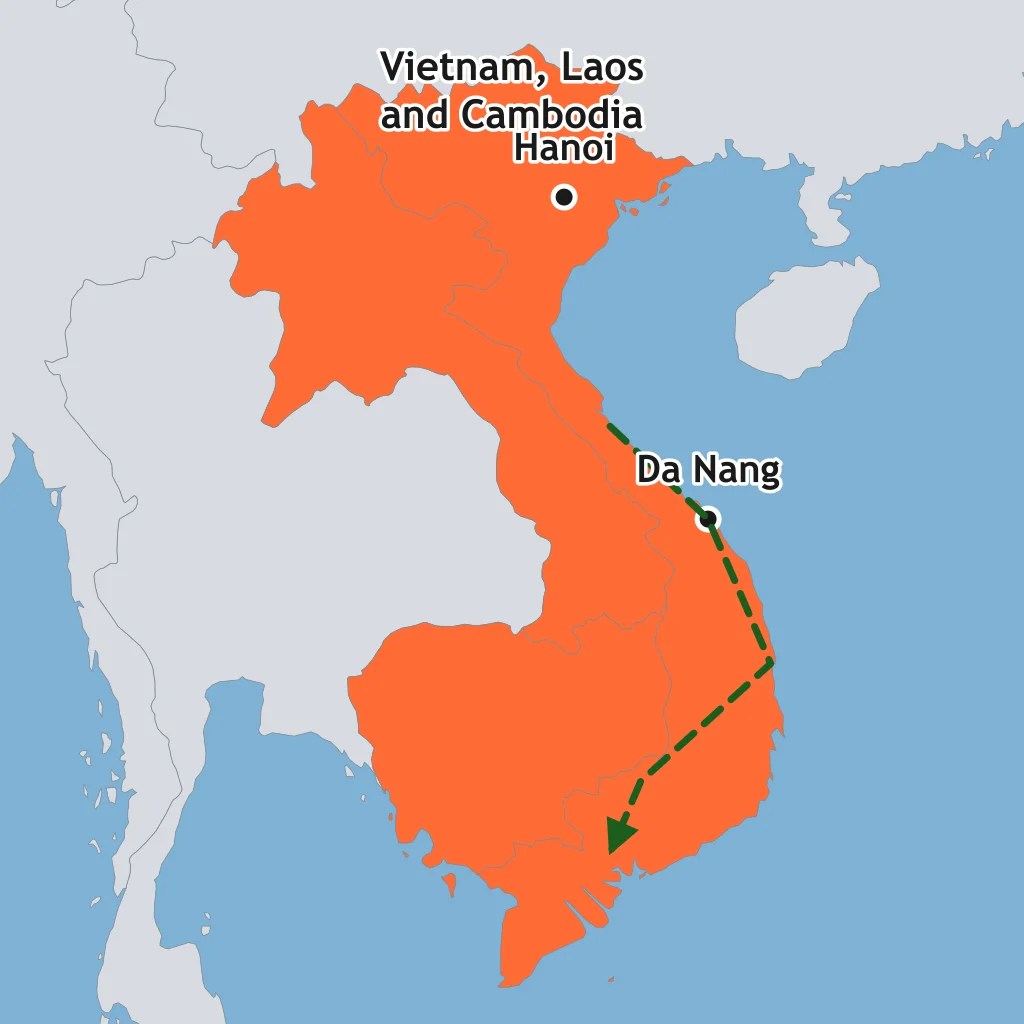
South Vietnam's army was larger and better equipped than the force that beat it, yet it collapsed in weeks in 1975. What best accounts for the speed of that collapse?
Place these four steps in the order they happened. 1. The first US ground combat units come ashore in South Vietnam 2. France's garrison in the northwest surrenders 3. Congress passes the Gulf of Tonkin Resolution 4. Geneva talks divide Vietnam
Put these in order. 1. The Pentagon Papers are published 2. A countrywide surprise offensive opens during the lunar new year truce 3. The Paris Peace Accords are signed 4. US and allied forces attack base areas across the western border
Which of these steps into Vietnam came first?
Which sequence describes the phases of American involvement in Vietnam in the right order?
Put these in order. 1. Johnson announces he will not seek another term 2. Congress passes the Gulf of Tonkin Resolution 3. The last American combat troops leave Vietnam 4. Nixon begins withdrawing troops and rearming South Vietnam's army
Put these final steps in order. 1. The last American combat troops leave Vietnam 2. Congress passes the War Powers Resolution 3. The South Vietnamese government surrenders 4. The Paris Peace Accords are signed
Crack the passcode before the zombies get in.
Answer, then swat bugs for bonus points.
Race through questions at your own speed.
Same question on every screen. Fastest wins.

Pick a tile, answer, hit bonuses and steals.

Nixon, Watergate and the Cover-Up
30 questions