Loading
by BlastRoom
Trace human genetic disorders from their molecular or chromosomal cause to their inheritance pattern and the risk they carry in a family.
#biology
20 questions
One question set, multiple game modes. Tap any game to see it in action. Not sure which to pick?
Answer to place stones and capture territory.
Outrun the snow together.
Earn blasts, then hunt the other team.
Answer to earn energy, then climb.

The class blasts through walls together.
Bid on mystery lots. Most money wins.
Sell tours. Nice, standard, or a total scam.

Answer, restock, and serve the rush.
More correct answers pulls the rope your way.
Answer, then shoot down the alien wave.
Answer, then tap to leap the frozen ridge.
A gene on chromosome 7 codes for a channel that moves chloride ions out of the cells lining the airways and the pancreas. The channel never reaches the membrane, so the mucus on those surfaces stays thick and sticky. Which disorder is described?
One base change in the beta-globin gene puts valine where glutamic acid belongs. The protein stacks into stiff fibers when oxygen is low, and red blood cells become rigid crescents that jam in capillaries. Which disorder is this?
A child inherits two nonworking copies of the HEXA gene, so the enzyme hexosaminidase A is missing. A lipid called GM2 ganglioside builds up inside nerve cells and destroys them. Which disorder is described?
A gene on the X chromosome fails to produce clotting factor VIII. The clotting cascade stalls, and bleeding into a joint after a small knock goes on for hours. Which disorder is described?
A stretch of CAG bases in the HTT gene on chromosome 4 is repeated far too many times. The altered protein damages neurons, and involuntary movements and memory loss usually begin between ages 30 and 50. Which disorder is described?
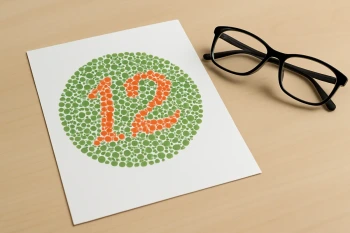
A gene on the X chromosome codes for a photopigment in one class of cone cells in the retina. When that pigment is altered, the person cannot tell red from green. Which condition is described?
Hemophilia A appears far more often in males than in females, and an affected boy's mother almost always shows no symptoms herself. Which inheritance pattern fits this?
Huntington's disease turns up in every generation of a family tree, strikes sons and daughters at about the same rate, and every affected person has an affected parent. Which inheritance pattern fits?
Two parents with no symptoms have a daughter with sickle cell anemia and a son without it. The gene involved sits on chromosome 11. Which inheritance pattern fits?
About 8 percent of males but well under 1 percent of females are red-green color blind. Which inheritance pattern explains this difference between the sexes?
Down syndrome does not run through a family tree as a dominant or a recessive trait, and the chance of a child having it rises sharply with the age of the mother. Which explanation fits?
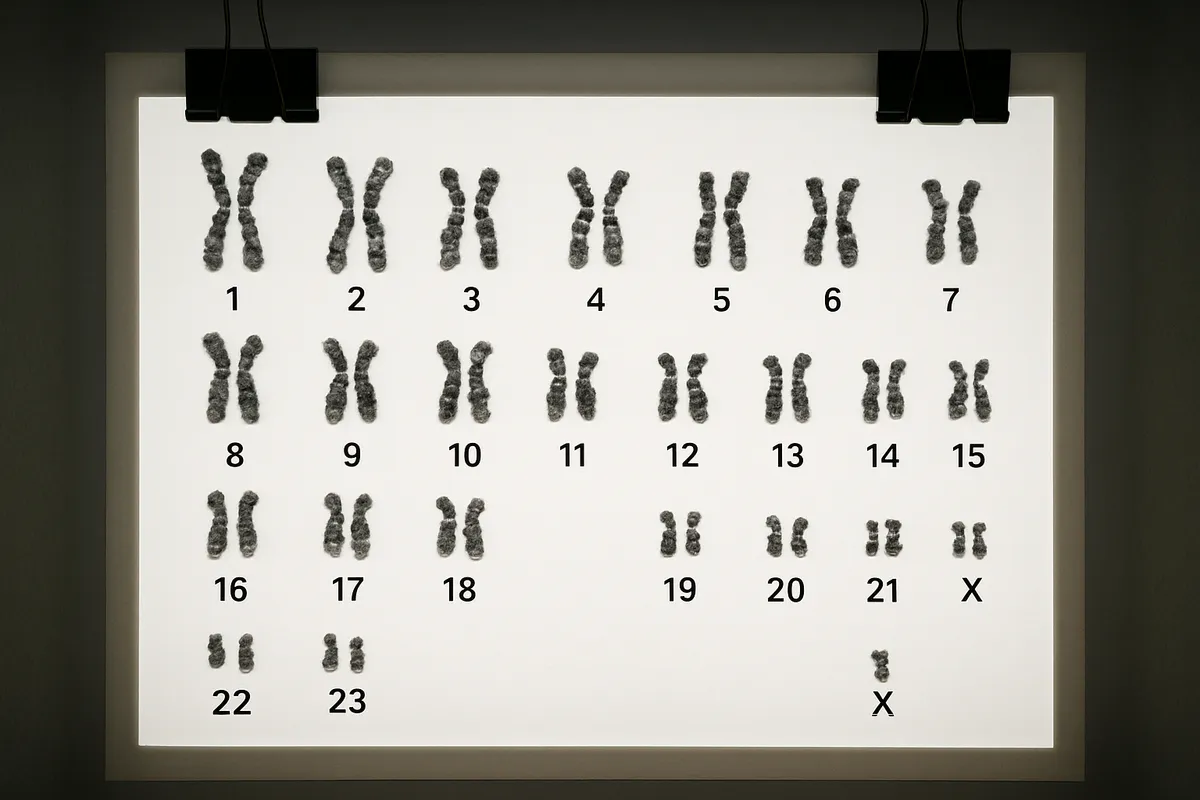
A karyotype from a newborn shows 47 chromosomes: three copies of chromosome 21 along with one X and one Y. Which statement about this child is correct?
A karyotype shows 45 chromosomes in total, with a single X and no second sex chromosome. Which condition does this karyotype indicate?
A karyotype from a male patient shows 47 chromosomes, with two X chromosomes and one Y. Which condition does this show, and how did it arise?
A child with cystic fibrosis has a karyotype showing the usual 46 chromosomes, with none missing, extra or broken. Why does the karyotype look normal?
A woman who is heterozygous for the Huntington's disease allele has children with a man who carries two normal alleles. What fraction of their children is expected to inherit the disease allele?
Both parents carry one working CFTR allele and one nonworking one, and neither has any symptoms. What is the probability that their next child has cystic fibrosis?
A woman does not have hemophilia A, but her father did. She has children with a man who does not have it. Their next child is a boy. What is the probability that this son has hemophilia A?
Two healthy parents each carry one normal beta-globin allele and one sickle cell allele. Out of four children, how many are expected to be carriers like their parents, with one allele of each kind?
A man who is red-green color blind has children with a woman who carries two normal alleles for the pigment gene. What is expected of their children?
Crack the passcode before the zombies get in.
Answer, then swat bugs for bonus points.
Race through questions at your own speed.
Same question on every screen. Fastest wins.

Pick a tile, answer, hit bonuses and steals.
PCR and Genetic Engineering
20 questions