Loading
by BlastRoom
Use balanced equations to find the limiting reactant, excess left over, and theoretical yield.
#chemistry
20 questions
One question set, multiple game modes. Tap any game to see it in action. Not sure which to pick?
Answer to place stones and capture territory.
Outrun the snow together.
Earn blasts, then hunt the other team.
Answer to earn energy, then climb.

The class blasts through walls together.
Bid on mystery lots. Most money wins.
Sell tours. Nice, standard, or a total scam.

Answer, restock, and serve the rush.
More correct answers pulls the rope your way.
Answer, then shoot down the alien wave.
Answer, then tap to leap the frozen ridge.
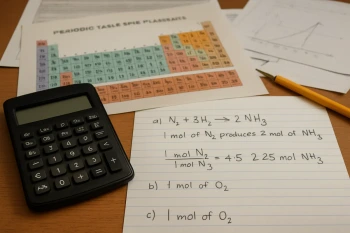
For N2 + 3H2 → 2NH3, 1.00 mol N2 reacts with 2.50 mol H2. Which reactant is limiting?
In 2Na + Cl2 → 2NaCl, a mixture starts with 0.750 mol Na and 0.500 mol Cl2. Which reactant will be used up first?
A reaction follows 4Fe + 3O2 → 2Fe2O3. If 1.20 mol Fe and 1.10 mol O2 are mixed, which reactant is limiting?
For P4 + 5O2 → P4O10, 0.400 mol P4 is combined with 1.50 mol O2. What is the limiting reactant?
Use 2C2H6 + 7O2 → 4CO2 + 6H2O. With 0.300 mol C2H6 and 1.40 mol O2, which reactant limits the reaction?
For 2SO2 + O2 → 2SO3, a chemist mixes 0.800 mol SO2 with 0.300 mol O2. Which reactant is limiting?
For 2Mg + O2 → 2MgO, 10.0 g Mg reacts with 8.00 g O2. Use Mg = 24.31 g/mol and O2 = 32.00 g/mol. Which reactant is limiting?
For N2 + 3H2 → 2NH3, 28.0 g N2 reacts with 4.00 g H2. Use N2 = 28.02 g/mol and H2 = 2.02 g/mol. Which reactant is limiting?
For 2Al + 3CuCl2 → 2AlCl3 + 3Cu, 5.40 g Al reacts with 40.0 g CuCl2. Use Al = 26.98 g/mol and CuCl2 = 134.45 g/mol. Which reactant limits?
In CaCO3 + 2HCl → CaCl2 + CO2 + H2O, 25.0 g CaCO3 reacts with 10.0 g HCl. Use 100.09 g/mol and 36.46 g/mol. Which reactant is limiting?
For 2AgNO3 + Cu → Cu(NO3)2 + 2Ag, 17.0 g AgNO3 reacts with 3.00 g Cu. Use 169.87 g/mol and 63.55 g/mol. Which reactant is limiting?
For 2H2 + O2 → 2H2O, 6.00 mol H2 reacts with 2.50 mol O2. How much H2 remains after the reaction is complete?
In 2Na + Cl2 → 2NaCl, 1.20 mol Na is mixed with 0.800 mol Cl2. How many moles of Cl2 remain?
For 4Al + 3O2 → 2Al2O3, 1.00 mol Al reacts with 1.00 mol O2. What amount of O2 remains after all the Al is used?
Use CaCO3 + 2HCl → CaCl2 + CO2 + H2O. If 0.300 mol CaCO3 reacts with 0.500 mol HCl, how much CaCO3 remains?
For 2Mg + O2 → 2MgO, 12.0 g Mg reacts with 12.0 g O2. Use Mg = 24.31 g/mol and O2 = 32.00 g/mol. What mass of O2 remains?
For 4Al + 3O2 → 2Al2O3, 0.600 mol Al reacts with 0.500 mol O2. What theoretical mass of Al2O3 forms? Use 101.96 g/mol.
For N2 + 3H2 → 2NH3, 5.60 g N2 reacts with 1.00 g H2. Use N2 = 28.02 g/mol, H2 = 2.02 g/mol, and NH3 = 17.03 g/mol. What mass of NH3 can form?
For 2K + Br2 → 2KBr, 3.00 mol K reacts with 2.00 mol Br2. What theoretical mass of KBr forms? Use KBr = 119.00 g/mol.
For CH4 + 2O2 → CO2 + 2H2O, 8.00 g CH4 reacts with 40.0 g O2 (CH4 = 16.04, O2 = 32.00, CO2 = 44.01 g/mol). What mass of CO2 forms?
Crack the passcode before the zombies get in.
Answer, then swat bugs for bonus points.
Race through questions at your own speed.
Same question on every screen. Fastest wins.

Pick a tile, answer, hit bonuses and steals.
Gas Stoichiometry
18 questions