Loading
by BlastRoom
Analyze the above-and-below opposition in Bong Joon-ho's Parasite through its stairs, rain, stone and staging.
#binary_opposition#matatag_english_10
20 questions
One question set, multiple game modes. Tap any game to see it in action. Not sure which to pick?
Parasite, directed by Bong Joon-ho, places the Kim family in a half-sunken apartment and the Park family in a hillside house reached by climbing. Which contrasting pair of ideas is the film built on?
In Bong Joon-ho's Parasite, Ki-woo climbs a long flight of steps to reach the Park house, and later the family runs down flight after flight in the rain. What are the stairs working as here?
By the end of Parasite, rain has soaked a garden tent above the hill and flooded a semi-basement below it. What has the rain come to stand for?
Min gives Ki-woo a scholar's stone in Parasite and says such stones bring wealth to families. In this moment, which is the sign and which is the referent?
In Parasite, Ki-woo wades into his flooded home and the scholar's stone rises to the surface, because the stone is hollow. What does this add to what the stone has meant?
In Bong Joon-ho's Parasite, Mr. Park tells his wife that his driver never crosses the line, but that the man's smell does. What does this say about the above-and-below opposition?
Early in Parasite, a street fumigation truck passes and Ki-taek tells the family to leave the window open for free pest control. They keep folding pizza boxes as the fumes fill the room. What does the staging carry?
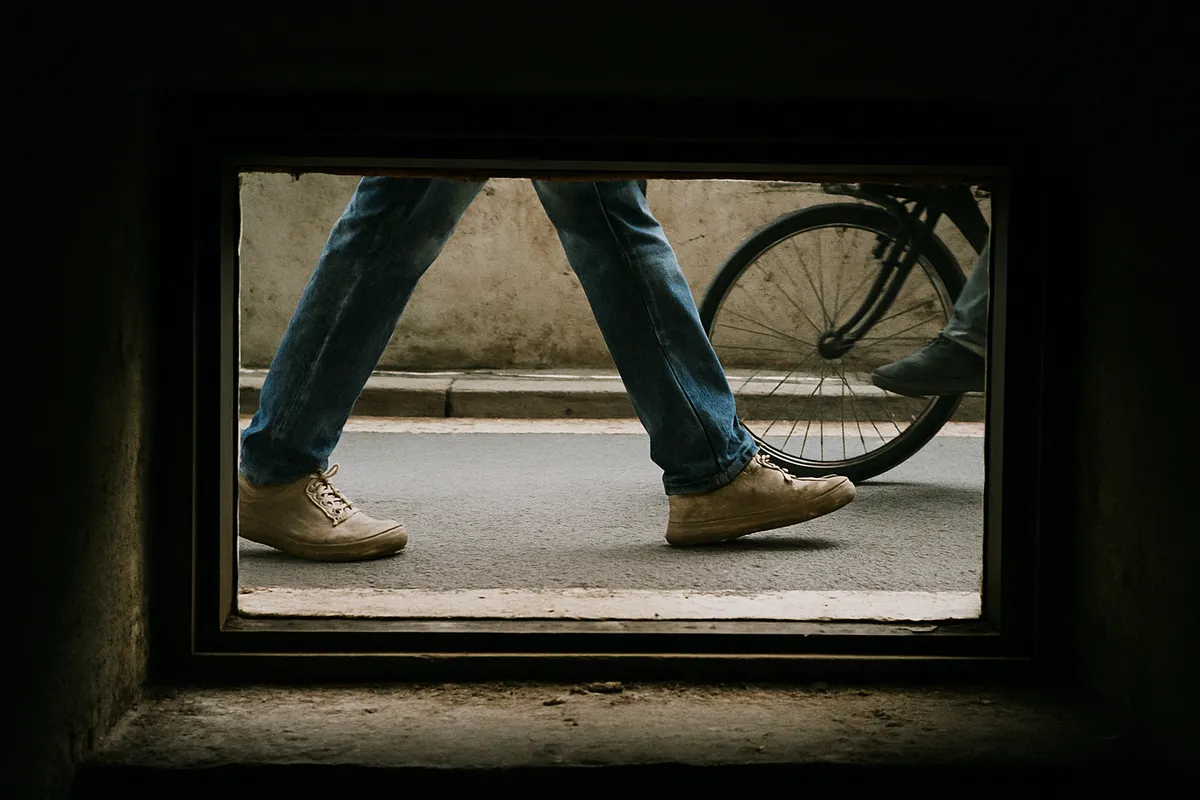
Parasite opens on the Kims' street-level window, with passing feet outside, and closes on the same window with snow falling. What does returning to this frame show?
After fleeing the Park house in Parasite, the Kims move down steps, alleys and a flooded street in one long run of descending shots. What does this sequence do that no line of dialogue does?
The morning after the flood in Parasite, Mrs. Park tells a friend by phone that the rain was a blessing because it cleared the sky for the garden party. Ki-taek is close enough to hear. What is the subtext?
In Parasite, the Parks sit warm and dry on their sofa and watch their son's garden tent through the living room window while the storm falls. What does this staging choice add?
In Parasite, the Kims' scheme to get the housekeeper dismissed plays out over a grand, baroque-sounding piece by composer Jung Jaeil. How does the music work against what is shown?
Stairs, rain and smell each return many times in Parasite. A learner points at one striking shot in the film and calls it a motif. Why is that use of the word wrong?
Near the end of Parasite, Ki-woo watches a hallway light in the Park house flick on and off in a pattern. In this moment, which is the sign and which is the referent?
Parasite keeps the Kims below and the Parks above, and then reveals a man who has lived for years in a bunker under the Park house. What does this hidden level do to the pattern?
In Parasite the Kims buy new clothes and adjust their speech to pass as hired experts, yet Mr. Park still notices their smell. What does this pairing show about appearance and reality?
Bong Joon-ho has described Parasite as a staircase movie, and the homes of the two families are placed at different heights.
In Parasite the camera follows the Kims closely through every step of their scheme, while the Park family is mostly seen as their employees see them. What does this choice do to the viewer?
In a gymnasium shelter in Parasite, Ki-taek tells his son that the plan that never fails is no plan at all. What does the line reveal underneath the words?
Parasite ends with Ki-woo writing that he has a plan to earn money and buy the Park house, shown as a bright scene, before the film cuts back to the semi-basement. What does the cut do to the plan?
Crack the passcode before the zombies get in.

Pick a tile, answer, hit bonuses and steals.
World Literature: Poetry, Prose and Drama
20 questions