Loading
by BlastRoom
Bioaccumulation and Biomagnification for high school Environmental Science, on-level and AP. Covers AP Environmental Science Unit 8: Aquatic and Terrestrial Pollution.
#environmental_science
30 questions
One question set, multiple game modes. Tap any game to see it in action. Not sure which to pick?
Answer to place stones and capture territory.
Outrun the snow together.
Earn blasts, then hunt the other team.
Answer to earn energy, then climb.

The class blasts through walls together.
Bid on mystery lots. Most money wins.
Sell tours. Nice, standard, or a total scam.

Answer, restock, and serve the rush.
More correct answers pulls the rope your way.
Answer, then shoot down the alien wave.
Answer, then tap to leap the frozen ridge.
A lake trout absorbs methylmercury faster than it can eliminate it, so its body burden rises as it ages. What process is occurring within the trout?
A turtle living for decades in contaminated water stores increasing amounts of a pesticide in its fatty tissue. What does this example show?
Researchers find a contaminant at low concentration in algae, higher concentration in minnows, and the highest concentration in herons that eat minnows. What process explains the pattern?
Two bass live in the same lake, but the older bass has a larger concentration of a persistent chemical because it has been exposed longer. What term best describes the difference?
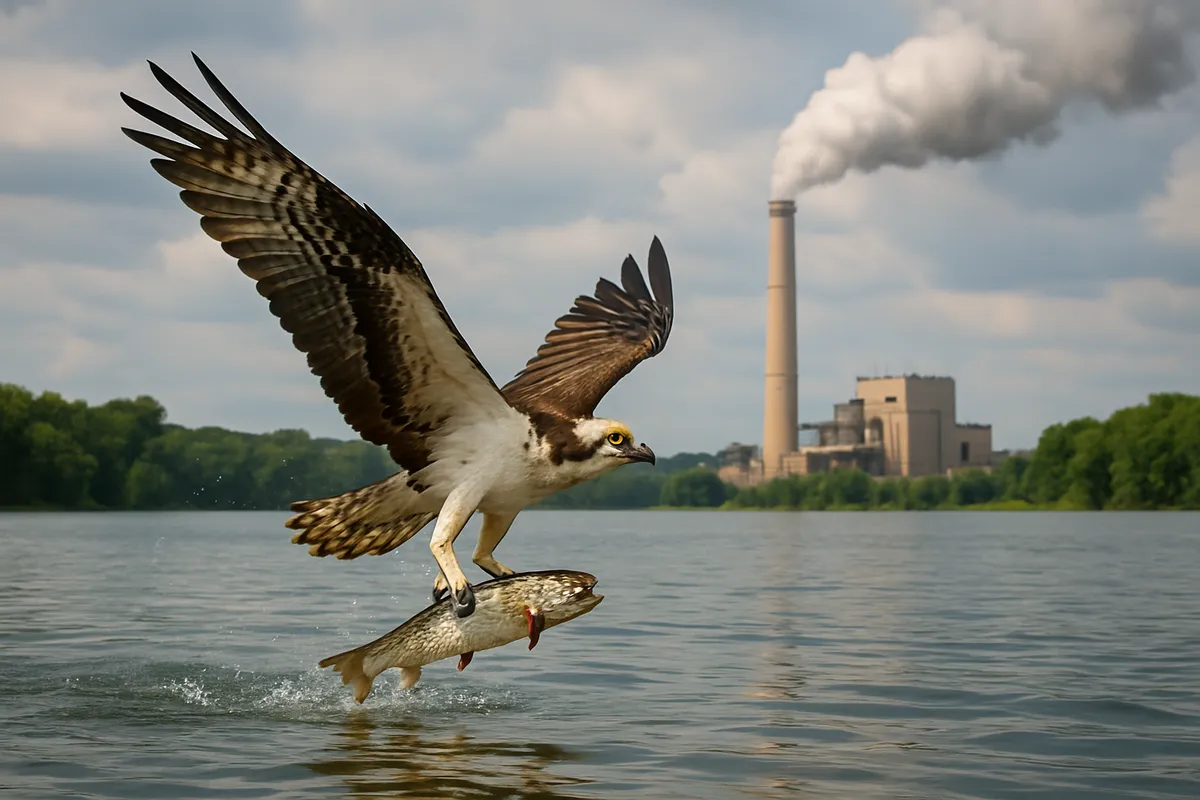
A contaminant concentration rises from aquatic insects to small fish to osprey. Which process does this pattern show?
A seal's PCB concentration increases during its life because PCBs enter with food and leave its body slowly. What is happening to the seal?
A hawk has a higher DDT concentration per gram of tissue than the mice it eats. What term describes the comparison between the hawk and its prey?
A scientist measures increasing mercury in one individual fish at ages 1, 3, and 6 years. What must be true for this increase to happen?
A pollutant is 0.02 ppm in algae and becomes 10 times more concentrated at each feeding step: algae → zooplankton → small fish → bass. What concentration is predicted in bass?
Small fish contain 0.4 ppm of a persistent contaminant. A bass that eats them has a concentration five times as high. What is the bass concentration?
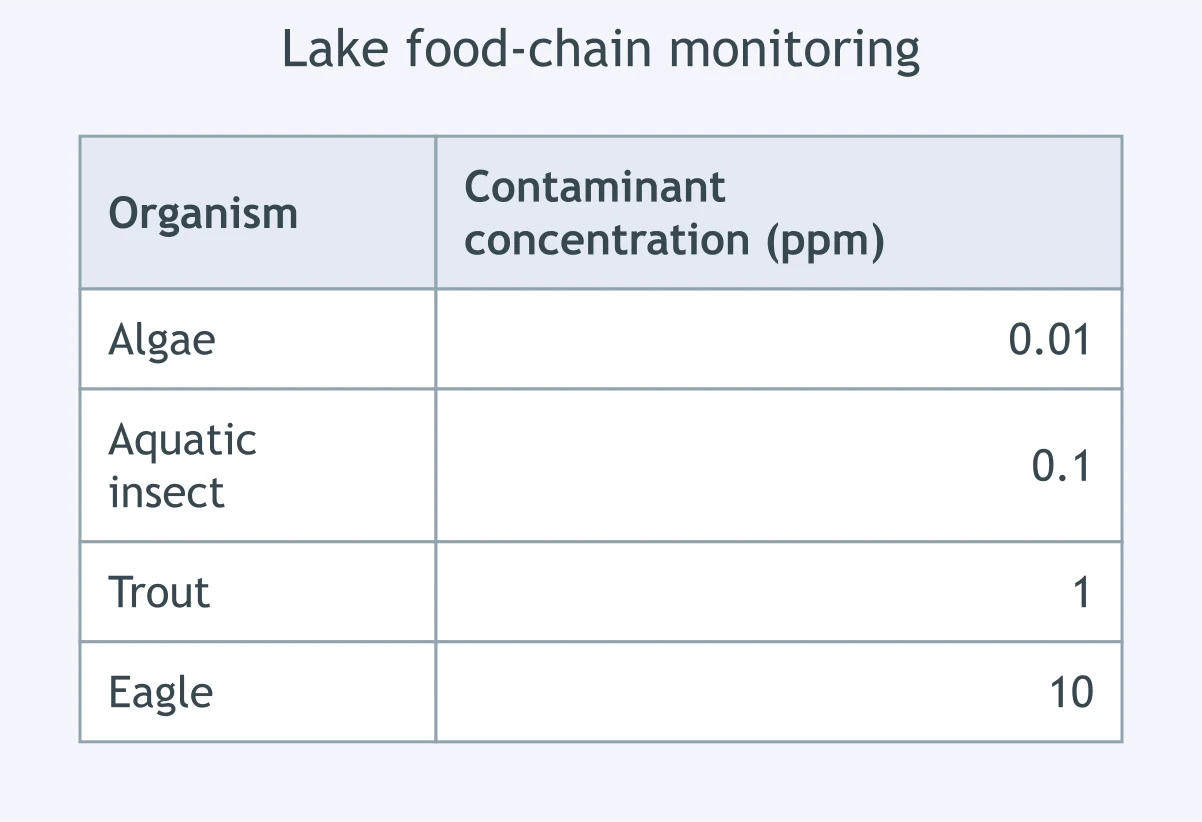
Use the table to identify the organism with the greatest contaminant concentration.
Chemical X starts at 0.1 ppb in algae and increases fourfold at each feeding step. In algae → minnow → pike, what concentration is predicted in pike?
Phytoplankton contain 3 ppb of a pollutant. Concentration increases tenfold at each step in phytoplankton → zooplankton → anchovy → tuna. What concentration is predicted in tuna?
Snails contain 2 ppb of a contaminant, sunfish contain 20 ppb, and herons contain 200 ppb. Which statement is supported by these data?
An algae sample has 0.5 ppb of a persistent pollutant. Each feeding step doubles concentration in algae → insect larvae → fish → osprey. What concentration is predicted in the osprey?
Chemical A remains at 0.1 ppm in algae, insects, fish, and birds. Chemical B rises from 0.01 ppm in algae to 10 ppm in birds. Which chemical biomagnifies?
Which of these pollutants is most likely to biomagnify through a food chain?
A chemical dissolves readily in water, is rapidly metabolized, and is quickly excreted by fish. How likely is it to biomagnify?
Why are pollutants stored in lipid tissue often more likely to biomagnify than pollutants stored only briefly in blood?
A pesticide remains in soil and organism tissues for years and has high lipid solubility. Which outcome is most likely in a nearby food web?
A contaminant is persistent but is easily dissolved in water and rapidly excreted. Which additional property would most increase its biomagnification potential?
A factory plans to replace a persistent, fat-soluble pesticide with a new one. Which property of the new pesticide would most reduce biomagnification risk?
PCBs are resistant to biodegradation and can accumulate in fatty tissues. Why can an orca that eats contaminated fish receive a high PCB dose?
Which pollutant profile is most likely to produce biomagnification in a lake food chain?
FDA and EPA advise people who are pregnant to avoid certain large predatory fish, such as bigeye tuna. What scientific pattern supports this advice?
FDA's fish advice lists canned light tuna as a Best Choice, albacore tuna as a Good Choice, and bigeye tuna as a Choice to Avoid for people who are pregnant. What explains these different categories?
In the DDT case, bald eagle reproduction declined after DDE, a DDT breakdown product, accumulated through food webs. What direct effect contributed to reproductive failure?
After the United States banned most uses of DDT in 1972, bald eagle and other bird-of-prey populations slowly recovered. What does this outcome support?
ATSDR notes that PCBs biomagnify in aquatic food chains. A family lives near a lake with PCB-contaminated sediment. Which meal would likely add the most PCBs to their diet?
FDA and EPA advise checking local advisories for fish caught by family or friends. Why can these advisories differ from one lake to another?
Crack the passcode before the zombies get in.
Answer, then swat bugs for bonus points.
Race through questions at your own speed.
Same question on every screen. Fastest wins.

Pick a tile, answer, hit bonuses and steals.
Environmental Economics and Cost-Benefit Analysis
25 questions