Loading
by BlastRoom
What a metrical break, a rhyme or a run of alliteration accomplishes at that moment in the poem.
#sound#ap_english_literature
25 questions
One question set, multiple game modes. Tap any game to see it in action. Not sure which to pick?
Answer to place stones and capture territory.
Outrun the snow together.
Earn blasts, then hunt the other team.
Answer to earn energy, then climb.

The class blasts through walls together.
Bid on mystery lots. Most money wins.
Sell tours. Nice, standard, or a total scam.

Answer, restock, and serve the rush.
More correct answers pulls the rope your way.
Answer, then shoot down the alien wave.
Answer, then tap to leap the frozen ridge.
Paradise Lost runs in iambic pentameter, then falls into "Hurld headlong flaming from th' Ethereal Skie." What does opening on stressed "Hurld" do?
Donne's sonnet moves in iambic pentameter but opens, "Batter my heart, three-person'd God; for you." What does the stressed imperative "Batter" do?
King Lear's blank verse breaks into "Never, never, never, never, never!" What does this metrical collapse accomplish?
Keats's iambic sonnet begins, "Bright star! would I were stedfast as thou art—" What do the opening stresses on "Bright star" do?
Wordsworth's sonnet calls, "Milton! thou shouldst be living at this hour." How does the heavy opening name affect the line?
In Sonnet 73, the iambic line opens, "Bare ruined choirs, where late the sweet birds sang." What does the stress on "Bare" do?
In "Ozymandias," the sonnet's line stops: "Nothing beside remains. Round the decay." What does the hard pause after "remains" do?
Dickinson pairs "firm" with "Room" as a near-rhyme in "And Breaths were gathering firm / For that last Onset—when the King / Be witnessed—in the Room—." What does the near-rhyme do?
Blake rhymes "bright" with "night" in "Tyger Tyger, burning bright, / In the forests of the night." What does the rhyme join?
Sonnet 130 closes, "I think my love as rare / As any she belied with false compare." What does the rhyme "rare/compare" do?
Frost rhymes "deep" and "keep" in "The woods are lovely, dark and deep, / But I have promises to keep." What does the rhyme do?
Dickinson writes, "He kindly stopped for me— / The Carriage held but just Ourselves— / And Immortality." What does the rhyme-like echo of "me" and "Immortality" do?
Dickinson's "Room" nearly rhymes with "Storm" in "The Stillness in the Room / Was like the Stillness in the Air— / Between the Heaves of Storm—." What is the effect?
Hopkins writes "morning's minion, king- / dom of daylight's dauphin, dapple-dawn-drawn Falcon." What does the rush of repeated sounds do?
Poe writes, "the silken, sad, uncertain rustling of each purple curtain." What does the sibilance emphasize?
Coleridge writes, "The fair breeze blew, the white foam flew, / The furrow followed free." What do the repeated f and b sounds do?
Keats opens, "Season of mists and mellow fruitfulness." What does the cluster of soft m and s sounds do?
Tennyson writes, "The moan of doves in immemorial elms, / And murmuring of innumerable bees." What do the repeated m and n sounds create?
Hardy writes, "The tangled bine-stems scored the sky / Like strings of broken lyres." What do the scraping s and t sounds emphasize?
Tennyson opens, "Break, break, break, / On thy cold gray stones, O Sea!" What do the stressed monosyllables do to the pace?
Macbeth says, "Out, out, brief candle!" What do the clipped monosyllables do?
Donne begins, "Death, be not proud, though some have called thee." What do the opening monosyllables do?
Dickinson writes, "I heard a Fly buzz—when I died—." What does the slow sequence of monosyllables and dashes do?
Blake asks, "What the hammer? what the chain, / In what furnace was thy brain?" What do the stressed nouns do to the pace?
Owen's line erupts, "Gas! GAS! Quick, boys!—An ecstasy of fumbling." What do the shouted monosyllables do before the longer phrase?
Crack the passcode before the zombies get in.
Answer, then swat bugs for bonus points.
Race through questions at your own speed.
Same question on every screen. Fastest wins.

Pick a tile, answer, hit bonuses and steals.
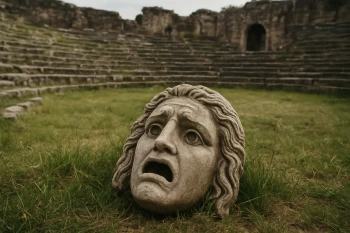
Greek Tragedy: Hubris, Hamartia, Catharsis, Chorus
25 questions