Loading
by BlastRoom
Ecological Footprint and Resource Consumption for high school Environmental Science, on-level and AP. Covers AP Environmental Science Unit 5: Land and Water Use.
#environmental_science

25 questions
One question set, multiple game modes. Tap any game to see it in action. Not sure which to pick?
Answer to place stones and capture territory.
Outrun the snow together.
Earn blasts, then hunt the other team.
Answer to earn energy, then climb.

The class blasts through walls together.
Bid on mystery lots. Most money wins.
Sell tours. Nice, standard, or a total scam.

Answer, restock, and serve the rush.
More correct answers pulls the rope your way.
Answer, then shoot down the alien wave.
Answer, then tap to leap the frozen ridge.
What does an ecological footprint, reported in global hectares per person, measure?
In ecological-footprint accounting, what is a global hectare?
Which demand is directly included in an ecological footprint?
What does a region’s biocapacity describe?
Within ecological-footprint accounting, what does the carbon component represent?
Country A has a footprint of 6.0 global hectares per person and Country B has 2.0, measured with the same method. What does the difference chiefly indicate?
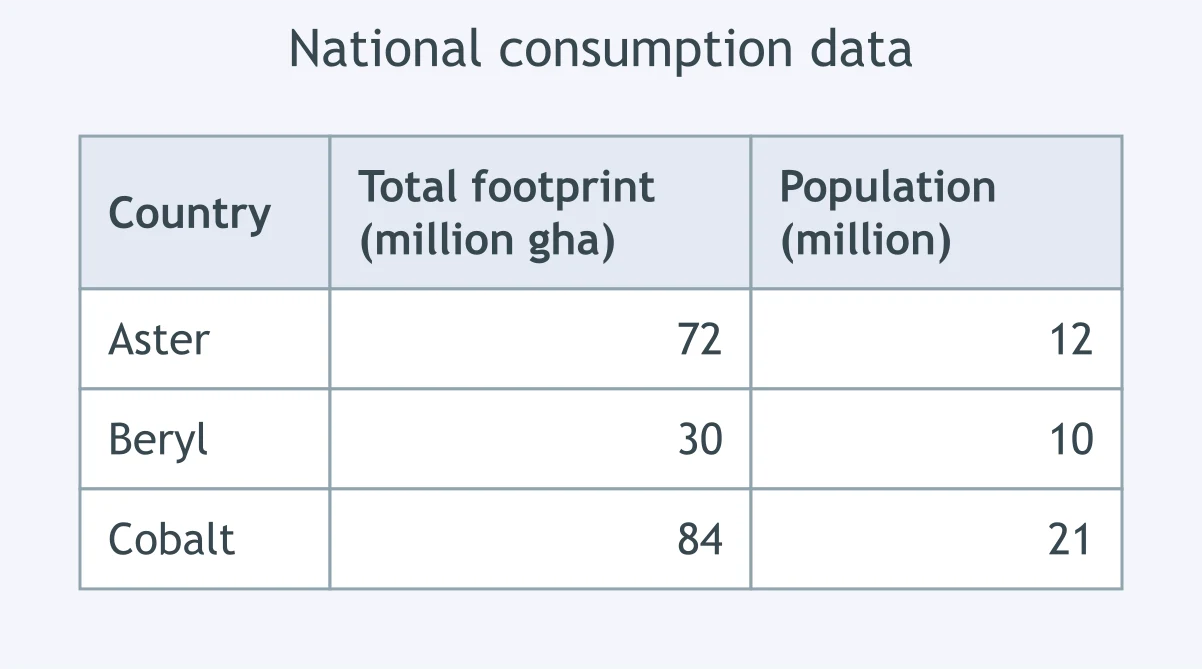
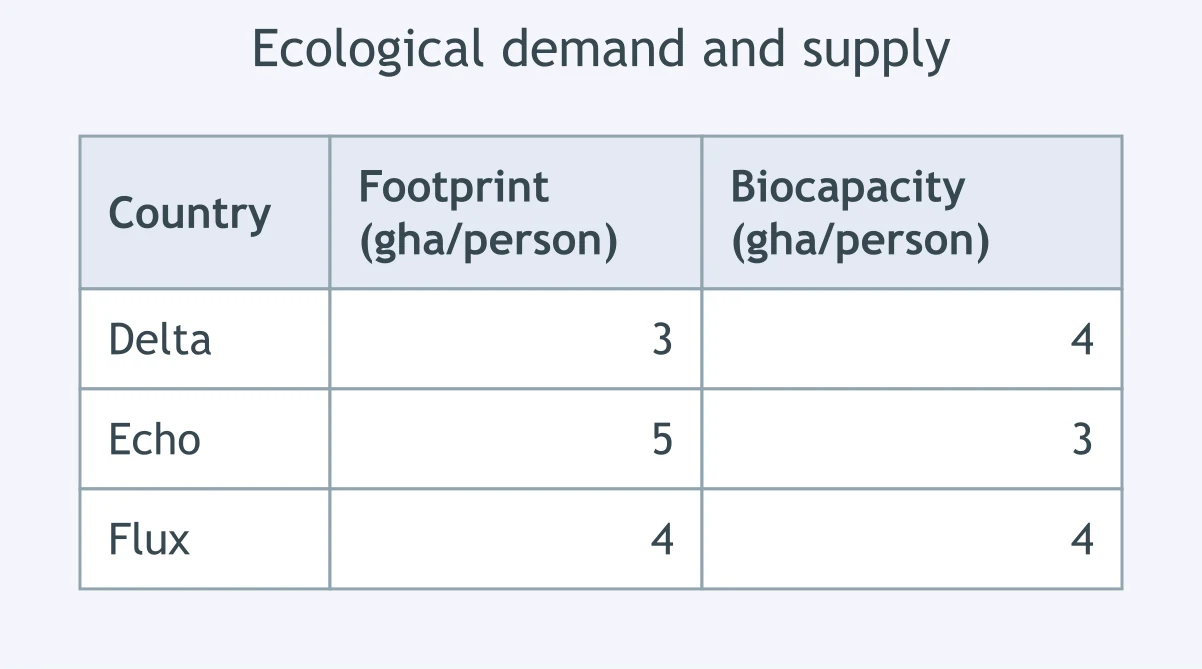
Use the table. Which country has the highest ecological footprint per person?
Mina and Leo have identical food, housing, and goods footprints. Mina’s mobility footprint is 3.2 global hectares per year; Leo’s is 1.1. Who has the larger total footprint?
Country L produces goods with a footprint of 20 million global hectares, imports 7 million, and exports 4 million. Country M produces 20 million, imports 3 million, and exports 8 million. Which has the higher consumption footprint?
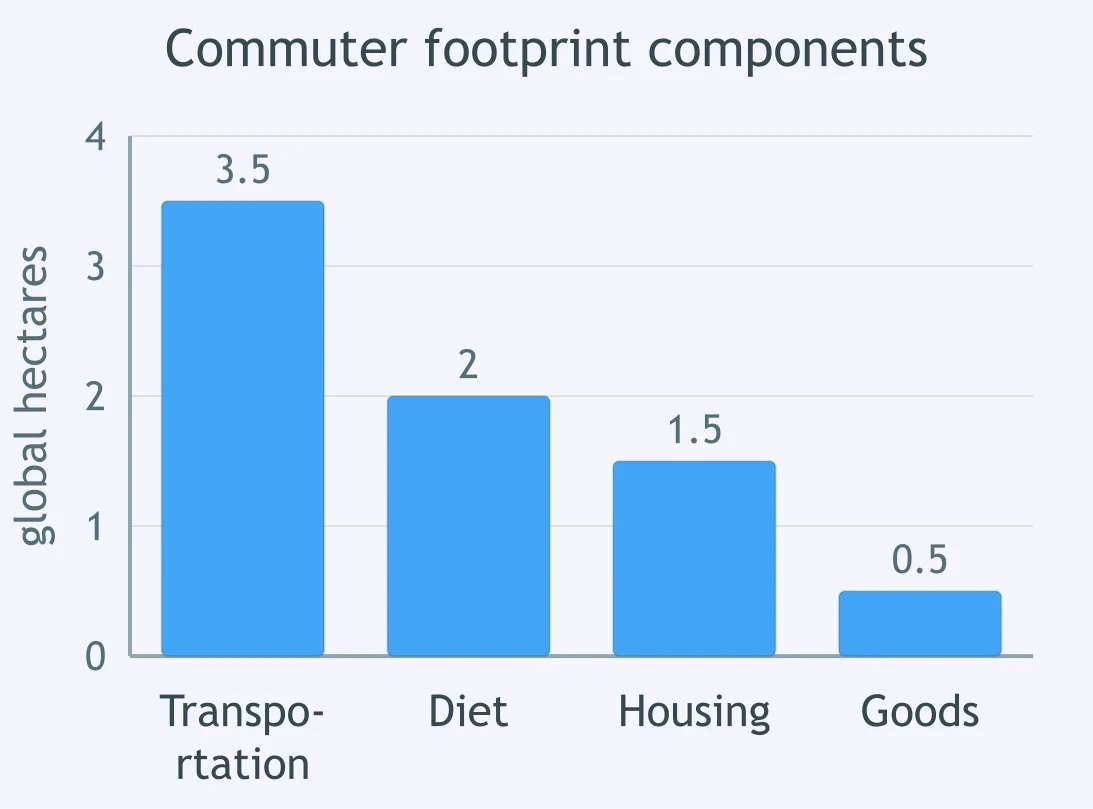
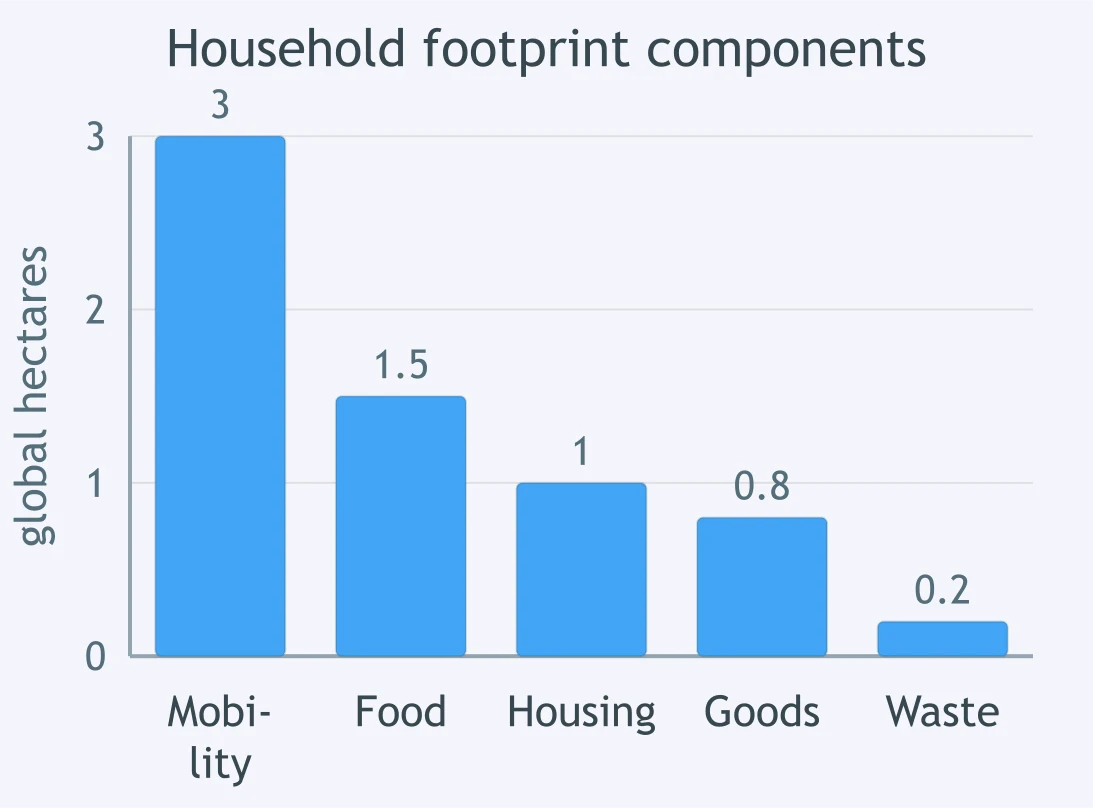
Use the chart. If a commuter can cut only one component in half, which cut would reduce the total footprint the most?
Country R uses 5 global hectares per person for 20 million people. Country S uses 1.5 global hectares per person for 100 million people. Which country places greater total demand on biocapacity?
Two cities have the same per-person footprint, but City X has a much larger population. What comparison is most likely true?
A country’s footprint is 5 global hectares per person while its biocapacity is 2 global hectares per person. What does this gap show?
Use the table. Which country has a biocapacity reserve rather than an ecological deficit?
A city of 500,000 people has a footprint of 2.4 global hectares per person and biocapacity of 1.6 global hectares per person. What is the city's total ecological deficit?
In a model scenario, humanity's footprint is 18 billion global hectares while global biocapacity is 12 billion global hectares. What does this indicate?
A country has an ecological deficit but imports food and timber. Which statement best explains how imports can help meet its demand?
A region’s footprint exceeds its biocapacity. If it cannot cover the gap through trade, what outcome is consistent with ecological overshoot?
A country of 10 million people has a total ecological footprint of 45 million global hectares. What is its footprint per person?
A student’s annual footprint has these components: mobility 2.1, food 1.4, housing 1.8, and goods 0.7 global hectares. What is the total footprint?
A household lowers its footprint from 8.0 to 6.0 global hectares per person. By what percentage did it decrease?
A household’s total footprint is 5.0 global hectares, including 3.0 from its carbon component. A change cuts that carbon component by 20% and changes nothing else. What is the new total?
Use the chart. If this household can halve only one component, which change would reduce its footprint the most?
A school’s footprint audit estimates annual components of heating 2.4, equipment purchases 1.0, cafeteria food 1.4, and waste 0.3 global hectares. Which 50% reduction would cut the total most?
A life cycle assessment of a device assigns 4.0 global-hectare-years to production, 0.8 to use, and 0.2 to transport. If one stage alone is cut by 50%, which intervention has the greatest effect?
Crack the passcode before the zombies get in.
Answer, then swat bugs for bonus points.
Race through questions at your own speed.
Same question on every screen. Fastest wins.

Pick a tile, answer, hit bonuses and steals.

Environmental Science Vocabulary: Rapid Review
40 questions