Loading
by BlastRoom
Classify one-dimensional collisions by kinetic energy and use momentum conservation to analyze them.
#physics
25 questions
One question set, multiple game modes. Tap any game to see it in action. Not sure which to pick?
Answer to place stones and capture territory.
Outrun the snow together.
Earn blasts, then hunt the other team.
Answer to earn energy, then climb.

The class blasts through walls together.
Bid on mystery lots. Most money wins.
Sell tours. Nice, standard, or a total scam.

Answer, restock, and serve the rush.
More correct answers pulls the rope your way.
Answer, then shoot down the alien wave.
Answer, then tap to leap the frozen ridge.
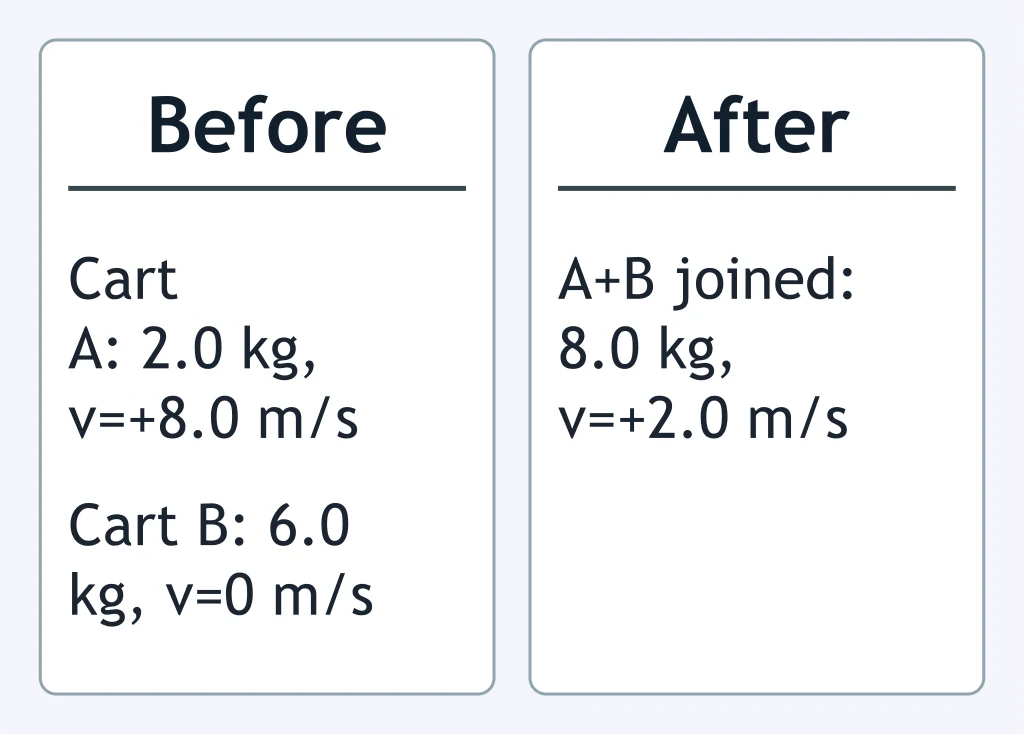
The figure shows two carts before and after a collision. Take motion to the right as positive. How should the collision be classified?
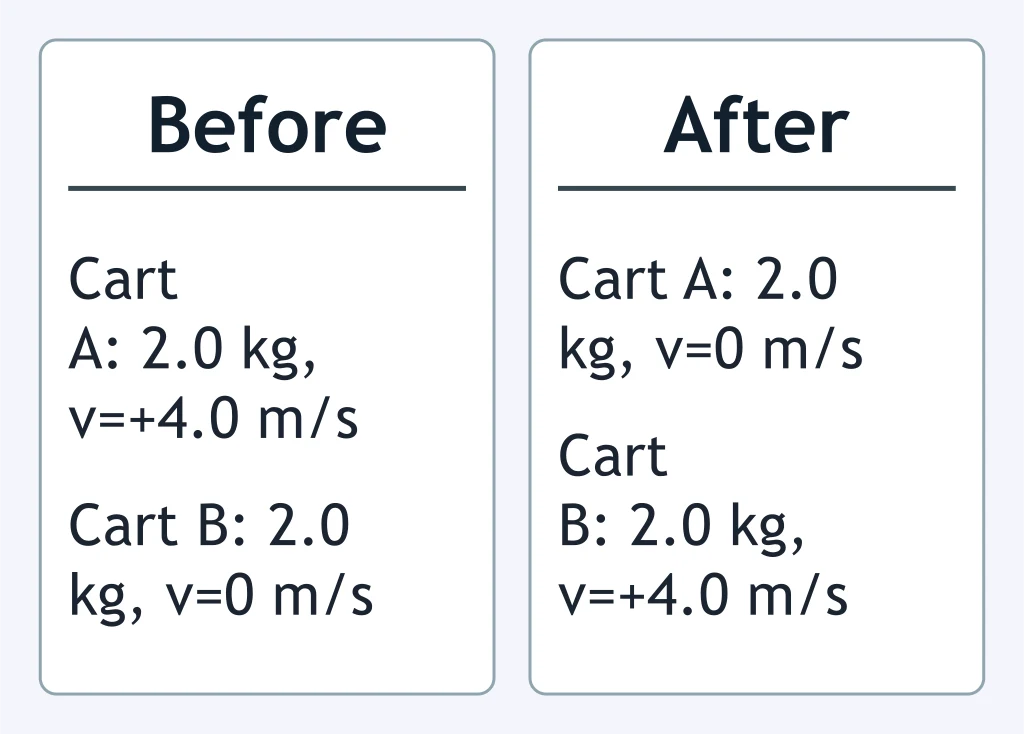
Use the before-and-after values in the figure. Take right as positive. Which classification is correct?
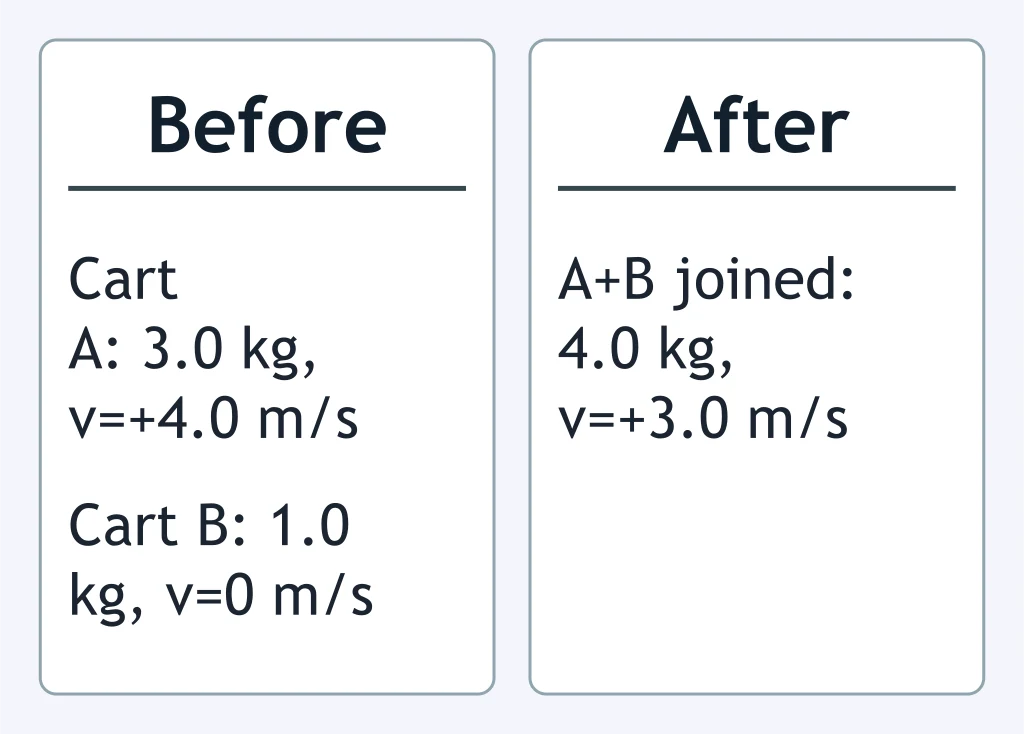
The figure gives all masses and velocities for a closed collision. Take right as positive. What type of collision is shown?
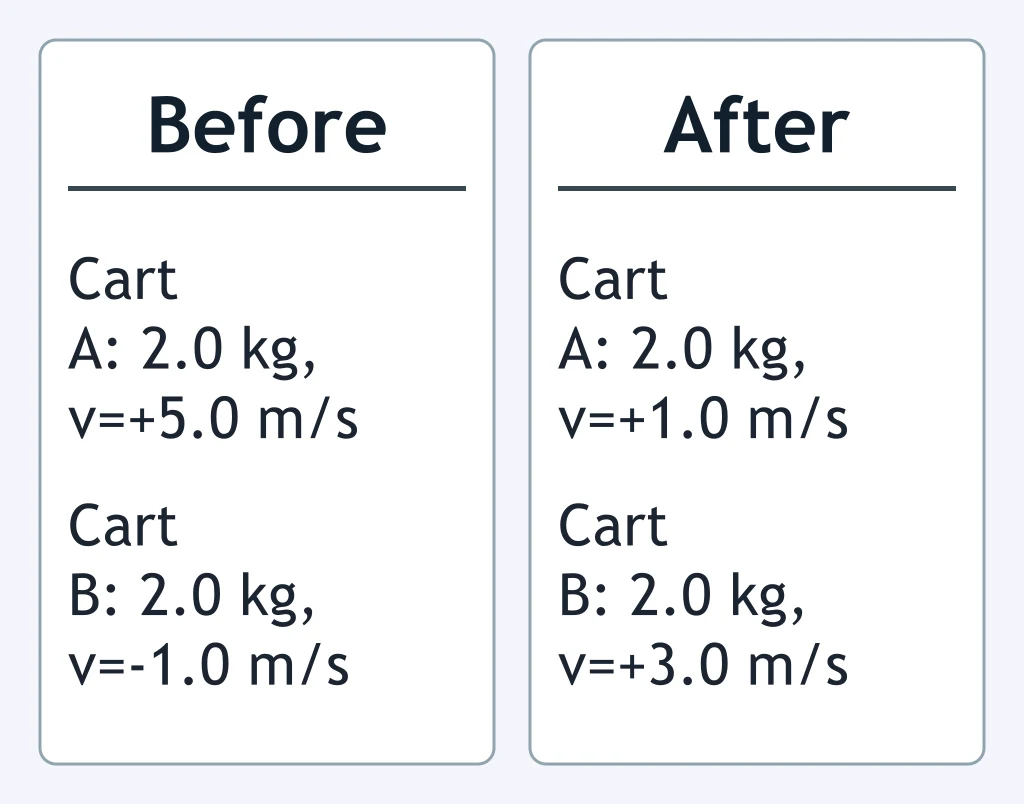
Compare the total kinetic energy before and after in the figure. Take motion right as positive. How should this collision be classified?
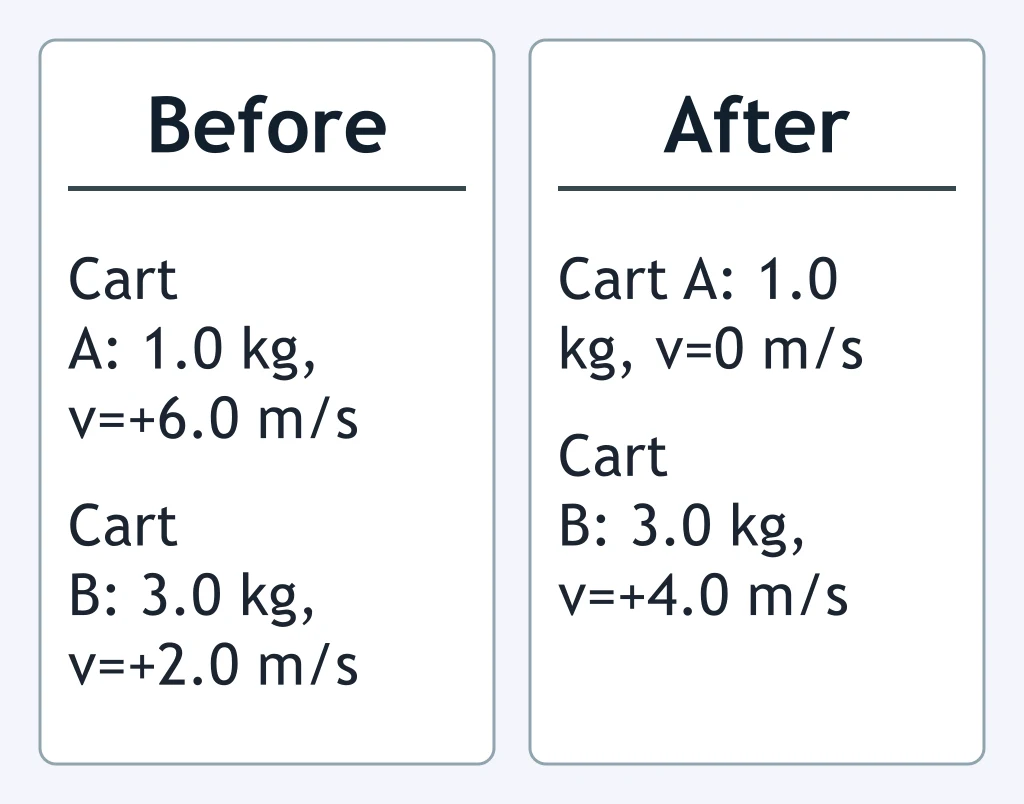
The two panels show a collision on a nearly frictionless track. Take right as positive. Which label best fits the collision?
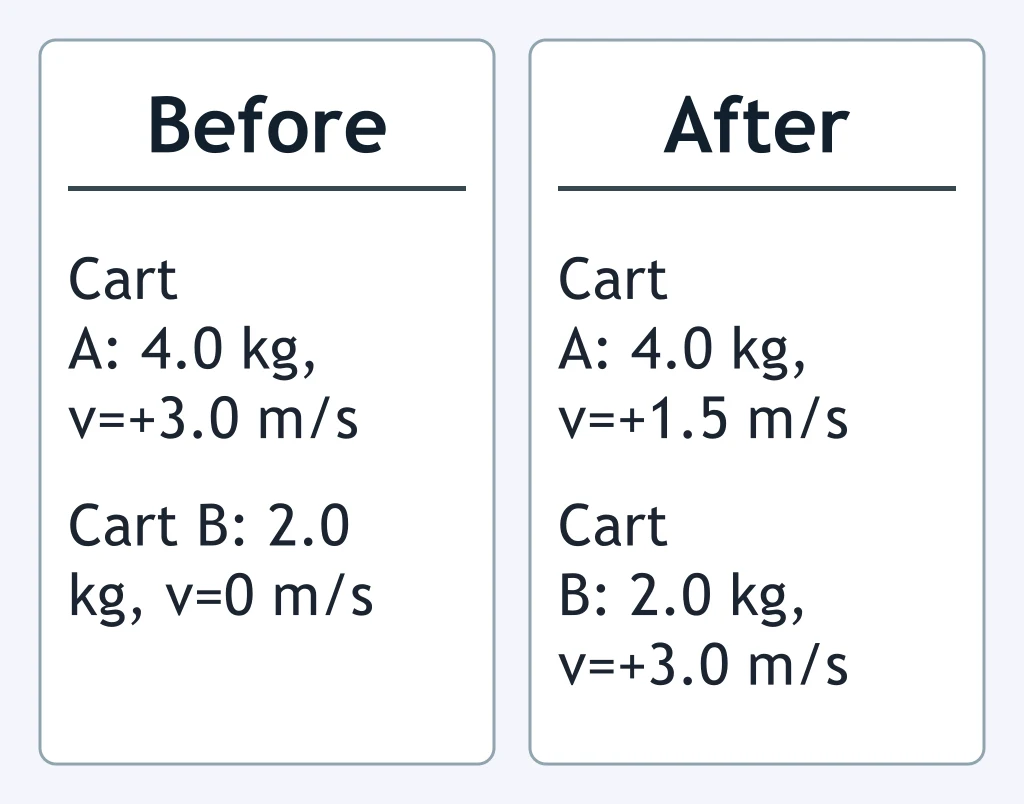
Use the figure to decide the collision type. Take motion right as positive.
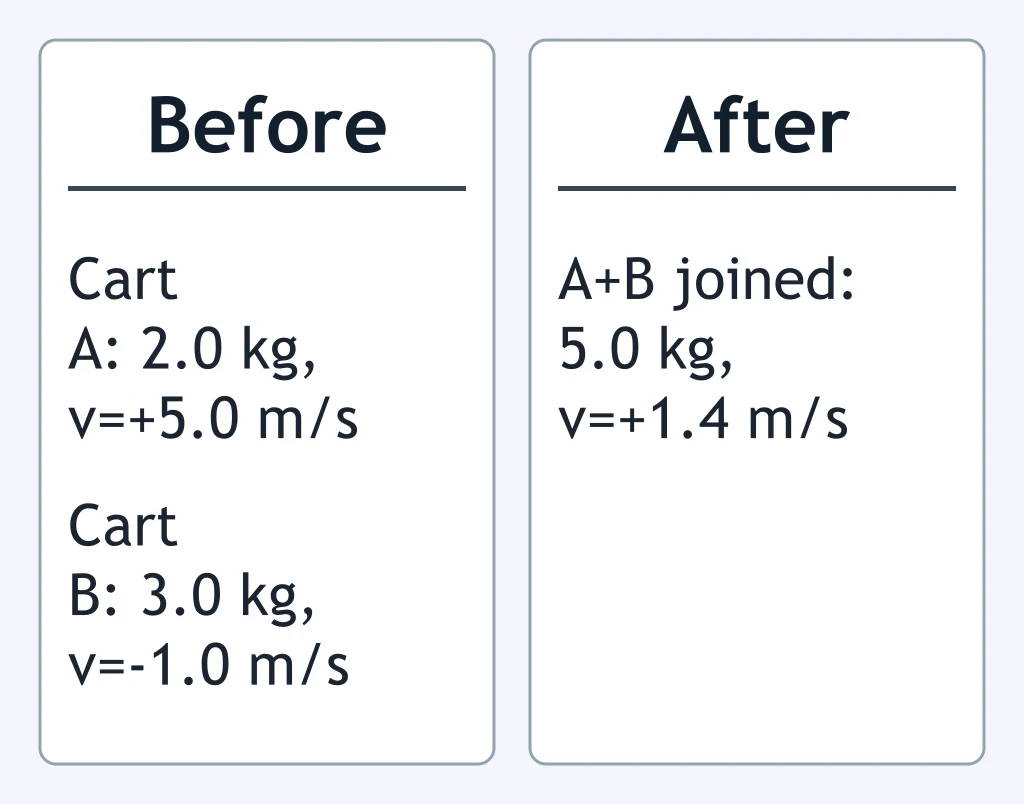
The figure shows a closed two-cart collision. Take right as positive. Which classification matches the data?
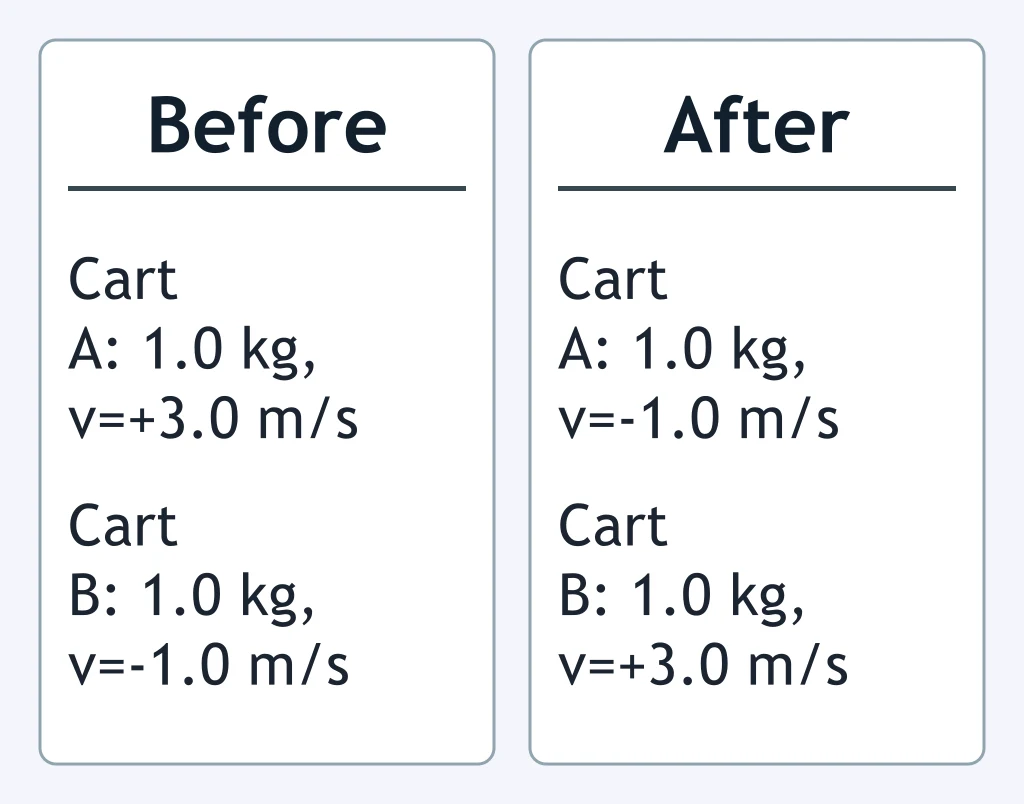
Read the values in both panels. Take right as positive. How should the collision be classified?
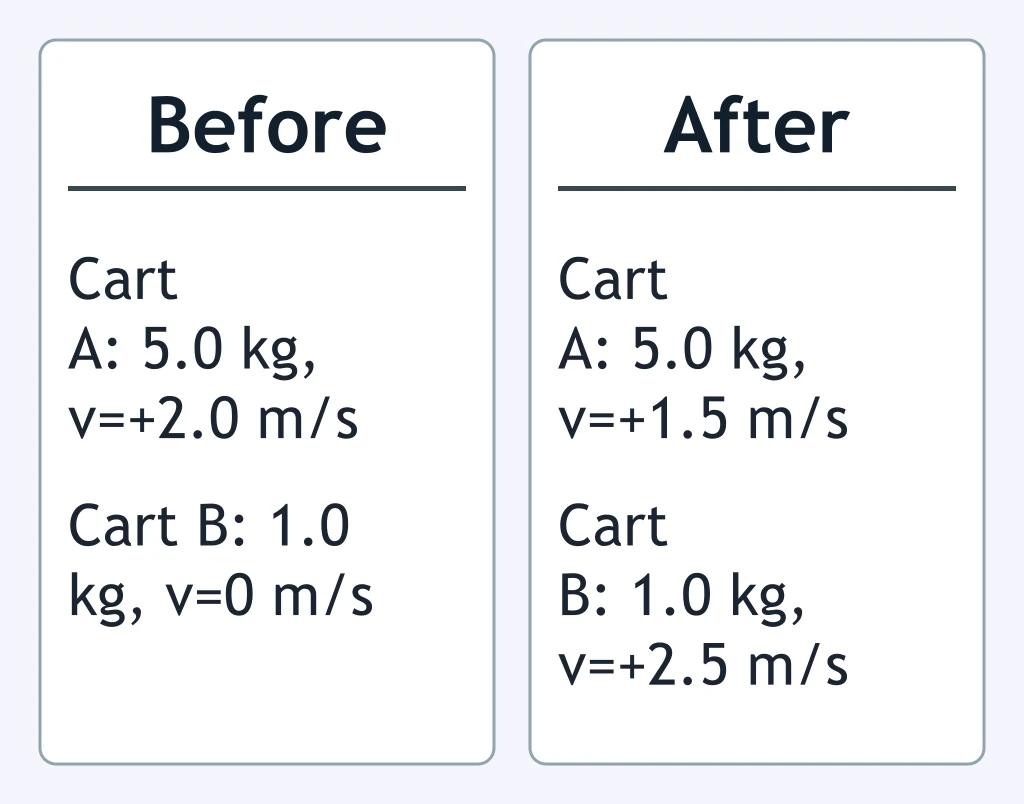
The figure gives mass and velocity before and after a collision. Take right as positive. What type of collision is shown?
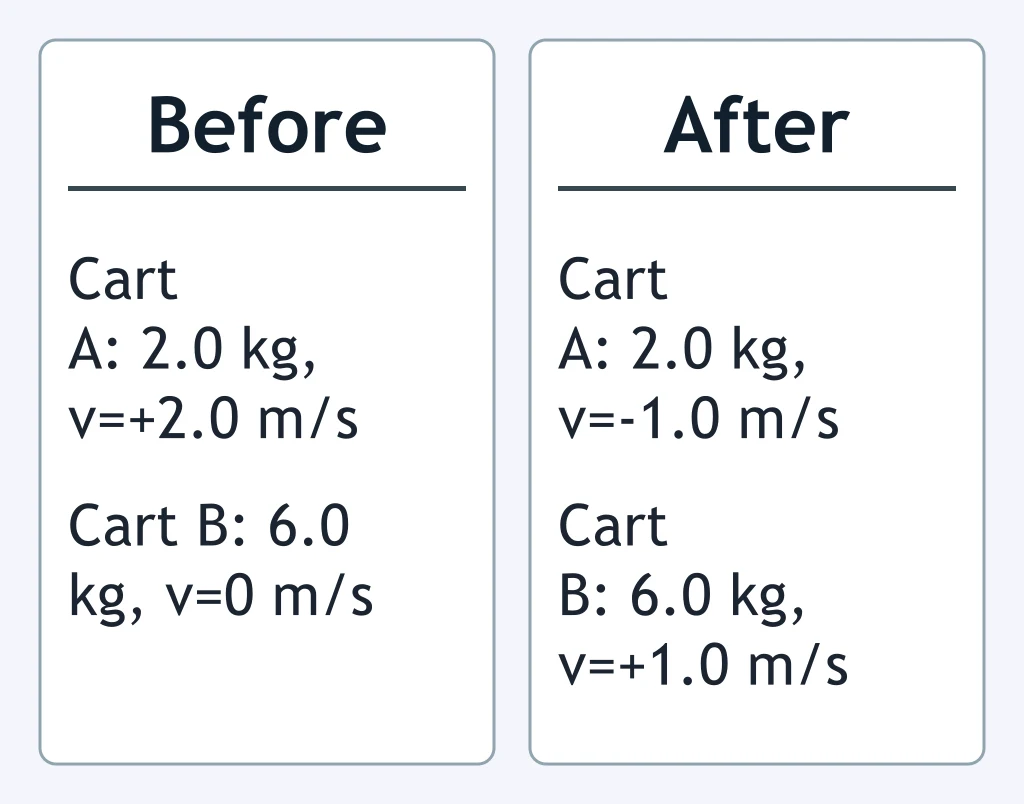
Use the two-panel data. Take right as positive. Which classification is best?
A 1.0 kg cart moving +4.0 m/s collides with a 3.0 kg cart at 0 m/s; after impact both carts have +1.0 m/s. Which classification fits?
In a closed collision, a 2.0 kg cart at +5.0 m/s and a 2.0 kg cart at -2.0 m/s collide; total kinetic energy changes from 29 J to 17 J. What is conserved?
A 2.0 kg glider at +3.0 m/s and a 2.0 kg glider at -3.0 m/s collide; measurements show total kinetic energy is 18 J before and 18 J after. What type is it?
A 1.0 kg puck at +6.0 m/s hits a 3.0 kg puck at 0 m/s; afterward the pucks move separately and total kinetic energy falls from 18 J to 12 J. Which type?
A 0.50 kg cart at +8.0 m/s collides with a 1.50 kg cart at 0 m/s in a closed system. Which quantity is guaranteed to have the same total before and after?
A 0.40 kg cart at +6.0 m/s hits a 0.60 kg cart at 0 m/s; after the collision both carts have +2.4 m/s. What makes this perfectly inelastic?
A 4.0 kg block moving 5.0 m/s east hits a stationary 6.0 kg block, and they move together. Take east as positive. How much kinetic energy is converted?
A 1.5 kg cart moving 8.0 m/s east collides with a 0.5 kg cart moving 4.0 m/s west, and they move together. Take east as positive. What is their final velocity?
A 3.0 kg cart at +2.0 m/s collides with a 1.0 kg cart at -6.0 m/s, and they move together. How much kinetic energy is converted to other forms?
A 2.0 kg cart moving 10.0 m/s east hits a stationary 3.0 kg cart, and the carts move together. Take east as positive. What is their common final velocity?
A 5.0 kg cart at +3.0 m/s collides with a 5.0 kg cart at -1.0 m/s, and they move together. How much kinetic energy is lost?
A 0.20 kg puck at 30 m/s east hits a 0.30 kg puck at 10 m/s west, and they move together. Take east as positive. What is the common final velocity?
A 0.20 kg puck at +5.0 m/s collides with a 0.20 kg puck at -5.0 m/s. If the collision is elastic, what does elastic mean here?
A 1.0 kg cart at +4.0 m/s hits a 1.0 kg cart at 0 m/s in a closed system, and total kinetic energy decreases. A student says momentum turned into heat. What is correct?
A 2.0 kg cart at +3.0 m/s and a 1.0 kg cart at -3.0 m/s have a perfectly inelastic collision. Which statement must be true right after?
Crack the passcode before the zombies get in.
Answer, then swat bugs for bonus points.
Race through questions at your own speed.
Same question on every screen. Fastest wins.

Pick a tile, answer, hit bonuses and steals.
Momentum: Mixed Practice
20 questions