Loading
by BlastRoom
Practice comparing and calculating rotational inertia from mass distribution and axis choice.
#physics
30 questions
One question set, multiple game modes. Tap any game to see it in action. Not sure which to pick?
Answer to place stones and capture territory.
Outrun the snow together.
Earn blasts, then hunt the other team.
Answer to earn energy, then climb.

The class blasts through walls together.
Bid on mystery lots. Most money wins.
Sell tours. Nice, standard, or a total scam.

Answer, restock, and serve the rush.
More correct answers pulls the rope your way.
Answer, then shoot down the alien wave.
Answer, then tap to leap the frozen ridge.
Use the figure comparing two light-rod arrangements, each spun about an axis through its center. How do their rotational inertias compare?
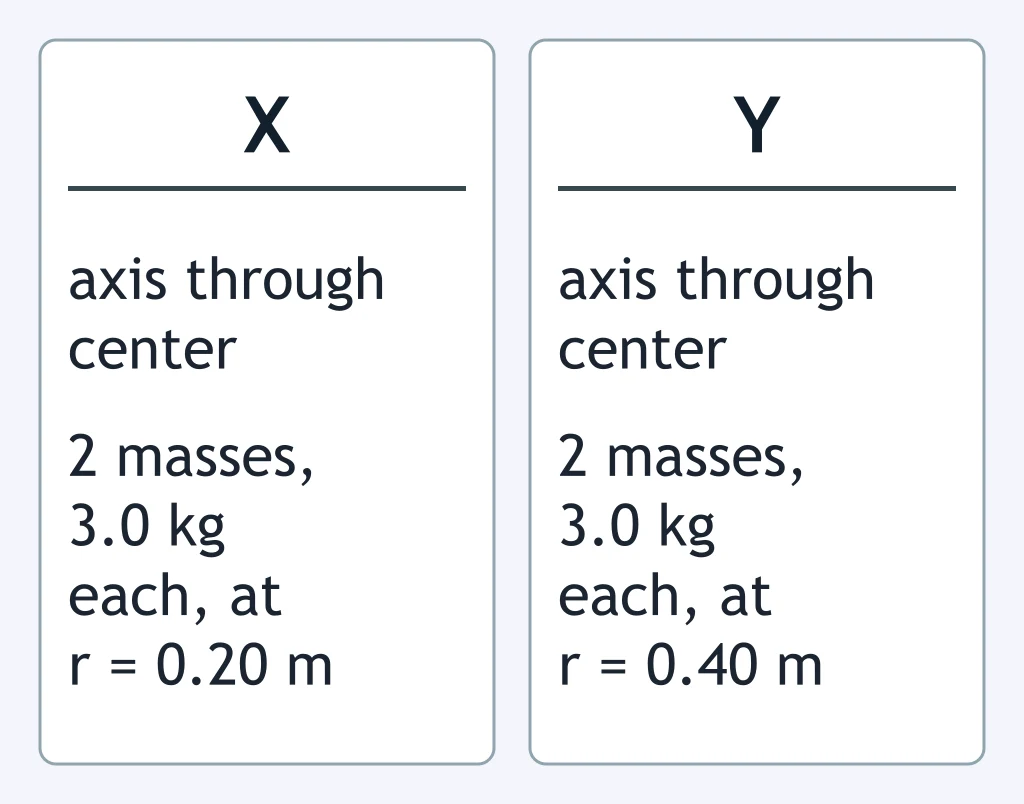
Use the figure. Which arrangement has the greater rotational inertia about the marked axis?
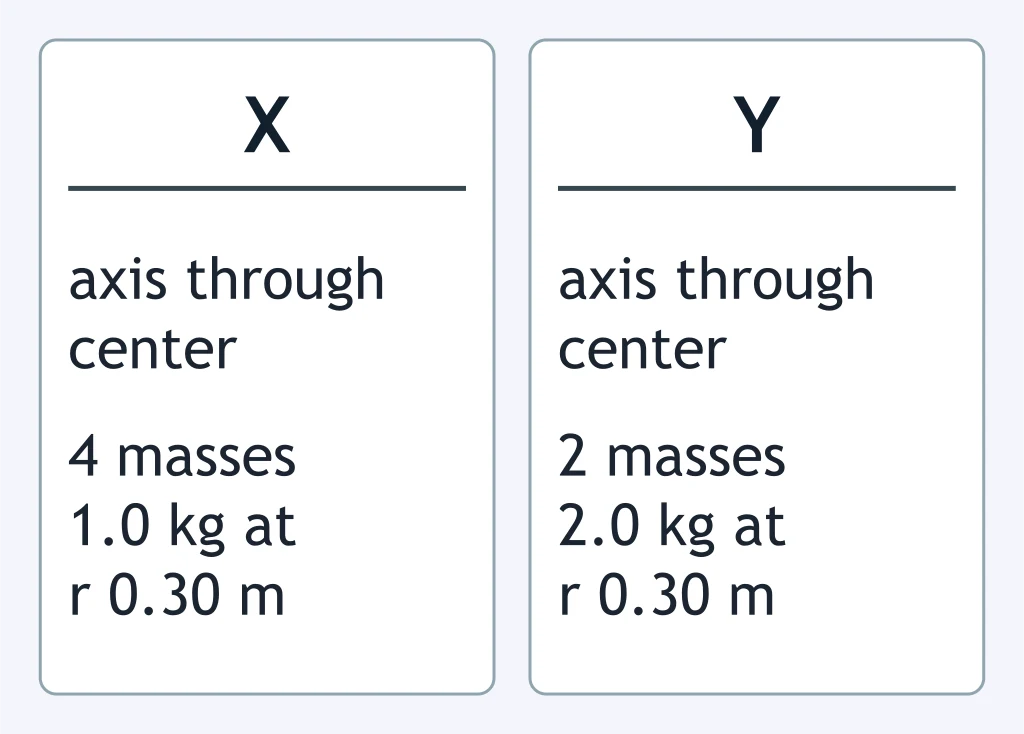
The two arrangements in the figure have masses at different distances from the axis. Which comparison is correct?
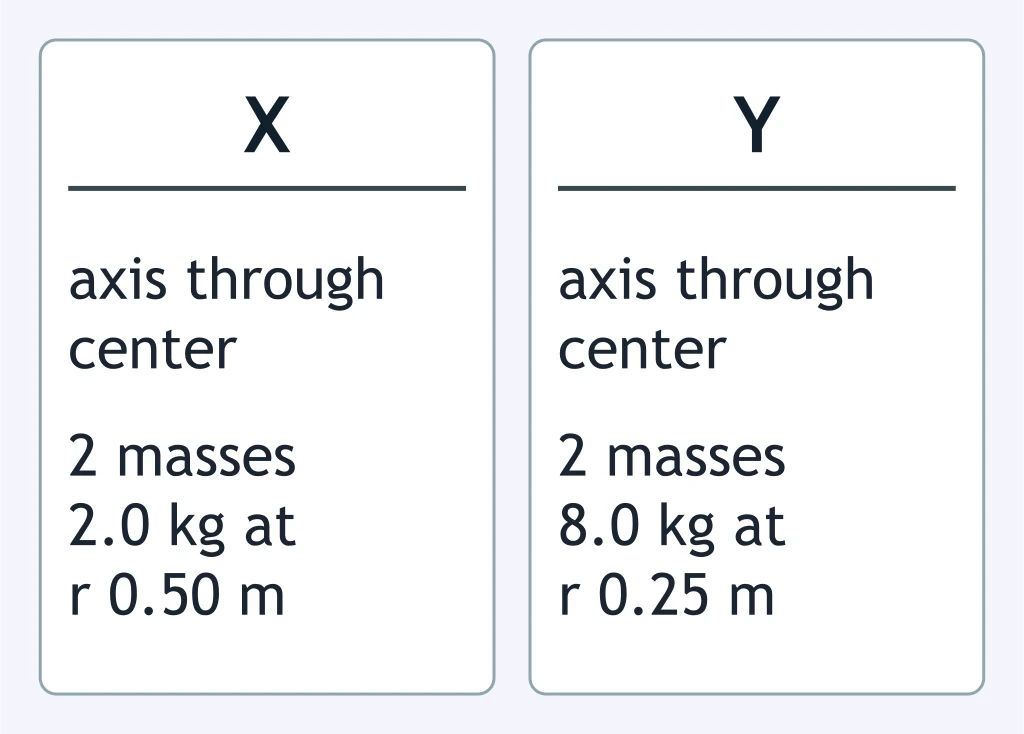
Use the figure comparing arrangements X and Y about the same marked axis. Which statement is true?
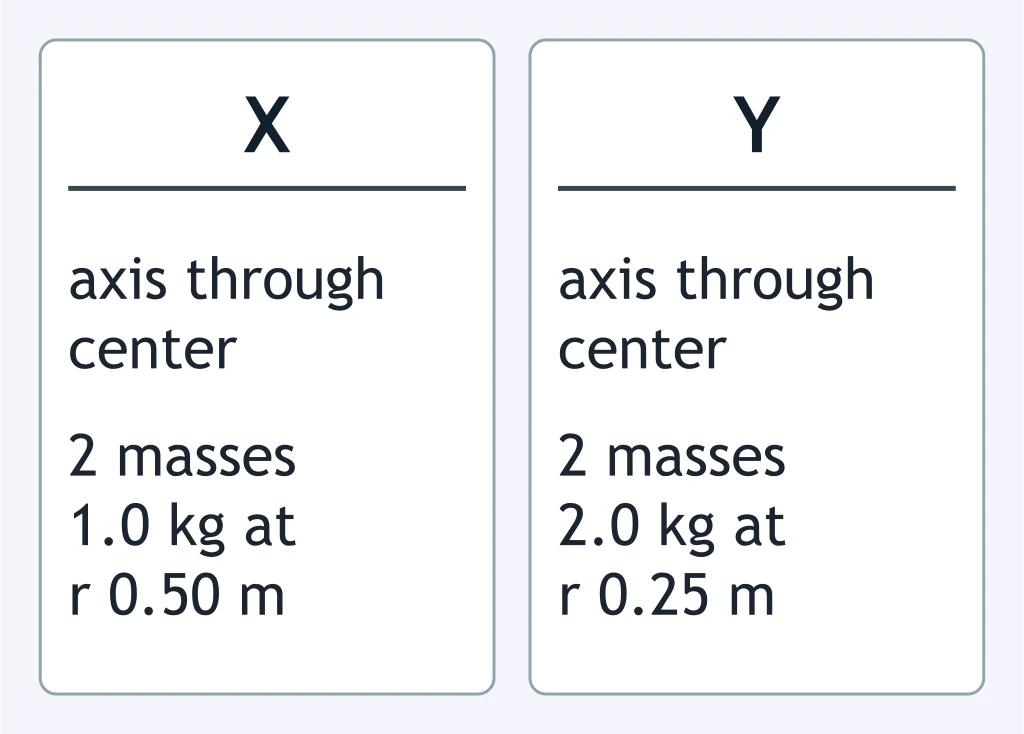
In the figure, both arrangements have two identical 3.0 kg masses but different positions relative to the axis. How do their rotational inertias compare?
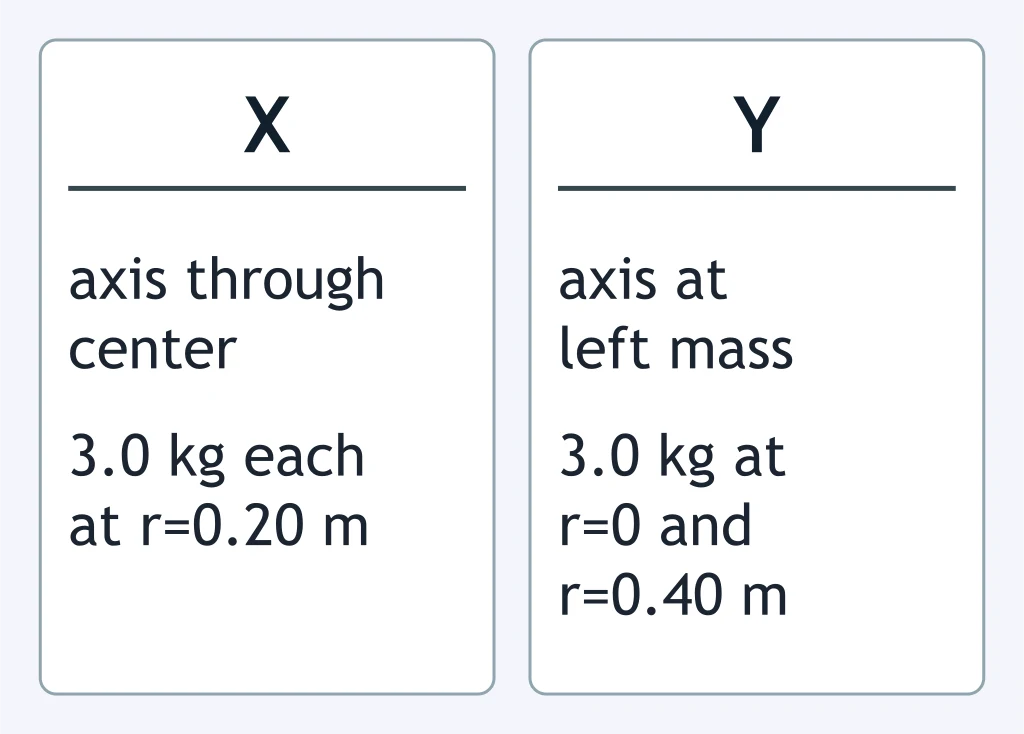
Use the figure. Which arrangement is harder to angularly accelerate about the marked axis?
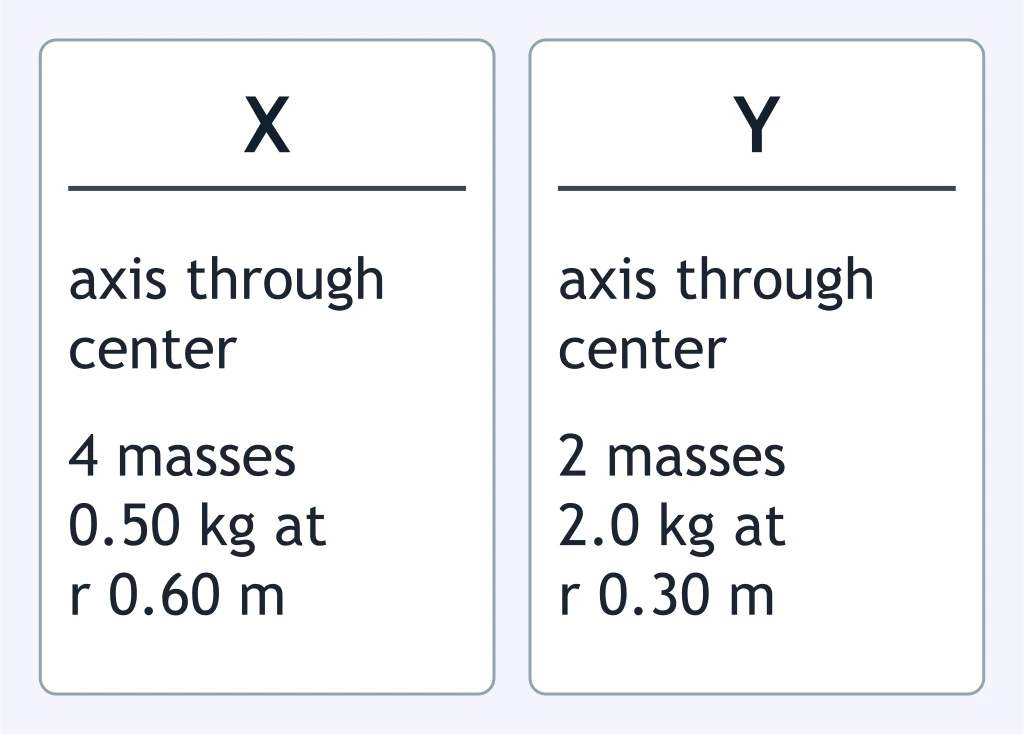
The figure shows two dumbbells about the same type of central axis. Which comparison of rotational inertia is correct?
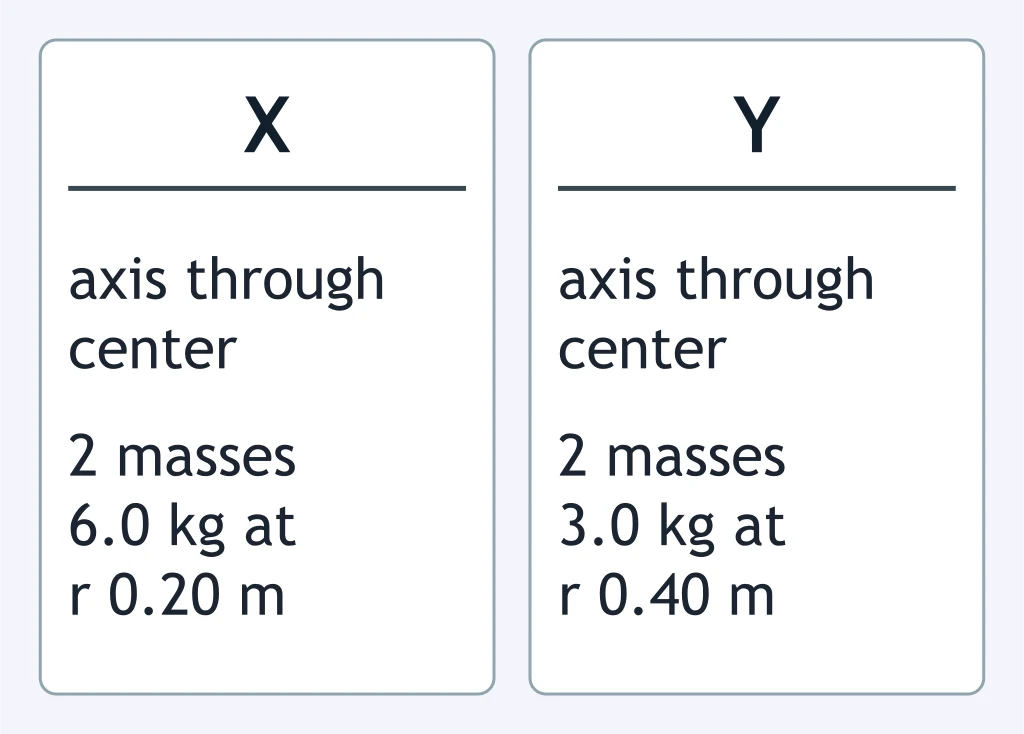
Use the figure comparing X and Y, each spun about an axis through its center. Which statement best ranks their rotational inertias?
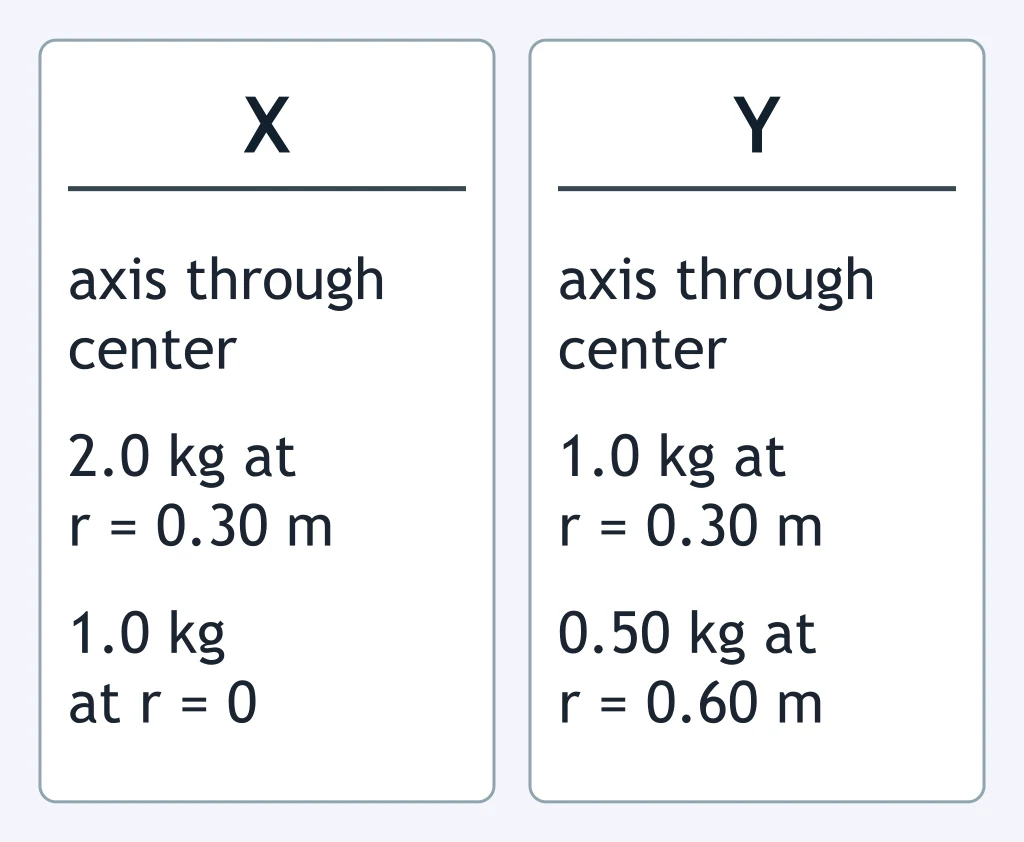
Use the table of expressions. For the same M and R, which body has the largest rotational inertia about the axis shown?
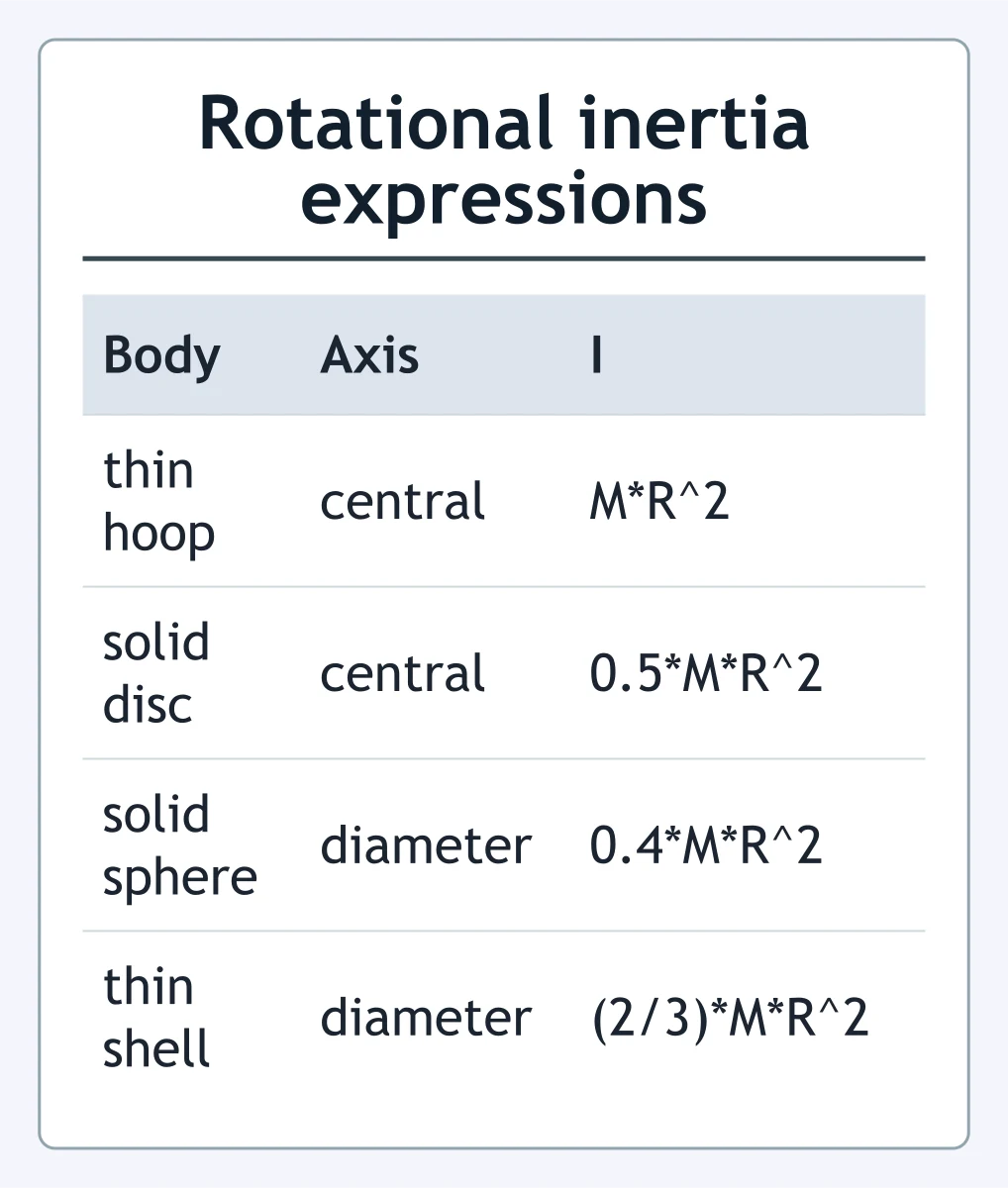
Use the table. Which body has exactly half the rotational inertia of the thin hoop when M and R are the same?
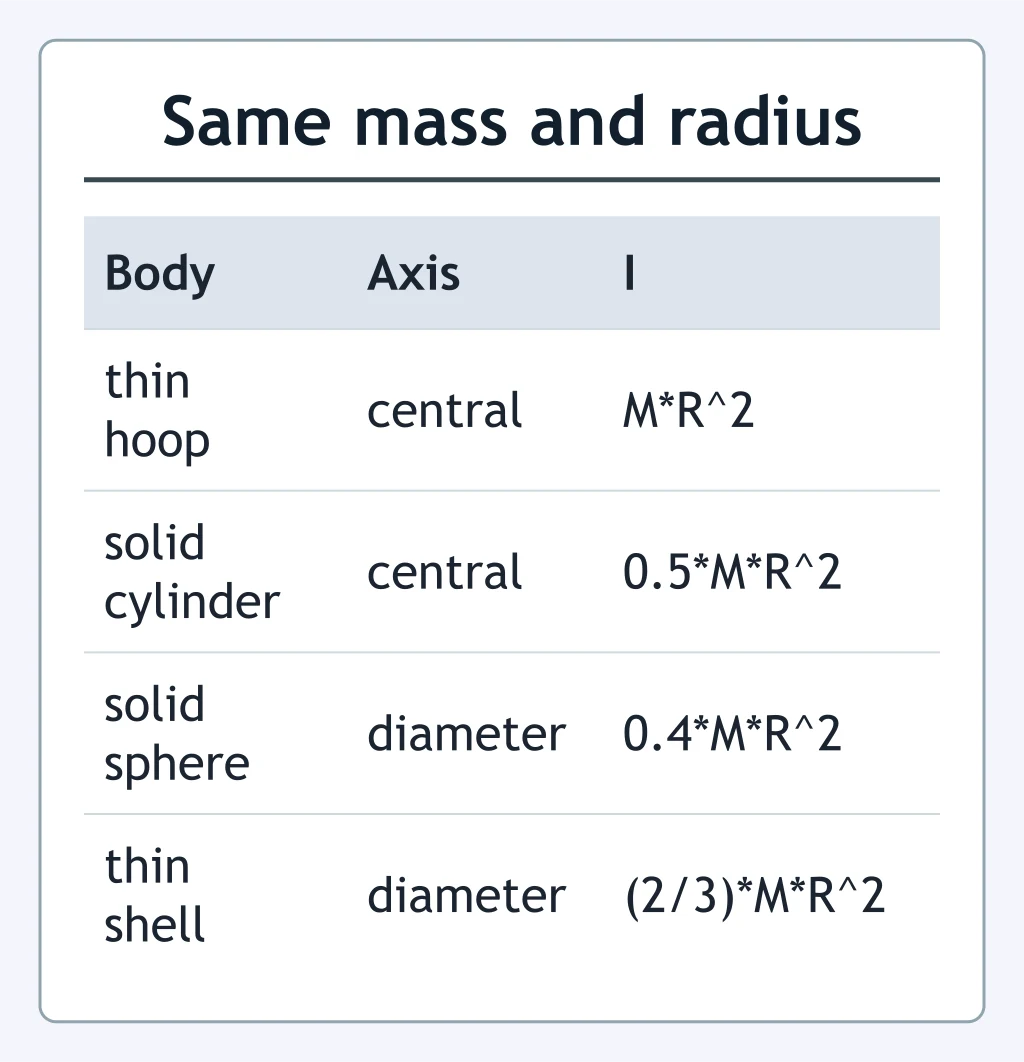
Use the table. Which two entries have equal rotational inertia for the same M and R?
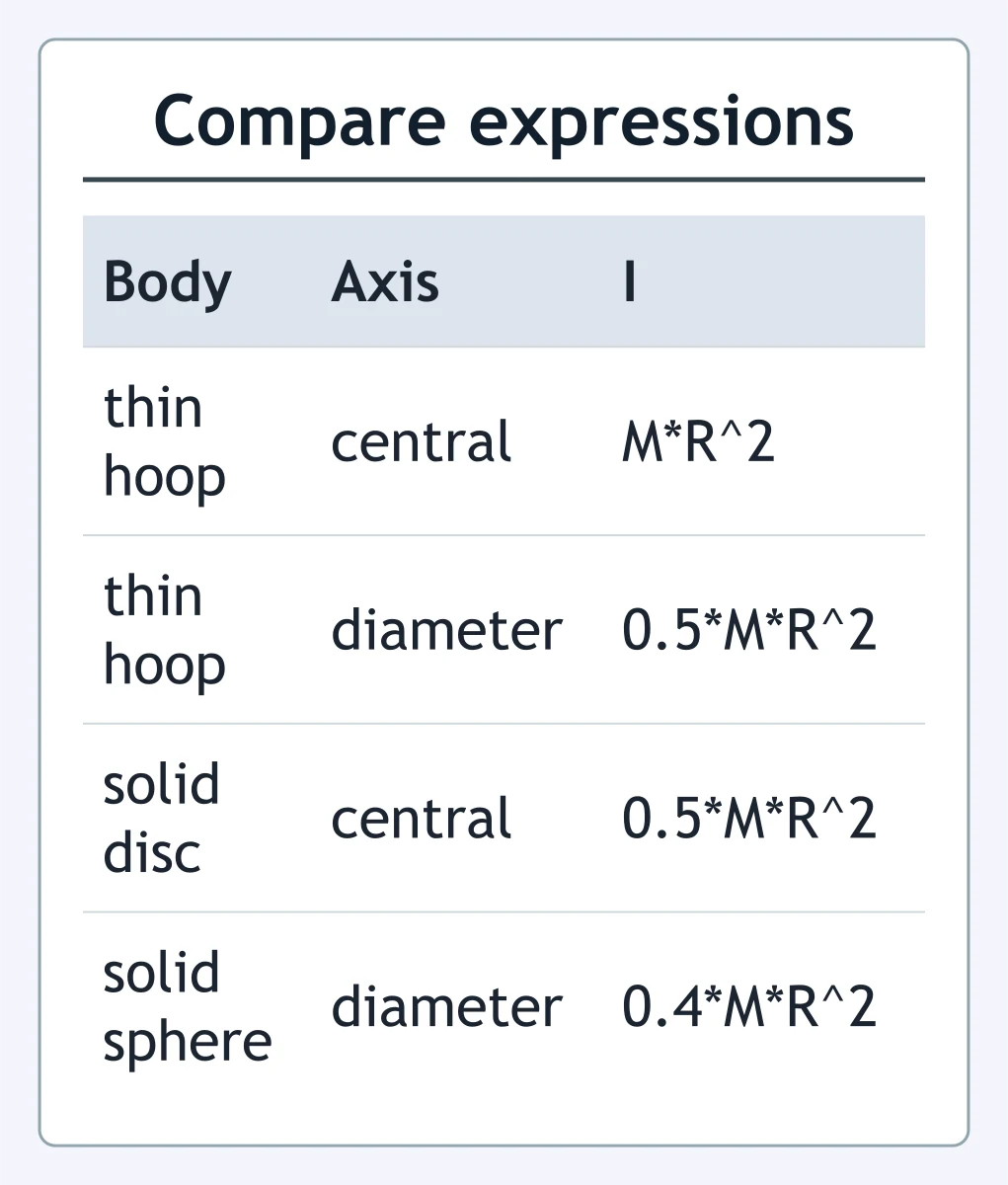
Use the table. For the same M and R, which object-axis pair has the second-largest rotational inertia?
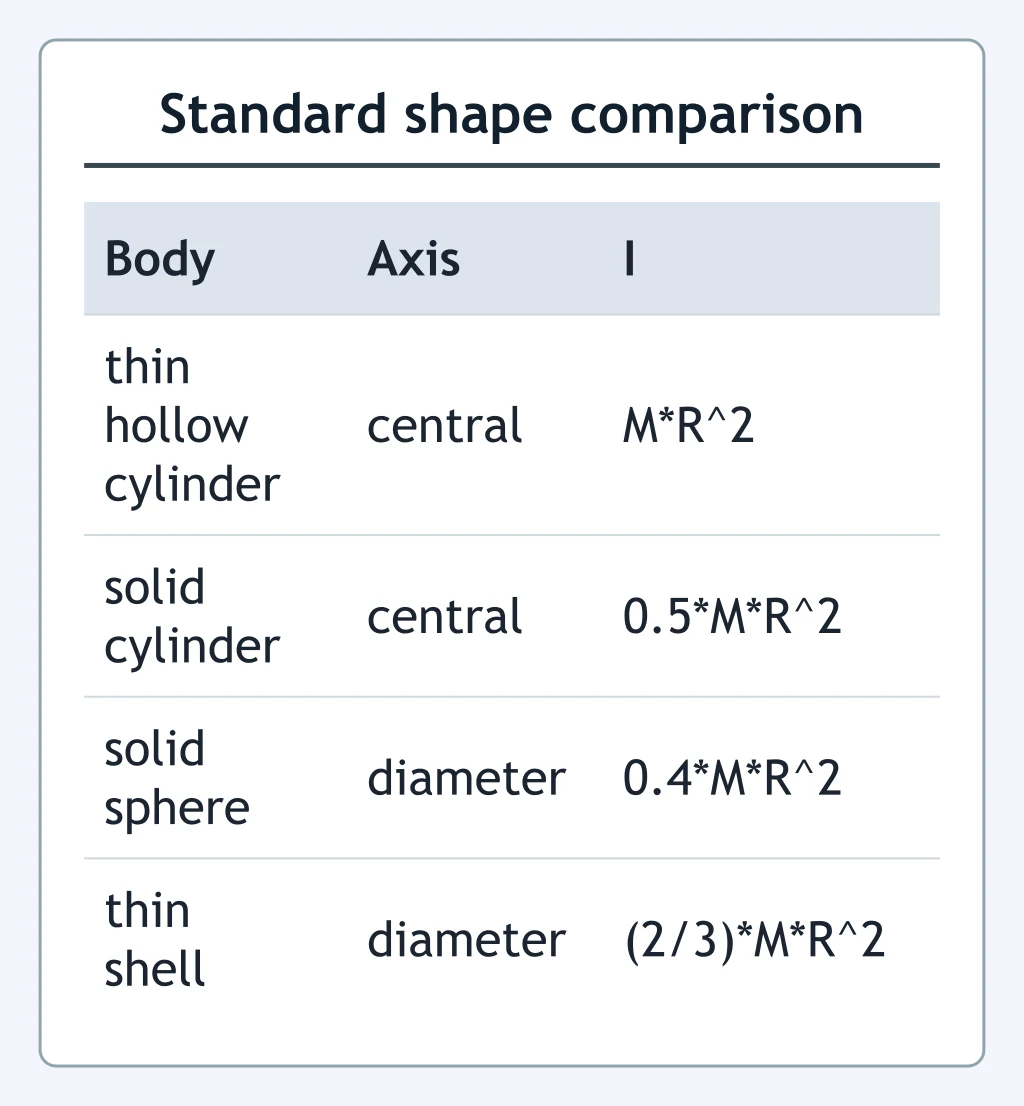
Two 2.0 kg balls are fixed to a rod of negligible mass, each 0.30 m from an axis through the rod's center. What is the rotational inertia about that axis?
A light frame holds 1.5 kg at 0.20 m, 2.0 kg at 0.30 m, and 0.50 kg at 0.40 m from the axis. What is the total rotational inertia?
A light rod has a 0.80 kg mass 0.10 m from the axis and a 1.20 kg mass 0.50 m from the axis. What is the rod-and-mass system's rotational inertia?
Four 0.50 kg masses are fixed on a light frame, each 0.25 m from the rotation axis. What is the rotational inertia of the frame?
A light rod has a 3.0 kg mass 0.10 m from the axis, a 1.0 kg mass 0.40 m from the axis, and a 2.0 kg mass on the axis. What is I?
Two 4.0 kg masses sit at the ends of a 1.00 m light rod. The axis passes through one end, so one mass is on the axis. What is the rotational inertia?
Three beads on a light rod are 0.20 kg at 0.50 m, 0.40 kg at 0.25 m, and 0.20 kg at 0.50 m from the axis. What is I?
Four 0.75 kg point masses sit at the corners of a light square frame, and each corner is 0.50 m from the central axis. What is the frame's rotational inertia?
A solid disc of mass 4.0 kg and radius 0.25 m turns about its central axis. For this shape, . What is I?
A thin hoop has mass 2.5 kg and radius 0.40 m. About its central axis, . What is the hoop's rotational inertia?
A solid sphere has mass 6.0 kg and radius 0.20 m. About a diameter, . What is its rotational inertia?
A thin spherical shell has mass 3.0 kg and radius 0.30 m. About a diameter, . What is its rotational inertia?
A thin rod of mass 1.2 kg and length 0.90 m rotates about an axis through its center, perpendicular to the rod. If , what is I?
A thin rod of mass 2.4 kg and length 0.75 m rotates about an axis through one end, perpendicular to the rod. If , what is I?
To calculate the rotational inertia of point masses about a fixed axis, which information is needed for each mass?
The same rigid object is rotated about two different parallel axes. Why can its rotational inertia be different?
Two wheels experience the same net torque. Wheel A has a larger rotational inertia than wheel B. How does A's angular acceleration compare with B's?
A spinning student pulls their arms closer to the rotation axis. What happens to the student's rotational inertia about that axis?
Crack the passcode before the zombies get in.
Answer, then swat bugs for bonus points.
Race through questions at your own speed.
Same question on every screen. Fastest wins.

Pick a tile, answer, hit bonuses and steals.
Newton's Second Law in Rotational Form (AP Physics 1)
25 questions