Loading
by BlastRoom
Mixed review of thermal physics, quantum ideas, nuclear decay, and special relativity.
#physics
50 questions
One question set, multiple game modes. Tap any game to see it in action. Not sure which to pick?
Answer to place stones and capture territory.
Outrun the snow together.
Earn blasts, then hunt the other team.
Answer to earn energy, then climb.

The class blasts through walls together.
Bid on mystery lots. Most money wins.
Sell tours. Nice, standard, or a total scam.

Answer, restock, and serve the rush.
More correct answers pulls the rope your way.
Answer, then shoot down the alien wave.
Answer, then tap to leap the frozen ridge.
A sealed rigid gas cylinder warms from 290 K to 348 K while the amount of gas stays fixed. Which relationship connects the pressure readings?
A slow-moving piston compresses a gas while its temperature is held constant at 300 K. Which relationship should be used for the before-and-after gas readings?
A flexible balloon is heated while outside pressure stays constant and no gas escapes. Which relationship connects its volume and temperature?
A metal block is warmed by a hot plate, and the problem gives its mass, specific heat capacity, and temperature change. Which relationship connects those values?
A gas absorbs energy by heating while pushing a piston outward. Which equation tracks the change in the gas’s internal energy?
Two lamps emit red and violet light. Which relationship decides which individual photon has the greater energy?
An electron in an atom drops from a higher energy level to a lower one and emits one photon. Which relationship gives the photon energy?
A radioactive sample is measured after a whole number n of half-lives. Which relationship gives the remaining number of undecayed nuclei?
A spaceship turns on a lamp while passing Earth at constant velocity. Which principle connects the light-speed readings in the ship and Earth frames?
A student writes, 'Heat and temperature are the same thing because both increase when water is warmed.' Which correction is right?
A student says, 'A brighter green laser has photons with more energy than a dim green laser.' Which correction is right?
A student writes, 'At absolute zero, an object has negative thermal energy because 0 K is below 0 °C.' Which correction is best?
A student says, 'Time dilation is only a clock error seen by a slow observer.' Which correction matches special relativity?
A student solves a gas-law ratio using 20 °C and 40 °C directly. Which correction should replace that step?
A student writes, 'After two half-lives, all radioactive nuclei are gone.' Which correction is right?
A student says, 'A hot block contains heat.' Which correction uses physics terms correctly?
A student writes, 'A glowing gas makes a continuous rainbow because its atoms can have any energy.' Which correction is right?
A student says, 'In E = mc², mass is destroyed and energy is created from nothing.' Which correction is right?
A student writes, 'If a gas expands and does 80 J of work, that work increases its internal energy.' Which correction fits ΔU = Q − W?
Use the activity graph; time labels are in hours. What is the half-life of the sample?
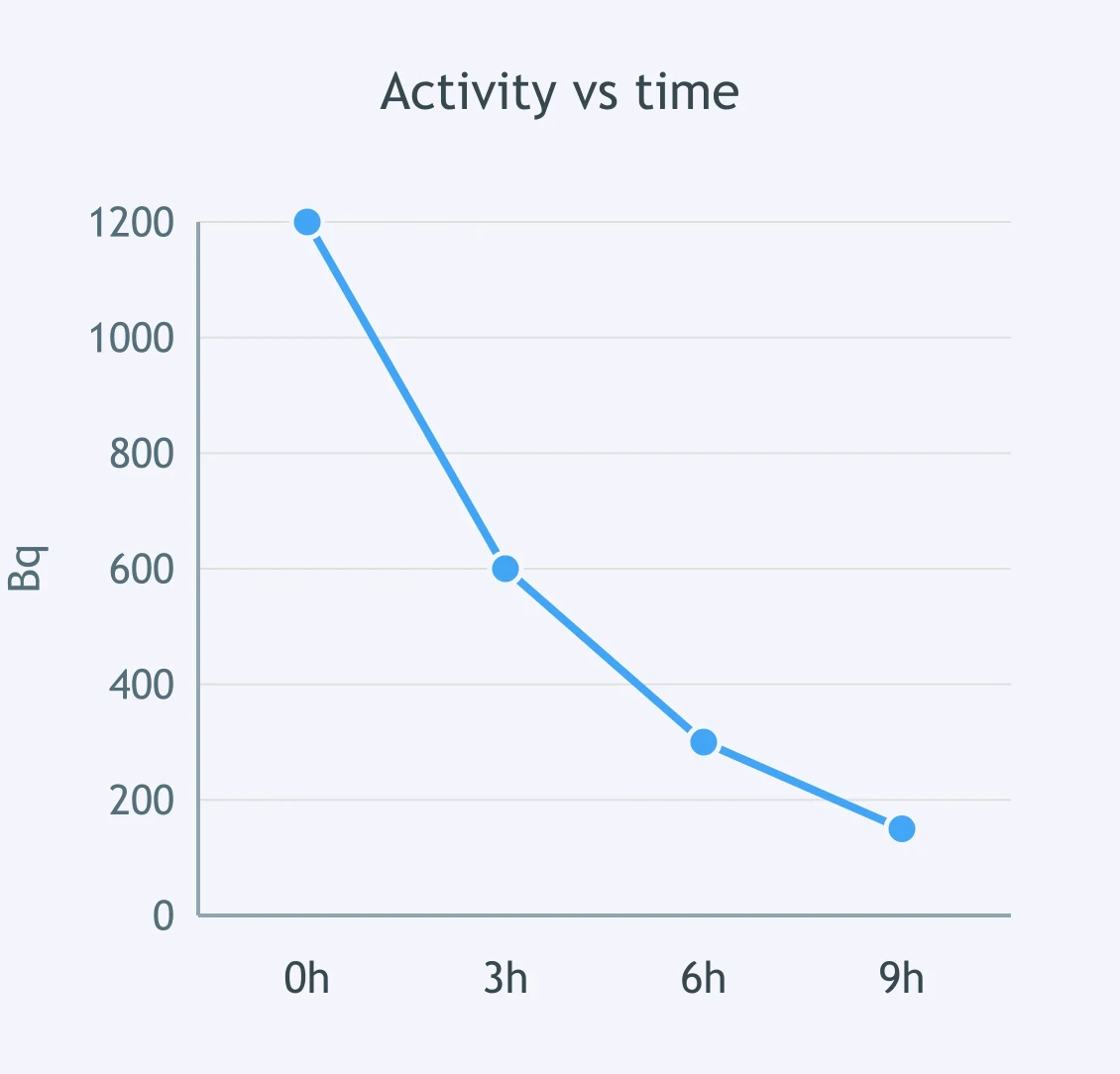
Use the activity graph; time labels are in days. What activity is shown at 8 days?
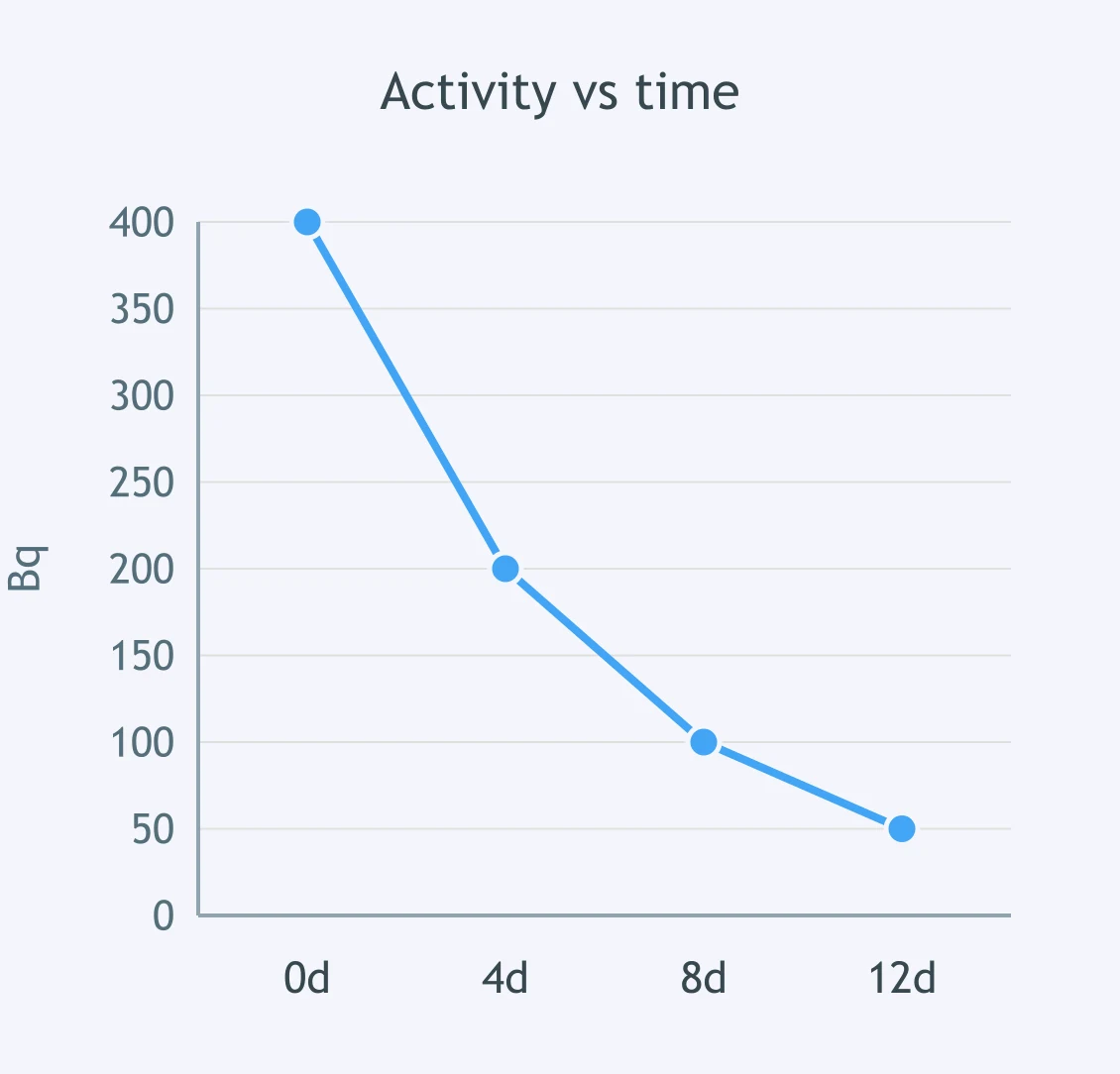
Use the decay graph. How many half-lives have passed by the last plotted point?
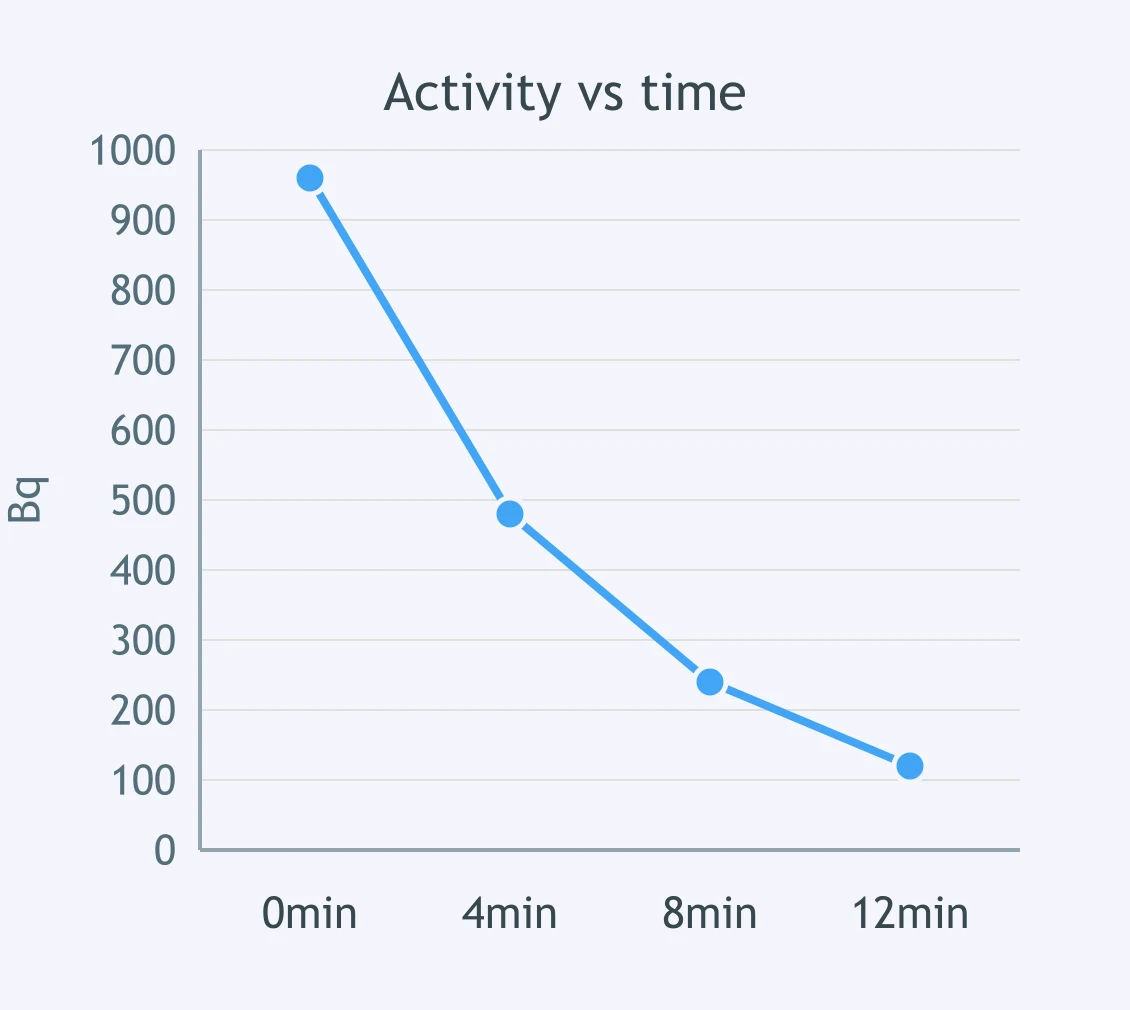
Use the activity graph; time labels are in days. What half-life does the graph show?
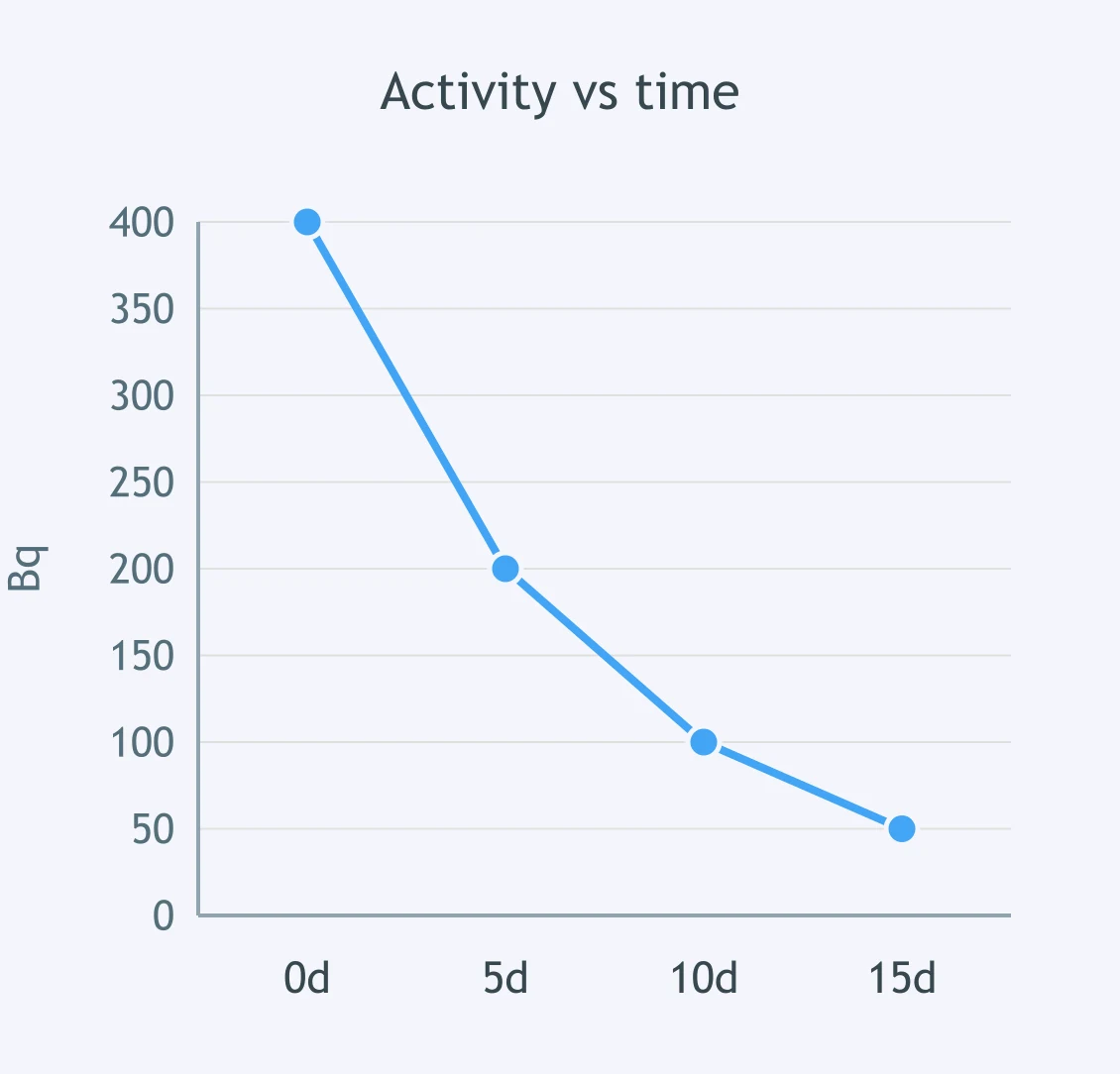
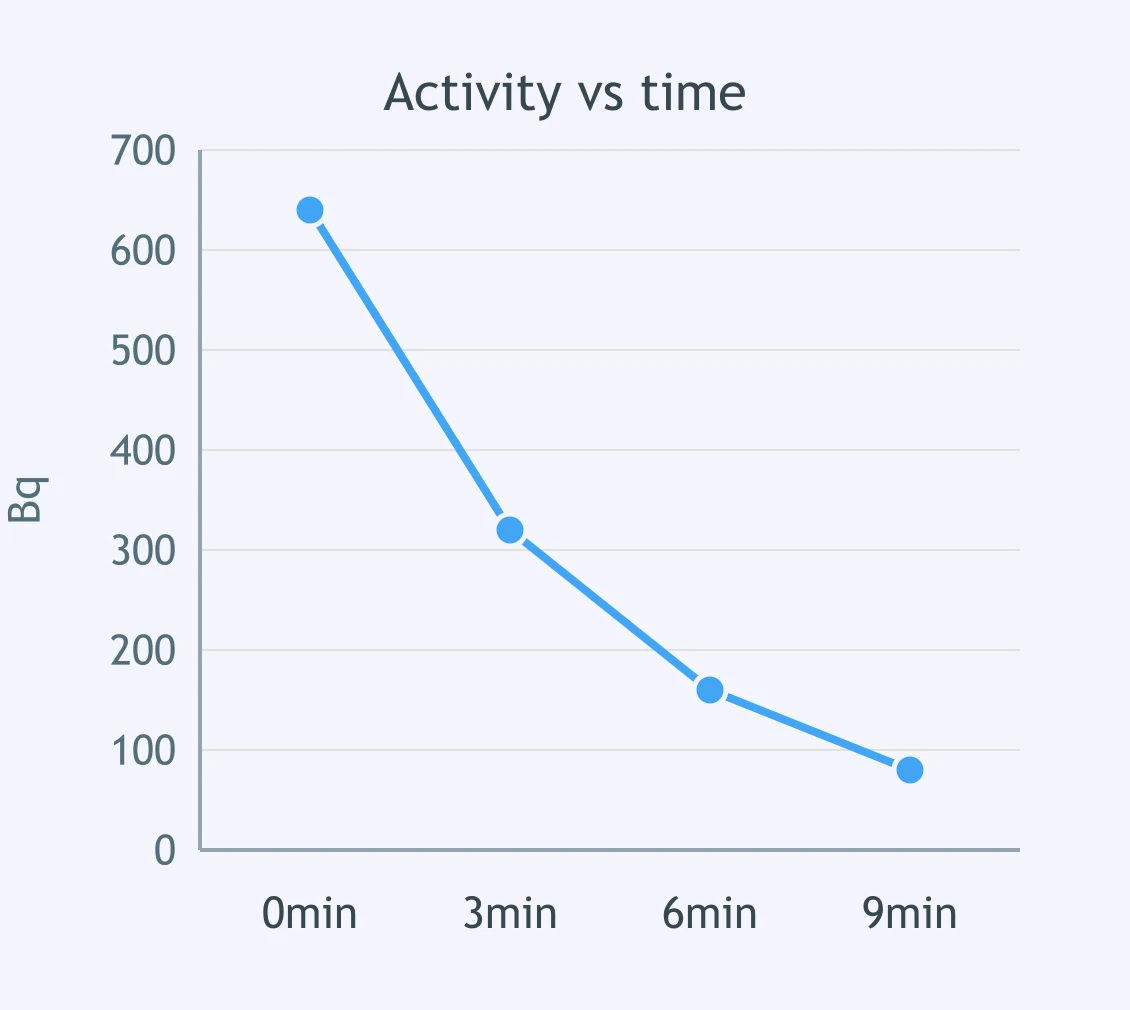
Use the graph; time labels are in minutes. What activity is shown after 9 minutes?
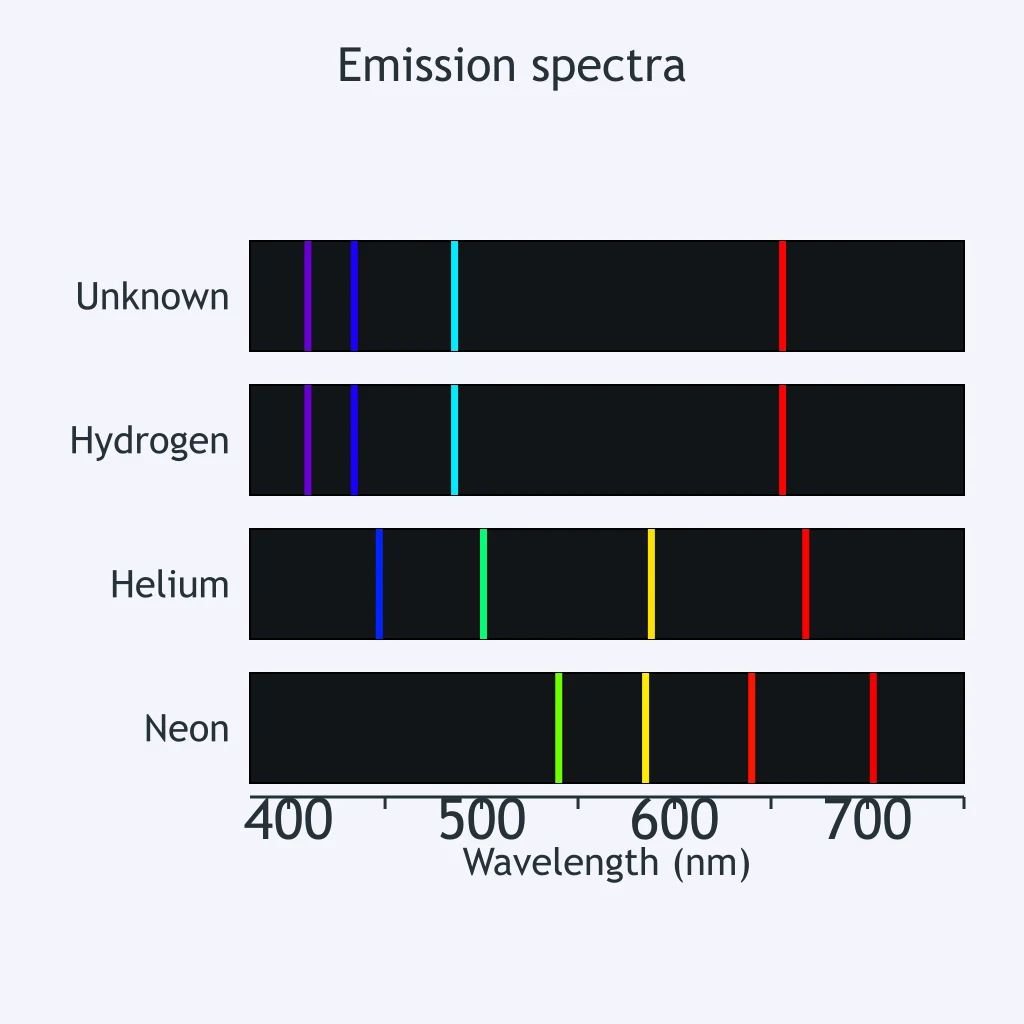
Use the emission spectra. Which reference gas exactly matches the unknown spectrum?
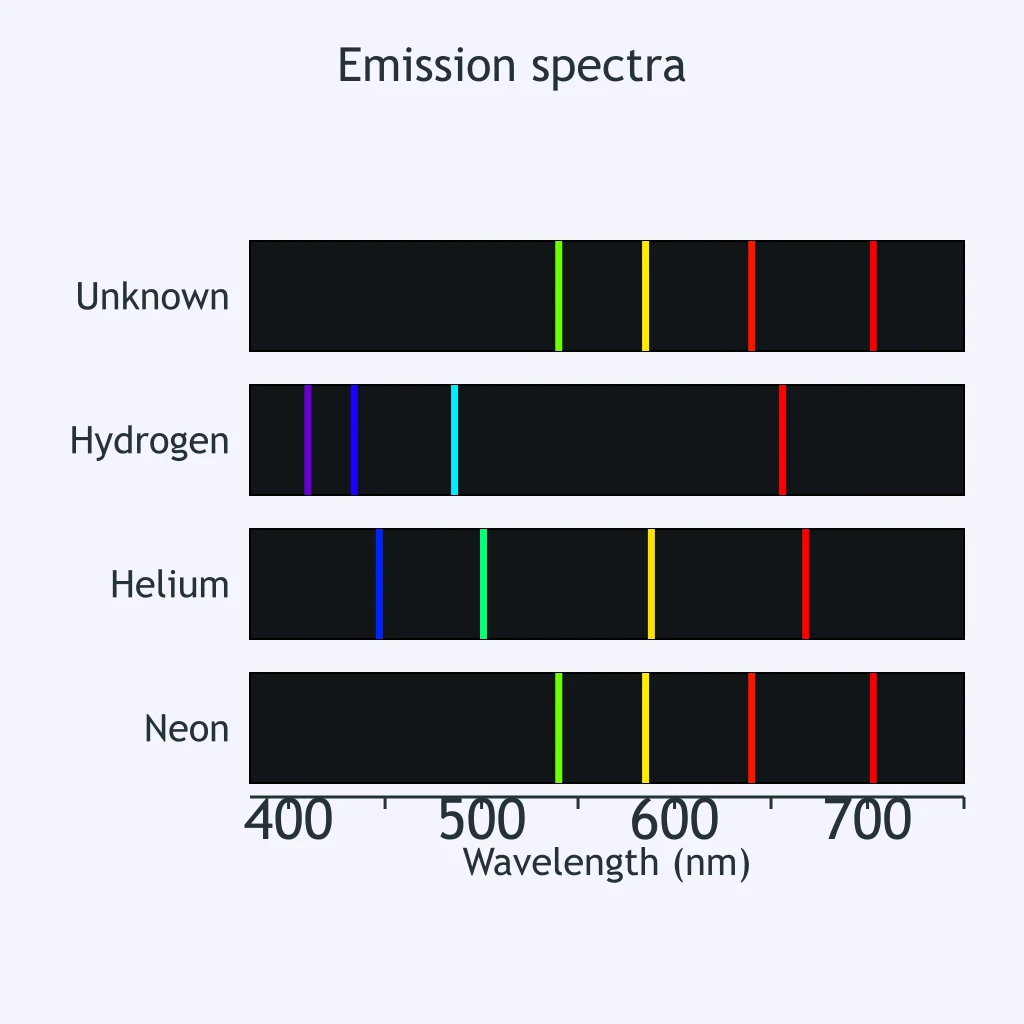
Use the emission spectra. Which reference gas exactly matches the unknown spectrum?
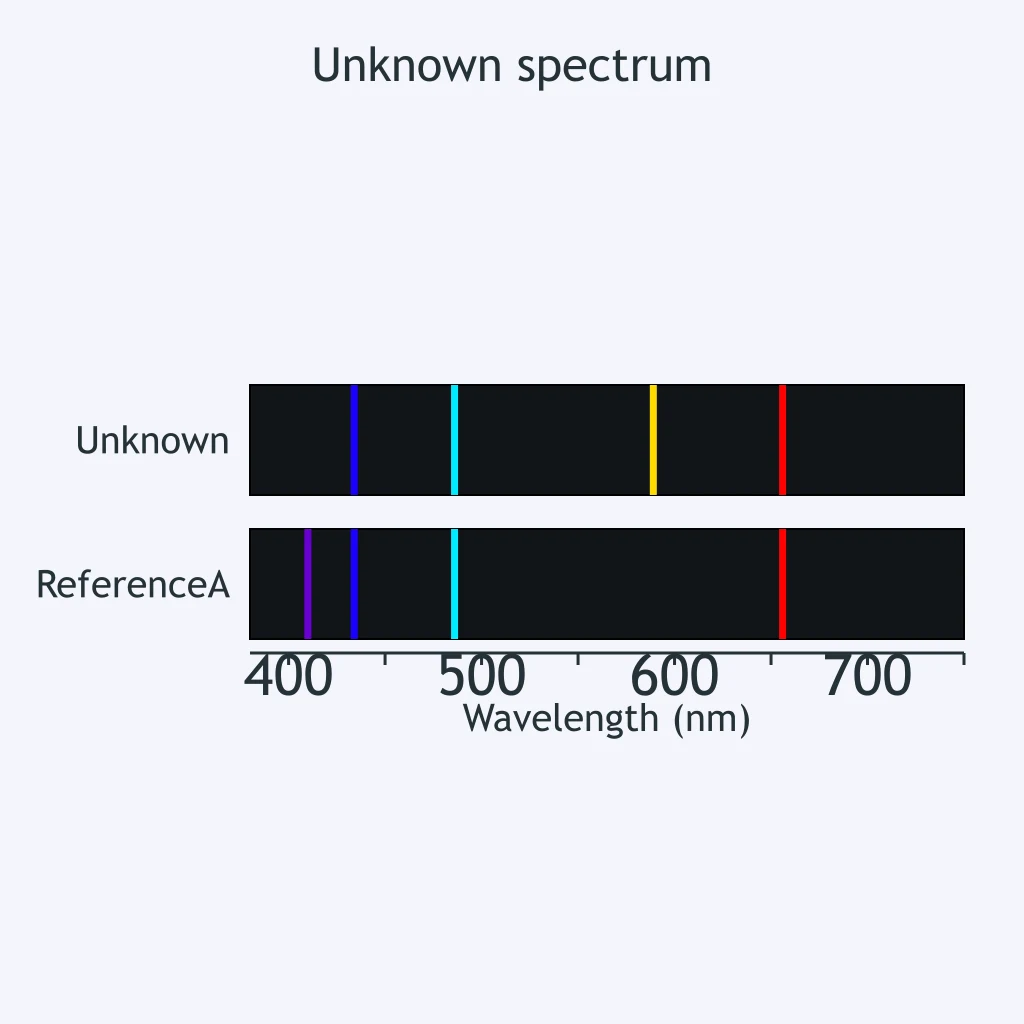
Use the emission spectrum and scale. Which wavelength is closest to the bright yellow line in the unknown band?
Use the emission spectra. Which gas has the same pattern as the unknown?
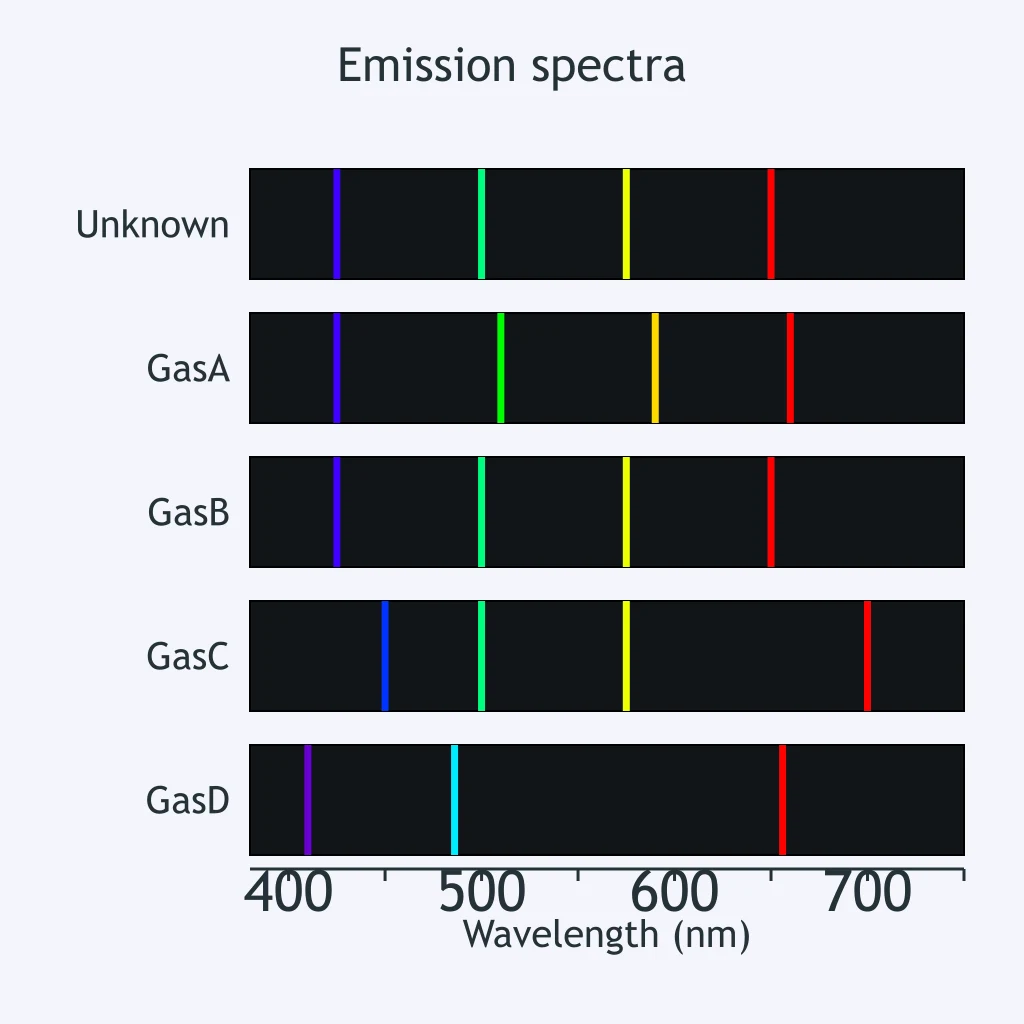
Use the activity graph; time labels are in seconds. What activity is shown at 10 seconds?
How much heat is needed to raise 0.25 kg of aluminum from 20 °C to 70 °C? Take c = 900 J/(kg·°C).
How much heat raises 0.20 kg of water from 293 K to 313 K? Take c = 4186 J/(kg·K).
A rigid tank holds gas at 100 kPa and 300 K. If it warms to 450 K with volume and amount fixed, what is the final pressure?
A gas at constant pressure has volume 2.0 L at 300 K. What is its volume at 240 K if the amount of gas stays fixed?
A system receives 500 J by heating and does 120 J of work on its surroundings. Using ΔU = Q − W, what is ΔU?
A system loses 200 J by heat transfer while 50 J of work is done on it. Using W as work done by the system, what is ΔU?
What is the energy of a photon with frequency 5.0 × 10¹⁴ Hz? Use h = 6.63 × 10⁻³⁴ J·s.
What is the energy of a 500 nm photon? Use h = 6.63 × 10⁻³⁴ J·s and c = 3.00 × 10⁸ m/s.
A sample starts with 800 undecayed nuclei. How many remain after 3 half-lives?
A source has activity 640 Bq and a half-life of 5 days. What is its activity after 15 days?
A moving particle has γ = 1.25. If 8.0 μs pass on the particle’s own clock, what time interval does a lab observer measure?
A spacecraft has proper length 10 m and moves past an observer with γ = 2.0. What length does that observer measure along the motion?
If 2.0 × 10⁻⁶ kg of mass is converted to energy, how much energy is released? Use c = 3.00 × 10⁸ m/s.
A beaker and a large tank of water both read 30 °C, but the tank has much more water. Which description is correct?
A hot mug cools on a table. Which pair of terms correctly describes what the mug has and what leaves it?
A red lamp and a blue lamp each give off the same light power. Which statement correctly compares their photons?
A dim violet lamp and a bright red lamp shine on a detector. Which statement separates photon energy from brightness?
Two samples contain the same isotope, but one sample has twice as many radioactive nuclei. Which pair of quantities is compared correctly?
Two radioactive samples contain the same number of undecayed nuclei, but isotope A has a shorter half-life than isotope B. Which statement is correct?
An astronaut’s clock measures 4.0 s between two flashes at the same place in the spacecraft; Earth observers measure a longer interval. Which terms fit?
A 12 m rod is at rest beside one observer and passes another observer at relativistic speed. Which length comparison is correct?
Crack the passcode before the zombies get in.
Answer, then swat bugs for bonus points.
Race through questions at your own speed.
Same question on every screen. Fastest wins.

Pick a tile, answer, hit bonuses and steals.
The Rotational Kinematic Equations (AP Physics 1)
25 questions